What's in this review
- How many calories are in milk
- Why milk has no single calorie number
- Fat is the variable that moves the number
- The arithmetic behind any milk calorie figure
- Whole reduced-fat low-fat and skim in order
- What stays roughly the same when the fat comes out
- What actually changes when the fat comes out
- Serving size is the most common source of confusion
- A cup a glass and a carton are three different amounts
- Why plant milk calories vary so widely
- The base ingredient sets the starting point
- Dilution is the quiet variable
- Added oils and why some plant milks read higher
- Sweetened unsweetened original and flavoured
- Barista formulations and what they change
- Fortification is something a manufacturer adds
- Milk in coffee is the real daily contribution
- Milk on cereal and the amount you never measure
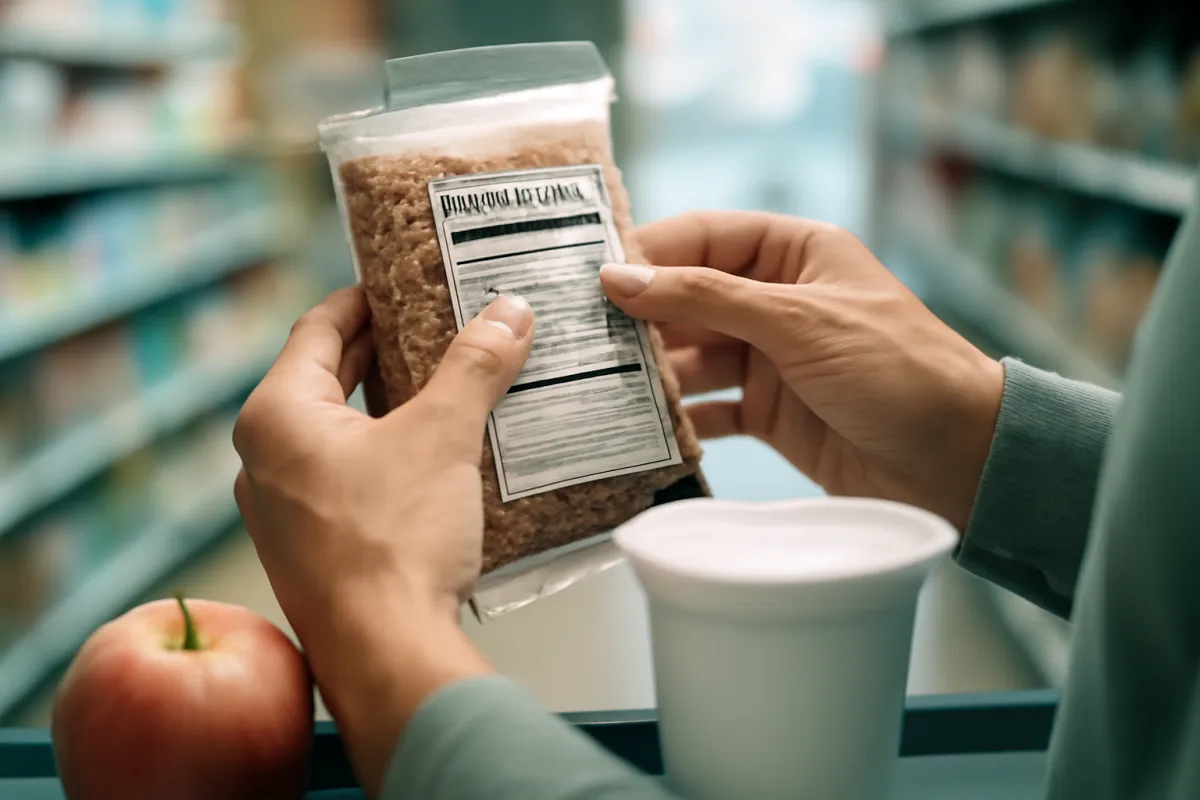
- How to read the panel instead of a remembered number
- A worked example you can repeat with your own carton
- Lactose-free evaporated condensed and powdered milk
- Cream half and half and where milk stops being milk
- Common mistakes when counting milk calories
- How milk fits a daily calorie target
- Calories in milk in every phrasing
- The bottom line
How many calories are in milk? There is no single number, and any answer that arrives without asking what is in your carton is guessing on your behalf. Milk is a category rather than a product. Under that one word sit whole, reduced-fat, low-fat and skim dairy milks that differ deliberately in fat content, plus a wide shelf of plant drinks built from beans, grains, nuts and seeds, some diluted heavily with water, some carrying added oil, many of them sweetened and some of them not. Those products do not share a calorie figure, and they are not close enough to each other for a remembered number to be useful.
This evidence review is a plain-language explanation of why the number moves, arranged so you can work out the figure for the carton you actually own instead of borrowing one from a page that describes a different product. It works through fat as the main driver across the dairy range, what stays roughly constant when fat is removed and what does not, serving size as the most common source of confusion, why plant drinks vary so widely, what sweetened and original and flavoured really mean, barista formulations, fortification, and the milk in coffee and cereal that makes up most people’s actual daily contribution. It describes food composition and label reading only, and it is not medical, dietetic or nutritional advice. For the wider table see our reference on calories in common foods, for the panel itself see our nutrition label walkthrough, and you can run your own carton’s figures through the companion below.
Key takeaways
- There is no single calorie figure for milk. The word covers products that differ by design, so the honest answer is the one printed on the panel of the carton in your hand.
- Within a dairy range, fat is the variable that moves the number. Fat carries about 9 calories per gram against about 4 for protein and carbohydrate, so removing it lowers the figure faster than any other change.
- Protein and the milk sugar sit in the watery fraction and largely stay put when cream is separated off, which is why lower-fat dairy milk changes on some lines of the panel and barely moves on others.
- Plant drinks vary because four independent levers exist: the base ingredient, how much water it is diluted with, whether oil has been added, and whether it is sweetened. Sweetening is the biggest and most common one.
- Every figure in this review is either arithmetic you can repeat or an explicitly invented illustrative example. None of it is nutrition data for any real product, and personal targets belong with a doctor or registered dietitian.
How many calories are in milk
The honest answer to the search is that milk does not have a calorie figure, because milk is not one thing. A carton labelled whole milk and a carton labelled skim milk are the same liquid with different amounts of fat left in it, by deliberate design. A carton labelled almond drink and a carton labelled oat drink share nothing except a shelf and a shape. Asking for the calories in milk is like asking for the price of a car: there is an answer for every specific one, and no answer for the category.
What you can have instead is something more useful than a memorised figure, which is a working understanding of what moves the number and in which direction. That understanding transfers. Once you know that fat is the heaviest contributor per gram, that water is free, that added sugar shows up on a specific line, and that the serving size at the top of the panel governs every figure below it, you can read any carton in any aisle and get the right answer for that product in about ten seconds.
That is what this review teaches. It deliberately does not hand you a table of per-serving figures for named products, because such a table would be stale the moment a manufacturer reformulated, wrong for half the brands on your shelf, and impossible for you to check. The panel on your carton is authoritative for your carton. Nothing on any website is.
Why milk has no single calorie number
Three separate sources of variation stack on top of each other, and each one alone would be enough to break a single figure.
The first is the product itself. Dairy milk is sold in a graded range where fat content is the graded variable, so the same dairy, the same herd and the same day produce four different products with four different panels. Plant drinks are formulated rather than graded, and two manufacturers making an oat drink can arrive at genuinely different compositions from the same grain.
The second is the serving. A panel figure is always attached to a stated quantity, and the quantity people actually pour is set by the glass in the cupboard rather than by the panel. A remembered figure detached from its serving size is not a figure at all.
The third is that manufacturers change formulations. Recipes are revised, sweetening is reduced in response to demand, oils are added or removed, fortification is introduced or dropped. A number that was accurate for a product two years ago may describe nothing currently on sale. None of that is a reason to give up on counting. It is a reason to count from the carton rather than from memory, which is both faster and more accurate.
Fat is the variable that moves the number
Within the dairy range, one variable does nearly all the work, and it is fat. The reason is arithmetic rather than nutrition. Of the three components a nutrition panel counts as sources of energy, fat supplies roughly 9 calories per gram, while protein and carbohydrate each supply roughly 4. Fat is therefore more than twice as dense as either alternative, and any change in the fat content of a fixed volume of liquid moves the calorie total more than an equivalent change in anything else would.
That is the whole mechanism behind the dairy range. Separating cream from milk removes fat and leaves the rest of the liquid behind. What replaces the removed fat, in volume terms, is essentially the watery fraction that was always there, and water carries no calories at all. So the calorie figure falls as you move from whole through reduced-fat and low-fat to skim, and it falls specifically because of the fat line and not because anything else was taken out.
This also explains why the ordering is reliable even when the figures are not. You can be confident that within a single brand’s range the skim product reads lower than the whole product, because that difference is the entire reason both products exist. You cannot be confident about how much lower without reading both panels, because the fat targets that define each tier are set by regulation and by the manufacturer rather than by any universal constant.
The arithmetic behind any milk calorie figure
Here is the calculation the panel is doing, which you can repeat yourself for any carton. Take the grams of fat, multiply by 9. Take the grams of protein, multiply by 4. Take the grams of total carbohydrate, multiply by 4. Add the three results. The total will land close to the calorie figure printed on the panel, with small differences from rounding and from how fibre and sugar alcohols are treated in products that contain them.
The chart below isolates the fat term of that calculation, because it is the term doing the most work in the dairy range. It is pure multiplication and it is not a nutrition table. Nothing in it claims that any product carries any particular fat figure. It simply shows what a given number of grams of fat contributes, so that you can look up the fat grams printed on your own carton and see the size of that contribution immediately.
Calories contributed by fat alone, by grams of fat on the panel
Arithmetic, not nutrition data. Fat supplies about 9 calories per gram, so multiplying the fat grams printed on a panel by 9 gives the calories that fat contributes to that serving. This chart makes no claim about which product carries which fat figure.
Bars scale to the 12 gram row at 100 percent. The gram figures on the left are chosen to space the chart evenly and are not claims about any product, dairy or plant. Read the fat grams off the panel in front of you and do the same multiplication.
Two things follow from that chart. The first is that the gap between a low-fat and a high-fat version of the same volume of liquid is large in absolute terms, which is why the dairy range is graded by fat at all. The second is that the fat term alone never tells you the total, because protein and carbohydrate are still sitting underneath it. A product with almost no fat is not a product with almost no calories, and that mistake is made constantly with skim dairy milk and with unsweetened plant drinks alike.
Whole reduced-fat low-fat and skim in order
The four common dairy tiers are defined by fat content, and the naming is regulated in most markets so that a tier means something specific. Whole milk keeps essentially the fat the milk arrived with, standardised to a target. Reduced-fat and low-fat products have had a defined proportion of that fat removed. Skim, sometimes labelled fat-free or non-fat, has had nearly all of it removed, leaving a trace that is usually rounded to zero on the panel.
The percentages that appear on cartons in some markets refer to fat as a proportion of the liquid by weight, not to a proportion of calories, and that distinction trips people up constantly. A milk described as low-fat by percentage still gets a meaningful share of its calories from fat, because a small weight of fat converts into a relatively large number of calories at 9 per gram. If you want the share of calories coming from fat rather than the share of the liquid, do the arithmetic from the panel: fat grams times 9, divided by the calorie figure.
What you should take from the tier system is the ordering and the mechanism, not a set of numbers. Whole reads highest, skim reads lowest, and the two intermediate tiers sit between them in the order their names suggest. That ordering holds because it is the design intent. The size of each step is a property of the specific brand and market, so read it rather than assume it.
What stays roughly the same when the fat comes out
This is the part most explanations skip, and it is the part that makes the dairy range make sense. Milk is mostly water. Suspended and dissolved in that water are proteins, milk sugar, minerals and a fat fraction that exists as droplets rather than in solution. Separating cream removes the fat droplets. It does not remove the things that are dissolved in the water, because they are not in the fat.
So the protein fraction largely stays. The milk sugar largely stays. The mineral fraction, including the calcium-bearing portion that dairy is known for, largely stays, because those minerals are associated with the watery phase and with the protein structures in it rather than with the cream. That is why a skim product and a whole product from the same dairy can look similar on several lines of the panel while differing sharply on the fat line and the calorie line.
The practical consequence is that lower-fat dairy milk is not a diluted version of whole milk. It is whole milk with one component removed. Those are different things, and confusing them leads people to assume that every nutrient falls in proportion when the calorie figure falls. It does not. Our practical list of calcium-bearing foods covers where that mineral shows up across the diet more broadly, without attaching figures to any particular carton.
What actually changes when the fat comes out
Several things do change, and pretending otherwise would be as inaccurate as pretending everything changes.
Texture and flavour change first and most obviously. Fat carries aroma compounds and coats the mouth, so a lower-fat milk reads as thinner rather than simply lighter. That is a sensory fact rather than a nutritional one, but it drives a lot of real behaviour, including people adding more of a thinner milk to a coffee to get the same effect.
Some vitamins travel with the fat rather than with the water, so removing the cream removes a portion of them. This is why fortification is common in lower-fat dairy products and why the panel and ingredient list will say so. A fortified product carries what the manufacturer put back, in the amount they chose, which is a decision rather than a property of milk.
Finally, the balance of the remaining calories shifts. When fat is removed from a fixed volume, the calories that are left come proportionally more from protein and milk sugar, even though the absolute amounts of those two barely moved. That is a shift in shares, not a shift in quantities, and reading it as the latter is a common error. Our reference on daily fat intake covers how fat fits a whole day rather than a single glass.
Serving size is the most common source of confusion
Every figure on a nutrition panel is attached to the serving size printed at the top of it, and the serving size is a reference quantity chosen for labelling rather than a description of how anyone drinks. This is the single most common reason a remembered calorie figure comes out wrong, and it has nothing to do with the product at all.
A panel might state its figures per cup, per 100 millilitres, per 250 millilitres, or per some other reference quantity depending on the market and the pack format. Two cartons standing next to each other can use different reference quantities, which makes the headline figures incomparable until you convert them. Converting is easy and almost nobody does it: divide the calorie figure by the serving size to get calories per unit of volume, then multiply by whatever you actually pour.
That single operation makes every carton comparable to every other carton, and it is the operation the companion on this page performs. It also protects you from a specific trap, which is a small stated serving size making a rich product look modest. The figure is honest. The serving is just smaller than the one in your hand. Our walkthrough of the nutrition label covers the rest of the panel in the same spirit.
A cup a glass and a carton are three different amounts
Follow the volume problem through and it gets worse before it gets better. A cup is a defined measure. A glass is not. A tumbler from one cupboard and a tumbler from another can differ substantially, and neither of them was designed to match the reference quantity on a carton. Restaurant and cafe glassware differs again, and a milky drink served in a large takeaway cup is a different quantity of milk from the same drink in a small one even when the menu name is identical.
Then there is the carton itself. Single-serve bottles and cartons are sometimes labelled per serving with more than one serving in the container, so drinking the whole thing means multiplying every figure on the panel. This is not a trick; the servings-per-container line states it plainly. It is simply a line that people skip on the way to the calorie figure.
The fix is unglamorous and permanent. Pour your usual amount into a measuring jug once, note the volume, and use that number from then on. One minute of measuring replaces years of guessing, and it converts every panel you will ever read into a figure that describes your actual pour rather than a labelling convention.
Why plant milk calories vary so widely
Plant drinks are formulated products. Nobody separates a plant drink out of an animal; somebody designs it. That single difference is why the spread across the plant aisle is far wider than the spread across the dairy range, and why the ordering that holds so reliably for dairy tiers does not hold at all here.
Four levers are available to whoever writes the recipe, and they move independently. The base ingredient sets the starting composition. The dilution sets how much of the finished carton is water. Added oil raises the fat line directly. Sweetening raises the carbohydrate line, sometimes a great deal. A manufacturer can pull any combination of those four, and two brands making a drink from the same base ingredient routinely end up somewhere quite different from each other.
The consequence for counting is straightforward and slightly annoying: there is no such thing as the calories in almond drink, or in oat drink, or in soy drink, any more than there is such a thing as the calories in soup. There is only the carton. The next four sections take the four levers one at a time, because understanding them lets you predict roughly where a product will sit before you even turn it around.
The base ingredient sets the starting point
A bean, a grain, a nut and a seed are not interchangeable raw materials, and the drinks made from them inherit that. A legume base such as soy brings the protein that the bean itself carries. A grain base such as oat brings a starchy fraction. A nut base brings the oil that the nut stores. A seed base brings its own mix again. None of that is a health claim; it is simply what the raw material is made of, and the finished drink starts from there.
The important qualifier is that the base only sets a starting point, and the other three levers can override it entirely. A drink built on an oil-rich nut can still read low if the recipe is mostly water. A drink built on a modest base can read high if it has been sweetened. So the base ingredient tells you what kind of product you are looking at and roughly what its character will be, and the panel tells you where the recipe actually landed.
If you are choosing a plant drink partly for its protein content, that is a comparison to make between panels rather than between categories, because the protein line varies by brand as much as by base. Our reference on getting protein without meat covers the wider set of options, and our protein requirement review covers how much a whole day needs.
Dilution is the quiet variable
Dilution is the lever nobody talks about and it may be the most powerful of the four. A plant drink is, mechanically, a small amount of plant material suspended in a large amount of water. How large is a recipe decision, and it is often visible on the front of the pack as a percentage of the base ingredient, or on the ingredient list where water almost always appears first.
Water carries no calories. So a drink that is heavily diluted starts from a low base by construction, regardless of how energy-dense the underlying nut or grain might be. This is why some unsweetened nut drinks read remarkably low: the carton is mostly water, and the nut content is a small percentage of it. It is also why comparing a drink to the whole food it came from is meaningless. A handful of nuts and a glass of drink made from a small percentage of the same nuts are not comparable quantities of anything.
Two practical habits follow. Look for the percentage of the base ingredient on the front of the pack when it is given, because it is one of the more informative numbers a plant drink carries. And read the ingredient list in order, since ingredients are listed by descending weight and the position of water tells you a great deal.
Added oils and why some plant milks read higher
Many plant drinks contain added oil, and it is usually there for texture rather than nutrition. Plant material alone often produces a thin, watery drink that separates in the carton and behaves poorly in hot liquid. A small amount of added oil restores body, helps the emulsion stay stable, and makes the drink behave more like the dairy product people are used to.
Because that oil is fat, it lands on the calorie figure at roughly 9 calories per gram, the same as any other fat. This is the mechanism behind a result that surprises people: a plant drink can carry more fat than a lower-fat dairy milk, not because the plant is oily but because oil was added on purpose. The chart earlier in this review applies just as directly here. Look up the fat grams on the panel, multiply by 9, and you have the fat contribution regardless of where the fat came from.
You will find added oils on the ingredient list under names that describe the oil itself. Their presence is not a defect and their absence is not a virtue; it is a formulation choice that affects both how the drink behaves and what its panel says. Our note on foods carrying omega-3 fats covers the wider question of which fats turn up where in a diet.
Sweetened unsweetened original and flavoured
This is the lever that moves the number most often and most dramatically, and it is also the one hidden behind the least informative language on the shelf.
Unsweetened generally means no sugar was added during production. You can verify it two ways: the added sugars line on the panel, and the ingredient list, where a sweetener would have to appear. Some products still carry carbohydrate from the base ingredient itself even when unsweetened, which is normal and is not the same thing as added sugar.
Original is where the confusion lives. It reads like a neutral baseline and it is not one. Original is a product tier name, and in a great many ranges the original version is the sweetened version, sold right next to an unsweetened version in a very similar carton. People buy one habitually while believing they are buying the other for years at a time.
Flavoured versions such as vanilla or chocolate are usually sweetened further again, and chocolate versions in particular are closer to a sweetened drink than to a plain one. None of this makes any of them a problem. It makes the panel worth ten seconds. Our reference on spotting hidden sugar on labels and our daily sugar review cover the lines to read.
Barista formulations and what they change
Barista versions of plant drinks exist because ordinary versions often fail in coffee. Hot, acidic coffee can cause a plant drink to curdle or split, and many plant drinks will not hold a stable microfoam when steamed. Neither failure is about nutrition; both are about physics and chemistry.
Manufacturers solve the problem by reformulating. Common adjustments include raising the fat or oil content to improve body and foam stability, adjusting the protein content, and adding acidity regulators or stabilisers so the drink survives contact with coffee. Several of those changes also move the calorie figure, generally upward, because more oil means more fat and more fat means more calories per unit of volume.
The practical point is that a barista carton and a standard carton from the same brand and the same base ingredient are two different products with two different panels. If you switched to a barista version because your coffee kept splitting, you changed the product, and the figure you were using no longer applies. Read the new panel once and update the number you carry. The companion on this page will do the conversion for whatever volume you actually pour into a cup.
Fortification is something a manufacturer adds
Plant drinks are not naturally equivalent to dairy milk in mineral content, and where they carry a comparable amount it is generally because a manufacturer added it. Fortification is a deliberate production step, and it varies by product, by brand and by market.
That matters for two reasons. First, it means a plant drink’s mineral content is not a property of the plant. Two oat drinks on the same shelf can differ in whether they are fortified at all, and an organic version of a fortified product is sometimes unfortified because of the rules that apply to that category. Second, fortified minerals can settle in the carton, which is why so many plant drinks tell you to shake before pouring. A carton poured without shaking does not deliver what the panel describes, distributed evenly across the pours.
None of this is a reason to prefer or avoid any product. It is a reason to read the panel rather than assume equivalence in either direction, and to shake the carton. Our daily nutrient intake reference sets out how these nutrients are usually discussed across a whole diet, and our review of daily magnesium targets covers one of the minerals that comes up in the same conversations. Anyone relying on a particular product for a particular nutrient should confirm the approach with a doctor or registered dietitian rather than with a website.
Milk in coffee is the real daily contribution
For a large number of people, the milk that matters is not the glass. It is the milk in the coffee, several times a day, never measured once.
The spread here is enormous and it is driven entirely by volume. A splash in a black coffee is a small quantity of liquid. A flat white is a modest quantity. A large milky coffee is essentially a cup of warm milk with a shot of coffee in it. Those three are described the same way in conversation and are separated by a factor that can exceed ten. Nothing about the milk changed; the amount did.
Three habits fix this permanently. Measure your usual pour once with a jug and write the number down. Recognise that a large size in a cafe is usually a larger milk volume rather than a larger coffee volume. And remember that switching to a lower-fat milk in a large drink changes the figure more than the same switch in a splash, because the change scales with volume. Our review of daily calorie needs gives the context those figures sit inside, and the companion on this page will scale your carton’s panel to your own measured pour.
Milk on cereal and the amount you never measure
Cereal is the coffee problem with a bowl instead of a cup, and bowls vary more than cups do. The volume of milk poured onto cereal is set by the size of the bowl and by the moment the flakes stop looking dry. Neither of those is a serving size, and neither is stable from day to day or household to household.
There is a second effect specific to cereal, which is that the milk left in the bowl at the end is often drunk or tipped away, and either choice changes the total. Nobody accounts for it and nobody should feel obliged to, but it is worth knowing that a cereal bowl is a genuinely imprecise measurement even when the cereal itself is weighed.
If you want a workable figure, pour your usual amount of milk into a measuring jug once, then into the bowl. Most people find the honest number is larger than the one they assumed. That is not a problem to solve; it is a figure to know. Our review of the calories in oatmeal deals with the same measurement issue on the cereal side, where dry weight and cooked volume diverge sharply, and our back-to-school lunch note covers the drinks that travel with a packed meal.
How to read the panel instead of a remembered number
Here is the whole method, in the order the panel gives it to you.
Start at the top with the serving size and the servings per container. Everything below depends on both. If the serving is 100 millilitres and you pour 300, every figure on the panel triples for you.
Next, read the calorie figure and note which serving it belongs to. Then read the fat line, and multiply the grams by 9 to see how much of that calorie figure is fat. That one operation tells you more about the product than any front-of-pack claim.
Then read the total carbohydrate line and, underneath it, the added sugars line if your market prints one. That distinguishes a sweetened product from an unsweetened one faster than the name on the front will.
Then read the protein line if protein is why you are buying the product, because it varies far more between plant drinks than most people expect.
Finally, read the ingredient list in order. Ingredients are listed by descending weight, so the position of water tells you about dilution, and the presence of an oil or a sweetener tells you which levers were pulled. Our nutrition label walkthrough covers the same panel in more general terms.
A worked example you can repeat with your own carton
The panel used here is invented. It is not a real product and it does not describe any milk on any shelf. It exists so the arithmetic is visible, and you should replace every figure in it with the figures from your own carton.
Suppose a made-up panel states, per a 240 millilitre serving, 8 grams of fat, 8 grams of protein and 12 grams of total carbohydrate. Multiply the fat by 9 to get 72 calories. Multiply the protein by 4 to get 32. Multiply the carbohydrate by 4 to get 48. Add them: 72 plus 32 plus 48 is 152 calories for that invented serving.
The chart below turns those three products into shares of the total. Again, the shares belong to an invented panel and are shown so you can see the shape of the arithmetic, not so you can apply them to anything.
Where the calories sit in one deliberately invented nutrition panel
A made-up panel of 8 g fat, 8 g protein and 12 g total carbohydrate per 240 ml, chosen to make the arithmetic easy to follow. It is not data for any product. Do this same calculation with the numbers printed on your own carton.
Shares are of the 152 calorie total for this invented serving and sum to 100 percent after rounding. Every figure here is illustrative arithmetic. The panel on your own carton is the only source that describes what you are drinking.
Two observations transfer even though the numbers do not. Fat took the largest share while weighing the same as the protein, which is the 9 against 4 doing its work. And removing all of the fat from that invented serving would leave 80 calories rather than none, which is the point about skim products and unsweetened plant drinks that so many people get wrong.
Lactose-free evaporated condensed and powdered milk
Several dairy products sit next to milk and get counted as if they were milk. They are not.
Lactose-free dairy milk is usually ordinary milk treated with an enzyme that splits the lactose into simpler sugars. The carbohydrate is still there, in a different form, so the calorie figure is broadly similar to the equivalent standard product rather than lower. Many people find it tastes sweeter, which is a perception created by the simpler sugars rather than by anything added.
Evaporated milk has had a substantial share of its water removed, which concentrates everything else. Per unit of volume it is a denser product than the milk it came from, and using it as a direct substitute in a cup of coffee is not a like-for-like swap.
Condensed milk is concentrated and heavily sweetened, and it belongs with sweet ingredients rather than with milk for counting purposes.
Powdered milk has had nearly all the water removed, so its panel usually reports both the powder as sold and the reconstituted drink. Read which one you are looking at, because they differ enormously.
Cream half and half and where milk stops being milk
Moving up the fat scale from whole milk, the products keep going. Single and double creams, whipping cream, and the pouring blends sold under names like half and half sit above whole milk on the fat scale, some of them far above it, and they are separated from milk by fat content rather than by any other difference.
That matters for coffee more than anywhere else. A pouring cream added to coffee is a much richer addition than milk, and the volume added is usually similar, so the substitution changes the figure substantially even though the physical act looks identical. The same applies to the small sealed pots supplied in cafes and on trains, which are frequently a cream blend rather than milk.
Non-dairy creamers are another category again, often built from oil, a sweetener and stabilisers, and their panels look nothing like a milk panel. Powdered versions in particular concentrate everything.
None of these products is being criticised here. The point is that they are not milk, they should not inherit a milk figure, and each of them carries its own panel. Our grocery list walkthrough covers the habit of checking a category before assuming it behaves like its neighbour.
Common mistakes when counting milk calories
A short list of the errors that come up most often, all of them fixable in seconds.
Using a remembered figure for a product you no longer buy. Formulations change and so do people’s habits, and the number in your head is usually attached to a carton you stopped buying two years ago.
Assuming original means unsweetened. It usually does not, and the unsweetened version is normally on the same shelf.
Comparing panels with different serving sizes. Convert both to the same volume before you compare anything.
Counting a glass as a cup. A cup is a defined measure and a glass is whatever is in your cupboard.
Assuming a low-fat product is a low-calorie product. Removing the fat removes the fat term only; protein and carbohydrate keep contributing.
Forgetting the milk in coffee entirely. For many people it is the largest single source of milk in the day and it is never counted because it never looks like a serving.
Treating a plant drink category as a fixed thing. There is no such product as almond drink in the abstract; there is only the carton you bought.
Applying a barista carton’s habits to a standard carton, or the reverse, after switching between them.
How milk fits a daily calorie target
Milk is a liquid, and liquids behave differently from solids in a day’s counting for one practical reason: they are consumed quickly, in quantities set by containers rather than by appetite, and they are frequently attached to something else such as coffee or cereal rather than eaten as a distinct item. That combination makes milk easy to under-count and easy to under-notice.
None of that makes milk a problem, and this review takes no position on how much milk anyone should drink. What it does suggest is that if you count, count the milk on its own line, at your own measured volume, using your own carton’s panel. The figure will be whatever it is, and knowing it is worth more than any general rule.
If you are working to a target, the useful framing is substitution rather than subtraction. Changing the product you use, or the volume you pour, or the size of the drink you order, are three separate levers and they do not have the same effect. Our explanation of a calorie deficit covers how targets are usually set, and our low calorie snacks collection covers the rest of the day. Any personal target belongs with a doctor or registered dietitian rather than with an article.
Calories in milk in every phrasing
The question arrives in many wordings and the answer is structurally the same in all of them.
Calories in a cup of milk depends on which milk and on whether the panel’s serving is a cup. Calories in a glass of milk depends additionally on the glass, which is not a defined measure. Calories in whole milk against skim milk is a question about fat content, and the direction is reliable while the size of the gap is not. Calories in almond milk, oat milk or soy milk is a question with no category-level answer at all, because the base ingredient is only one of four levers that set the figure.
Calories in milk in coffee is a question about volume more than about milk. Calories in milk in tea is the same question with a smaller pour. Calories in milk in cereal is the same question with an unmeasured pour.
In every case the method is identical: find the serving size, find the calorie figure, convert both to the volume you actually use, and check the fat and added sugars lines to understand why the number is what it is. Then it stops mattering how the question was phrased.
The bottom line
The calories in milk have no single answer, and the useful reply to the question is a method rather than a figure. Within a dairy range, fat is the variable that moves the number, because fat carries roughly 9 calories per gram against roughly 4 for protein and carbohydrate, so the ordering from whole down through reduced-fat and low-fat to skim is reliable even when the size of each step is not. Removing fat leaves the protein, the milk sugar and the mineral-bearing watery fraction largely where they were, which is why a lower-fat product is not a diluted product. Across plant drinks there is no ordering at all, because the base ingredient, the dilution, any added oil and above all the sweetening are four independent choices a manufacturer makes, and original is a tier name rather than a description of sweetness. Serving size is the most common source of error in either aisle, and a glass, a cup and a carton are three different quantities. Every number in this review is either arithmetic you can repeat or an explicitly invented example, because a table of per-serving figures for real products would be wrong for your carton on the day you read it. Measure your usual pour once, read the panel of the product in your hand, run both through the companion on this page, and take anything touching your weight, your blood sugar, an allergy, an intolerance, a pregnancy or any medical condition to a qualified professional such as a doctor or registered dietitian.
This evidence review exists to explain why the calorie figure for a milk moves and how to read it off a label, and it does nothing else. It is educational writing about food composition and packaging, not medical advice, dietetic advice, an eating plan or a product recommendation, and reading it creates no clinician-patient relationship. It deliberately publishes no table of per-serving calorie counts for real dairy or plant products: every number above is either open arithmetic, such as 9 calories per gram of fat, or a clearly labelled invented example used to show a calculation. Those invented figures describe no product on any shelf and must not be applied to one. Recipes, fat targets, dilution, added oils, sweetening and fortification differ by brand, by market and by production run, and manufacturers change them without notice, so the panel and ingredient list on the carton in front of you are the only accurate source for that carton. Nothing here compares dairy and plant drinks on health grounds, recommends one over another, or claims that any milk prevents, treats or affects any condition. If you are managing weight, blood sugar, cholesterol, bone health, a dairy allergy, lactose intolerance, a pregnancy, an infant’s feeding, or any medication or medical condition, take your figures and your decisions from a qualified health professional rather than from this page.
Frequently asked questions
How many calories are in milk?
There is no single figure, because milk is a category rather than a product. Whole, reduced-fat, low-fat and skim versions of the same dairy milk differ mainly in how much fat is left in them, and fat is by far the most energy-dense of the three things a nutrition panel counts, so the calorie figure falls as the fat comes out. Plant drinks spread wider still, because the base ingredient, how much water the product is diluted with, whether oil has been added and above all whether it is sweetened each move the number independently of the others. The only reliable answer for the carton in your fridge is printed on that carton, next to a serving size you should read rather than assume. Any figure you carry in your head came from a different product.
Which milk has the fewest calories?
Within a single dairy range, the ordering is predictable because it is created deliberately: skim sits lowest, then low-fat, then reduced-fat, then whole, because each step up leaves more fat in the same volume of liquid. Across plant drinks there is no fixed ranking at all. An unsweetened drink built from a small percentage of a nut and a large percentage of water can read very low, while a sweetened or oil-enriched product made from the same base reads far higher, and the two often sit on the same shelf in similar cartons. Comparing the two panels in your hands is the only honest method. Nothing here is a recommendation about which milk anyone should drink, which is a question for you and a qualified health professional.
Why do whole milk and skim milk differ if they look so similar?
Because the difference is fat, and fat is the component that carries the most energy per gram. Of the three things a nutrition panel counts, fat supplies roughly twice as many calories per gram as protein or carbohydrate do, so taking fat out of a fixed volume of liquid removes calories faster than any other change would. What is left behind is mostly water, and water carries none. The protein and the milk sugar sit in the watery fraction and largely stay put when the cream is separated off, which is why the two products can look similar on every line of the panel except the fat line and the calorie line. Read both lines rather than the front of the carton.
Does taking the fat out change anything besides the calories?
It changes several things that the calorie line does not show. Fat carries flavour and mouthfeel, which is why a lower-fat milk tastes thinner rather than merely lighter. Some vitamins travel in the fat fraction rather than the watery one, which is part of why many lower-fat dairy products are fortified after processing, and why the fortification is listed on the panel as something added rather than something inherent. The protein and the milk sugar largely stay where they were. This review describes composition only and makes no claim that any version of milk is better or worse for any person, a question that belongs with a doctor or registered dietitian.
Why do plant milks vary so much from brand to brand?
Four levers move independently and a manufacturer can pull any of them. The base ingredient sets the starting point, since a bean, a grain, a nut and a seed do not carry the same mix of fat, protein and carbohydrate. Dilution sets how much of the finished carton is simply water. Added oil, which is common in products designed to feel creamy or to steam well, raises the fat line directly. Sweetening raises the carbohydrate line, sometimes substantially, and it is the single most common reason two cartons of the same base ingredient carry very different figures. Because those four levers are choices rather than properties, the panel is the only thing that describes the product you actually bought.
Is unsweetened the same as original?
No, and treating them as equivalent is one of the most common counting errors in the plant milk aisle. Unsweetened generally signals that no sugar has been added during production, which you can check on the ingredient list and against the added sugars line of the panel. Original is a product tier name rather than a regulated description of sweetness, and in many ranges the original version is the sweetened one, with the unsweetened version sold alongside it in a similar carton. Flavoured versions such as vanilla or chocolate are usually sweetened more heavily again. Our reference on spotting hidden sugar on labels walks through the lines to read, and the ingredient list settles it faster than the front of the pack ever will.
Why is barista milk different from the regular version?
Barista formulations exist to solve a physical problem rather than a nutritional one: ordinary plant drinks can split in hot acidic coffee and often refuse to hold a stable foam. Manufacturers address that by adjusting the formulation, commonly by raising the fat or oil content, adjusting protein, and adding stabilisers or acidity regulators. Several of those adjustments also change the calorie figure, usually upward, which is why a barista carton and a standard carton of the same brand and base ingredient can read differently on the same shelf. The panel on the barista carton is the one that describes what goes in your cup. Treat the two as separate products rather than as the same drink in a different box.
How much do milk in coffee and milk on cereal actually add up to?
That depends entirely on volume, and volume is the thing almost nobody measures in either case. A splash in a black coffee is a small quantity of liquid, while a large milky coffee is mostly milk with coffee in it, and the two can differ by an order of magnitude even though both are described as a coffee with milk. Cereal is the same problem with a bowl instead of a cup, since the amount poured is set by the size of the bowl and the moment the flakes look wet rather than by any serving size. The useful exercise is to measure your own habitual pour once with a measuring jug, then keep using that figure. The companion on this page will scale your carton's own panel to whatever volume you find.

Hamza Hai is the editor of NourishMark. She holds an MBA and reviews the site's articles against our editorial standards, checking that every figure is labelled for what it is, that nothing is presented as verified fact without a source the reader can check, and that the writing stays useful to a non-specialist.