What's in this review
- Can you get enough protein without meat?
- Complete proteins, explained honestly
- Before you start: your target and your pattern
- Step 1: Set your rough daily protein target
- Step 2: Make legumes the base of your plate
- Step 3: Put soy foods in the weekly rotation
- Step 4: Keep eggs and dairy if you eat them
- Step 5: Round out the day with grains, nuts, and seeds
- Step 6: Vary plant proteins across the day
- Step 7: Upgrade breakfast and snacks first
- Step 8: Check a full day against your target
- How to get protein as a vegetarian
- How to get protein as a vegan
- How to get protein without meat or dairy
- A worked example: a meatless day near 74 grams
- Common mistakes when replacing meat protein
- Troubleshooting and edge cases
- Your meatless protein checklist
- The bottom line
Short answer: Most healthy adults can meet commonly cited protein targets without meat by building meals around legumes and soy foods, commonly cited around 12 to 18 grams per cooked cup or serving, then adding whole grains, nuts, seeds, and optionally eggs and dairy. Portions need to be generous, a full cup of lentils rather than a spoonful, because plant foods carry more water and fiber. Combining proteins at every meal is unnecessary.
Ask someone what they would miss most about giving up meat and the honest answer is usually not flavor, it is certainty: meat is the one food everyone knows counts as protein. Take it off the plate and the question of what replaces it feels bigger than it is. The reassuring, well-established answer is that protein without meat is not a puzzle, it is a short list of dense plant foods, a couple of honest rules about portions and variety, and a rough daily number to aim at. People have eaten this way for generations across much of the world, long before anyone counted grams.
This evidence review walks through how to get protein without meat in eight practical steps, then adapts the plan for three patterns: vegetarian with eggs and dairy, fully vegan, and meat-free without dairy. It covers the commonly cited per-serving figures for the plant foods that matter, what complete proteins actually require of you (much less than folklore says), a worked example day, the common mistakes, and the edge cases. The gram figures follow the same commonly cited references as our protein in common foods evidence review, and the daily targets come from our protein needs evidence review. Everything here is general education about food composition, not medical or dietary advice, and you can run your own numbers in the companion below as you read.
Key takeaways
- Most healthy adults can meet commonly cited protein targets without meat: legumes, soy foods, grains, nuts, seeds, and optionally eggs and dairy cover it from ordinary groceries.
- Density is the real difference: plant foods carry more water and fiber alongside their protein, so portions need to be generous, a full cup of lentils rather than a spoonful.
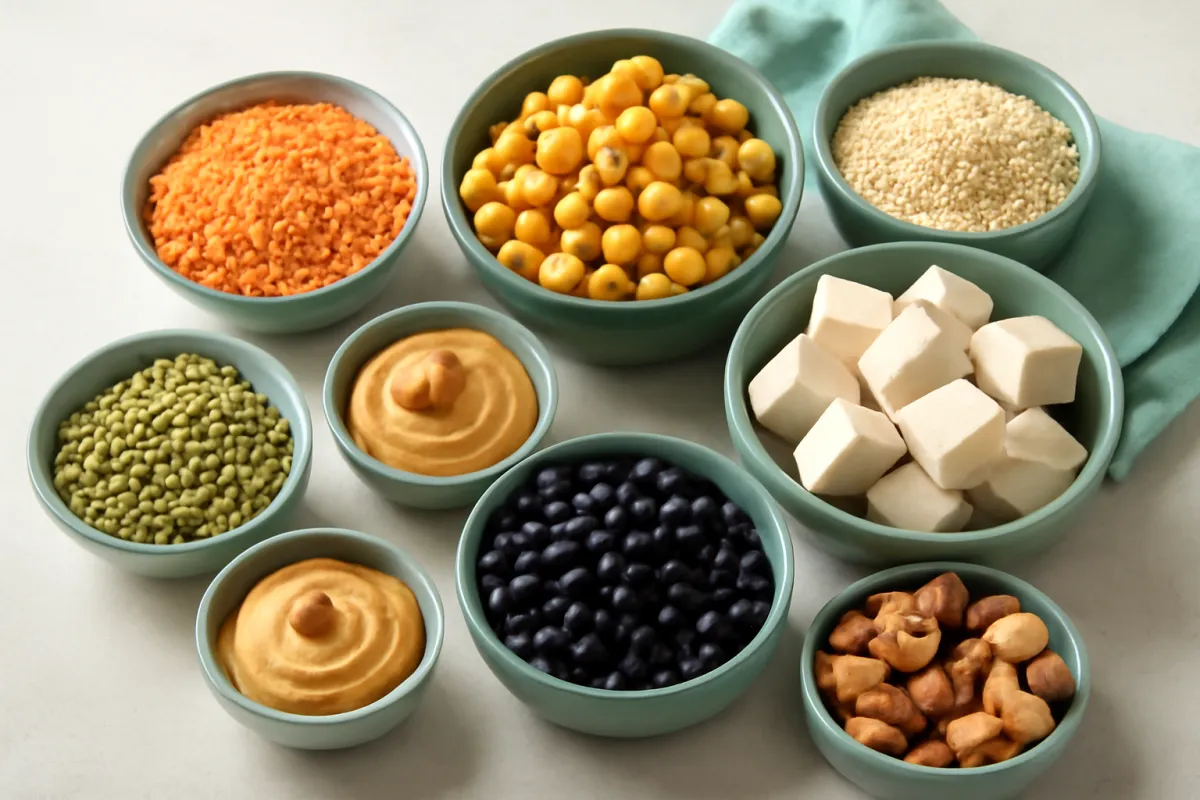
- Legumes and soy are the workhorses, commonly cited around 12 to 18 grams per cooked cup or serving; make them the base of the plate, not a side.
- Complete-protein combining at every meal is a myth: variety across the whole day covers the amino acids for most people, no pairing charts required.
- Every figure here is a commonly cited illustrative reference, not a personal prescription; anyone with a health condition or a fully restricted diet should confirm the details with a doctor or registered dietitian.
Can you get enough protein without meat?
Settle the anxiety first, because it is the question underneath all the others. For most healthy adults, the answer from mainstream nutrition guidance is a plain yes. The commonly cited baseline recommendation, about 0.8 grams of protein per kilogram of body weight per day, does not care where the grams come from, and legumes, soy foods, grains, nuts, seeds, eggs, and dairy can supply them. Large populations around the world have always eaten little or no meat, and the traditional dishes that sustained them, lentils and rice, beans and tortillas, tofu and grains, are quietly well-constructed protein delivery systems.
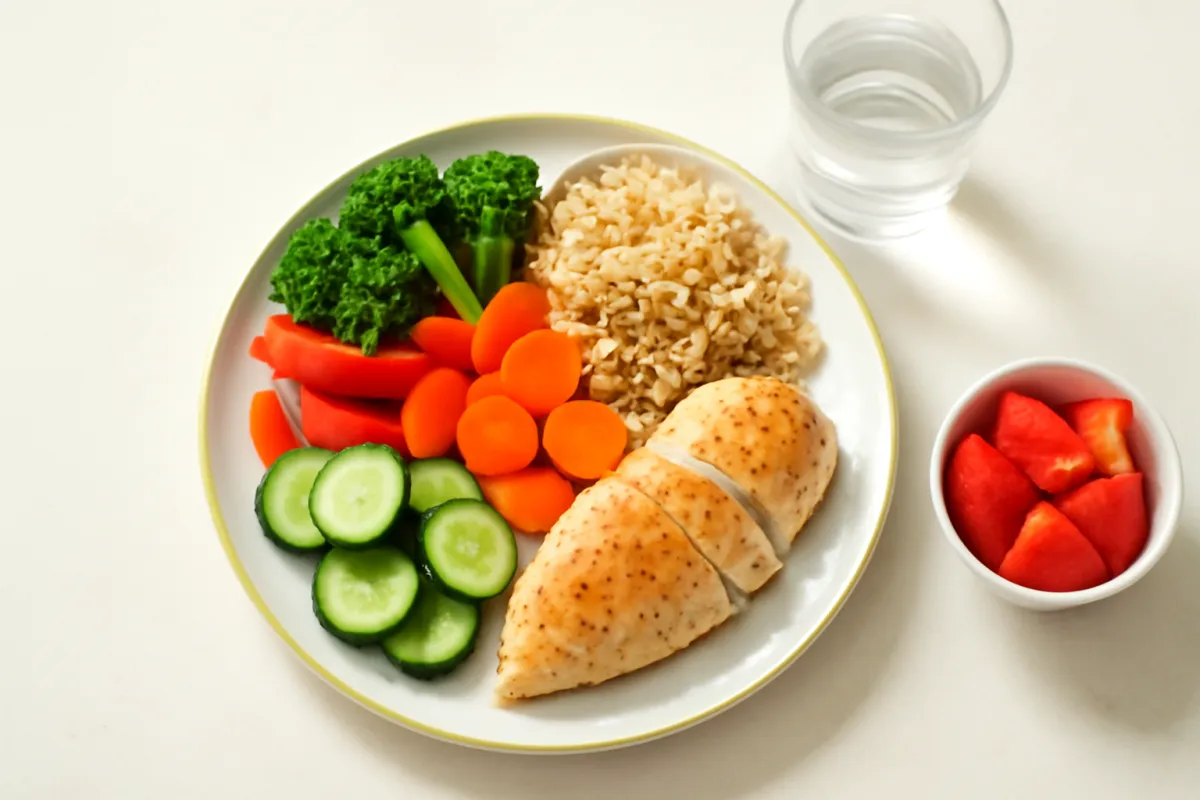
What changes without meat is not the possibility but the geometry. Meat is protein-dense: a modest 100-gram portion of cooked chicken breast is commonly cited around 31 grams of protein, which means one palm-sized piece can carry a third of many people’s day. The densest everyday plant foods top out lower per serving, so the same daily total is assembled from more contributors: a generous cup of lentils here, a block of tofu there, yogurt or eggs if you eat them, nuts and grains filling gaps. That is the entire trade-off. It costs a little more attention and slightly larger portions, and it brings fiber and a broader nutrient mix along for free.
The honest caveats belong up front too. Hitting high targets, the kind sometimes pursued by strength athletes, takes more deliberate planning from plants alone, though it is done routinely. And a fully plant-based diet needs separate attention to nutrients like vitamin B12 that have nothing to do with protein; our daily nutrient intake reference maps those commonly cited values. None of this review is a verdict on what anyone should eat. It is an account of how the protein arithmetic works when meat is off the plate.
Complete proteins, explained honestly
The phrase that scares people off meatless eating is “complete protein”, so it deserves a plain explanation. Protein is built from about twenty amino acids, nine of which the body cannot make and must get from food. A food is called complete when it carries all nine in useful proportions. Meat, fish, eggs, and dairy are complete. Among plants, soy foods and quinoa are commonly cited as complete on their own, while most individual plant foods run lower in one amino acid or another: grains tend to be lower in lysine, legumes lower in methionine.
That fact spawned decades of advice about carefully combining complementary proteins at every meal, rice with beans on the same plate, or the meal somehow did not count. The modern understanding is more relaxed and worth stating clearly: the body maintains a circulating pool of amino acids and draws on it across hours, not minutes. Eating a reasonable variety of plant proteins over the course of a day covers the full essential range for most people, with no requirement to engineer each individual meal. The traditional pairings still work, and they are pleasant food, but they are a culinary tradition rather than a biochemical deadline.
The practical translation is one word: variety. A day built entirely on one plant food would be a genuinely unbalanced way to chase a protein target, but almost nobody eats that way. Beans at lunch, tofu at dinner, grains alongside, nuts as a snack, and the amino acids sort themselves out. This is why the steps below emphasize rotating sources rather than memorizing charts. Anyone building a fully plant-based diet around unusual constraints, or managing a health condition, is the exception for whom professional guidance earns its keep.
Before you start: your target and your pattern
The steps work better with two loose facts in hand, neither of which needs precision. This takes about five minutes and no equipment.
- A rough daily target. The commonly cited baseline is about 0.8 grams per kilogram of body weight, roughly 0.36 grams per pound, with ranges often cited near 0.5 to 0.7 grams per pound for very active or older adults. For an illustrative 160-pound adult that spans roughly 58 to 112 grams a day, with a common middle-ground aim near 80. The companion below computes your own band, and our protein needs evidence review explains where the numbers come from.
- Your pattern. Decide which foods are actually on your table: vegetarian with eggs and dairy, fully vegan, meat-free but also dairy-free, or mostly meatless with occasional fish. The steps are the same for all four; the sections after the steps adapt the emphasis for each.
Time and difficulty: the changes below are grocery-list changes, not cooking-school changes. Most people can switch their staple meals over inside a week or two, and canned beans, blocks of tofu, and bags of lentils are among the cheapest and most shelf-stable foods in the store. Expect the first week to involve a little label reading and portion recalibration, and expect it to stop feeling like effort shortly after.
Step 1: Set your rough daily protein target
Start with the number, because every later decision is easier when you know roughly what the day is supposed to add up to. Multiply your body weight in pounds by about 0.36 for the commonly cited baseline, and by 0.5 to 0.7 for the higher range often suggested for active or older adults. An illustrative 160-pound adult gets a floor near 58 grams and a wide band up to roughly 112, with the practical middle ground near 80. You do not need to hit a precise figure, you need to know whether your habitual day lands near the band or far below it.
Then take a rough reading of where you are now. Mentally walk through yesterday: if breakfast was toast and coffee, lunch a salad with no legumes, and dinner pasta with vegetables, the day may have carried 30-odd grams, which is the common shape of an accidentally low-protein meatless day. Notice which meals carried a real protein source and which coasted. That gap between habit and target, not any single food choice, is what the remaining steps close.
A watch-out for this step: do not let the wide band paralyze you. The difference between 58 and 112 grams reflects genuinely different bodies and goals, not disagreement about facts, and any point inside the band is a defensible aim for a healthy adult. Pick the middle unless you have a reason not to, revisit it as your activity changes, and treat the whole exercise as navigation rather than examination. These are commonly cited general figures, and a registered dietitian can convert them into a personal target if your health situation calls for one.
Step 2: Make legumes the base of your plate
Legumes are the single most important food group in meatless protein, so promote them from side dish to foundation. Cooked lentils are commonly cited near 18 grams of protein per cup, black beans and chickpeas near 15 grams per cup, and the rest of the bean family lands in the same neighborhood. Those are serious numbers: one generous cup of lentils delivers more protein than two eggs and rivals a serving of Greek yogurt. Legumes also arrive with fiber, iron, and folate, cost very little, and keep for months in a can or a bag.
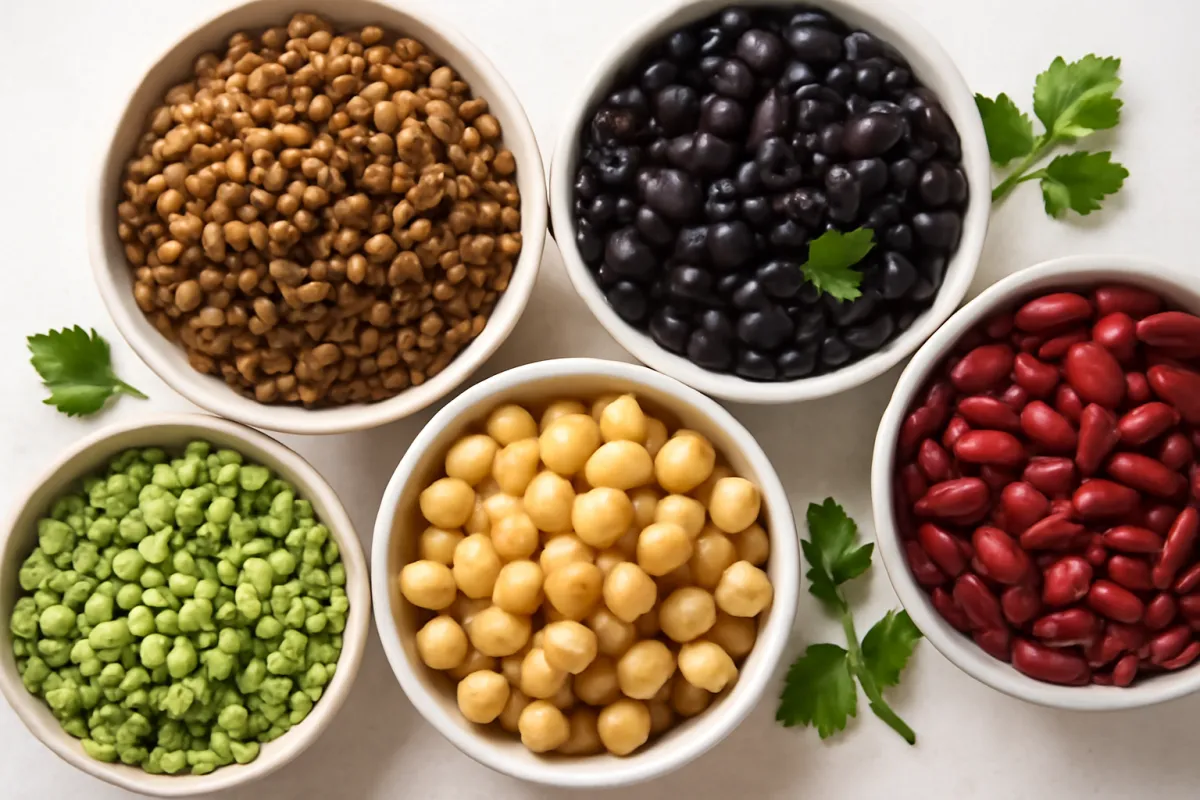
The practical move is structural: build the meal around the legume instead of adding a spoonful for decoration. Lentil soup or dal as the main event, a burrito bowl where the beans outweigh the rice, chickpea curry, pasta with a white-bean sauce, chili dense enough to stand a spoon in. Portion size is the honest lever here, because the commonly cited figures assume a full cooked cup, and a garnish-sized serving delivers garnish-sized protein. Canned beans, rinsed, are nutritionally respectable and turn most of these meals into fifteen-minute work.
Watch out for the salad trap: a large bowl of leafy vegetables with a scattering of chickpeas reads as healthy but may carry only a few grams of protein. Vegetables are excellent food and poor protein sources, and the distinction matters when they are standing where meat used to stand. If the legume is the base and the vegetables are the surroundings, the same salad becomes a legitimate meal.
Step 3: Put soy foods in the weekly rotation
Soy is the closest thing plants offer to meat’s protein profile: dense, versatile, and complete on its own, which is why it anchors meatless cooking across much of the world. Firm tofu is commonly cited near 12 grams of protein per 100 grams, and a realistic dinner portion of 150 grams brings roughly 18. Tempeh, denser because it is fermented whole soybeans, is commonly cited near 18 grams per 100 grams. Edamame lands near 17 grams per shelled cup, and fortified soy milk near 7 grams per cup, close enough to dairy milk to stand in for it almost gram for gram.
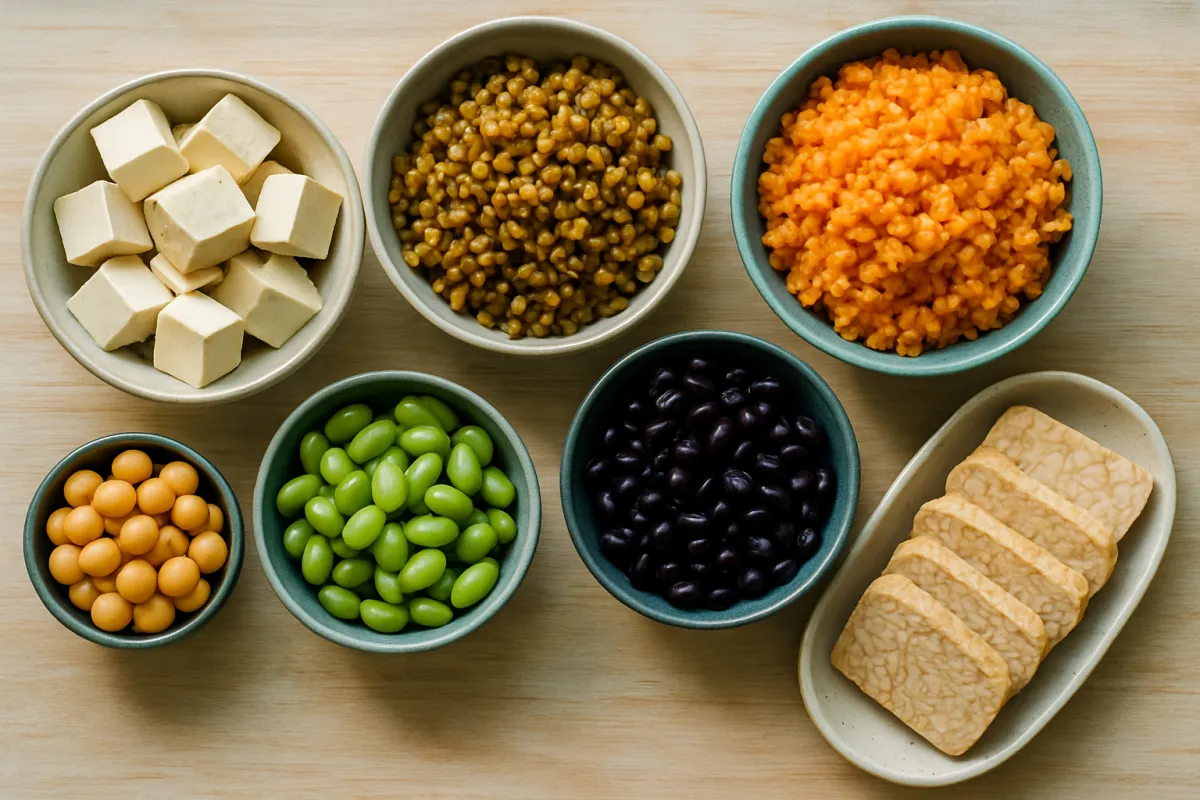
The technique complaint about tofu, that it is bland, is actually its feature: it takes on whatever it is cooked with. Pressed and pan-fried until crisp, crumbled into a scramble, cubed into curry or stir-fry, blended into sauces, it slots into the dinner rotation wherever meat used to sit. Tempeh’s nutty density suits marinades, sandwiches, and anything grilled. Edamame works as a snack or tossed through grain bowls. Two or three soy-anchored dinners a week, on top of the legume base from Step 2, quietly carries a large share of the weekly target.
Watch out for the processed shortcut becoming the whole strategy. Modern meat substitutes, burgers and sausages built on soy or pea protein, often carry respectable protein and are perfectly reasonable in rotation, but their sodium and ingredient lists vary widely, so read the panel rather than assuming. Whole-food soy is the dependable core; the engineered versions are convenience, best used as such.
Step 4: Keep eggs and dairy if you eat them
For vegetarians who keep them, eggs and dairy are the density shortcut that makes the arithmetic almost effortless, because they are complete proteins in compact servings. Two large eggs are commonly cited near 12 grams of protein, three quarters of a cup of plain Greek yogurt near 17 grams, half a cup of cottage cheese near 14, and a cup of milk near 8. Our egg protein evidence review walks the per-egg figure through sizes and cooking methods; the useful summary is that the commonly cited 6 grams per large egg survives every cooking method.
The strategic use of these foods is at the meals plants cover least conveniently: breakfast and snacks. A yogurt bowl or a two-egg scramble turns the day’s traditionally weakest protein meal into a 12-to-17-gram start before the first legume appears. Cottage cheese, string cheese, or a glass of milk closes afternoon gaps without cooking. Layered over the legume and soy base, this is how ovo-lacto vegetarians routinely land in the same daily range as meat eaters with no special effort.
Two honest watch-outs. First, cheese is a weaker protein play than it feels: hard cheeses are protein-dense per 100 grams, but normal portions are small, and the calories and sodium arrive faster than the grams. Treat cheese as flavor with a protein bonus, not as an anchor. Second, do not let dairy crowd out the plants: a vegetarian pattern that leans entirely on yogurt and eggs misses the fiber and variety that make the plant base worth having, and variety across sources remains the quiet rule of the whole plan.
Step 5: Round out the day with grains, nuts, and seeds
No single grain, nut, or seed will anchor your day, but together they are the difference between a day that limps to its target and one that clears it comfortably. Quinoa is commonly cited near 8 grams per cooked cup and is complete on its own. Peanut butter brings about 7 grams per two tablespoons, almonds about 6 per ounce, and hemp seeds are commonly cited near 10 grams per three-tablespoon serving. Whole grains like oats, brown rice, and whole wheat bread each add a few grams that accumulate across a normal day of eating.
The move here is substitution at zero effort: quinoa or a quinoa blend where plain rice would have gone, whole grain bread over white, oats cooked in soy or dairy milk rather than water, a spoonful of hemp or chia seeds into oatmeal or smoothies, nuts where chips would have been. None of these choices is dramatic, and that is the point. Eight to ten background grams from grains and seeds, on top of anchored meals, is often exactly the margin between 65 and 75 grams on the day’s ledger.
Seitan deserves its own mention as the outlier: made from wheat gluten, it is often cited above 20 grams per 100 grams, varying widely by brand, which makes it the most protein-dense plant food many people have never cooked. It is meat-like in texture, takes sauces well, and suits stir-fries and sandwiches, though it is unsuitable for anyone avoiding gluten. Watch out, throughout this step, for calorie mathematics: nuts and nut butters deliver their protein alongside substantial energy, so they are better as measured additions than as an unlimited grazing strategy, a trade-off our protein in common foods evidence review quantifies per calorie.
Meatless protein per serving, commonly cited figures
Illustrative reference values for everyday plant proteins, in grams per typical serving.
Commonly cited reference figures that vary by brand and preparation; bar lengths are proportional to the gram values. Eggs and dairy, for those who eat them, add complete options in the 6-to-17-gram range per serving.
Step 6: Vary plant proteins across the day
This is the step that replaces the old combining charts. Because most individual plant foods run lower in one essential amino acid, and because the body pools amino acids across hours rather than demanding them per meal, the working rule is simply to rotate sources across the day rather than repeating one. Legumes at one meal, soy at another, grains and nuts in the gaps: that ordinary variety covers the essential amino acids for most people without a single deliberate pairing.
In practice this happens almost by accident once Steps 2 through 5 are running, and noticing it takes the pressure off. A day of peanut butter oats, a chickpea grain bowl, and a tofu stir-fry has already rotated legume, soy, grain, and seed proteins before anyone thought about lysine. The traditional pairings, beans with rice, hummus with pita, lentils with flatbread, remain excellent food and slot in wherever you like them; they are simply no longer homework. Soy and quinoa, complete on their own, make the variety rule even more forgiving wherever they appear.
The watch-out is monotony at the extreme, not imperfect pairing. A pattern that draws essentially all its protein from a single source, the person eating peanut butter as the answer to every meal, is the one place the amino-acid question becomes practical rather than theoretical, and it is also usually a sign the rest of the diet has narrowed too. If each day includes at least two or three different protein families, which the steps above produce naturally, the composition takes care of itself for most healthy people. Anyone with unusual restrictions layered on top of a meatless pattern is the case where a registered dietitian’s review is genuinely worth it.
Step 7: Upgrade breakfast and snacks first
If you change only one meal, change breakfast, because it is the meal where meatless days most often fall behind. Toast, fruit, or plain oatmeal with coffee can carry under 10 grams, which leaves lunch and dinner chasing the whole target. The meatless fixes are easy and mostly effortless: oats cooked in soy or dairy milk with a spoonful of peanut butter and hemp seeds, a yogurt bowl for vegetarians, a tofu scramble that replaces eggs gram for gram for vegans, or last night’s beans folded into a breakfast wrap. Moving breakfast from 5 grams to 15 or 20 changes the shape of the entire day.
Snacks are the second front, because default snack food, chips, crackers, fruit, granola bars, is protein-empty, while the meatless alternatives are genuinely good: edamame, roasted chickpeas, a handful of almonds, peanut butter on apple slices, hummus with vegetables, cottage cheese or yogurt for those who eat dairy. Two snacks at 6 to 8 grams each contribute a quiet 12 to 16 grams, which is frequently the exact size of the gap between a low day and an adequate one. Our walkthrough on eating more protein covers this front-loading logic for every diet pattern; without meat, it simply matters a little more.
Watch out for drinking your snacks unexamined: smoothies can be real protein delivery, soy milk, peanut butter, yogurt, or a scoop of plant powder, or they can be fruit juice with better marketing. The panel, not the label art, tells you which one is in the glass. Spreading intake this way also aligns with the practical case for moderate protein at each sitting laid out in our protein per meal review.
Step 8: Check a full day against your target
Close the loop once: add up one ordinary day and compare it to the band from Step 1. This is not a lifestyle of logging, it is a single calibration exercise that most people only need to do once or twice. Walk through a typical day, assign each meal its commonly cited figure, and see where the total lands. The worked example below runs the arithmetic for one illustrative vegetarian day; the companion below does the target side for your own body weight and pattern.
The likely findings are instructive either way. Land inside the band and the plan is done: keep the structure, forget the counting, and let the habits carry it. Land short and the gap is nearly always visible at a glance, a proteinless breakfast, garnish-sized legume portions, or snack calories carrying no grams, and the fix maps straight back to one of the earlier steps rather than requiring anything new. Recheck after any real change in pattern: going from vegetarian to vegan, a new training load, or age creeping the target upward.
Watch out for false precision in both directions. The commonly cited figures are references, real foods vary by brand and cooking, and your true requirement is a band rather than a line, so treat a total within 10 grams of target as on target. The purpose of the check is confidence, not accounting: one honest audit that proves the meatless structure covers the number, so the question of whether you are getting enough protein stops occupying space it does not deserve. If the audit keeps coming up short despite the structure, that is the signal to bring in a registered dietitian rather than to keep guessing.
How to get protein as a vegetarian
The ovo-lacto vegetarian, keeping eggs and dairy, has the gentlest version of this plan, because two complete, dense animal proteins remain on the table. The working structure is a plant base with dairy-and-egg reinforcement: legumes and soy anchoring lunches and dinners per Steps 2 and 3, with eggs, Greek yogurt, cottage cheese, and milk carrying breakfast, snacks, and the occasional dinner. On commonly cited figures, a yogurt breakfast near 17 grams, a lentil lunch near 18, and a tofu or bean dinner near 18 to 20 lands the day around 70 grams before snacks are counted.
The characteristic vegetarian failure mode is worth naming: cheese-and-carb vegetarianism, where meat leaves the plate and pasta, bread, and cheese quietly take its place. It is a pleasant way to eat and a poor way to get protein, since cheese in normal portions contributes fewer grams than it feels like it does, alongside substantial calories and sodium. The corrective is the same structure as always, with the legume or soy food at the center of the plate and the dairy in the supporting roles where its density shines.
One adjacent note for the mostly-meatless: some people give up meat but keep fish, and that pattern, pescatarian in practice, keeps one of the densest proteins available, with canned tuna commonly cited above 20 grams per 100 grams drained; our tuna protein evidence review lays out those figures. Nothing about the plant base changes, fish simply joins eggs and dairy in the reinforcement layer. In every variant, the vegetarian version of this plan is less a protein challenge than a plate-architecture change, and most people find the numbers work out with almost no counting.
How to get protein as a vegan
The fully plant-based eater runs the same plan with the reinforcement layer removed, which means the base has to be built properly: legumes and soy stop being one good option and become the daily engine. The practical pattern that works is an anchor at every meal, tofu scramble or peanut butter oats with soy milk at breakfast, a bean or lentil dish at lunch, tofu, tempeh, or seitan at dinner, with edamame, nuts, and hummus filling the snack slots. On commonly cited figures those anchors run 12 to 18 grams each, and three of them plus ordinary grains and snacks assembles a day in the 60-to-80-gram range without exotic products.
Portions deserve special honesty here, because the vegan pattern has the least density slack. The difference between a decorative 40 grams of tofu and a real 150-gram portion is the difference between 5 grams of protein and 18; the difference between a half-cup of beans and a full cup is 8 or 9 grams. Where a vegetarian’s yogurt can quietly cover an underbuilt meal, the vegan plate has no such backstop, so the generous-portion rule from Step 2 is doing real work at every meal. Fortified soy milk over almond milk is a similar quiet win, roughly 7 grams per cup against 1.
Two closing honesty notes. First, protein is the easy part of a well-planned vegan diet; vitamin B12, and for some people iron, calcium, and a few other nutrients, need attention protein does not, and our daily nutrient intake reference maps the commonly cited values. Second, a fully plant-based pattern is exactly the situation where one consultation with a registered dietitian pays for itself, not because the diet is risky, but because a professional can confirm in an hour what guesswork confirms slowly.
How to get protein without meat or dairy
The meat-free, dairy-free pattern, whether from lactose intolerance, allergy, or preference, sits between the previous two: eggs may or may not remain, and the yogurt-and-cheese shortcut is gone either way. The plan is the vegan engine with one possible addition: legumes and soy carry the base, and if eggs are kept, they reclaim the breakfast-and-snack role dairy used to play, two eggs delivering a commonly cited 12 grams in any cooking style. If eggs are gone too, the pattern is simply the vegan plan and the previous section applies in full.
The dairy-specific substitutions matter more than they first appear, because dairy tends to exit the diet through a dozen small doors at once: the milk in coffee and oatmeal, the yogurt snack, the cheese on everything. Each exit removes a few grams, and the replacements are not equal. Fortified soy milk, commonly cited near 7 grams per cup, replaces dairy milk nearly gram for gram; almond, oat, and rice milks mostly do not, typically carrying 1 to 3 grams. Soy-based yogurts vary widely, so the nutrition panel decides. Choosing the soy option at each of these small doors preserves 10 or more daily grams that otherwise vanish unnoticed.
Otherwise the rules repeat on purpose: generous legume portions, soy in the dinner rotation, grains and nuts in the background, variety across the day, and one audit against the target. A dairy-free day built this way, tofu scramble, lentil soup with bread, tempeh stir-fry over quinoa, edamame and peanut butter in the gaps, clears 70 grams on commonly cited figures without dairy ever being missed. Anyone managing a true allergy, or dropping dairy on a clinician’s instruction, should fold that professional’s advice over anything general written here.
A worked example: a meatless day near 74 grams
Numbers make the plan concrete, so here is one illustrative vegetarian day, assembled entirely from the commonly cited per-serving figures used throughout this evidence review. Breakfast is three quarters of a cup of plain Greek yogurt with fruit and oats, roughly 17 grams. Lunch is a lentil and quinoa bowl, a full cup of cooked lentils near 18 grams plus a cup of cooked quinoa near 8, roughly 26 together. Dinner is a stir-fry built on 150 grams of firm tofu, roughly 18 grams. Snacks are two tablespoons of peanut butter on apple slices and an ounce of almonds, roughly 13 grams combined. The day totals roughly 74 grams.
Where the example day's ~74 grams come from
Each meal's share of the illustrative vegetarian day above.
Segments show each meal's share of the illustrative ~74-gram day and sum to 100 percent. Reference figures, not a prescribed plan; the vegan swap below lands within a few grams.
Two things are worth noticing. First, no meal is heroic: every dish is ordinary food in normal portions, and the day still lands comfortably inside the illustrative 58-to-112-gram band for a 160-pound adult, close to the common middle aim near 80. Second, the structure is swappable. Make it vegan by replacing the yogurt with a tofu scramble, two eggs’ worth of protein territory, and the day lands within a few grams of the same total. Make it dairy-free-with-eggs by using the scramble from actual eggs. The architecture, an anchor at every meal plus real snacks, is what produces the number; the specific foods are preference.
Run your own version in the companion below: enter your weight and pattern, and compare the example day’s shape to your target band. Every figure in the example is a commonly cited reference, not a measured plate, and your real foods will vary around them.
Common mistakes when replacing meat protein
Most meatless protein shortfalls trace to a handful of predictable patterns, all of them fixable at the grocery list.
- Removing meat without replacing its job. The most common error: the plate keeps its old architecture with a hole where the protein stood, and pasta or rice expands to fill it. Something has to inherit the anchor role, and Steps 2 and 3 name the candidates.
- Garnish-sized portions of the dense foods. A spoonful of chickpeas on a salad or 40 grams of tofu in a vegetable stir-fry carries single-digit protein. The commonly cited figures assume real portions: a full cooked cup, a 150-gram block.
- Leaning on cheese and eggs alone. Comfortable, but cheese under-delivers per portion, and a two-food protein strategy misses the fiber and variety the plant base provides.
- The protein-free breakfast. Toast, fruit, or plain cereal starts the day 15 grams behind, and meatless days rarely recover the deficit at dinner.
- Assuming all plant milks are equal. Soy sits near 7 grams per cup, most almond, oat, and rice milks near 1 to 3. Chosen blind, this one swap silently deletes several grams a day.
- Combining anxiety. Building every meal around pairing charts is effort the biology does not require: variety across the day is the actual rule, and the old rice-and-beans folklore is cuisine, not homework.
- Buying the label instead of the panel. “Plant-based” and “high protein” on the front mean nothing until the Nutrition Facts panel confirms the grams; some meat substitutes carry 20 grams per serving, others 4.
Every one of these is structural rather than a matter of willpower, which is the encouraging part: fix the plate architecture once and the mistakes stop being available.
Troubleshooting and edge cases
What if beans upset your stomach? This is common and usually transitional: the fiber load rises faster than the gut adapts. Practical mitigations include increasing portions gradually over a few weeks, rinsing canned beans well, favoring lentils and split peas, which many people tolerate best, and cooking beans thoroughly. Soy foods and, for those who eat them, eggs and dairy carry the protein load in the meantime. Persistent trouble is a conversation for a clinician rather than a reason to abandon the pattern.
What if you are also avoiding soy? The plan loses its densest plant family but survives: legumes become the sole base, seitan (if gluten is acceptable) covers the meat-like dinner role at 20-plus commonly cited grams per 100, and eggs and dairy, where kept, matter more. A soy-and-meat-free vegan pattern is the one variant where hitting higher targets gets genuinely effortful, and where a dietitian’s input moves from sensible to strongly worthwhile.
What about athletes and higher targets? The often-cited 0.5-to-0.7-grams-per-pound range is reachable without meat, but it demands deliberate structure: dense anchors at every meal, larger portions, and often a plant protein powder as a practical convenience rather than a crutch. The arithmetic is unforgiving at 110 grams in a way it is not at 60, so this is the population that benefits most from actually running Step 8’s audit.
What about children, pregnancy, or medical conditions? Meatless eating can be compatible with all of these, and all of them are outside the scope of general reference figures. Protein needs, and the nutrients that travel with meat and dairy, carry higher stakes in growth and pregnancy, and kidney disease in particular changes protein guidance entirely. These situations call for individualized professional advice, full stop.
Your meatless protein checklist
The whole plan compresses to a list you can keep on the fridge.
- Know your band: weight in pounds times roughly 0.36 to 0.7 grams, from our protein needs review or the companion.
- Anchor every meal: a legume, soy, egg, or dairy protein at breakfast, lunch, and dinner, no exceptions for breakfast.
- Real portions: a full cooked cup of legumes, 150 grams of tofu, a proper bowl of yogurt; garnishes do not count.
- Soy in the rotation: two or three tofu, tempeh, or edamame meals a week; fortified soy milk where milk is used.
- Background grams: quinoa over plain rice, whole grains, nuts, seeds, and hummus filling the gaps.
- Variety across the day: at least two or three protein families daily; no pairing charts required.
- Snacks that carry weight: edamame, roasted chickpeas, nuts, peanut butter, yogurt if you eat dairy.
- Audit once: total one ordinary day against your band, fix the visible gap, then stop counting.
- Escalate honestly: fully restricted patterns, athletic targets, or any health condition merit a registered dietitian’s review.
The bottom line
Getting protein without meat is a solved problem wearing an intimidating reputation. The commonly cited targets do not change when meat leaves the plate; only the delivery does, and the delivery is a short list of ordinary foods: legumes near 15 to 18 grams per cooked cup, soy foods near 12 to 18 per serving, eggs and dairy adding dense complete options for those who keep them, grains, nuts, and seeds filling the background. Build each meal around one of those anchors, keep portions honest, rotate sources across the day instead of engineering each plate, and an ordinary day of pleasant food lands inside the same band a meat eater aims at.
The failure modes are just as knowable: the unreplaced anchor, the garnish portion, the protein-free breakfast, the almond milk that stood in for soy. Fix the architecture once and the question stops demanding attention, which is the real goal, protein as a settled background fact rather than a daily worry. Check your numbers in the companion below, audit one day, and let the structure do the rest.
NourishMark publishes this evidence review as plain-language education about food composition and commonly cited nutrition reference values; it is not medical, dietary, or clinical advice and cannot account for your health history. Every gram figure and daily target above is an illustrative reference that varies with brand, preparation, body size, activity, and age, not a number anyone is being told to hit. Meat-free, vegan, and dairy-free patterns also involve nutrients beyond protein, such as vitamin B12, that deserve separate attention. Before restructuring your diet around any pattern described here, especially with a medical condition, an allergy, a pregnancy, or a child involved, review the specifics with your doctor or a registered dietitian, whose individual guidance overrides anything general written on this page.
Frequently asked questions
What is the best way to get protein without meat?
The most practical approach is to make legumes and soy foods the base of your meals rather than a side dish, because they are the densest everyday plant sources. Lentils, black beans, and chickpeas are commonly cited around 15 to 18 grams of protein per cooked cup, and tofu, tempeh, and edamame sit in a similar per-serving range. Vegetarians who keep eggs and dairy can add dense, complete options like Greek yogurt and eggs on top of that base. From there it is mostly arithmetic: a protein-bearing food at every meal, variety across the day, and a rough daily target to aim at. These are commonly cited educational figures, not a personal plan, and a registered dietitian can tailor one to you.
Can you get enough protein without eating meat?
For most healthy adults, yes, and this is the mainstream position of nutrition guidance rather than a fringe claim. The commonly cited baseline of about 0.8 grams of protein per kilogram of body weight per day is reachable from legumes, soy foods, grains, nuts, seeds, and, for those who include them, eggs and dairy. The practical difference is density: many plant foods carry more water and fiber alongside their protein, so meeting a higher target from plants alone usually means somewhat larger or more frequent servings. That is a planning fact, not a barrier. Anyone with a health condition, or anyone unsure they are meeting needs on a fully plant-based pattern, should confirm the details with a doctor or registered dietitian.
Do I need to combine plant proteins at every meal?
No, and this is one of the most persistent myths in nutrition. The old advice to pair complementary proteins at the same sitting, rice with beans on one plate, has softened into the modern understanding that the body maintains a pool of amino acids and draws on it across hours. Eating a reasonable variety of plant proteins over the course of a day covers the essential amino acids for most people without any meal-by-meal engineering. Traditional pairings like beans and rice or hummus and pita still work beautifully, but they are a culinary convenience rather than a biochemical requirement. This is a factual account of food composition, not personalized advice.
How do vegans get enough protein?
Vegans build their intake from legumes, soy foods, whole grains, nuts, and seeds, with soy usually doing the heaviest lifting because tofu, tempeh, and edamame are dense and complete on their own. A cup of cooked lentils is commonly cited near 18 grams, 100 grams of firm tofu near 12 grams, and tempeh near 18 grams per 100 grams, so ordinary vegan meals can carry real protein without special products. Because plant foods tend to be less protein-dense per calorie than animal foods, portions matter more: a full cup of beans rather than a spoonful, tofu as the center of the plate rather than a garnish. A registered dietitian can help anyone eating fully plant-based confirm they are covering protein along with nutrients like vitamin B12 that need separate attention.
How can I get protein without meat or dairy?
Dropping dairy as well as meat removes the yogurt-and-cheese shortcut, so legumes and soy carry nearly all of the load, with eggs adding a dense, complete option for those who still eat them. Practical anchors include lentil or bean dishes at roughly 15 to 18 grams per cooked cup, tofu and tempeh at roughly 12 to 18 grams per serving, edamame, peanut butter, and fortified soy milk, which is commonly cited near 7 grams per cup and stands in for dairy milk almost gram for gram. The same rules apply: a protein source at every meal, generous portions of the dense foods, and variety across the day. These are commonly cited illustrative figures, and individual needs vary, so professional guidance is sensible for a fully restricted pattern.
What plant foods have the most protein?
Among everyday whole foods, the leaders are legumes and soy. Cooked lentils are commonly cited near 18 grams per cup, black beans and chickpeas near 15 grams per cup, tempeh near 18 grams per 100 grams, edamame near 17 grams per shelled cup, and firm tofu near 12 grams per 100 grams. Seitan, made from wheat gluten, is often cited above 20 grams per 100 grams, though brands vary widely. Nuts, seeds, and grains contribute smaller amounts, with quinoa near 8 grams per cooked cup and peanut butter near 7 grams per two tablespoons. All of these are commonly cited reference figures that vary by brand and preparation, so treat them as a map rather than a precise ledger.
Do vegetarians need protein powder?
No. Powder is a convenience, not a requirement, and most vegetarians and vegans can reach a reasonable protein intake from ordinary food. Whole foods also bring fiber and other nutrients a scoop does not. A plant-based powder can be a practical way to close a gap on a busy day, and there is nothing wrong with using one, but it belongs in the optional column. Supplements are loosely regulated, so anyone who does use a powder should choose reputable brands, and anyone with a health condition should ask a clinician first. The framing that matters: fix the meals first, and let powder be a patch rather than the plan.
How much protein do I need if I don't eat meat?
The target does not change because the sources change. The commonly cited baseline for healthy adults is about 0.8 grams of protein per kilogram of body weight per day, roughly 0.36 grams per pound, with higher ranges often suggested for very active or older adults, frequently cited around 0.5 to 0.7 grams per pound. For an illustrative 160-pound adult that spans roughly 58 to 112 grams a day. Meatless eaters simply meet the same number from different foods, and may need slightly more attention to portions because plant sources are less dense. These are general guidelines rather than personal targets, and a registered dietitian can set a number that fits your body, activity, and health.

Hamza Hai is the editor of NourishMark. She holds an MBA and reviews the site's articles against our editorial standards, checking that every figure is labelled for what it is, that nothing is presented as verified fact without a source the reader can check, and that the writing stays useful to a non-specialist.

Dr. Shayaan Khan is the medical reviewer for NourishMark. He holds an MBBS from MGM Medical College, Navi Mumbai, and is the author of published research including a narrative review of postpartum anxiety and depression in Mental Health Science. He has taught physiology at university level. He reviews the site's health content for medical accuracy: that physiology and mechanisms are described correctly, that no claim is stated more strongly than the evidence behind it, and that anything specific to an individual reader is sent to that reader's own clinician.
Not medical advice. Dr. Khan reviews NourishMark's health content for medical accuracy. He is not a registered dietitian, he does not hold a United States practising licence, and he is not your doctor. His review does not make anything here medical advice. Always talk to a qualified health professional about your own situation, and never delay or stop care because of something you read here.