What's in this review
- Foods High in Potassium, at a Glance
- Why Bananas Became the Potassium Symbol (and What Beats Them)
- How to Read the Potassium Figures in This List
- What Potassium Does in the Body
- Fruits and Dried Fruit High in Potassium
- Root Vegetables and Potatoes
- Leafy Greens and Other Vegetables
- Legumes: Beans, Lentils, and Soybeans
- Dairy, Fish, and Meat
- Juices, Grains, Nuts, and Seeds
- The Complete High-Potassium Foods List by Group
- Which Foods Have the Most Potassium per Serving
- Sodium and Potassium: Why the Balance Matters
- How These Foods Fit a Day’s Reference Intake
- Where a Day’s Potassium Comes From
- Cooking Methods That Change Potassium
- Who Should Limit Potassium: Kidney Disease and Medications
- Potassium Supplements: Why Food Is the Default
- A Worked Example: A Day Built From This List
- Common Mistakes When Trying to Eat More Potassium
- When a Blood Test, Not a Food List, Is the Answer
- A Quick High-Potassium Shopping Checklist
- The Bottom Line
Short answer: Per serving, the highest-potassium foods are dried apricots near 1,100 mg for half a cup, canned white beans near 1,000 mg a cup, a baked potato with skin near 900 mg, cooked spinach near 840 mg a cup, and cooked lentils near 730 mg a cup. A medium banana, the food most associated with potassium, carries only about 420 mg, well below all of those. Commonly cited daily reference figures are about 3,400 mg for men and 2,600 mg for women, and people with kidney disease or on certain medications should follow their own clinician's limit rather than a general list.
Foods high in potassium are not hiding, and they are not bananas, or at least not mainly bananas. They are potatoes, beans, leafy greens, dried fruit, dairy, and fish, most of them already in a typical kitchen, and several of them carry more potassium per serving than the fruit culture has decided is the mineral’s mascot. What a plain list often skips is the two details that make the numbers actionable: a reference figure to measure a day against, and the honest caveat that a meaningful share of the population should not simply eat their way to the top of this list without a clinician’s input first.
This food reference is a plain-language list of potassium-rich foods organized by group, with illustrative, commonly cited milligrams per typical serving for fruit and dried fruit, root vegetables, leafy greens, legumes, dairy, fish, and the smaller everyday contributors. It also spends real space on the sodium and potassium relationship and on who should be cautious, because a mineral this useful also carries a real medical caveat that a shopping list should not paper over. For the daily amount question and the wider set of reference figures, our potassium per day review sits alongside this piece and shares its reference numbers. Everything here is general education describing approximate figures, not medical or dietary advice, and you can run your own tally in the companion below.
Key takeaways
- Per serving, the highest-potassium foods are dried apricots (~1,100 mg), canned white beans (~1,000 mg), a baked potato with skin (~900 mg), cooked spinach (~840 mg), and cooked lentils (~730 mg).
- A medium banana carries roughly 420 mg, genuinely useful but well below potatoes, beans, spinach, lentils, yogurt, sweet potato, salmon, and orange juice, all of which commonly beat it.
- Commonly cited Adequate Intake figures are about 3,400 mg a day for adult men and about 2,600 mg for adult women, while the Nutrition Facts label still calculates its percentage against an older 4,700 mg figure.
- Potassium and sodium work as a pair in the body, and the balance between the two is a more complete picture than either mineral counted alone.
- People with chronic kidney disease, and anyone on certain blood pressure or heart medications, may need to limit potassium, and should get their specific target from a clinician or renal dietitian rather than this general list.
Foods High in Potassium, at a Glance
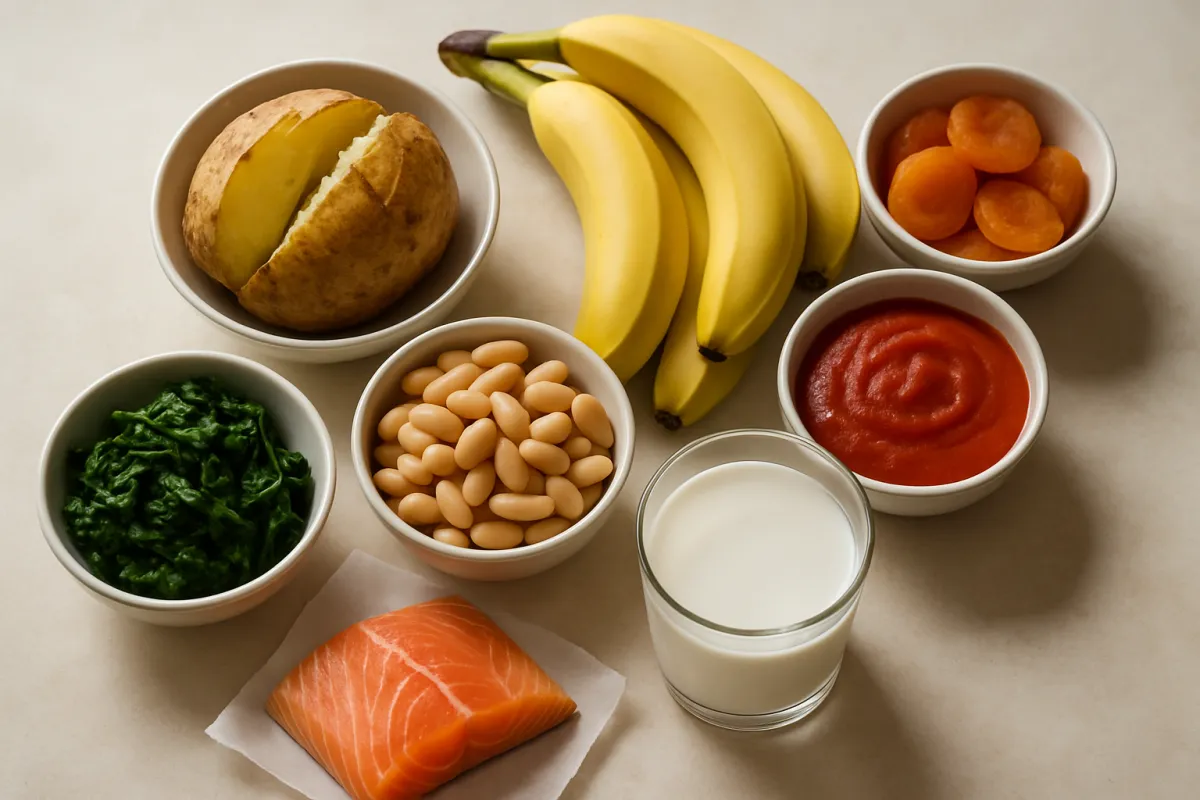
Before the group-by-group detail, the headline is worth seeing in one place. The top of the list belongs to a handful of concentrated plant foods: dried apricots are commonly cited near 1,100 mg for a half-cup serving, canned white beans near 1,000 mg a cup, and a baked potato eaten with its skin near 900 mg, each of those beating a banana by a comfortable margin. Cooked spinach near 840 mg a cup and cooked lentils near 730 mg a cup round out the strongest everyday plant sources.
The middle of the list is where dairy, fish, and the rest of the produce aisle sit. Plain yogurt is commonly cited near 570 mg a cup, a baked sweet potato near 540 mg, cooked salmon near 500 mg for three ounces, and a cup of orange juice near 500 mg. A medium banana, at roughly 420 mg, sits below every one of those, which is the detail most food lists quietly skip in favor of the easier, more familiar headline. Milk, avocado, chicken breast, and a watermelon wedge trail further down, each contributing real but smaller amounts.
Why Bananas Became the Potassium Symbol (and What Beats Them)
Ask most people to name a high-potassium food and the answer arrives instantly: banana. The reputation is not wrong, exactly, but it is overstated, and it is worth understanding why it formed in the first place before correcting it. A banana is portable, requires no refrigeration or preparation, has its own packaging, and was an easy fruit for decades of nutrition education and advertising to attach a single nutrient to. None of that reflects where a banana actually ranks on a milligram table.
The correction is simple arithmetic. A medium banana carries roughly 420 mg of potassium. A cup of canned white beans carries roughly 1,000 mg, more than double. A baked potato with its skin carries roughly 900 mg. A cup of cooked spinach carries roughly 840 mg. Even a cup of plain yogurt, not typically thought of as a potassium food at all, edges past a banana at roughly 570 mg. None of this makes the banana a bad choice, since 420 mg is still a meaningful contribution to a day, carried in a food that needs no plate, knife, or cooking. It simply means that anyone trying to raise their potassium intake meaningfully should look past the fruit bowl toward the rest of this list.
How to Read the Potassium Figures in This List
A word on the numbers keeps the whole reference honest. Every milligram figure here is a commonly cited, rounded, approximate reference for a typical serving, of the kind that food-composition tables and nutrition labels echo. Real foods vary: potassium content shifts with the variety of a fruit or vegetable, the soil it grew in, how ripe it was when picked, and how it was cooked, and processed foods vary further still because formulation is a manufacturer’s choice rather than a fixed property of the ingredient.
That is why this list leans on words like “about,” “near,” and “commonly cited” throughout, and why a tilde appears before almost every figure. The numbers are for reasoning and comparison, not for precise counting, and no figure here is a measurement of the food in front of you. When a label is available, the printed potassium line for that specific product is more reliable than any general figure, though many packaged foods in the United States are not required to print it, which is its own small obstacle this reference cannot solve. Treat this list as a map of which foods sit in the high, middle, and low tiers, and use that shape to build meals rather than chasing an exact daily total.
What Potassium Does in the Body
Potassium is one of the body’s principal electrolytes, a mineral that carries an electrical charge and sits mostly inside cells rather than in the fluid around them, which is the opposite arrangement from sodium. That inside-the-cell position is not incidental; it is central to how nerves transmit signals, how muscles, including the heart muscle, contract, and how fluid balance is maintained across the whole body. Every one of those processes depends on potassium moving in and out of cells in a carefully regulated way.
The kidneys are the main regulator, filtering blood continuously and adjusting how much potassium is excreted in urine to keep blood levels inside a narrow range. That regulation is also why kidney function matters so much to this topic: when the kidneys work normally, they absorb genuinely large swings in potassium intake without difficulty, which is why a healthy person eating from the top of this list all week faces little risk. When kidney function is reduced, that buffering capacity shrinks, and the same foods that are harmless for most people can become a real concern, a point this reference returns to later rather than glossing over.
Fruits and Dried Fruit High in Potassium
Fresh and dried fruit are where most people start looking for potassium, and the category rewards a closer look past the banana. Dried apricots lead the fruit group and arguably the whole list, commonly cited near 1,100 mg for a half-cup serving, a concentration effect from removing water that applies to dried fruit generally. Prunes follow at roughly 700 mg for the same half-cup measure, and raisins near 620 mg. Among fresh fruit, cantaloupe is commonly cited near 430 mg a cup, a banana near 420 mg, watermelon near 320 mg for two cups, and orange juice, technically a juice rather than a whole fruit, near 500 mg a cup.
| Fruit | Typical serving | Potassium |
|---|---|---|
| Dried apricots | 1/2 cup | ~1,100 mg |
| Prunes, dried | 1/2 cup | ~700 mg |
| Raisins | 1/2 cup | ~620 mg |
| Orange juice | 1 cup | ~500 mg |
| Cantaloupe | 1 cup | ~430 mg |
| Banana | 1 medium | ~420 mg |
| Avocado | 1/2 fruit | ~345 mg |
| Watermelon | 2 cups | ~320 mg |
Drying is the lever worth understanding here. Removing water concentrates everything that was dissolved in a fruit, potassium included, so a half-cup of dried apricots represents several whole apricots’ worth of fruit, and its potassium total reflects that concentration rather than any special property of dried fruit itself. The tradeoff is that dried fruit also concentrates sugar and calories in the same way, so a half-cup is a meaningfully larger dose of fruit than it first appears, a detail worth keeping in mind alongside the potassium figure.
Root Vegetables and Potatoes
Root vegetables, and potatoes in particular, are the most underrated potassium source on most people’s mental list. A baked potato eaten with its skin is commonly cited near 900 mg, among the highest figures for any single everyday food, and a baked sweet potato follows at roughly 540 mg. Acorn squash, mashed, is commonly cited near 640 mg a cup, and other winter squash varieties sit in similar territory.
The skin matters more for potatoes than for almost any other food on this list. A substantial share of a potato’s potassium sits just beneath the skin, so a peeled potato carries noticeably less than one eaten skin-on, and boiling a peeled potato in a large volume of water carries even more away into the cooking liquid, a mechanism covered in full later in this reference. Roasting or baking a potato whole in its skin preserves the most potassium of the common cooking methods, while mashing a peeled, boiled potato preserves the least.
Leafy Greens and Other Vegetables
Cooked leafy greens carry some of the highest potassium figures of any vegetable, with the same cooking-versus-raw gap that applies to their iron and calcium content. Cooked spinach is commonly cited near 840 mg a cup, while raw spinach, which wilts down to a fraction of its raw volume once cooked, carries closer to 330 mg for two cups raw. Cooked broccoli is commonly cited near 230 mg for a half cup, and mushrooms, cooked, near 280 mg for the same measure.
| Vegetable | Typical serving | Potassium |
|---|---|---|
| Baked potato, with skin | 1 medium | ~900 mg |
| Acorn squash, mashed | 1 cup | ~640 mg |
| Spinach, cooked | 1 cup | ~840 mg |
| Sweet potato, baked | 1 medium | ~540 mg |
| Tomato sauce | 1/2 cup | ~450 mg |
| Mushrooms, cooked | 1/2 cup | ~280 mg |
| Spinach, raw | 2 cups | ~330 mg |
| Broccoli, cooked | 1/2 cup | ~230 mg |
Tomato products deserve their own mention, since they are easy to overlook as a vegetable source. A half-cup of tomato sauce is commonly cited near 450 mg, a figure that reflects the same concentration principle as dried fruit: tomatoes cooked down into a sauce pack several raw tomatoes’ worth of potassium into a smaller volume. Tomato juice follows a similar pattern, commonly cited near 525 mg a cup. Anyone managing sodium alongside potassium should check the label on prepared tomato sauces and juices, since many are salted, a tension this reference returns to in the sodium section.
Legumes: Beans, Lentils, and Soybeans
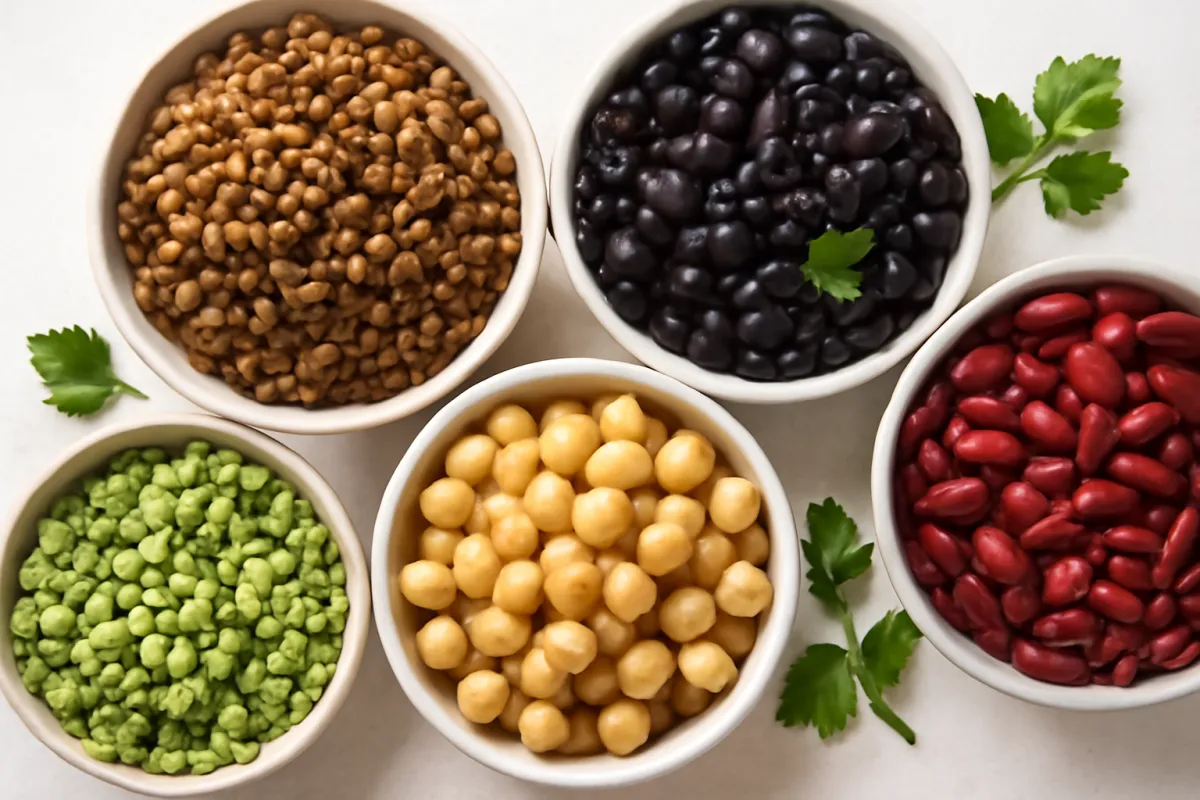
Legumes sit at or near the top of this entire list, and they are also, not coincidentally, a backbone food for several other nutrient categories on this site. Canned white beans lead at roughly 1,000 mg a cup, cooked lentils follow at roughly 730 mg, kidney beans, canned, near 600 mg, and cooked soybeans near 440 mg for a half cup. Chickpeas and black beans sit in comparable territory to kidney beans, generally in the 500 to 600 mg range per cup depending on preparation.
The practical appeal of legumes for potassium is the same as for fiber and iron: they are cheap, shelf-stable, easy to batch cook, and forgiving of imprecise portioning. A can of white beans rinsed into a soup or a salad does real, measurable work toward a day’s potassium reference figure without requiring a single fresh ingredient. Our high-fiber foods list and foods high in iron reference cover much of the same legume shelf from their own angles, and the overlap is not an accident; beans are simply an efficient food across several nutrients at once.
Dairy, Fish, and Meat
Dairy and fish are not the first foods most people associate with potassium, and that is a genuine gap in the popular picture. Plain yogurt is commonly cited near 570 mg a cup, milk near 370 mg, cooked salmon near 500 mg for three ounces, and cooked halibut near 450 mg for the same portion. Meat trails behind fish and dairy on this particular mineral: chicken breast is commonly cited near 330 mg for three ounces and beef near 320 mg, both meaningfully lower than a cup of yogurt or a modest fish portion.
| Dairy, fish, or meat | Typical serving | Potassium |
|---|---|---|
| Plain yogurt | 1 cup | ~570 mg |
| Salmon, cooked | 3 oz | ~500 mg |
| Halibut, cooked | 3 oz | ~450 mg |
| Milk | 1 cup | ~370 mg |
| Chicken breast, cooked | 3 oz | ~330 mg |
| Beef, cooked | 3 oz | ~320 mg |
| Tuna, canned | 3 oz | ~200 mg |
The pattern within fish is worth a sentence of its own. Halibut and salmon, both larger, meatier fish, carry noticeably more potassium than canned tuna, which is commonly cited near only 200 mg for the same three-ounce serving, a reminder that “fish” is no more one category for potassium purposes than “shellfish” was for iron. For readers combining this reference with a protein goal, our salmon protein review and tuna protein review cover the same portions from the protein side.
Juices, Grains, Nuts, and Seeds
The tail of the list is made of foods that contribute real but smaller amounts, useful mainly because they show up often rather than because any single serving is dramatic. Pistachios are commonly cited near 290 mg an ounce, among the higher figures for any nut, with almonds near 200 mg an ounce. Coffee, brewed, carries a surprising amount for a beverage most people do not think of nutritionally at all, commonly cited near 115 mg a cup, which adds up across several cups a day.
Grains sit at the lower end of this list almost across the board. Whole wheat bread is commonly cited near 80 mg a slice and white rice, cooked, near only 55 mg a cup, both modest next to a single serving of beans or a baked potato. This is not a criticism of grains, which contribute other nutrients covered in our daily nutrient intake reference, simply an honest placement: grains are not where potassium gains come from, and nobody should expect bread or rice to move a day’s total meaningfully.
The Complete High-Potassium Foods List by Group
The master table below gathers the whole reference in one place, sorted roughly from the highest figures down. It mixes fruit, vegetables, legumes, dairy, fish, and grains deliberately, because the point of a single list is to let the real milligrams sit side by side before you decide which route suits your kitchen.
| Food | Typical serving | Potassium |
|---|---|---|
| Dried apricots | 1/2 cup | ~1,100 mg |
| White beans, canned | 1 cup | ~1,000 mg |
| Baked potato, with skin | 1 medium | ~900 mg |
| Spinach, cooked | 1 cup | ~840 mg |
| Lentils, cooked | 1 cup | ~730 mg |
| Prunes, dried | 1/2 cup | ~700 mg |
| Acorn squash, mashed | 1 cup | ~640 mg |
| Raisins | 1/2 cup | ~620 mg |
| Kidney beans, canned | 1 cup | ~600 mg |
| Plain yogurt | 1 cup | ~570 mg |
| Sweet potato, baked | 1 medium | ~540 mg |
| Tomato juice | 1 cup | ~525 mg |
| Salmon, cooked | 3 oz | ~500 mg |
| Orange juice | 1 cup | ~500 mg |
| Tomato sauce | 1/2 cup | ~450 mg |
| Halibut, cooked | 3 oz | ~450 mg |
| Soybeans, cooked | 1/2 cup | ~440 mg |
| Cantaloupe | 1 cup | ~430 mg |
| Banana | 1 medium | ~420 mg |
| Milk | 1 cup | ~370 mg |
| Avocado | 1/2 fruit | ~345 mg |
| Chicken breast, cooked | 3 oz | ~330 mg |
| Spinach, raw | 2 cups | ~330 mg |
| Beef, cooked | 3 oz | ~320 mg |
| Watermelon | 2 cups | ~320 mg |
| Pistachios | 1 oz | ~290 mg |
| Mushrooms, cooked | 1/2 cup | ~280 mg |
| Broccoli, cooked | 1/2 cup | ~230 mg |
| Almonds | 1 oz | ~200 mg |
| Tuna, canned | 3 oz | ~200 mg |
| Coffee, brewed | 1 cup | ~115 mg |
| Whole wheat bread | 1 slice | ~80 mg |
| White rice, cooked | 1 cup | ~55 mg |
Read down the table and the shape of a good potassium strategy appears on its own. The top third is almost entirely plant foods eaten in genuinely common servings, not exotic ones, which means the gains are available in an ordinary grocery cart rather than a specialty aisle. The bottom third, grains and coffee, is worth knowing mainly so expectations stay realistic about what those foods can and cannot contribute.
Which Foods Have the Most Potassium per Serving
The chart below lines up twelve of the strongest single servings so the scale between them is visible at a glance. Dried apricots set the top of the range and every other bar is drawn as its share of that figure, which is why the familiar banana bar sits well short of several less celebrated foods.
Potassium per typical serving, twelve high-potassium foods
Commonly cited potassium per typical serving, in milligrams. Approximate reference figures that vary by variety, ripeness, and preparation, not exact measurements.
Bars scale to the dried apricots figure at 100 percent. These are commonly cited reference figures that vary by variety, ripeness, brand, and preparation, not exact measurements.
The chart’s most useful job is correcting the banana’s outsized reputation in one glance. Seven of the eleven other foods shown outrank it, several by a wide margin, and none of them require more effort to prepare than peeling a banana would, since a can of beans, a tub of yogurt, and a glass of orange juice are each about as fast.
Sodium and Potassium: Why the Balance Matters
Potassium rarely gets discussed on its own for long before sodium enters the conversation, and there is a real mechanistic reason for that pairing rather than a marketing one. The two minerals work as counterparts in the body: sodium is the dominant electrolyte outside cells, potassium the dominant one inside them, and the two are regulated together to manage fluid balance and, through that, blood pressure. A diet that is simultaneously high in sodium and low in potassium pushes that balance in one direction, while a diet higher in potassium relative to sodium pushes it the other way.
This is a mechanism, not a prescription, and this reference is not setting a sodium or potassium target for anyone’s blood pressure. What can be said generally is that many of the foods on this list, beans, potatoes, leafy greens, dairy, and fresh fruit, are also naturally low in sodium before anything is added to them, so building meals around this list tends to move both numbers in a favorable direction at once without any separate sodium strategy. Our sodium per day review covers the other half of that pair in full, and anyone managing blood pressure specifically should set targets for both minerals with their own clinician rather than from a food list.
How These Foods Fit a Day’s Reference Intake
A list of foods only means something against a reference figure, and potassium has an unusually tangled recent history on that front. Older guidance, still widely printed and still the basis for the percent Daily Value on nutrition labels, set a reference of 4,700 mg a day for adults. More recent Adequate Intake figures, now more commonly cited in nutrition guidance, are lower: about 3,400 mg a day for adult men and about 2,600 mg for adult women, with roughly 2,900 mg suggested in pregnancy and about 2,800 mg while breastfeeding.
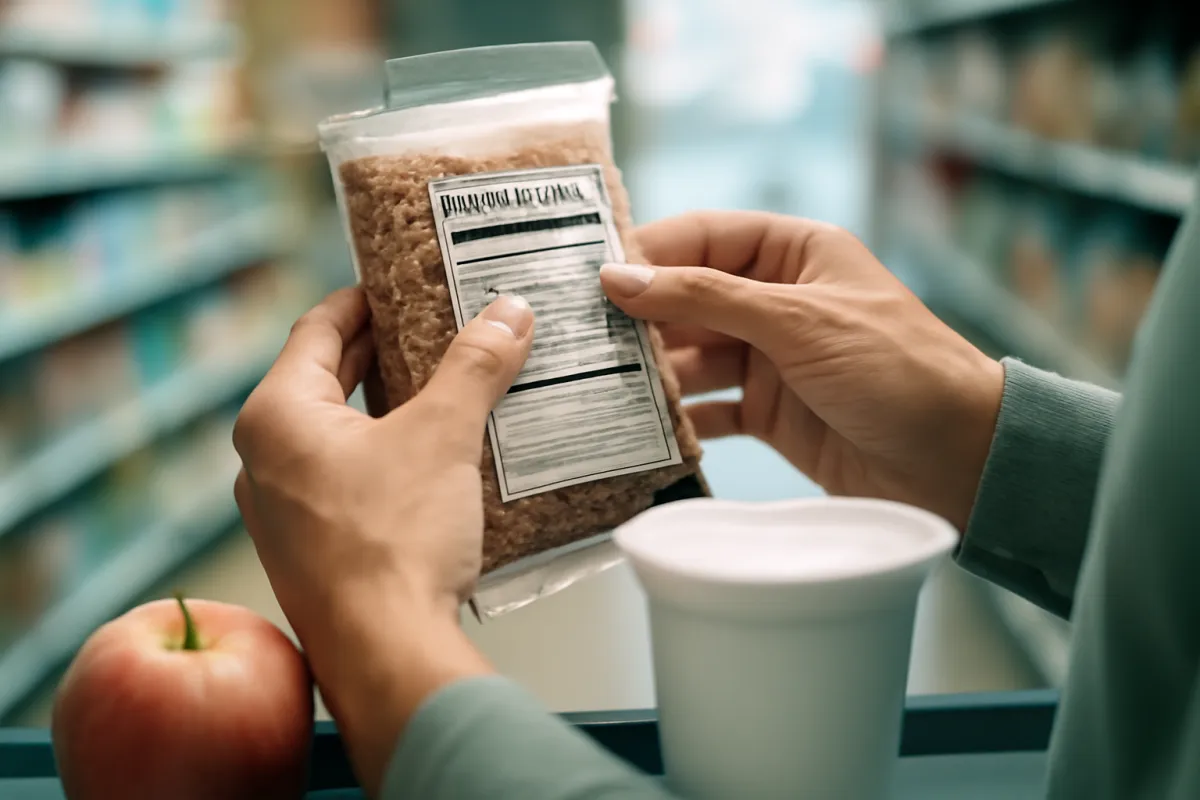
That gap between the label’s yardstick and the newer reference figures is worth internalizing rather than treating as an error. A food supplying 500 mg of potassium shows roughly 11 percent of the Daily Value on its label, calculated against 4,700 mg, but the same 500 mg covers closer to 15 percent of the 3,400 mg figure for men or about 19 percent of the 2,600 mg figure for women. Neither number is wrong; they are answering against different, both legitimately cited, reference points, and the label’s percentage is simply the more conservative of the two. The companion below runs your own selections against whichever reference figure applies to you.
Where a Day’s Potassium Comes From
It helps to see how a mixed day distributes its potassium across meals rather than foods in isolation. The breakdown below follows the worked example later in this reference exactly, so the shares are the arithmetic of one specific illustrative day totaling roughly 3,780 mg, comfortably past the reference figure for men and well past the figure for women.
Where one illustrative day's potassium comes from
Share of the worked example day's ~3,780 mg by meal. Shares sum to 100 percent and describe one illustrative day, not a rule.
Segments show each meal's share of the worked example day's total milligrams. One illustrative day, not a prescription.
Two things stand out in that distribution. No single meal has to carry the day, which mirrors the pattern seen with iron and most other nutrients on this site; four ordinary eating occasions, none of them heroic, reach a strong total between them. And the dinner course, built from a protein and two vegetables rather than any single potassium superfood, contributes the largest single share, which is a useful reminder that a balanced plate often outperforms a single targeted ingredient.
Cooking Methods That Change Potassium
Unlike most of the minerals covered on this site, potassium is unusually sensitive to how a food is cooked, because it dissolves readily in water. Boiling a potassium-rich vegetable, particularly a cut or peeled potato, in a generous volume of water and then draining that water away is commonly described as removing a meaningful share of the vegetable’s potassium, with longer boiling times, smaller cut pieces, and more water generally associated with more loss. Steaming, roasting, and baking lose much less, since there is little or no water for the mineral to dissolve into and drain away.
This fact cuts two different ways depending on who is reading it. For most people trying to raise their potassium intake, the practical lesson is to bake or roast vegetables rather than boil and drain them, and to use any cooking liquid in a soup or sauce rather than discarding it, since that liquid now carries potassium that left the vegetable. For people managing a potassium-restricted diet for kidney disease, the same mechanism is used deliberately in reverse, often called leaching: cutting vegetables small, soaking or double-boiling them in a large volume of fresh water, and discarding that water is a specific technique sometimes taught by a renal dietitian to lower a vegetable’s potassium before it is eaten. That second use is a medical technique with its own specific method, not a general cooking tip, and anyone following a potassium-restricted diet should get it from their own care team rather than from this paragraph.
Who Should Limit Potassium: Kidney Disease and Medications
Nearly everything in this reference so far describes potassium as a mineral worth getting more of, and for most readers with normally functioning kidneys, that framing is appropriate. It is not appropriate for everyone, and this section exists because a food list that only ever says “more” without naming the exception would be incomplete in a way that could cause real harm.
Chronic kidney disease is the condition most commonly discussed in this context. Healthy kidneys filter blood continuously and adjust how much potassium is excreted to keep levels inside a narrow, safe range, absorbing wide day-to-day swings in intake without issue. As kidney function declines, that regulatory capacity shrinks, and potassium can build up in the blood to levels that affect heart rhythm, a condition clinicians call hyperkalemia. People with chronic kidney disease are often given a specific daily potassium target and a tailored food list by a nephrologist or renal dietitian, and that individualized plan, not this general reference, is the one that applies to them.

Several medications also change how the body handles potassium, independent of kidney disease. Some blood pressure medications, certain diuretics specifically described as potassium-sparing, and some heart medications can raise blood potassium levels or are prescribed alongside dietary potassium awareness for that reason. Anyone taking a prescription medication who is unsure whether it affects potassium should ask the prescribing clinician or a pharmacist rather than guess from a general article, since the interaction depends on the specific drug and dose.
Potassium Supplements: Why Food Is the Default
Potassium is one of the nutrients where food is overwhelmingly the recommended route and supplements are approached with real caution rather than treated as an easy top-up. Part of the reason is dosing: food delivers potassium gradually, spread across a meal and absorbed over time, while a concentrated supplement dose arrives all at once, which is harder for even healthy kidneys to buffer smoothly and considerably harder for impaired ones.
Over-the-counter potassium supplements are also generally capped at a relatively low dose precisely because of this risk, a regulatory decision that reflects how seriously excess potassium is taken compared with many other minerals. Salt substitutes marketed to reduce sodium intake frequently replace some or all of the sodium with potassium chloride, which makes them a meaningful potassium source that is easy to use without realizing it, a detail worth knowing for anyone with a kidney condition or on a potassium-sensitive medication. Nobody should start a potassium supplement, including a salt substitute used liberally, without a clinician confirming it is appropriate for their kidney function and medications.
A Worked Example: A Day Built From This List
Here is one illustrative day assembled from the tables above, chosen to be ordinary rather than optimized, and matched to the figures used throughout this reference and its companion piece on daily potassium targets. Breakfast is a cup of plain yogurt at about 570 mg with a medium banana at about 420 mg, for roughly 990 mg. Lunch is a cup of lentil soup at about 730 mg alongside a two-cup raw spinach salad at about 330 mg, for roughly 1,060 mg.
The afternoon snack is a quarter cup of dried apricots, about half of the 1,100 mg half-cup figure, for roughly 550 mg. Dinner is three ounces of cooked salmon at about 500 mg, a half cup of tomato sauce at about 450 mg, and a half cup of cooked broccoli at about 230 mg, for roughly 1,180 mg. The day totals approximately 3,780 mg: comfortably past the 3,400 mg reference figure commonly cited for men and well past the 2,600 mg figure for women, with no single food doing all the work and no exotic ingredient anywhere in the plan. Enter your own foods in the companion below to build a comparable day against your own reference figure.
Common Mistakes When Trying to Eat More Potassium
The first mistake is stopping at bananas and assuming the job is done, when a single piece of fruit at roughly 420 mg is a fraction of most days’ reference figure and far from the strongest option on this list. The second is peeling potatoes and boiling them in a large volume of water, which together strip away a meaningful share of the vegetable’s potassium before it ever reaches the plate, the opposite of what someone trying to raise their intake wants.
The third is reading the nutrition label’s Daily Value percentage as the newer, lower reference figure, when it is actually calculated against the older 4,700 mg number, which makes high-potassium foods look like a smaller share of a day than the newer figures suggest. The fourth, and the one with real consequences, is assuming that because potassium is encouraged throughout this reference, more is automatically better for everyone, which is not true for people with reduced kidney function or certain medications. The fifth is reaching for a potassium supplement or using a potassium-based salt substitute heavily without checking with a clinician first, exactly the shortcut the previous section cautions against.
When a Blood Test, Not a Food List, Is the Answer
This reference can tell you which foods carry potassium and how cooking method changes the amount that survives to the plate. It cannot tell you whether your own potassium level is low, normal, or high, and neither can any article, because potassium status is a blood test question, not a symptom-reading or food-counting one. The interpretation of that test also depends on kidney function, medications, and the reason it was ordered, all of which a clinician assesses together rather than in isolation.
If you have a reason to wonder about your potassium, whether because of kidney disease, a medication you take, a symptom that concerns you, or simply family history, the useful next step is an appointment rather than a supplement aisle or a stricter version of this food list. A clinician can decide whether testing is appropriate, what the result means in your specific context, and whether any dietary change is warranted in either direction. This reference belongs on the general food-education side of that line, and it says so plainly rather than overstepping it.
A Quick High-Potassium Shopping Checklist
A compact list is easier to act on than a long one. For the strongest everyday sources, a bag of dried apricots, canned white beans, potatoes for baking with their skins on, fresh or frozen spinach, and dried lentils cover most of the top of this reference in a single trip. For the middle tier, plain yogurt, a carton of orange juice, and whatever fish is fresh that week round things out without requiring anything unusual.
For cooking habits, favor baking, roasting, and steaming over boiling and draining when the goal is to keep potassium in the food, and keep any vegetable cooking liquid for a soup or sauce rather than pouring it away. This list overlaps substantially with the shopping baskets built for iron and fiber on this site, so the foods high in iron reference and the high-fiber foods list can be run alongside this one without adding a second trip to the store.
The Bottom Line
Foods high in potassium are led by a cluster of everyday plant foods that rarely get the credit a banana does: dried apricots near 1,100 mg, canned white beans near 1,000 mg, a baked potato with its skin near 900 mg, cooked spinach near 840 mg, and cooked lentils near 730 mg, all ahead of a banana’s roughly 420 mg. Dairy, fish, and citrus fill in a strong middle tier, grains and coffee contribute modestly, and cooking method, especially boiling versus baking, moves the figure for vegetables more than most people expect.
Commonly cited reference figures are about 3,400 mg a day for men and about 2,600 mg for women, both lower than the 4,700 mg figure still used to calculate the label’s percentage, so a food’s printed Daily Value understates its real share of the newer targets. None of this is a reason to chase a number alone: potassium works as a pair with sodium, and for people with chronic kidney disease or on certain medications, more is not automatically better and can be genuinely risky. Pair this list with our potassium per day review for the daily amount question in full, and confirm anything specific to your own kidney function, medications, or health with a doctor or registered dietitian.
This food reference is published for general education and describes approximate, commonly cited nutrition figures. It is not medical, nutritional, or dietary advice, and reading it establishes no clinician-patient relationship. Every milligram figure above is a rounded population reference rather than a measurement of any particular food, and potassium content varies substantially with variety, ripeness, brand, and preparation, so a specific product’s own label is always the better source for that product where one is printed. Nothing here is intended to help anyone identify, rule out, or treat a potassium imbalance or any other condition; that work belongs to blood testing and a qualified clinician. Potassium restriction and potassium supplementation both carry real risks for some people, particularly those with chronic kidney disease or on certain medications, and neither should be adopted or ignored without medical guidance. Before changing your diet or acting on anything in this reference, speak with a doctor or registered dietitian who knows your history.
Frequently asked questions
What foods are highest in potassium?
Per typical serving, the highest-potassium foods on this list are dried apricots at roughly 1,100 mg for half a cup, canned white beans near 1,000 mg a cup, a baked potato with skin near 900 mg, cooked spinach near 840 mg a cup, and cooked lentils near 730 mg a cup. Plain yogurt, sweet potato, salmon, and orange juice all cluster near 500 mg, and a medium banana, the food most associated with potassium, sits lower than all of them at roughly 420 mg. These are commonly cited, approximate figures that shift with variety, brand, and preparation, offered as general education rather than a personal plan.
Do bananas really have the most potassium?
No, and this is the single most common misconception about the mineral. A medium banana is commonly cited near 420 mg, which is a genuinely useful amount but one that a baked potato, white beans, spinach, dried apricots, and several other everyday foods all beat, several of them by a wide margin. Bananas earned their reputation through portability and marketing rather than through topping any food composition table. They remain a perfectly good source; they are simply not the strongest one, and leaning on bananas alone leaves easier gains on the table.
How much potassium do adults need per day?
Commonly cited Adequate Intake figures are about 3,400 mg a day for adult men and about 2,600 mg for adult women, with roughly 2,900 mg suggested in pregnancy and about 2,800 mg while breastfeeding. These replaced an older reference value of 4,700 mg a day that still circulates widely and still sets the Daily Value percentage printed on nutrition labels, which is why label percentages for potassium often read lower than the newer reference figures would suggest. These are population reference figures rather than a personal quota, and your own number belongs with a doctor or registered dietitian, particularly if you have kidney disease.
Why does the Nutrition Facts label show a different potassium value?
The percent Daily Value printed on a nutrition label is calculated against 4,700 mg, the older reference figure, even though newer Adequate Intake figures of 3,400 mg for men and 2,600 mg for women are now more commonly cited elsewhere. A food supplying 500 mg therefore shows about 11 percent DV on the label, while the same 500 mg covers a larger share, around 15 to 19 percent, of the newer reference figures. Neither number is wrong; they are simply answering against different yardsticks, and the label's percentage is the more conservative of the two.
Can boiling vegetables reduce their potassium?
Yes. Potassium dissolves readily in water, so boiling a potassium-rich vegetable in a large volume of water and then discarding that water, a technique sometimes called leaching, is commonly described as removing a meaningful share of the mineral, with longer boiling, smaller pieces, and more water generally associated with more loss. This is a deliberate technique taught to some people managing kidney disease who need to lower the potassium in their vegetables, not a general cooking tip, and anyone following that approach should get the specific method from their renal dietitian rather than a general food reference.
Who needs to limit potassium intake?
People with chronic kidney disease are the group most often discussed in this context, because failing kidneys lose some of their ability to clear potassium from the blood, which can let it build to dangerous levels. Certain medications, including some blood pressure drugs, potassium-sparing diuretics, and some heart medications, also raise potassium levels or are prescribed alongside a potassium-aware diet. Anyone in either situation should follow the specific limit and food list their own clinician or renal dietitian gives them rather than a general high-potassium list like this one, which is written for a general healthy population.
Is too much potassium from food dangerous?
For someone with normally functioning kidneys, getting too much potassium from food alone is uncommon, because healthy kidneys clear the surplus efficiently. The real-world risk concentrates in people whose kidneys cannot clear potassium normally, in certain medication combinations, and in potassium supplements or salt substitutes taken without medical guidance, where the dose is concentrated and easy to misjudge. This reference describes food sources for a general population and does not set a safe upper amount for anyone, since that figure depends entirely on individual kidney function and medications, which only a clinician can assess.
Can you get enough potassium without eating bananas?
Easily. Bananas are a convenient, portable source, but the arithmetic in this reference shows that a cup of white beans, a baked potato with skin, a cup of cooked spinach, or half a cup of dried apricots each supply more potassium than a banana does, often by a wide margin. A diet built around legumes, potatoes, leafy greens, dairy, and fish reaches the commonly cited daily reference figures without any bananas at all. Bananas are a fine habit to keep, not a requirement, and the rest of this list is where most of the real headroom sits.

Hamza Hai is the editor of NourishMark. She holds an MBA and reviews the site's articles against our editorial standards, checking that every figure is labelled for what it is, that nothing is presented as verified fact without a source the reader can check, and that the writing stays useful to a non-specialist.

Dr. Shayaan Khan is the medical reviewer for NourishMark. He holds an MBBS from MGM Medical College, Navi Mumbai, and is the author of published research including a narrative review of postpartum anxiety and depression in Mental Health Science. He has taught physiology at university level. He reviews the site's health content for medical accuracy: that physiology and mechanisms are described correctly, that no claim is stated more strongly than the evidence behind it, and that anything specific to an individual reader is sent to that reader's own clinician.
Not medical advice. Dr. Khan reviews NourishMark's health content for medical accuracy. He is not a registered dietitian, he does not hold a United States practising licence, and he is not your doctor. His review does not make anything here medical advice. Always talk to a qualified health professional about your own situation, and never delay or stop care because of something you read here.