What's in this review
- Calories in Pasta: The Direct Answer
- Dry vs Cooked Pasta: The Number That Trips Everyone Up
- Calories in Pasta by Portion: A Quick Table
- How Many Calories in 100g of Dry Pasta?
- How Many Calories in 100g of Cooked Pasta?
- How Many Calories in a Cup of Cooked Pasta?
- The Absorption Ratio, Worked Both Ways
- Calories by Dry Portion: A Reference Table
- The Label Portion vs the Restaurant Portion
- Where the Calories in Pasta Come From
- Whole Wheat Pasta Calories
- Legume and Chickpea Pasta Calories
- Fresh Egg Pasta Calories
- Gluten-Free Pasta: Rice, Corn, and Blends
- Why the Sauce Moves the Number More Than the Pasta
- A Worked Example: A Pasta Plate by the Numbers
- Protein and Fiber in Pasta
- Carbs in Pasta and How They Fit
- Pasta, Blood Sugar, and Cooking Time
- Pasta and Weight Management
- Portioning Pasta Without a Scale
- How Pasta Fits Your Daily Calories
- Pasta vs Rice and Other Staples
- Common Mistakes Counting Pasta Calories
- How to Count Pasta Calories Accurately
- The Bottom Line
Pasta is one of the easiest foods in the kitchen to miscount, and the reason is almost never the pasta itself. It is that the number printed on the box describes the dry pasta in the box, while the thing you actually eat is the same pasta after it has soaked up a large amount of water and roughly doubled in weight. Quote a dry figure against a cooked plate and you can be off by more than half. That single confusion accounts for most of the mislogged pasta meals people ever have.
This evidence review starts with that dry versus cooked conversion and works outward: the calories in a standard dry portion and the cooked portion it becomes, how a restaurant plate compares with a label portion, how whole wheat, legume and fresh egg pasta differ, why the sauce usually swings the total more than the pasta does, what protein and fiber the pasta brings, and how to portion it without a scale. Our rice calorie review deals with the identical dry versus cooked problem in the other big staple grain, and the two are worth reading together. Every figure here is a commonly cited approximation, not medical or dietetic advice.
Key takeaways
- Plain dry pasta is commonly cited near 360 calories per 100 grams, so the standard 2 ounce (about 56 gram) dry portion lands near 200 calories.
- Pasta absorbs water as it boils and gains roughly two to two and a half times its dry weight, so that same 200 calorie portion becomes about 125 grams on the plate and cooked pasta reads near 160 calories per 100 grams.
- Portion size, not pasta type, is the main lever: a restaurant plate commonly holds two to three label portions of pasta before anything is poured over it.
- Whole wheat and legume pastas are close to regular pasta on calories; their advantage is fiber and, for legume pasta, protein, not a lower number.
- Every figure here is an illustrative approximation that varies by shape, brand and doneness; anyone with diabetes or coeliac disease should take their questions to a doctor or registered dietitian.
Calories in Pasta: The Direct Answer
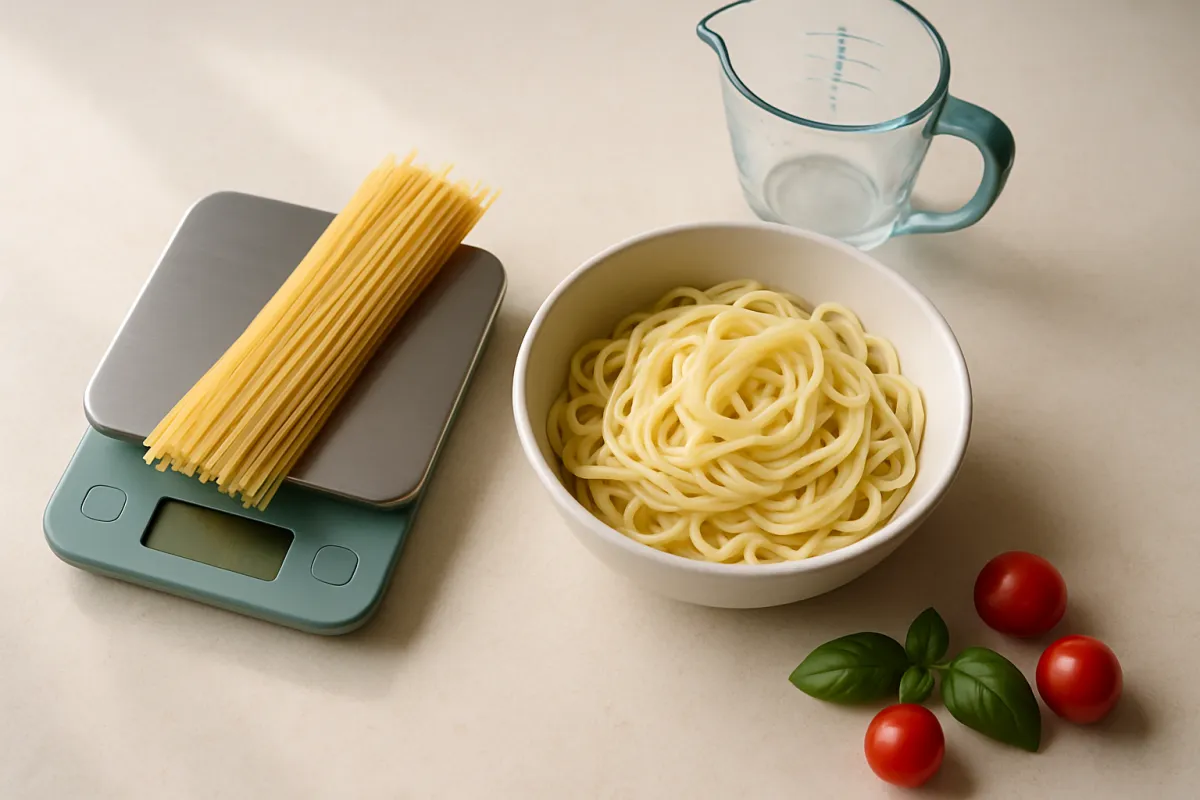
The direct answer has two halves, and skipping either one is where the counting goes wrong. Plain dry wheat pasta carries roughly 360 calories per 100 grams, which makes the standard 2 ounce dry portion, about 56 grams, close to 200 calories. Cooked plain pasta carries roughly 160 calories per 100 grams, because the boiled strands are now mostly absorbed water by weight.
Both figures describe the same food. A 56 gram dry portion at 200 calories becomes about 125 grams of cooked pasta still holding 200 calories, which is exactly 160 calories per 100 grams on the new weight. Nothing was added and nothing was destroyed; the water simply spread the energy across more grams. If you weigh your pasta dry, use 3.6 calories per gram. If you weigh it cooked, use 1.6 calories per gram. Mixing the two is the single most common pasta counting error there is, and it can overstate a plate by more than double.
The rest of this review breaks that down by portion, by pasta type and by what goes on top. Set your own portion in the companion below to watch the arithmetic move as you read. These are commonly cited references for plain pasta, not exact readings of any specific bowl.
Dry vs Cooked Pasta: The Number That Trips Everyone Up
It is worth slowing down here, because this is the section that makes the rest of the numbers usable. Dry pasta shows about 360 calories per 100 grams. Cooked pasta shows about 160 calories per 100 grams. The instinct is to assume that boiling somehow removed calories, and it did not. Boiling cannot destroy energy.
What happens is that dry pasta is close to bone dry, holding only a small percentage of water, and the starch in it takes up a great deal more during cooking. The commonly cited working figure is that pasta comes out of the pot at roughly 2 to 2.5 times its dry weight, with about 2.25 times being a reasonable middle for regular shapes boiled to a normal doneness. So 100 grams of dry pasta at 360 calories becomes something close to 225 grams of cooked pasta holding those same 360 calories, which works out to 160 calories per 100 grams cooked.
That is the whole trick. Weigh dry and multiply by 3.6, or weigh cooked and multiply by 1.6, but never cross the two. Our rice calorie review handles the same absorption problem for rice, which expands even more.
Calories in Pasta by Portion: A Quick Table
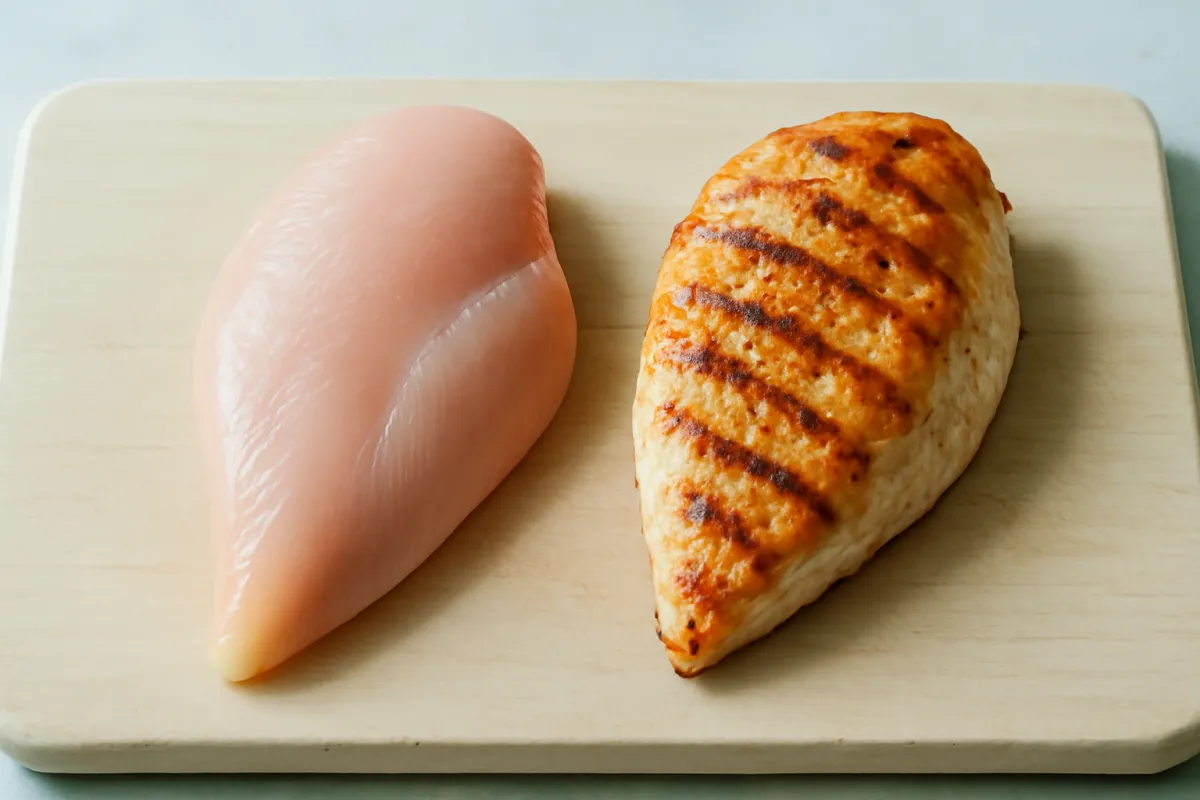
Because the same portion has a dry weight and a cooked weight, the clearest way to show pasta calories is to put both in one table. The figures below are commonly cited approximations for plain wheat pasta boiled in water with nothing added, using the 3.6 calories per dry gram rate and an absorption factor of about 2.25.
| Portion | Dry weight | Cooked weight, roughly | Calories, roughly |
|---|---|---|---|
| Half a label portion | ~28 g (1 oz) | ~63 g | ~100 kcal |
| Standard label portion | ~56 g (2 oz) | ~125 g | ~200 kcal |
| Generous home serving | ~85 g (3 oz) | ~190 g | ~305 kcal |
| Large serving | ~113 g (4 oz) | ~255 g | ~405 kcal |
| Restaurant sized plate | ~170 g (6 oz) | ~385 g | ~610 kcal |
| 100 g dry, as a reference | 100 g | ~225 g | ~360 kcal |
| 100 g cooked, as a reference | ~44 g | 100 g | ~160 kcal |
Two things stand out. First, the calories scale cleanly with the dry weight, so doubling the pasta doubles the number with no complications. Second, the cooked column explains why plates deceive: 385 grams of cooked pasta looks like an ordinary restaurant portion, but it started life as six ounces of dry pasta and carries about 610 calories before a spoonful of sauce. Every figure here is an illustrative approximation for plain pasta.
How Many Calories in 100g of Dry Pasta?
One hundred grams of dry wheat pasta is commonly cited near 360 calories, and that figure is the anchor for everything else in this review. It applies to plain semolina pasta made from durum wheat, whether it is spaghetti, penne, fusilli or shells, because shape changes how pasta cooks and packs but not what it is made of.
Behind that 360 sits a straightforward composition: roughly 74 grams of carbohydrate, about 13 grams of protein and only around 1.5 grams of fat per 100 grams dry. At the standard conversion of 4 calories per gram of carbohydrate, 4 per gram of protein and 9 per gram of fat, that comes to about 296 plus 52 plus 13, which lands near 360. Pasta is a starch food with a useful protein share and almost no fat of its own.
A 100 gram dry measure is more than most people cook for themselves, since it is close to two label portions. It is a convenient reference precisely because it makes the arithmetic obvious: whatever your dry weight is, divide by 100 and multiply by 360. These figures are commonly cited approximations that shift a little between brands.
How Many Calories in 100g of Cooked Pasta?
One hundred grams of cooked plain pasta is commonly cited near 160 calories, roughly 44 grams of the dry pasta it came from. The number is lower than the dry figure for one reason only: more than half the weight on the scale is now water the starch absorbed.
The macronutrients scale down by the same factor. Per 100 grams cooked, plain pasta carries roughly 33 grams of carbohydrate, about 6 grams of protein and well under a gram of fat, which at 4, 4 and 9 calories per gram again lands near 160. Nothing has changed about the food, only how much water is sitting alongside it.
There is one wrinkle worth knowing. Pasta cooked very soft has absorbed more water than pasta pulled out firm, so a firm cooked gram carries slightly more calories than a soft cooked gram. The gap is small, generally a matter of ten or fifteen calories per 100 grams either side of the 160 reference, and it disappears entirely if you weigh dry. That is one more argument for weighing before the pot. Try it both ways in the companion below. Illustrative figures only.
How Many Calories in a Cup of Cooked Pasta?
A cup is how most people picture a pasta serving, so it deserves a direct answer even though it is the least precise measure here. A cup of cooked long strands weighs about 140 grams, which at 160 calories per 100 grams is close to 220 calories, and it traces back to roughly 62 grams of dry pasta.
Short shapes complicate this. Penne, rigatoni and shells trap air between the pieces, so a cup of them weighs noticeably less than a cup of packed spaghetti, often somewhere in the 110 to 125 gram range, which puts a cup nearer 175 to 200 calories. Small shapes such as orzo or ditalini pack tighter and read higher. So a cup of cooked pasta is realistically a 200 to 220 calorie band rather than a single figure, and the shape decides where in it you land.
This is precisely why weight beats volume for pasta. A cup measure of a food full of holes is an estimate of an estimate. If you want a number you can rely on, weigh the dry pasta before it goes in the pot. These are commonly cited approximations, not exact measurements.
The Absorption Ratio, Worked Both Ways
The absorption ratio is the one piece of arithmetic that makes every other figure in this review convertible, so it is worth being able to run it in both directions. The working figure is that cooked pasta weighs about 2.25 times its dry weight, within a commonly cited range of roughly 2 to 2.5 depending on shape, cooking time and how much water clings to the strands after draining.
To go from dry to cooked, multiply the dry weight by 2.25. Fifty six grams dry becomes about 125 grams cooked. Eighty five grams dry becomes about 190 grams cooked. To go the other way, divide the cooked weight by 2.25, or multiply by about 0.44. So 300 grams of cooked pasta on your plate came from roughly 133 grams of dry pasta, which at 3.6 calories per dry gram is close to 480 calories.
That reverse calculation is the useful one when somebody else cooked. You cannot un-boil a restaurant plate, but you can weigh or estimate what is in front of you, divide by 2.25, and get a defensible dry equivalent. The ratio is an approximation, so treat the result as a ballpark.
Calories by Dry Portion: A Reference Table
Since dry weight is the stable measure, here is how the calories scale across the dry portions people actually cook. All figures assume plain wheat pasta at about 360 calories per 100 grams dry, with the cooked weight each portion produces shown alongside so you can match it to a plate.
| Dry portion | Cooked weight, roughly | Calories, roughly | Carbs, roughly |
|---|---|---|---|
| 1 oz (~28 g) | ~63 g | ~100 kcal | ~21 g |
| 2 oz (~56 g) | ~125 g | ~200 kcal | ~41 g |
| 3 oz (~85 g) | ~190 g | ~305 kcal | ~63 g |
| 4 oz (~113 g) | ~255 g | ~405 kcal | ~84 g |
| 6 oz (~170 g) | ~385 g | ~610 kcal | ~126 g |
The spread is the point. A modest single portion and a restaurant sized plate are the same food and a sixfold difference in calories, from about 100 to about 610, before anything is added. Nothing about the pasta changed; only the amount did. Where a plate falls on this table matters far more than whether it is penne or spaghetti, semolina or whole wheat. How this fits a day is the job of our calorie needs review. Illustrative approximations only.
Calories by dry pasta portion
Plain wheat pasta at about 360 kcal per 100 g dry, with the cooked weight each dry portion produces. Illustrative reference values.
Bars scale to the 6 oz dry portion at 100 percent. Figures are for plain pasta before sauce, oil or cheese, and are illustrative references rather than targets.
The chart makes visible what the box cannot: the standard label portion sits at a third of the tall bar, and most restaurant plates sit at or near the top of it. That gap, not the choice of shape or flour, is where pasta plates diverge from each other. Every value here is a commonly cited approximation that moves with brand and doneness.
The Label Portion vs the Restaurant Portion
The dry versus cooked confusion is the technical trap. The portion gap is the bigger practical one, and it usually costs more calories. The label portion on a box of dry pasta is 2 ounces, about 56 grams, near 200 calories. A one pound box therefore holds about eight of those portions and roughly 1,630 calories in total, which is a number worth sitting with the next time a box feeds three people.
Real servings run well above the label. A generous home portion is commonly three to four ounces dry, or 305 to 405 calories of plain pasta. A restaurant entree plate frequently lands in the four to six ounce dry range, which is 405 to 610 calories of pasta alone, and some pasta-forward restaurants go higher still. That is two to three label portions before a spoonful of sauce, a slick of oil or a handful of cheese.
None of this makes a restaurant plate wrong. It makes the label figure a poor description of it. If you have anchored your mental picture of pasta to the 200 calorie number on the box, a normal plate out is commonly two to three times that, and knowing the multiplier is more useful than trying to shrink the plate.
Where the Calories in Pasta Come From
Pasta is a simple food, and its calorie profile reflects that. Plain wheat pasta is made from durum wheat semolina and water, so per 100 grams dry it carries roughly 74 grams of carbohydrate, about 13 grams of protein and only around 1.5 grams of fat. Multiply those by 4, 4 and 9 calories per gram and you get about 296, 52 and 13, which sums close to the commonly cited 360.
Two features of that split are worth naming. The first is how little fat plain pasta contains: essentially none, which means every gram of fat in a finished pasta dish was added by the cook. The second is that 13 grams of protein per 100 grams dry is a real contribution for a starch food, better than most grains on a dry weight basis, and it comes from the gluten proteins in durum wheat.
So plain pasta is not, in nutritional terms, empty calories. It is a starch-dominant food with a meaningful protein share, some fiber, and a set of B vitamins and iron that in many countries are added back through enrichment. What it is not is a complete meal on its own. Our nutrition label walkthrough covers how to read all of this off a box. Illustrative approximations only.
Whole Wheat Pasta Calories
Whole wheat pasta is the substitution people expect to save calories, and on that count it mostly does not. A 2 ounce dry portion of whole wheat pasta is commonly cited near 200 calories, essentially level with regular semolina pasta, because both are starch and protein with almost no fat. Per 100 grams dry it runs near 355 calories, which is inside the noise between brands.
The difference is in what those calories are made of. Whole wheat pasta keeps the bran and germ that refining strips out, so a dry portion typically carries roughly 5 grams of fiber against about 2 grams in regular pasta, along with about a gram more protein and more magnesium, phosphorus and B vitamins. On a per 100 gram dry basis that is roughly 70 grams of carbohydrate, 14 grams of protein and 2 grams of fat, which again lands near 355 by the 4, 4 and 9 arithmetic.
The honest framing is the same one that applies to brown rice: whole wheat pasta is not the lower calorie choice, it is the higher fiber one. Our high-fiber foods list puts that 5 gram figure in context against a day. Whole wheat pasta also cooks differently, holding a firmer, chewier texture, which some people prefer and some do not.
Legume and Chickpea Pasta Calories
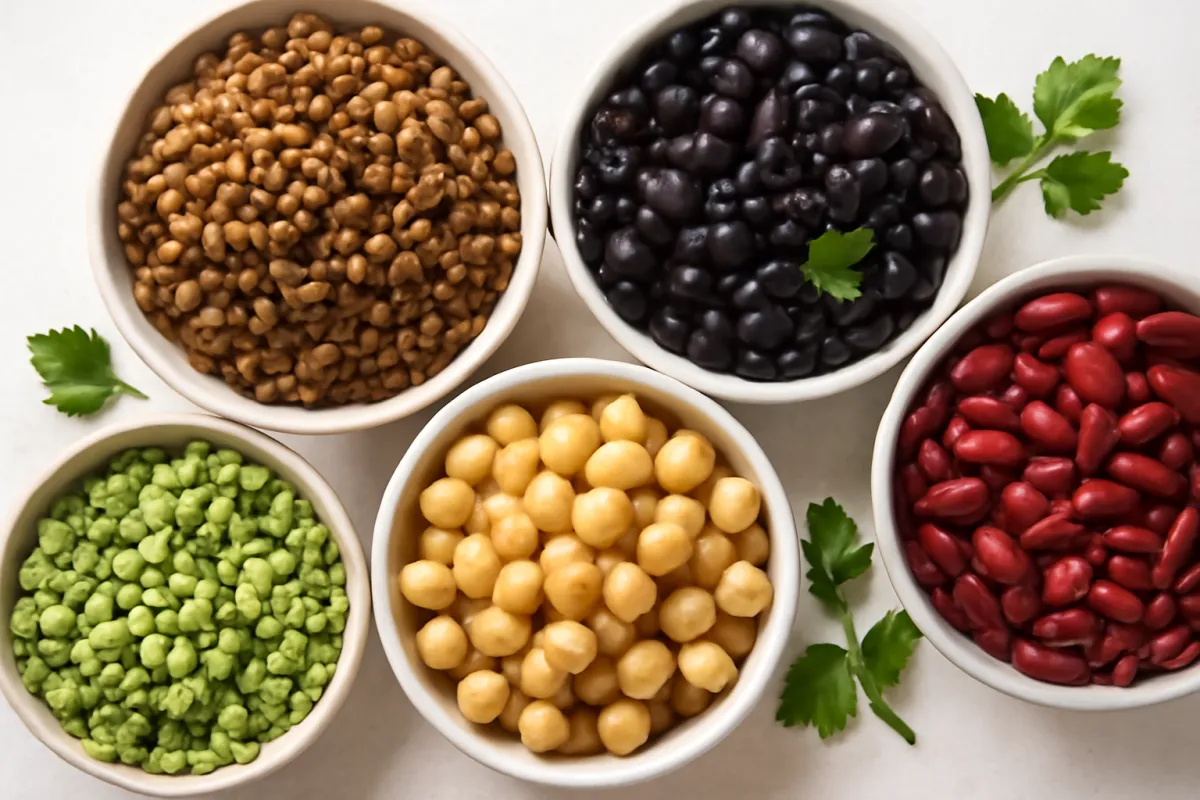
Pastas made from chickpea, red lentil, green pea or black bean flour have become common, and the calorie question comes up constantly. A 2 ounce dry portion is commonly cited near 200 calories, which puts legume pasta essentially level with wheat pasta. Calories are not where these products differ.
The macronutrient split is where they differ, and substantially. A dry portion of legume pasta often carries roughly 12 grams of protein and 6 grams of fiber, against about 7 grams of protein and 2 grams of fiber in regular pasta, with correspondingly less starch, around 33 grams of carbohydrate rather than 41. Per 100 grams dry that is roughly 58 grams of carbohydrate, 22 grams of protein and 4 grams of fat, landing near 355 calories.
Two honest caveats. Brands vary widely, far more than wheat pasta brands do, so the panel on the specific box is the only reliable source. And because these products are high in fiber, label calories are sometimes calculated with an adjustment for fiber, so multiplying the grams by 4, 4 and 9 can come out slightly above the printed figure. Legume pasta also behaves differently in the pot, softening faster and often needing less cooking time. Our protein without meat review covers where else that protein can come from.
Fresh Egg Pasta Calories
Fresh pasta, the refrigerated kind sold in sheets or nests, follows a different rule, and applying dry pasta figures to it produces a badly wrong answer. Fresh pasta has never been fully dried, so it already holds a substantial amount of water. That means it reads lower per gram than dry pasta but higher per gram than cooked dry pasta, and it barely expands in the pot.
Commonly cited figures put fresh egg pasta near 270 calories per 100 grams as sold, from roughly 52 grams of carbohydrate, about 11 grams of protein and around 2 grams of fat, which lands near 270 by the standard arithmetic. Because it is already hydrated, fresh pasta typically gains only about a third to a half of its weight in cooking rather than more than doubling, and it is usually ready in two to four minutes.
Portions are also sold differently. A typical single serving of fresh pasta is around 100 to 115 grams as sold, which is roughly 270 to 310 calories, somewhat more than the 200 calorie dry portion most people compare it to. The egg contributes the extra protein and the small amount of fat. Producers vary a great deal here, so the package panel matters more than any general figure. These are illustrative approximations.
Gluten-Free Pasta: Rice, Corn, and Blends
Gluten-free pastas built on rice flour, corn flour or blends including quinoa and cassava are, on calories, close to wheat pasta. A 2 ounce dry portion is commonly cited near 200 calories, which again means the swap is not a calorie decision.
The composition tends to shift the other way from legume pasta. Rice and corn based pastas usually carry more starch and less protein than wheat pasta, often around 44 grams of carbohydrate and roughly 4 grams of protein per dry portion, with about 1 gram of fiber, which sums near 200 by the 4, 4 and 9 arithmetic. Blends containing quinoa, legume flours or added bran land higher on both protein and fiber. Texture varies enormously between products and they are generally less forgiving about cooking time.
An important boundary: coeliac disease is a medical diagnosis, and gluten-free pasta is a medically necessary food for people who have it, not a general nutritional upgrade. This review is describing food composition only. Anyone with coeliac disease, a wheat allergy or suspected gluten sensitivity should work with a doctor or registered dietitian rather than take dietary direction from a calorie article.
Why the Sauce Moves the Number More Than the Pasta
Here is the part that usually decides how a pasta meal actually lands. The pasta portion is a fixed, knowable quantity once you weigh it. The sauce is not, and its range is enormous. A half cup of simple tomato or marinara sauce is commonly cited near 70 calories. A half cup of cream style sauce is commonly cited near 300. Two tablespoons of pesto, which is mostly oil and nuts, run near 160, and a single tablespoon of olive oil stirred through the pot adds about 120.
| Addition | Typical amount | Calories, roughly |
|---|---|---|
| Tomato or marinara sauce | 1/2 cup (~125 g) | ~70 kcal |
| Meat ragu | 1/2 cup (~125 g) | ~180 kcal |
| Pesto | 2 tbsp (~30 g) | ~160 kcal |
| Cream style sauce | 1/2 cup (~125 g) | ~300 kcal |
| Olive oil | 1 tbsp (~14 g) | ~120 kcal |
| Butter | 1 tbsp (~14 g) | ~100 kcal |
| Grated hard cheese | 2 tbsp (~10 g) | ~45 kcal |
Two plates built on the identical 200 calorie pasta portion can therefore finish anywhere from about 270 to well over 600 calories depending on nothing but what was poured on. That is a wider swing than doubling the pasta produces. If you want one lever that changes a pasta meal’s calories most, it is the fat in the sauce, not the pasta underneath it. These are illustrative typical values that vary greatly by recipe.
A Worked Example: A Pasta Plate by the Numbers
To put those pieces together, here is an illustrative home plate, chosen only to show the arithmetic rather than to recommend anything. Start with a 2 ounce dry portion of regular pasta at about 200 calories, which cooks up to roughly 125 grams. Add a half cup of tomato sauce at about 70, a tablespoon of olive oil used in the pan at about 120, and two tablespoons of grated hard cheese at about 45.
The plate totals near 435 calories. Read the parts and the lesson is immediate: the pasta is under half of it, the single tablespoon of oil is more than a quarter, and the sauce and cheese together account for the rest. The oil in particular is the item most people leave out of a mental tally entirely.
Now build the restaurant version. Six ounces of dry pasta at 610 calories, three quarters of a cup of a cream style sauce at about 450, and two tablespoons of cheese at 45 comes to roughly 1,105 calories for one plate, about two and a half times the home version. Neither figure is a verdict on either meal. Both are just arithmetic. Build your own version, with your portion, pasta type and sauce, in the companion below.
Where the calories in a home pasta plate come from
Share of the illustrative 435 kcal plate above: 2 oz dry pasta, half a cup of tomato sauce, a tablespoon of olive oil and two tablespoons of grated cheese.
Segments show each item's share of the illustrative 435 kcal total and sum to 100 percent. Swap the tomato sauce for a cream style sauce and the pasta's share falls below a third. Illustrative figures.
The chart is the argument of this whole review in one bar. The food people name the meal after supplies under half its calories, and the two items easiest to forget, the oil and the cheese, supply nearly four tenths between them. Change the sauce and the shares redraw completely while the pasta bar stays exactly where it is.
Protein and Fiber in Pasta
Pasta is routinely written off as empty calories, and the composition does not support that. A 2 ounce dry portion of regular wheat pasta carries roughly 7 grams of protein, which is more than most people expect from a starch and comes from the gluten proteins in durum wheat. It also carries about 2 grams of fiber, modest but not nothing, and in many countries enriched pasta has iron and several B vitamins added back after milling.
For scale, 7 grams of protein per portion puts a cup of cooked pasta at about 8 grams, meaningfully above the roughly 4 grams in a cup of cooked white rice. Pasta is not a protein food, but it contributes more to a day’s protein total than its reputation suggests, and our protein in common foods reference sets it against the actual protein sources.
The fiber picture is where the pasta type genuinely matters. Regular pasta gives about 2 grams per dry portion, whole wheat about 5, and legume pasta about 6. Across a week those differences add up, and fiber is one of the nutrients most people fall short on. So the useful reframe is not that pasta is empty, but that the flour it is made from decides how much more than starch it brings. Illustrative approximations only.
Carbs in Pasta and How They Fit
Pasta is above all a carbohydrate food, which is a description rather than a criticism. A 2 ounce dry portion carries roughly 41 grams of carbohydrate, and per 100 grams dry the figure is near 74 grams. Cooked, the same pasta reads near 33 grams per 100 grams because of the absorbed water. Almost all of that carbohydrate is starch, with only a trace of sugar in plain pasta.
That is why portion size matters most for anyone tracking carbohydrate. A restaurant plate at six ounces dry carries roughly 126 grams of carbohydrate from the pasta alone, before bread, before sauce, before anything else. A single label portion at 41 grams is a very different proposition. The pasta type shifts this too: legume pasta at roughly 33 grams per dry portion carries meaningfully less starch and more of its carbohydrate as fiber.
How much total carbohydrate suits a given day depends on the person, their activity and their circumstances, and our carbohydrate intake review works through the general framework. It does not set a number for anyone. Anyone managing diabetes, prediabetes or any blood sugar condition should confirm their own carbohydrate approach with a doctor or registered dietitian rather than with a food composition article.
Pasta, Blood Sugar, and Cooking Time
This subject attracts more confident claims than the evidence supports, so it is worth handling carefully and non-clinically. Pasta is a starch, and starches raise blood glucose. What is commonly observed about pasta specifically is that its starch is packed into a dense, extruded structure that hydrates less completely than, say, the starch in a boiled potato or in very soft rice, and that this appears to slow digestion somewhat compared with other refined starches.
Cooking time is the part people ask about most. Pasta boiled to a firm doneness has taken up less water and its starch is less fully gelatinized than pasta boiled soft, and it is commonly observed that firmer pasta tends to digest more gradually. The calories are identical either way, since boiling only adds water. Cooling cooked pasta and eating it later, as in a pasta salad, is also commonly discussed as changing how some of the starch behaves.
None of this is a prescription, a treatment or a clinical claim, and the size of any of these effects varies between individuals, between brands and between meals, especially once sauce, fat, protein and vegetables are on the plate. Anyone with diabetes, prediabetes, insulin resistance or any other condition that touches blood sugar should get individual direction from a doctor or registered dietitian.
Pasta and Weight Management
Pasta carries a reputation it has not really earned, and the honest position is that no single food causes or prevents weight change on its own. Body weight responds to overall energy balance across a whole diet, alongside activity, sleep, medications, genetics and circumstances. Pasta appears in that picture as one contributor among many.
Where pasta does become relevant is that it is easy to serve in large amounts without noticing, and easy to pair with the most calorie dense additions in the kitchen. A plate that quietly holds three label portions plus a cream sauce is a large number arrived at through two invisible steps, neither of which is the existence of pasta. The countermeasures are equally unremarkable: portion the dry pasta before cooking, and put the pasta beside protein and vegetables rather than alone.
Fiber and protein help here too, which is the practical argument for whole wheat or legume pasta over a calorie argument that does not exist. Our balanced meal walkthrough develops the plate composition side. This describes general nutrition principles rather than a weight loss plan, and anyone pursuing weight change, particularly alongside a health condition, should work with a doctor or registered dietitian.
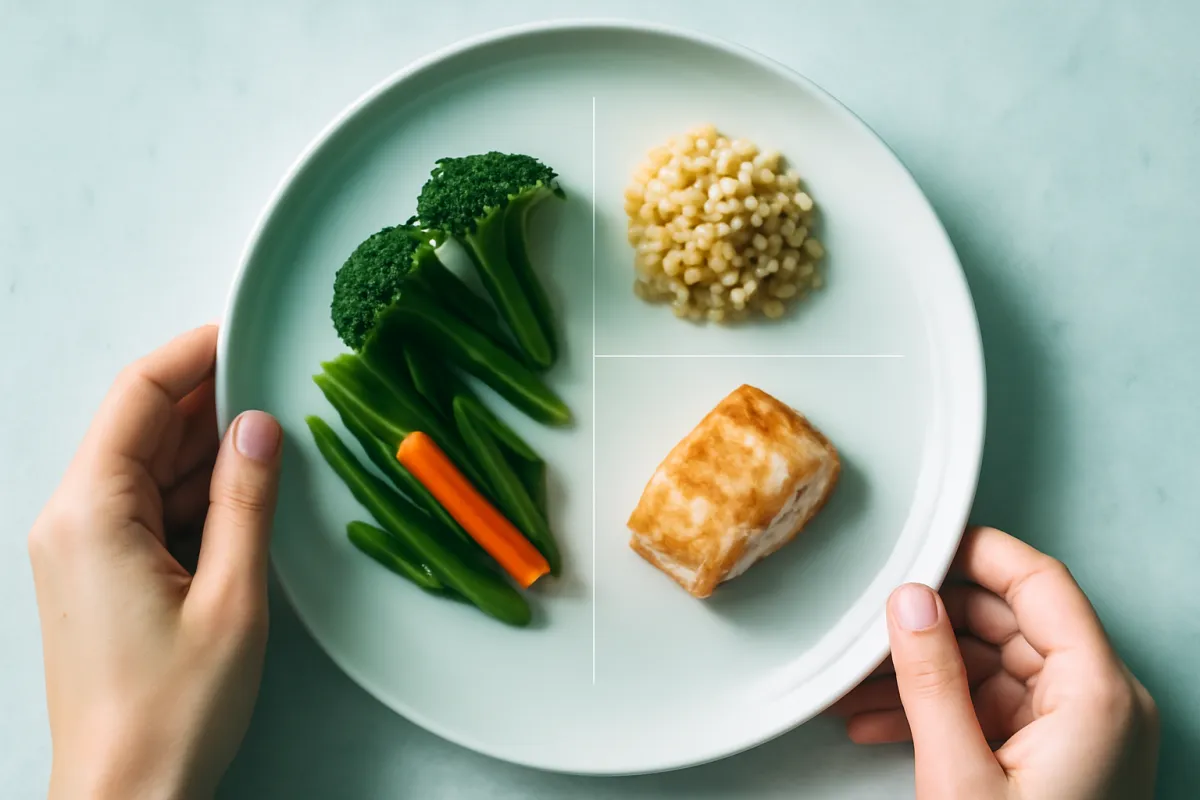
Portioning Pasta Without a Scale
A kitchen scale is the reliable answer, but plenty of kitchens do not have one, and the workarounds for pasta are better than for most foods because dry pasta is stable and sold in fixed weights.
The strongest method is arithmetic on the box. A standard one pound box holds about eight 2 ounce portions and roughly 1,630 calories in total. Cook a quarter of the box and you have about two portions and near 400 calories of pasta. Cook half and you have four portions and near 815. Dividing the box by eye is far more accurate than guessing a bundle, because the total is known.
For long strands, a commonly cited visual is that a single dry portion is a bundle about the diameter of a US quarter, and some colanders and pasta jars have a hole cut for exactly that. For short shapes, a dry portion is often close to half a cup for larger shapes like rigatoni and nearer three quarters of a cup for smaller ones, though the variation is real. Cooked, a single portion is roughly a heaped cupped handful. Measure once against a scale if you can, remember what it looked like, and reuse that picture. These are general strategies, not a prescribed portion for anyone.
How Pasta Fits Your Daily Calories
A pasta portion only means something against a daily total, and this review does not set that total for anyone. Daily needs depend on body size, activity, age and circumstances, which our calorie needs review works through in detail. Using a 2,000 calorie day purely as an illustrative reference point, since individual needs run well above and below it, the arithmetic is easy to picture.
A single 2 ounce dry portion of plain pasta at 200 calories is about a tenth of that reference day. The illustrative home plate at 435 calories is closer to a fifth. The restaurant version at roughly 1,105 calories is over half of it in one sitting. Same food, three very different places in a day, decided almost entirely by portion and by what went on top.
That is the practical reason all of this arithmetic is worth knowing. Pasta is not a food that has to be managed carefully because it is unusually calorie dense, since per cooked gram it sits in the ordinary range for a cooked staple. It is a food worth knowing the numbers for because the gap between a label portion and a served plate is unusually wide. Your own daily figure is best confirmed with a qualified professional.
Pasta vs Rice and Other Staples
Setting pasta against the other staples clarifies where it actually sits, and the answer is: unremarkably. Per cooked cup, plain pasta is near 220 calories, cooked white rice near 205, cooked brown rice near 218 and cooked quinoa near 222. Cooked oats come in lower per cup, near 150, largely because oats hold more water than any of them.
| Staple (cooked) | Portion | Calories, roughly | Carbs, roughly |
|---|---|---|---|
| Pasta | 1 cup (~140 g) | ~220 kcal | ~46 g |
| White rice | 1 cup (~158 g) | ~205 kcal | ~45 g |
| Brown rice | 1 cup (~195 g) | ~218 kcal | ~46 g |
| Quinoa | 1 cup (~185 g) | ~222 kcal | ~39 g |
| Oats | 1 cup (~234 g) | ~150 kcal | ~27 g |
| Bread | 1 slice (~30 g) | ~80 kcal | ~15 g |
The interesting difference is per gram rather than per cup. Cooked pasta reads near 160 calories per 100 grams while cooked white rice reads near 130, and the reason is absorption: rice roughly triples in weight while pasta roughly doubles, so rice carries more water per gram of starch. That is a physics difference, not a nutrition verdict. Our rice calorie review and our bread calorie review take each of those staples on its own terms, and our common foods calorie reference lays out the wider field.
Common Mistakes Counting Pasta Calories
A handful of recurring errors explain nearly all of the confusion about pasta, and each is fixable once named.
- Applying the dry rate to a cooked weight. Plain pasta is about 360 calories per 100 grams dry and about 160 cooked. Using 360 on a cooked plate can more than double the true figure, and using 160 on a dry weight badly undercounts it.
- Forgetting that pasta gains weight. A 56 gram dry portion becomes about 125 grams cooked, so a scoop that looked small in the box looks like a full plate on the table while holding the same 200 calories.
- Measuring cooked pasta by the cup. Short shapes trap air, so a cup of penne can weigh a fifth less than a cup of packed strands. Volume is the least reliable measure pasta has.
- Counting the pasta and forgetting the pan. The oil, butter, cheese and cream are frequently more than half a pasta plate’s calories, and they are the items least likely to be logged.
- Assuming whole wheat or legume pasta is lower in calories. It generally is not. Those swaps change fiber and protein, not the calorie total.
- Treating any of these numbers as exact. Every figure here is a commonly cited approximation that shifts with brand, shape and doneness.
Naming these makes the underlying rule reliable: pick dry or cooked, use the matching rate, and count everything that went in the pan separately.
How to Count Pasta Calories Accurately
If you want a pasta number you can trust, the method is short. Weigh the pasta dry, before it goes anywhere near the water, and multiply by 3.6 calories per gram. Dry pasta is stable, it does not gain or lose water on the shelf, and it is the same weight the box’s own figures describe, so this removes every source of error at once.
If it is easier to weigh cooked, that works too, as long as you apply 1.6 calories per gram to the cooked weight rather than the dry rate, and accept a slightly wider margin because doneness moves the water content. If somebody else cooked, estimate the cooked weight, divide by about 2.25 to get a dry equivalent, and use the dry rate on that.
Then count the additions separately and honestly: the oil in the pan, the butter stirred through, the cheese grated over, the cream in the sauce. These are individually small actions and collectively the largest variable in the meal. Done this way, plain pasta is one of the more predictable foods to count, and the only genuine unknowns are the portion and the pan. Run your own numbers in the companion below. These remain illustrative references; anything tied to your health belongs with a qualified professional.
The Bottom Line
Calories in pasta come down to one conversion and one habit. The conversion is that plain dry pasta runs near 360 calories per 100 grams while cooked pasta runs near 160, because pasta gains roughly two to two and a half times its weight in water, which makes the standard 2 ounce dry portion about 200 calories whether you weigh it before or after the pot. The habit is to weigh dry and never mix the two rates.
Beyond that, the portion does more work than the pasta type. A label portion is 200 calories, a generous home serving is 305 to 405, and a restaurant plate is commonly 405 to 610 of pasta alone. Whole wheat and legume pastas land at essentially the same calories and win on fiber and protein instead. And in most real meals the sauce, oil and cheese account for more of the plate than the pasta does, which is why the illustrative home plate above finishes at 435 calories with the pasta supplying under half.
Every number here is a commonly cited approximation for food composition, not a personal target. Pair it with our calorie needs review for daily totals and our carbohydrate intake review for the carbohydrate side, and take anything specific to your health to a qualified professional.
This evidence review is educational writing about the commonly cited composition of pasta and general nutrition science. It is not medical, dietetic or dietary advice, it does not diagnose or treat anything, and reading it establishes no clinician-patient relationship. The calorie, macronutrient and weight figures throughout are widely referenced approximations rather than measurements, and real pasta varies with the shape, the flour, the brand, how long it boils and how much water clings to it after draining, so a specific box’s own panel always outranks a general figure here. Nothing above tells anyone how much pasta to eat, and the sections on blood sugar and cooking time describe commonly observed patterns in food science rather than clinical guidance for any person. Anyone living with diabetes, prediabetes, coeliac disease, a wheat allergy, kidney disease or any other condition that touches what they eat should follow their own clinician’s direction rather than this article. For a calorie target, a carbohydrate approach or an eating pattern matched to your body, your medications and your circumstances, speak with a doctor or a registered dietitian.
Frequently asked questions
How many calories are in a serving of pasta?
The standard label portion of dry pasta is 2 ounces, about 56 grams, and it is commonly cited near 200 calories, drawing on the roughly 360 calories per 100 grams that plain dry semolina pasta carries. That same portion cooks up to about 125 grams on the plate, because pasta absorbs a large amount of water, and it still holds those same 200 calories. Most real servings are larger than the label portion, so a home bowl often holds two of them and a restaurant plate can hold three. These are commonly cited approximations that vary by shape, brand and how long the pasta is boiled, not exact measurements of any particular bowl.
How many calories are in a cup of cooked pasta?
A cup of cooked pasta weighing about 140 grams is commonly cited near 220 calories, working from a cooked rate close to 160 calories per 100 grams. Short shapes such as penne or fusilli pack more loosely into a cup than long strands, so a cup of those often weighs less and lands closer to 200 calories. That is why weighing beats measuring by volume when you want a number you can trust. Treat the 200 to 220 band as an illustrative reference for plain pasta before any sauce, oil or cheese is added, and add those separately.
Why do dry and cooked pasta calorie figures differ so much?
Dry pasta holds almost no water, so its calories are concentrated: about 360 per 100 grams. As it boils it absorbs water and roughly doubles to two and a half times its weight, which spreads the same calories through a much heavier serving and drops the figure to about 160 calories per 100 grams cooked. Cooking does not remove energy; it dilutes it with water. The practical rule is to weigh dry and use the dry rate, or weigh cooked and use the cooked rate, and never apply one rate to the other weight.
Is whole wheat pasta lower in calories than regular pasta?
Not meaningfully. A 2 ounce dry portion of whole wheat pasta is commonly cited near 200 calories, essentially the same as regular semolina pasta, because both are mostly starch and protein with very little fat. What changes is the composition rather than the total: whole wheat pasta typically carries roughly 5 grams of fiber per dry portion against about 2 grams in regular pasta, plus a little more protein and more of the minerals held in the bran and germ. The extra fiber is the reason to choose it, not a lower calorie count. These are illustrative figures that vary by brand.
How many calories are in chickpea or lentil pasta?
Legume pastas made from chickpea, lentil or pea flour are commonly cited near 200 calories for a 2 ounce dry portion, which puts them very close to wheat pasta on calories. The difference is in the macronutrient split: a dry portion often carries roughly 12 grams of protein and 6 grams of fiber against about 7 grams of protein and 2 grams of fiber in regular pasta, with correspondingly less starch. Labels on high-fiber products are sometimes calculated with an adjustment for fiber, so a strict multiplication of the grams can run slightly above the printed calorie figure. Brands vary widely, so read the panel on the box you actually buy.
Does the sauce add more calories than the pasta?
It often does, and that is the part most people underestimate. A 2 ounce dry portion of plain pasta is near 200 calories, while a half cup of cream-style sauce is commonly cited near 300, two tablespoons of pesto near 160, and a single tablespoon of olive oil near 120. A simple tomato sauce is much lighter, often near 70 calories for a half cup. Because the pasta figure is fixed by weight and the sauce figure swings across a wide range, the sauce is usually where the variance between two pasta plates comes from. These are illustrative typical values that vary a great deal by recipe.
Does cooking pasta al dente change its calories?
The calories in the pasta itself do not change with doneness, since boiling only adds water. What changes is the weight on the plate: firmer pasta has absorbed less water, so a cooked gram of it carries slightly more calories than a cooked gram of soft pasta, while the dry portion behind both is identical. Separately, it is commonly observed that firmer, less fully gelatinized starch tends to digest more slowly than very soft pasta, though the effect varies between people and between meals and is not a clinical instruction. Anyone managing blood sugar should discuss what this means for them with a doctor or registered dietitian.
How can I portion pasta without a kitchen scale?
The simplest method is arithmetic on the box: a standard one pound box holds about eight 2 ounce portions, so cooking a quarter of the box gives roughly two portions and near 400 calories of plain pasta. For long strands, a commonly cited visual is that a single dry portion is a bundle about the diameter of a US quarter. For short shapes, a dry portion is often close to half a cup to three quarters of a cup depending on how large the shape is. Measuring once with a scale and remembering what it looked like in your own hand or cup is more reliable than any rule of thumb.

Hamza Hai is the editor of NourishMark. She holds an MBA and reviews the site's articles against our editorial standards, checking that every figure is labelled for what it is, that nothing is presented as verified fact without a source the reader can check, and that the writing stays useful to a non-specialist.