What's in this review
- The baseline number, and what it actually means
- Why protein matters beyond muscle
- How to calculate your own baseline
- How much protein is on your plate
- Exercise: the commonly cited higher ranges
- Age: why older adults are often advised to aim higher
- Spreading protein across the day
- Animal, plant, or both: sources compared
- What a day of adequate protein looks like
- Protein and weight management
- Can you have too much?
- Do you need powders and supplements?
- Signals your intake may be off
- How protein fits into your overall calories
- Tracking your intake without obsession
- Three example people, three different targets
- Finding protein on a nutrition label
- Reaching a higher target on a plant-forward plate
- Common protein mistakes
- A protein checklist
- The bottom line
Short answer: The commonly cited baseline is about 0.8 grams of protein per kilogram of body weight per day, generally framed as adequate for most healthy, sedentary adults, so a 70 kilogram adult lands near 56 grams. Active people are often guided toward frequently referenced ranges of roughly 1.2 to 2.0 grams per kilogram, and older adults are commonly advised to aim above the baseline. Kidney conditions call for a doctor's target.
How many grams of protein do you need? Protein is the nutrient people argue about most and understand least. One camp treats the official baseline as all anyone ever needs; another acts as if no amount is enough. The truth sits in the middle and is refreshingly practical: there is a well-established baseline number, there are commonly cited higher ranges for specific situations like training and aging, and your personal target is a matter of matching those numbers to your body size, activity, and goals.
This evidence review walks through the numbers in plain language: where the baseline comes from, how needs shift with exercise and age, what a day of adequate protein actually looks like on a plate, and the honest limits of general guidance. It is educational, not medical advice, and anyone with a health condition should confirm their target with a clinician. You can estimate your own baseline needs in about a minute with our BMI and daily calorie tool.
Key takeaways
- The commonly cited baseline is about 0.8 grams of protein per kilogram of body weight per day, generally framed as adequate for most healthy, sedentary adults.
- Active people are often guided toward more, with frequently referenced ranges of roughly 1.2 to 2.0 grams per kilogram depending on training.
- Older adults are commonly advised to aim above the baseline, because aging muscle needs more support and uses protein less efficiently.
- Plant proteins can fully meet needs with everyday variety, and whole food beats powders as the foundation for almost everyone.
- More is not automatically better, and people with kidney or other conditions should set targets with their doctor rather than from general guidance.
The baseline number, and what it actually means
Start with the figure most guidance is built on: roughly 0.8 grams of protein per kilogram of body weight per day. For a 70-kilogram adult, that works out to about 56 grams of protein daily; for someone at 60 kilograms, about 48 grams. This is the widely cited baseline recommendation for healthy adults, and knowing what it represents matters as much as knowing the number itself.
The baseline is generally framed as the intake adequate to meet the basic needs of most healthy people, a floor designed so that nearly everyone consuming it avoids deficiency. That is a meaningful standard, but it is a different question from what best supports a hard training program, preservation of muscle through aging, or appetite control during weight management. This distinction, adequate versus optimal for a goal, explains almost every disagreement you have heard about protein. Both camps are quoting real numbers; they are just answering different questions. The rest of this review walks through when the baseline is the right target and when commonly cited guidance points higher.
Why protein matters beyond muscle
Protein’s reputation is tied to muscle, but its job description is far longer, which is why adequacy matters even for people who never touch a weight. Dietary protein supplies amino acids, the building blocks your body uses continuously to repair tissue, maintain skin and bone, produce enzymes and hormones, and support the immune system. Muscle is simply the most visible customer of a supply chain the whole body depends on.
Protein is also notably satiating, meaning it helps you feel full, which is one reason adequate protein features in most sensible approaches to appetite and weight management. And unlike some nutrients, the body does not keep a large dedicated reserve of amino acids to draw on, so intake needs to be reasonably regular rather than occasional. None of this makes protein magic, and it does not need to be: it is a structural requirement, like sleep, where the goal is to be reliably sufficient rather than heroically maximal. The practical question is simply whether your usual eating pattern delivers your target consistently, and for many people the honest answer, especially at breakfast, is not quite.
How to calculate your own baseline
The arithmetic takes one minute. Take your body weight in kilograms and multiply by 0.8 to get the baseline daily grams. If you think in pounds, divide your weight by 2.2 first, or simply multiply your weight in pounds by about 0.36. A 150-pound adult lands near 55 grams a day at the baseline; a 200-pound adult near 73 grams.
Two refinements make the number more useful. First, the guideline keys off body weight because needs scale with body size, so your number is personal rather than a universal figure, and it changes if your weight changes meaningfully. Second, if you are significantly overweight, some practitioners calculate from a healthier reference weight rather than total weight, one of several judgment calls where individual guidance beats a formula. Treat the calculation as your floor: the sections ahead cover the situations, training, aging, and certain goals, where commonly cited guidance suggests aiming above it. Our BMI and daily calorie tool runs the numbers for you alongside your overall calorie picture, which is the context protein targets live in.
How much protein is on your plate
Targets only help if you can see them in food, so calibrate your eye with rough, commonly used figures. A chicken breast carries somewhere around 30 grams of protein. An egg has about 6. A serving of Greek yogurt often lands near 15 to 20. A cup of cooked lentils or beans contributes roughly 15 to 18. A palm-sized piece of fish is generally in the 20s. A serving of tofu sits near 15 to 20, and a handful of nuts adds about 5 to 7.
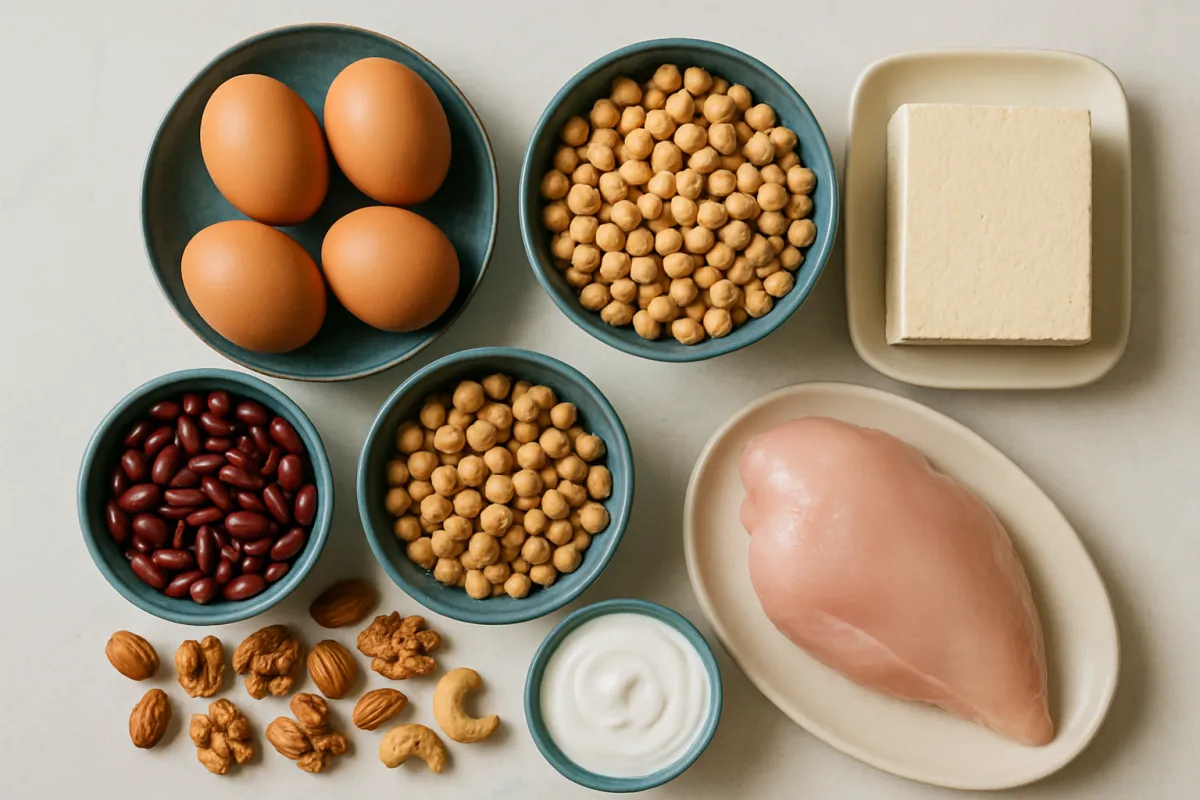
Stack those against a baseline of 50 to 70 grams and the picture becomes reassuring: an egg breakfast, a bean-and-grain lunch, yogurt as a snack, and a normal dinner protein clears the baseline without any special effort. It also becomes clear why some patterns fall short. A day of toast, pasta, and snack foods can be filling while carrying surprisingly little protein, which is how people miss even modest targets without noticing. The skill is not eating enormous portions; it is making sure each meal includes something from the protein column, which the sections on distribution and food sources return to.
Exercise: the commonly cited higher ranges
The baseline assumes a mostly sedentary life, and training changes the math. Exercise, particularly strength training, increases the body’s use of amino acids for repair and adaptation, which is why sports-nutrition guidance commonly suggests active people take in more than the baseline. The frequently referenced range runs from roughly 1.2 to 2.0 grams per kilogram per day, a wide band that maps to how hard and what kind of training someone does.
Commonly cited daily protein ranges, by situation
Grams per kilogram of body weight per day. General guidance, not personal prescriptions.
Ranges widely referenced in sports-nutrition guidance. Individual needs vary with training load, body composition, and diet, which is what a professional tailors.
Two honest notes keep the chart in perspective. The ranges are general guidance distilled from sports-nutrition literature, not a prescription for any individual, and the differences between adjacent bands matter less than consistently landing in the right neighborhood. And higher targets are about supporting training, not replacing it: protein does not build muscle on its own, it supplies the materials that training turns into adaptation. An active person eating toward the middle of the range, training consistently, and sleeping properly is doing the whole job; obsessing over the last decimal of grams per kilogram is not where results live.
Age: why older adults are often advised to aim higher
Protein needs do not retire when you do. Aging brings a gradual, well-documented loss of muscle mass and strength, and older bodies also appear to respond less efficiently to a given dose of protein than younger ones. Put together, those two facts explain why guidance for older adults commonly suggests intakes above the standard baseline, often paired with the strength-preserving activity that gives the protein something to do.

The practical challenge is that appetite often declines with age at exactly the moment needs rise, so older adults can drift below even the baseline without any change in habits, just smaller meals. That combination, rising needs and shrinking appetite, is why protein deserves deliberate attention in later decades: making the smaller meals count, leaning on easy dense sources like eggs, dairy, fish, and legumes, and spreading intake across the day rather than relying on one main meal. Preserving muscle is one of the strongest levers on independence and quality of life in later years, and adequate protein plus regular strength work is the unglamorous, well-supported combination behind it. As always, anyone managing health conditions should set their personal target with their clinician.
Spreading protein across the day
Beyond the daily total, the pattern matters, at least somewhat. A common eating pattern concentrates most of the day’s protein at dinner, with a light, carbohydrate-heavy breakfast and lunch. Commonly suggested guidance leans the other way: distributing protein reasonably across meals, so each one delivers a meaningful dose, an approach often discussed as more supportive of muscle maintenance than one large evening bolus.
The practical translation is simple and forgiving. Aim for a real protein source at each meal, on the order of 20 to 30 grams for a typical adult, rather than treating breakfast as an afterthought. Eggs, Greek yogurt, or leftover dinner at breakfast; beans, tuna, tofu, or cheese at lunch; whatever your normal protein is at dinner. The daily total still matters most, and nobody needs to weigh food or hit identical numbers at every sitting. But the spread has a second, underrated benefit: it makes the total achievable. Sixty-plus grams is hard to assemble in one meal and easy to assemble in three, which is why the people who consistently hit their target are usually the ones who stopped saving all their protein for dinner.
Animal, plant, or both: sources compared
Where the protein comes from matters less than reliably getting it, but the sources do differ in useful ways. Animal foods, meat, fish, eggs, and dairy, are complete proteins, carrying all the essential amino acids in one package, and they tend to be dense, delivering a lot of protein per serving. Plant foods, beans, lentils, tofu and soy, nuts, seeds, and whole grains, bring protein along with fiber and a different nutrient profile, though many individual plant sources are lower in one amino acid or another.
The old worry about carefully combining plant proteins at every meal has softened into something more relaxed: eating a reasonable variety of plant sources across the day covers the full amino-acid range for most people, no meal-by-meal engineering required. Soy foods and a few other plant sources are complete on their own. So vegetarians and vegans can meet any of the targets in this review with modest planning, mainly by making legumes, soy, and dairy-or-alternatives regular features rather than occasional ones. For everyone else, the sensible default is a mix: fish, eggs, dairy, and lean meats alongside beans and lentils, which covers protein while pulling the rest of the diet in a good direction. The best source is the one you will actually eat consistently.
What a day of adequate protein looks like
Abstract targets become easy when you see them as ordinary food. Here is how a routine day covers a mid-range target without a single unusual ingredient.
How an ordinary day reaches ~75 grams
Illustrative meals for a typical adult. Figures are approximate.
No shakes, no supplements, no oversized portions: three normal meals with a protein source each, plus a snack, clears most commonly cited targets.
Two eggs with yogurt at breakfast, a lentil soup or tuna sandwich at lunch, a normal palm-sized portion of chicken, fish, or tofu with dinner, and a handful of nuts somewhere in between: roughly seventy-five grams, achieved by a day nobody would describe as a diet. Scale portions modestly up or down and the same shape covers the baseline for a smaller person or the training ranges for a larger, active one. The lesson of the chart is that adequate protein is a pattern, not a project, and the pattern is simply: something from the protein column, every meal.

Protein and weight management
Protein earns a specific mention in weight management for two well-grounded reasons. First, it is the most satiating of the major nutrients for most people, so meals anchored by protein tend to hold hunger at bay longer than meals without it, which makes any calorie target easier to live with. Second, when someone loses weight, the goal is to lose fat rather than muscle, and adequate protein, especially combined with strength training, helps the body preserve muscle while the scale comes down.
This is why sensible weight-management guidance almost always includes keeping protein intake up, sometimes toward the higher commonly cited ranges, even as total calories fall. It is also why crash diets that slash everything indiscriminately leave people weaker as well as lighter: the missing protein and the missing training let muscle go along with the fat. None of this makes protein a weight-loss trick on its own, and total calories still govern the direction of the scale. But within any calorie level, arranging the diet so protein stays adequate is one of the most reliable ways to make the process more comfortable and the result better, and it costs nothing but attention to the plate.
Can you have too much?
Honesty requires the other direction too. For most healthy people, protein intakes within and somewhat above the commonly cited ranges are generally considered manageable, and the popular fear that normal-high protein harms healthy kidneys is not the settled picture headlines sometimes suggest. But more is not better without limit. Beyond the ranges that support training and health, additional protein delivers diminishing returns while displacing other things a diet needs, and extremely high intakes are simply unnecessary for almost everyone.
The genuinely important caution is medical: people with kidney disease or certain other conditions may need to limit protein, and for them, targets are a clinical decision, not a lifestyle one. The same applies to anyone managing a significant health condition: confirm your numbers with your doctor or a registered dietitian rather than adopting general guidance. For everyone else, the practical ceiling is less about danger and more about diet quality. A plate so dominated by protein that vegetables, fruits, and whole grains get crowded out has traded one imbalance for another, and the goal was always a diet that is adequate in protein, not a diet that is only protein.
Do you need powders and supplements?
The supplement aisle would like protein to feel complicated; the food-first answer is that most people never need it to be. Ordinary meals, as the day above showed, cover the commonly cited targets for the large majority of people, and food carries fiber, vitamins, and minerals that a scoop of powder does not. For health and even for building muscle, no powder is required; the requirements are the daily target, the training, and the consistency.
Where powders honestly earn a place is convenience. Someone whose appetite, schedule, or higher training target makes whole-food-only impractical can use a shake as a practical top-up, and older adults struggling with appetite sometimes find them a useful bridge. Used that way, a supplement is exactly what the word says, a supplement to a diet built on food, not its foundation. If you choose to use one, treat it as an occasional tool rather than a daily identity, and, as with everything in this article, anyone with health conditions should check with a professional before adding supplements. The unglamorous truth is that the grocery store solves the protein question for almost everyone, which is good news for both your cooking and your budget.
Signals your intake may be off
General education cannot diagnose anyone, but a few patterns are worth noticing as prompts to look closer. A diet where breakfast and lunch are mostly refined carbohydrates, with the day’s only real protein at dinner, frequently undershoots targets in total and certainly in distribution. Persistent hunger shortly after meals can reflect meals with little protein to sustain them. People eating very restrictively, whether from dieting, low appetite, or a narrow menu, can drift below even the baseline without realizing, and older adults are especially prone to this quiet drift.
The response to any of these is measured, not dramatic: run your rough numbers for a few ordinary days, using the per-food figures from earlier, and see where you actually land against your calculated target. Most people discover they are closer than feared and can close the gap with one habit, usually a real protein source at breakfast. And the standing caveat applies with full force here: fatigue, weakness, unexplained changes, or anything that feels like a symptom belongs in front of a clinician, not a nutrition article. This review can help you understand the numbers; it cannot examine you, and it does not try to.
How protein fits into your overall calories
Protein targets do not float free of the rest of the diet; they live inside your total calorie picture, and seeing the two together prevents a common confusion. Protein carries about 4 calories per gram, so a 75-gram day contributes roughly 300 calories, typically a modest share of an adult’s total intake. That means hitting a sensible protein target is not, by itself, a big calorie commitment, and it leaves ample room for the vegetables, fruits, whole grains, and healthy fats that fill out a good diet.
The interaction runs both ways. When calories drop, during weight management, the protein share deserves protection, as covered earlier, because the body needs the material to hold onto muscle while fat comes off. When calories are high to support heavy training, the protein target is easier to reach almost incidentally, since bigger meals carry more of everything.
And for people maintaining, the pattern of a protein source at each meal tends to settle the whole diet into better shape, because meals built around protein and vegetables leave less room for the ultra-processed filler that quietly dominates protein-light days. Thinking in this order, calories set the budget, protein claims its share first, the rest fills in around it, keeps both numbers honest, and it is exactly the view our BMI and daily calorie tool is designed to give you.
Tracking your intake without obsession
Knowing your target raises the practical question of how closely to track it, and the healthy answer for most people is: briefly, then loosely. Spending a few ordinary days tallying protein, using rough per-food figures or a label here and there, is genuinely revealing. Most people discover a consistent pattern, usually a light breakfast and a heavy dinner, and once seen, the fix does not require ongoing arithmetic, just a changed habit at the meals that were falling short.
Labels help when you use them for calibration rather than accounting. The protein line on a packaged food, checked occasionally, teaches you which of your regular foods carry real protein and which only look like they do. After a week or two of that, most people can eyeball a day accurately enough that formal tracking adds nothing. Long-term gram counting is rarely necessary for anyone but competitive athletes, and for some people it curdles into an unhealthy relationship with eating, which defeats the purpose of nutrition entirely. The goal of all these numbers was never the numbers; it was a reliable pattern you no longer have to think about. Measure until the pattern is visible, correct the weak meals, and then let the habit do the work.
Three example people, three different targets
Nothing makes the numbers concrete like running them for real situations, so here are three illustrative people, each with a different body size and life, worked through the same simple arithmetic. None is a recommendation for any actual reader; they only show how the baseline and the higher ranges land in practice.
First, a mostly sedentary office worker at 60 kilograms, about 132 pounds. The baseline calculation, weight times 0.8, puts her near 48 grams a day as a floor. In food that is roughly an egg-and-yogurt breakfast, a bean or tuna lunch, and a normal dinner protein, which she clears without any special effort. Her number is modest because her body is smaller and her days are calm, and for her the honest task is simply not skipping protein at breakfast.
Second, a recreational lifter at 80 kilograms, about 176 pounds, training four days a week. Commonly cited guidance for someone training with muscle goals points toward the upper band, so multiplying by something in the 1.6 to 2.0 range suggests a target somewhere near 130 to 160 grams a day. That is a real jump, and it is why he thinks in terms of a solid protein source at every meal plus a snack, an approach our protein per meal review breaks down.
Third, an older adult at 70 kilograms, about 154 pounds, retired and less active. The sedentary math would suggest about 56 grams, but because guidance for older adults commonly points above the baseline, a figure somewhat higher is often discussed, paired with regular strength work. Her real challenge is appetite rather than arithmetic, so dense, easy sources like eggs, dairy, and fish do the heavy lifting.
The three cases share one lesson: the formula is identical, and only the inputs and the situation change the answer. Run your own weight and situation through the same steps, and confirm the result with a professional if any health condition is in the picture, since these figures are general references rather than personal targets.
Finding protein on a nutrition label
Once you know your target, the nutrition label is where you check whether a food actually helps you reach it, and reading the protein line correctly avoids a common miscount. The protein figure on a packaged food is listed in grams per serving, not per package, so the first thing to confirm is the serving size at the top of the label and how many servings the container holds. A yogurt tub listing 8 grams of protein per serving with two servings inside carries 16 grams if you eat the whole thing, a distinction that quietly doubles or halves your tally.
The protein line itself is straightforward, since it is stated directly in grams rather than buried inside another number. What trips people up is the percent daily value that sometimes sits beside it, which is based on a generic reference figure rather than your personal target, so it is far less useful than the gram number for anyone counting against a calculated goal. Read the grams, and treat the percentage as background.
A label also lets you separate foods that look protein-rich from foods that genuinely are. A snack marketed as hearty may list only 3 or 4 grams, while a plain container of Greek yogurt or cottage cheese quietly lists 15 to 20. Checking a few of your regular foods once teaches you which ones carry real protein and which only feel substantial, which is the calibration that makes eyeballing possible later. Our nutrition label review walks through the whole panel in order.
The habit worth building is a quick glance at the serving size and the protein grams together, not the protein number alone. After a week or two of that, most people can estimate a day accurately without checking every package. The label numbers are manufacturer figures with the usual small tolerances, so treat them as close references rather than exact readings, which is all the precision everyday protein counting needs.
Reaching a higher target on a plant-forward plate
Plant-forward eaters sometimes worry that a higher protein target is out of reach without meat, so it helps to work through an ordinary day that lands well into the training ranges from plants and modest dairy alone. This is one illustrative pattern, not a prescription, and the portions are approximate.
Breakfast could be a bowl of Greek yogurt, roughly 15 to 18 grams, with oats and a spoon of peanut butter adding a few more. A mid-morning handful of nuts or edamame adds another 5 to 8. Lunch might be a lentil and grain bowl, where a cup of cooked lentils contributes around 15 to 18 grams and the grain and seeds nudge it higher. An afternoon snack of hummus with a whole-grain pita or a glass of soy milk adds several more. Dinner built on tofu or tempeh, commonly near 15 to 20 grams a serving, with beans and vegetables, rounds the day out. Totaled up, that ordinary plant-forward day sits comfortably above 90 grams, which covers the training ranges for many people.
Two practical points make it work. First, spreading protein across every meal matters more on a plant plate than an omnivore one, because individual plant sources are less dense, so leaning on one big source at dinner leaves the total short. Second, variety does double duty, since eating a range of legumes, soy, grains, nuts, and seeds across the day covers the full amino-acid picture without any meal-by-meal engineering. Our protein in common foods review lists the per-serving figures, and our review of eating more protein covers the habits that make a higher target routine.
The honest caveat is that reaching the very top of the ranges from plants alone takes deliberate planning and larger portions, which is where a soy or pea supplement can serve as a convenience rather than a requirement. Anyone following a restrictive pattern who is unsure about meeting their needs should confirm the plan with a registered dietitian.
Common protein mistakes
The same handful of errors accounts for most of the gap between targets and reality.
- Saving all the protein for dinner. The total suffers and the distribution is poor; breakfast is where most diets are quietly protein-light.
- Judging by fullness instead of content. Filling days of toast, pasta, and snacks can carry surprisingly little protein.
- Treating the baseline as optimal for every situation. Training and aging are the two common cases where commonly cited guidance points higher.
- Overcorrecting into protein obsession. Past the useful ranges, more protein mostly displaces the rest of a good diet.
- Building on powders instead of food. Supplements are a convenience layer, not a foundation.
- Applying general numbers to medical situations. Kidney and other conditions change the advice; those targets belong to your doctor.
Each mistake is cheap to fix once seen, and the first one, an honest look at breakfast, fixes more diets than any supplement ever has.
A protein checklist
Turn the numbers into a routine with these steps.
- Calculate your baseline: body weight in kilograms times 0.8 grams, as your floor.
- Adjust for your situation: commonly cited guidance suggests more if you train hard or are older, toward the referenced ranges.
- Put a protein source at every meal, starting with breakfast, rather than loading everything at dinner.
- Build from ordinary food, with variety across animal and plant sources, using powders only as convenience.
- Recheck against your real days: tally a few typical days with rough per-food figures and compare to your target.
- Confirm with a professional if you have any health condition, or whenever personal tailoring matters.
Estimate your baseline alongside your calorie picture with our BMI and daily calorie tool.
The bottom line
How much protein you need is one of the rare nutrition questions with usable numbers attached. Start from the commonly cited baseline of about 0.8 grams per kilogram of body weight, recognize the well-established situations, hard training and older age, where guidance points higher, and translate the target into the only form that matters: a real protein source at every meal, from ordinary food, most days. Skip the extremes on both sides, the complacency that ignores rising needs and the obsession that crowds out the rest of a good diet, and confirm your personal numbers with a professional if health conditions are in the picture. Protein is not complicated; it is consistent, and consistency is a thing your grocery list, not your supplement shelf, can deliver week after week.
This evidence review is published for education, not as medical or dietetic advice, and reading it creates no clinician-patient relationship. Every protein figure and range above is a commonly cited general reference rather than a personal recommendation, and individual needs shift with health conditions, medications, pregnancy, and age. Before changing your diet, confirm your numbers with a qualified health professional such as a doctor or registered dietitian, particularly if you live with kidney disease or any other medical condition.
Frequently asked questions
How much protein do you need per day?
The commonly cited baseline recommendation is about 0.8 grams of protein per kilogram of body weight per day, which is the level generally described as adequate for most healthy, relatively sedentary adults. Many nutrition guidelines suggest higher intakes for people who are very active, trying to build muscle, or older, often in ranges up to roughly double the baseline. Your personal target depends on your body size, activity, age, and goals, and a health professional can tailor it to your situation.
Is the baseline recommendation the same as the optimal amount?
Not necessarily. The baseline figure is generally framed as the amount adequate to meet basic needs for most healthy adults, which is a different question from what best supports training, muscle growth, appetite control, or healthy aging. That is why guidance for athletes and older adults commonly sits above the baseline. Adequate and optimal are different targets, and which one applies to you depends on your goals and circumstances.
Do I need more protein if I exercise?
Commonly cited sports-nutrition guidance suggests active people benefit from more protein than the sedentary baseline, with frequently referenced ranges of roughly 1.2 to 2.0 grams per kilogram per day depending on the type and intensity of training. Strength training and muscle-building goals tend to sit toward the higher end. These are general ranges rather than personal prescriptions, and individual needs vary with training load, body composition, and overall diet.
Do older adults need more protein?
Many experts suggest they do. Aging is associated with a gradual loss of muscle, and older adults appear to use protein less efficiently, which is why guidance for older adults often suggests intakes above the standard baseline alongside strength-preserving activity. Because appetite can also decline with age, meeting even the baseline can take deliberate attention. Anyone with health conditions should confirm targets with their clinician, since some conditions change protein advice.
Can you eat too much protein?
For most healthy people, moderately high protein intakes within commonly cited ranges are generally considered manageable, but more is not automatically better, and extremely high intakes offer diminishing benefits while crowding out other nutrients. Importantly, people with kidney disease or certain other conditions may need to limit protein, which is a decision for their doctor. If you have any medical condition, confirm your protein target with a professional rather than following general guidance.
Is plant protein as good as animal protein?
Plant proteins can absolutely meet your needs. Animal sources tend to be complete, providing all the essential amino acids in one food, while many individual plant sources are lower in one or another. Eating a variety of plant proteins across the day, such as beans, lentils, tofu, nuts, and grains, covers the full range for most people. Vegetarians and vegans generally meet protein needs with modest planning and variety rather than any special products.
Should I spread protein across the day?
Distributing protein reasonably across meals, rather than concentrating almost all of it at dinner, is a commonly suggested approach, particularly for supporting muscle. A practical pattern is to include a meaningful protein source at each meal, such as eggs or yogurt at breakfast, rather than saving it all for the evening. The total for the day matters most, but a sensible spread makes the total easier to reach and is often recommended.
What are the best high-protein foods?
Efficient high protein foods include animal sources such as chicken and turkey, fish and seafood, eggs, and dairy like Greek yogurt, cottage cheese, and milk, alongside plant sources such as beans, lentils, chickpeas, tofu, tempeh, edamame, nuts, and seeds. As commonly cited illustrative figures, 100 grams of cooked chicken breast carries around 31 grams of protein, a cup of cooked lentils around 18 grams, and two large eggs around 12 grams. Lean, protein-rich foods that stay lower in calories, such as skinless poultry, white fish, egg whites, and plain Greek yogurt, are useful when the goal is more protein without many extra calories. These are general educational figures rather than a meal plan, and anyone with a health condition should confirm their needs with a doctor or registered dietitian.
Do I need protein powders or supplements?
Most people can meet their protein target from ordinary food, and food brings other nutrients along with it. Powders are a convenience, useful when appetite, schedule, or specific goals make food alone impractical, not a requirement for health or for building muscle. If you use one, it supplements a diet built on real food rather than replacing it, and anyone with health conditions should check with a professional before adding supplements.

Hamza Hai is the editor of NourishMark. She holds an MBA and reviews the site's articles against our editorial standards, checking that every figure is labelled for what it is, that nothing is presented as verified fact without a source the reader can check, and that the writing stays useful to a non-specialist.

Dr. Shayaan Khan is the medical reviewer for NourishMark. He holds an MBBS from MGM Medical College, Navi Mumbai, and is the author of published research including a narrative review of postpartum anxiety and depression in Mental Health Science. He has taught physiology at university level. He reviews the site's health content for medical accuracy: that physiology and mechanisms are described correctly, that no claim is stated more strongly than the evidence behind it, and that anything specific to an individual reader is sent to that reader's own clinician.
Not medical advice. Dr. Khan reviews NourishMark's health content for medical accuracy. He is not a registered dietitian, he does not hold a United States practising licence, and he is not your doctor. His review does not make anything here medical advice. Always talk to a qualified health professional about your own situation, and never delay or stop care because of something you read here.