What's in this review
- Foods high in calcium, at a glance
- How to read the calcium figures in this list
- How much calcium a day the commonly cited figures set
- Why the milligram number alone misleads
- Dairy: milk, yogurt and cheese
- Fortified plant milks, and why they need shaking
- Fortified orange juice, cereals and other fortified foods
- Tofu set with calcium sulfate: the label detail that matters
- Canned fish with soft edible bones
- Low-oxalate greens: kale, bok choy, collards and broccoli
- Spinach, chard and the oxalate problem
- Beans, almonds, seeds and the smaller contributors
- The complete high-calcium foods list by group
- Which foods have the most calcium per serving
- Vitamin D: the pairing that governs absorption
- Why calcium is absorbed better in smaller doses
- Sodium, and the calcium it takes with it
- Calcium and iron compete for the same route
- Where a day’s calcium comes from
- A worked example: a day that reaches the target without supplements
- Calcium without dairy: a full-day route
- Common mistakes when trying to eat more calcium
- Why more is not better: calcium supplements and their cautions
- Who should talk to a clinician before changing calcium intake
- A quick high-calcium shopping checklist
- The bottom line
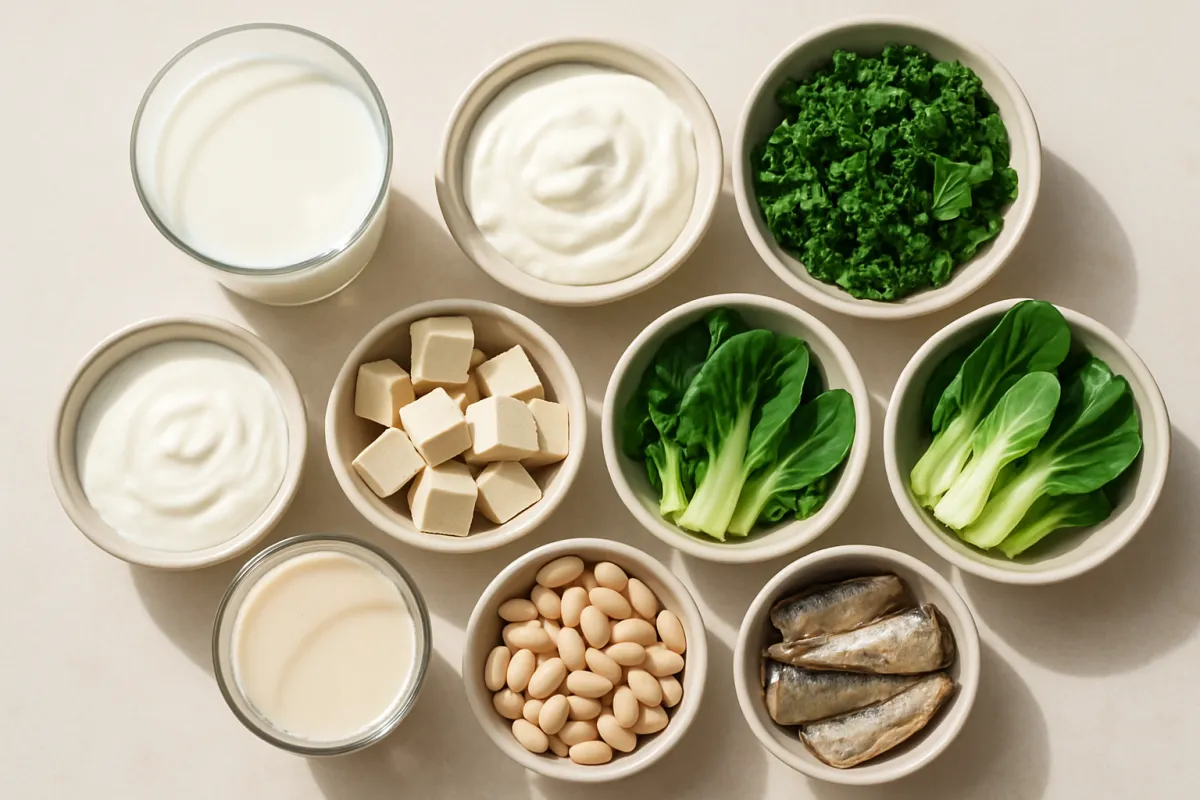
Foods high in calcium are easy enough to name. Milk, yogurt, cheese, tinned sardines, tofu, greens and a fortified carton of something are the whole cast, and the milligram figures for them are printed on packets and repeated in every list. What almost none of those lists explain is the part that decides whether the number reaches you: calcium is absorbed very differently depending on where it came from, and a large printed figure can quietly deliver very little.
This food reference lists calcium-rich foods by group, with illustrative, commonly cited milligrams per typical serving for dairy, fortified drinks and cereals, tofu, canned fish with soft bones, greens, beans, nuts and seeds. It then spends real space on absorption, because that is where the useful information sits: oxalate in spinach, the settling problem in fortified cartons, the vitamin D status that governs uptake at all, and the interactions with sodium and iron. For the wider set of reference values, our daily nutrient intake reference sits alongside this piece. Everything here is general education describing approximate figures, not medical or dietary advice, and you can tally your own day in the companion below.
Key takeaways
- Per serving, the leaders are plain yogurt (~450 mg a cup), fortified orange juice (~350 mg), part-skim mozzarella (~330 mg per 1.5 oz), sardines with bones (~325 mg per 3 oz), then milk, fortified plant milk and cheddar near 300 mg each.
- The milligram figure alone misleads: oxalate binds most of the calcium in spinach and chard, while low-oxalate greens such as kale, bok choy and collards are generally described as well absorbed.
- Fortified plant milks settle. The added calcium sinks to the bottom of the carton, so an unshaken pour can deliver far less than the label says.
- Vitamin D status governs how much calcium you take up at all, which makes it the single most important pairing on this page, and a question for a clinician rather than a food list.
- Commonly cited daily reference figures are about 1,000 mg for adults 19 to 50 and about 1,200 mg for women 51 and over and men 71 and over, with an upper level near 2,500 mg; more is not better, and supplements belong under clinical advice.
Foods high in calcium, at a glance
Before the group-by-group detail, the headline is worth seeing in one place. Unlike iron, calcium has no dramatic outlier at the top of the list. The strongest single servings cluster in a narrow band between roughly 250 and 450 mg, which is a genuinely useful fact: no food will carry a day on its own, and no food has to. Plain low-fat yogurt leads at about 450 mg a cup, fortified orange juice follows near 350 mg, part-skim mozzarella sits near 330 mg for 1.5 oz, and canned sardines eaten with their soft bones near 325 mg for 3 oz.
Below those, a wide plateau of everyday options all land near 300 mg: a cup of milk, a cup of fortified plant milk, 1.5 oz of cheddar or Swiss, a cup of kefir. Cooked collard greens sit near 270 mg a cup, calcium-set tofu near 250 mg per half cup, cooked spinach near 245 mg on paper, cooked kale and bok choy in the 160 to 180 mg range, and an ounce of almonds near 75 mg. Three or four of those in a day is the whole arithmetic. The complication is which of those milligrams the body actually takes up, and that is a different list.
How to read the calcium figures in this list
A word on the numbers keeps the whole reference honest. Every milligram figure here is a commonly cited, rounded, approximate reference for a typical serving, of the kind that food-composition tables and nutrition labels echo. Real foods vary a great deal. Cheese varies with type, moisture and age; yogurt varies with the strain, the strain-off and whether it has been thickened with milk solids; greens vary with variety and cooking; and fortified products vary most of all, because fortification is a formulation decision rather than a property of the food.
That variability is why this reference leans on words like “about”, “near” and “commonly cited”, and why a tilde precedes almost every figure. The numbers are for reasoning and comparison, not for precise counting, and none of them is a measurement of the food in front of you. Where a label exists, the printed calcium line for that specific product beats any general figure, and for fortified products it beats it by a wide margin. Use this reference to learn which foods sit in the high, middle and low tiers, then build meals from that shape rather than chasing an exact daily total.
How much calcium a day the commonly cited figures set
A food list only means something against a reference figure. The Dietary Reference Intakes set by the National Academies of Sciences, Engineering, and Medicine are the values most health bodies echo. They are commonly cited as about 1,000 mg a day for adults aged 19 to 50, rising to about 1,200 mg for women from age 51 and for men from age 71. Children and teenagers aged 9 to 18 are cited higher again, near 1,300 mg, because the skeleton is being built during those years and calcium is the raw material.
| Group | Commonly cited daily reference |
|---|---|
| Children 4 to 8 | ~1,000 mg |
| Children and teens 9 to 18 | ~1,300 mg |
| Adults 19 to 50 | ~1,000 mg |
| Women 51 to 70 | ~1,200 mg |
| Men 51 to 70 | ~1,000 mg |
| Adults 71 and over | ~1,200 mg |
Two features of that table deserve attention. The first is that the figure rises in later life rather than falling, which surprises people who assume nutrient needs shrink with age. The second is that the rise happens at different ages for women and men. There is also a tolerable upper intake level, commonly cited near 2,500 mg a day for adults under 51 and near 2,000 mg from 51 onward, counting food and supplements together. These are population reference values, not personal quotas, and the figure that suits your own body belongs with a doctor or registered dietitian.
Why the milligram number alone misleads
Here is the part that separates a useful calcium reference from a table of numbers. The printed milligrams tell you what is in the food. They tell you nothing about how much of it crosses out of the gut, and for calcium that gap is unusually large and unusually uneven. Two foods carrying identical figures can deliver very different amounts, and the direction is not intuitive: some of the largest printed numbers on any calcium list belong to foods that give up the least.
Three factors do most of the work. Oxalate, concentrated in spinach, chard, beet greens and rhubarb, binds calcium into a form the body largely cannot use, so those foods punch far below their printed weight. Phytate, in whole grains, beans and nuts, has a milder version of the same effect. And vitamin D status governs the whole system, because it regulates how much calcium is absorbed in the first place. Dose matters too: calcium is taken up more efficiently in smaller amounts, so 500 mg eaten twice generally does better than 1,000 mg eaten once.
The practical upshot runs through every section below. When you read the tables, read the source alongside the number. A cup of cooked spinach and a cup of cooked kale are not interchangeable calcium entries even when the spinach figure is larger, and a carton of fortified plant milk poured without shaking is not the food its label describes.
Dairy: milk, yogurt and cheese
Dairy earns its reputation here more cleanly than red meat earns its reputation for iron. Calcium in dairy is generally described as well absorbed, the servings are convenient, and the figures are consistent enough that you can plan around them without reading a label every time. A cup of milk sits near 300 mg regardless of fat level, since the calcium travels with the protein and mineral fraction rather than the cream.
Yogurt is the standout, with plain low-fat yogurt commonly cited near 450 mg a cup. Greek yogurt, which is strained, typically carries less calcium per ounce than the unstrained kind despite carrying more protein, so a 6 oz pot lands nearer 250 mg. Hard cheeses concentrate calcium well: 1.5 oz of part-skim mozzarella sits near 330 mg and the same amount of cheddar or Swiss near 300 to 330 mg. Cottage cheese is the exception that catches people out, at roughly 140 mg a cup, because most of its calcium leaves with the whey during production.
| Dairy food | Typical serving | Calcium per serving |
|---|---|---|
| Yogurt, plain, low-fat | 1 cup | ~450 mg |
| Ricotta, part-skim | 1/2 cup | ~340 mg |
| Mozzarella, part-skim | 1.5 oz | ~330 mg |
| Swiss cheese | 1.5 oz | ~330 mg |
| Milk, any fat level | 1 cup | ~300 mg |
| Cheddar cheese | 1.5 oz | ~300 mg |
| Kefir | 1 cup | ~300 mg |
| Greek yogurt, plain | 6 oz | ~250 mg |
| Cottage cheese | 1 cup | ~140 mg |
| Ice cream, vanilla | 1/2 cup | ~85 mg |
The pattern worth carrying away is that the harder and more concentrated the dairy, the more calcium per ounce, with cottage cheese and cream-heavy products as the exceptions. Butter and cream carry almost none, because they are the fat fraction rather than the mineral fraction.
Fortified plant milks, and why they need shaking
Fortified plant milks are formulated to sit near dairy milk on calcium, commonly around 300 mg a cup, and calcium-fortified soy milk in particular is often described as being absorbed comparably to dairy calcium. That makes the category genuinely useful rather than a consolation prize. Almond, oat, rice, cashew and pea milks are fortified to similar levels by most mainstream brands, though the exact figure varies and the range across a supermarket shelf is wide.
Two practical points matter more than the comparison. The first is that unfortified plant milk carries very little calcium. An almond milk made from almonds and water alone is nothing like the fortified version, and organic lines are more often unfortified because of how fortification interacts with organic standards in some markets. The carton has to be read, not assumed. The second is settling, and it is the one almost nobody is told.
The calcium added to a plant milk does not dissolve and stay suspended. It is a suspension of fine particles, and it sinks. A carton that has stood in the fridge for a day has most of its calcium sitting in the bottom inch, which means an unshaken pour delivers a fraction of the label figure while whoever gets the last glass receives a concentrated dose. Shaking the carton firmly before every pour is the entire fix, and it costs three seconds. Our walkthrough on how to read a nutrition label covers the percent Daily Value that plant milk labels use, which for calcium is based on 1,300 mg.
Fortified orange juice, cereals and other fortified foods
Fortification quietly supplies a large share of the calcium in many diets, and orange juice is the most heavily fortified everyday drink. A cup of calcium-fortified orange juice is commonly cited near 350 mg, which puts it above dairy milk per serving, and the calcium in it is generally described as well absorbed. The same settling caution applies: calcium-fortified juice benefits from a shake for exactly the same physical reason a plant milk does.

Breakfast cereals are the most variable category on this entire page. Fortification levels run from essentially nothing to a full day’s reference figure in a single bowl, and two boxes on the same shelf can differ tenfold. Anything else can be fortified too: some breads, some tofu, some snack bars, some flours, some bottled waters. None of this is knowable from the food itself. The percent Daily Value line, calculated against 1,300 mg, is the only reliable read, and it is why fortified products belong in a reference like this one with a permanent asterisk rather than a fixed number.
| Fortified food | Typical serving | Calcium per serving |
|---|---|---|
| Orange juice, calcium-fortified | 1 cup | ~350 mg |
| Soy milk, calcium-fortified | 1 cup | ~300 mg |
| Almond or oat milk, fortified | 1 cup | ~300 mg |
| Breakfast cereal, fortified | 1 serving | ~130 to ~1,000 mg |
| Plant milk, unfortified | 1 cup | ~15 mg |
Tofu set with calcium sulfate: the label detail that matters
Tofu is the one food on this list where two products with the same name differ by an order of magnitude on calcium, and the reason is in the ingredient list rather than the nutrition panel. Tofu is made by curdling soy milk with a coagulant. When that coagulant is calcium sulfate, the calcium becomes part of the curd, and the finished block is a substantial calcium food, commonly cited near 250 mg for half a cup and higher in firmer styles. When the coagulant is magnesium chloride, the traditional nigari used for many silken and Japanese-style tofus, the calcium content is a small fraction of that.
This is a genuine distinction rather than a technicality, and it is invisible unless you look. The ingredient list will name calcium sulfate, sometimes written as its mineral name, and the nutrition panel will show the difference plainly. Firmer tofu is pressed harder, so it packs more curd and more calcium into the same volume, which is why extra-firm blocks usually carry the largest figures. Tempeh, which is fermented rather than coagulated, carries considerably less, near 90 mg per half cup.
For readers assembling meals without dairy, tofu is the workhorse: it takes on the flavors around it, it is cheap, it keeps, and half a cup of the calcium-set kind does roughly what a glass of milk does. Our review on how to build a balanced meal covers where it fits on the plate, and the companion below will show you what adding a serving does to a day’s tally.
Canned fish with soft edible bones
Canned sardines and canned salmon are unusual on any nutrient list because the calcium is not really in the flesh. It is in the bones, which the canning process softens enough to eat without noticing. Three ounces of canned sardines with their bones is commonly cited near 325 mg, and 3 oz of canned salmon with bones near 180 mg. Both figures collapse if the bones are picked out, which is exactly what many people do without realizing they are removing the reason the food is on this page.
Sardines outperform salmon here because the bones are a larger share of a small fish. The same principle explains why canned fish beats fresh fillets by a wide margin for calcium: a fresh salmon fillet carries very little, because the skeleton went elsewhere. Anchovies, canned mackerel and any small whole tinned fish behave like sardines for the same reason.
| Canned fish | Typical serving | Calcium per serving |
|---|---|---|
| Sardines, canned with bones | 3 oz | ~325 mg |
| Salmon, canned with bones | 3 oz | ~180 mg |
| Anchovies, canned | 2 oz | ~110 mg |
| Salmon, fresh, cooked | 3 oz | ~15 mg |
| Tuna, canned light | 3 oz | ~10 mg |
The gap between the last two rows and the first is the whole story. Canned light tuna, the most-eaten canned fish in most households, is not a calcium food at all, because it is boneless flesh. If canned fish is going to contribute here, it has to be the kind with the bones still in it, and they have to be eaten.
Low-oxalate greens: kale, bok choy, collards and broccoli
Green vegetables are where the absorption story becomes practical rather than theoretical. Greens split into two groups that behave in opposite ways, and the split does not follow the color, the texture or anything else visible. Low-oxalate greens include kale, bok choy, collard greens, turnip greens, mustard greens, watercress, Chinese cabbage and broccoli. Their calcium is generally described as well absorbed, comparably to or in some cases better than the calcium in dairy, even though the printed figures are usually smaller.
Cooked collard greens lead the group near 270 mg a cup, with turnip greens near 200 mg, cooked kale near 180 mg, cooked bok choy near 160 mg and cooked broccoli near 60 mg. Those numbers look modest against a glass of milk, and the point of this section is that the comparison is closer than it appears once absorption is taken into account. A cup of cooked collards is doing real work in a day’s total.
| Low-oxalate green | Typical serving | Calcium per serving |
|---|---|---|
| Collard greens, cooked | 1 cup | ~270 mg |
| Turnip greens, cooked | 1 cup | ~200 mg |
| Kale, cooked | 1 cup | ~180 mg |
| Bok choy, cooked | 1 cup | ~160 mg |
| Mustard greens, cooked | 1 cup | ~160 mg |
| Broccoli, cooked | 1 cup | ~60 mg |
| Kale, raw | 1 cup | ~55 mg |
Two practical notes. Cooked and raw are very different servings, because a cup of raw kale is a much smaller quantity of kale than a cup of the wilted version, which is the same trap that catches people with spinach and iron. And these greens are cheap, freeze well and cook in minutes, which is what makes them a realistic habit rather than an aspiration.
Spinach, chard and the oxalate problem
Spinach is the food this reference most wants you to reconsider. Cooked spinach carries a large printed figure, commonly cited near 245 mg a cup, and it appears near the top of a great many calcium lists on the strength of it. Spinach is also unusually high in oxalate, a compound that binds calcium into an insoluble form the body largely cannot take up. The result is that most of that 245 mg does not reach you, and spinach is generally described as one of the poorest sources of absorbable calcium despite its position on the printed rankings.
Swiss chard, beet greens and rhubarb belong in the same category for the same reason. Amaranth leaves and purslane are often mentioned alongside them. This does not make any of these foods bad. Spinach carries other nutrients worth having, it is convenient frozen, and nobody should stop eating it over this. What it means is narrower and more specific: do not count spinach toward a calcium total, and do not treat a spinach-heavy day as a high-calcium day.
There is a second, smaller implication. Oxalate binds the calcium in whatever it is eaten with, not only its own, so a creamy spinach dish is a slightly less efficient delivery of the cream’s calcium than the same cream elsewhere. This is a minor effect in the scheme of a whole diet and not a reason to rearrange meals. Anyone with a history of kidney stones has a separate and more significant interest in oxalate, and that is a conversation for their clinician rather than a food list.
Beans, almonds, seeds and the smaller contributors
The tail of the list is made of foods nobody eats for their calcium, which is what makes them useful: they add milligrams to meals that were happening anyway. An ounce of almonds is commonly cited near 75 mg, two tablespoons of chia seeds near 180 mg, two tablespoons of tahini near 130 mg, a cup of canned white beans near 190 mg, half a cup of dried figs near 120 mg and a medium orange near 60 mg.
These foods carry phytate, which binds calcium in a milder version of what oxalate does, so their absorbed share is generally described as lower than the printed figures suggest. Soaking, sprouting and fermenting reduce phytate, which is one of several reasons those preparations keep being recommended. Even discounted, the contributions are real, and their virtue is repetition: a habit worth 150 mg on most days beats an occasional heroic serving of anything.
| Bean, nut, seed or fruit | Typical serving | Calcium per serving |
|---|---|---|
| White beans, canned | 1 cup | ~190 mg |
| Chia seeds | 2 tbsp | ~180 mg |
| Tahini or sesame paste | 2 tbsp | ~130 mg |
| Figs, dried | 1/2 cup | ~120 mg |
| Edamame, cooked | 1 cup | ~100 mg |
| Tempeh | 1/2 cup | ~90 mg |
| Chickpeas, cooked | 1 cup | ~80 mg |
| Almonds | 1 oz | ~75 mg |
| Orange | 1 medium | ~60 mg |
| Black beans, cooked | 1 cup | ~45 mg |
The complete high-calcium foods list by group
The master table below gathers the whole reference in one place, sorted roughly from the highest printed figures down. It mixes dairy, fortified products, fish, soy foods, greens and small contributors deliberately, because the point of a single list is to show where the milligrams sit before you decide which route suits your kitchen. The absorption column is the reminder that the number alone is not the whole story.
| Food | Typical serving | Calcium | Absorption note |
|---|---|---|---|
| Fortified breakfast cereal | 1 serving | ~130 to ~1,000 mg | Brand-dependent |
| Yogurt, plain, low-fat | 1 cup | ~450 mg | Generally well absorbed |
| Orange juice, calcium-fortified | 1 cup | ~350 mg | Generally well absorbed |
| Ricotta, part-skim | 1/2 cup | ~340 mg | Generally well absorbed |
| Mozzarella, part-skim | 1.5 oz | ~330 mg | Generally well absorbed |
| Swiss cheese | 1.5 oz | ~330 mg | Generally well absorbed |
| Sardines, canned with bones | 3 oz | ~325 mg | Bones must be eaten |
| Milk, any fat level | 1 cup | ~300 mg | Generally well absorbed |
| Cheddar cheese | 1.5 oz | ~300 mg | Generally well absorbed |
| Kefir | 1 cup | ~300 mg | Generally well absorbed |
| Soy milk, calcium-fortified | 1 cup | ~300 mg | Shake the carton |
| Almond or oat milk, fortified | 1 cup | ~300 mg | Shake the carton |
| Collard greens, cooked | 1 cup | ~270 mg | Low oxalate, well absorbed |
| Tofu, set with calcium sulfate | 1/2 cup | ~250 mg | Check the coagulant |
| Greek yogurt, plain | 6 oz | ~250 mg | Generally well absorbed |
| Spinach, cooked | 1 cup | ~245 mg | High oxalate, poorly absorbed |
| Turnip greens, cooked | 1 cup | ~200 mg | Low oxalate, well absorbed |
| White beans, canned | 1 cup | ~190 mg | Phytate reduces uptake |
| Kale, cooked | 1 cup | ~180 mg | Low oxalate, well absorbed |
| Salmon, canned with bones | 3 oz | ~180 mg | Bones must be eaten |
| Chia seeds | 2 tbsp | ~180 mg | Phytate reduces uptake |
| Bok choy, cooked | 1 cup | ~160 mg | Low oxalate, well absorbed |
| Mustard greens, cooked | 1 cup | ~160 mg | Low oxalate, well absorbed |
| Cottage cheese | 1 cup | ~140 mg | Generally well absorbed |
| Tahini or sesame paste | 2 tbsp | ~130 mg | Phytate reduces uptake |
| Figs, dried | 1/2 cup | ~120 mg | Modest contributor |
| Anchovies, canned | 2 oz | ~110 mg | Bones must be eaten |
| Edamame, cooked | 1 cup | ~100 mg | Phytate reduces uptake |
| Tempeh | 1/2 cup | ~90 mg | Fermented, phytate reduced |
| Ice cream, vanilla | 1/2 cup | ~85 mg | Comes with sugar and fat |
| Chickpeas, cooked | 1 cup | ~80 mg | Phytate reduces uptake |
| Almonds | 1 oz | ~75 mg | Modest contributor |
| Broccoli, cooked | 1 cup | ~60 mg | Low oxalate, well absorbed |
| Orange | 1 medium | ~60 mg | Modest contributor |
| Kale, raw | 1 cup | ~55 mg | Volume makes a cup small |
| Black beans, cooked | 1 cup | ~45 mg | Phytate reduces uptake |
| Salmon, fresh, cooked | 3 oz | ~15 mg | No bones, no calcium |
| Plant milk, unfortified | 1 cup | ~15 mg | Read the carton |
| Tuna, canned light | 3 oz | ~10 mg | No bones, no calcium |
Read down the absorption column and the shape of the problem appears. The high end of the printed figures is a mix of well-absorbed dairy and fortified products, one high-oxalate outlier that mostly does not count, and a group of greens whose smaller numbers punch above their weight. Anyone building a calcium-conscious plate is answering two questions at once: which foods carry the milligrams, and which of those milligrams are available.
Which foods have the most calcium per serving
The chart below lines up twelve strong single servings so the scale is visible. Plain low-fat yogurt sets the top of the range and every other bar is drawn as its share of that figure, which is why this chart looks so different from an iron chart: there is no runaway leader, just a broad band of options in the same neighborhood.
Calcium per typical serving, twelve high-calcium foods
Commonly cited calcium per typical serving, in milligrams. Approximate reference figures that vary by brand, variety, fortification and preparation, not exact measurements.
Bars scale to the plain yogurt figure at 100 percent. Bar length is printed milligrams, not absorbed calcium: the spinach bar in particular is largely bound by oxalate, while the shorter kale and collard bars are generally described as well absorbed. Commonly cited approximations; confirm any specific product against its own label.
The chart makes one argument well and one badly, and both are worth naming. It shows correctly that the top of the calcium list is a plateau rather than a peak, so no single food is essential and several routes reach the same place. What it cannot show is that the tenth bar, cooked spinach, delivers far less than its length implies, while the eleventh, cooked kale, delivers close to its length. Bar length is milligrams, not delivery, and calcium is the mineral where that distinction bites hardest.
Vitamin D: the pairing that governs absorption
If only one thing on this page changes how you eat, it should probably not be a food at all. Vitamin D governs how much of the calcium you eat is absorbed from the gut in the first place, which makes it the single most important partner for everything in the tables above. Bone health guidance almost never discusses calcium without discussing vitamin D alongside it, because a large calcium intake with inadequate vitamin D status delivers less than the milligram figures suggest.
Vitamin D is unusual as nutrients go, because most people’s supply comes from sunlight on skin rather than from food. Oily fish, egg yolks, some mushrooms and fortified products are the short food list, and fortified milk and plant milks quietly carry vitamin D as well as calcium in many markets. How much sunlight translates into vitamin D depends on latitude, season, time of day, skin tone, age, clothing, sunscreen and how much time you actually spend outside, which is why it is a genuinely individual question rather than one a food table can answer.
This reference deliberately stops there. It will not put a number on vitamin D intake, will not suggest a supplement dose, and will not describe how inadequate status feels, because vitamin D status is established by a blood test and interpreted by a clinician. If you are working on calcium seriously, whether for bone health or any other reason, vitamin D is the thing to raise at your next appointment. Tally your calcium in the companion below, and take the vitamin D half to someone who can test it.
Why calcium is absorbed better in smaller doses
Dose is a quieter factor than oxalate or vitamin D, and it changes how a day should be shaped. Calcium absorption is more efficient at smaller amounts and becomes less efficient as the single dose grows, which is why guidance around calcium supplements so often mentions splitting them and why a day spread across several eating occasions generally does better than the same milligrams in one sitting. A figure near 500 mg per occasion is commonly cited as the practical ceiling for efficient uptake.
For food, this is easier than it sounds, because ordinary eating already spreads calcium out. A glass of fortified milk at breakfast, a yogurt at lunch, some greens or tofu at dinner is three occasions and three moderate doses without any planning. The pattern to avoid is the one where a whole day’s calcium arrives in a single dairy-heavy meal and the rest of the day carries almost none.
It also means the arithmetic in the tables above is a ceiling rather than a promise. A day totalling 1,200 mg spread across four occasions is a different proposition from 1,200 mg in one. This is a general description of how the nutrient behaves rather than a rule anyone needs to follow precisely, and it matters most for people taking supplements, where a single large dose is easy to swallow and easy to overdo.
Sodium, and the calcium it takes with it
Calcium interacts with sodium in a way that rarely makes it onto food lists. Sodium and calcium share handling in the kidney, and high sodium intakes are commonly described as increasing the amount of calcium lost in urine. The practical version is that a very salty diet raises the calcium you need to replace, so two people eating identical calcium can end up in different places depending on what else is on their plates.

This is not a reason to fear salt or to add a sodium calculation to a calcium tally. It is a reason to notice that the two questions are connected, and that the same dietary pattern that lowers sodium, more home cooking, fewer packaged and restaurant meals, more vegetables, tends to raise calcium and potassium at the same time. Our review on how much sodium per day covers the sodium side properly, and our potassium reference covers the mineral that moves in the same direction. Caffeine is sometimes mentioned in the same breath, though the effect is generally described as small at ordinary intakes.
Calcium and iron compete for the same route
The other interaction worth knowing runs between calcium and iron, and it is the one that ties this reference to its sibling. Calcium is the single dietary factor commonly described as reducing the absorption of both forms of iron, heme and non-heme alike, when the two are eaten in the same meal. Almost every other iron inhibitor affects only the non-heme form; calcium is the exception that affects both.
The size of the effect at ordinary food intakes is debated, and the honest position is that a mixed diet containing both nutrients does not usually create a problem. Where it matters more is at the extremes: a large calcium supplement swallowed with an iron-heavy meal, or an iron supplement taken with a glass of milk. The standard practical response is scheduling rather than avoidance, keeping the calcium-heaviest part of the day away from the meal built around beans, lentils or fortified cereal.
Our foods high in iron reference covers the same interaction from the other side, along with the vitamin C pairing that pushes non-heme iron in the opposite direction. Read together, the two lists describe a single problem: minerals compete, the milligram column is not the whole answer, and timing is the lever most people never think to use. Anyone actively managing an iron or calcium issue should follow their clinician’s instructions rather than any general timing rule.
Where a day’s calcium comes from
It helps to see how a mixed day distributes its calcium across the groups. The breakdown below follows the worked example in the next section exactly, so the shares are the arithmetic of one specific illustrative day totalling about 1,350 mg rather than a generic guess. That particular day happens to contain no dairy at all, which is what makes it worth charting.
Where one illustrative dairy-free day's calcium comes from
Share of the worked example day's ~1,350 mg by food group. Shares sum to 100 percent and describe one illustrative day, not a rule.
Segments show each group's share of the worked example day's printed milligrams, not of the calcium actually absorbed, which depends on source, oxalate, phytate and vitamin D status. One illustrative day, not a prescription.
Two readings of that chart are useful. The obvious one is that no single food carries the day: five ordinary contributions, none of them large, assemble the total between them. The less obvious one is that this particular day would look completely different with dairy in it, because a single cup of yogurt at 450 mg would claim a third of the bar on its own. Both routes reach the same place, and neither is the correct one.
A worked example: a day that reaches the target without supplements
Here is one illustrative day assembled from the tables above, chosen to be ordinary rather than optimized, and built without dairy to show the harder version working. Breakfast is oats made with a cup of shaken fortified soy milk at about 300 mg, with two tablespoons of chia seeds stirred in at about 180 mg. That is 480 mg before nine in the morning, which is the single most efficient move available on this whole page.
Lunch is sardines on toast, a 3 oz tin eaten bones and all at about 325 mg, with a salad alongside. The afternoon brings an ounce of almonds at about 75 mg and a medium orange at about 60 mg, which is 135 mg from a snack nobody planned. Dinner is a stir fry with half a cup of calcium-set tofu at about 250 mg and a cup of cooked bok choy at about 160 mg, or 410 mg.
The day totals roughly 1,350 mg: 480 at breakfast, 325 at lunch, 135 at the snack and 410 at dinner. That clears the 1,000 mg reference figure for adults aged 19 to 50, clears the 1,200 mg figure for women 51 and over and men 71 and over, and sits well under the commonly cited 2,500 mg upper level. It also spreads across four occasions, none carrying more than 500 mg, which suits how the nutrient is absorbed. No supplements, no spinach and no unusual shopping. Build your own version in the companion below.
Calcium without dairy: a full-day route
The worked example above is one dairy-free day, and it is worth naming the general pattern behind it, because this is the question this reference gets asked most. Calcium without dairy rests on four pillars, and a day that includes three of them will usually land near the reference figures without any arithmetic at all.
The first pillar is a fortified drink: a shaken cup of fortified soy, almond or oat milk, or a glass of calcium-fortified orange juice, at roughly 300 to 350 mg. The second is calcium-set tofu, at roughly 250 mg per half cup, which slots into stir fries, curries, scrambles and sandwiches. The third is canned fish with soft bones, at roughly 325 mg for sardines and 180 mg for canned salmon. The fourth is low-oxalate greens, at roughly 160 to 270 mg a cup cooked, which cost almost nothing and cook in minutes.
Beyond those four, the small contributors fill gaps: chia seeds, tahini, white beans, dried figs, almonds, edamame and oranges. What does not work is assuming that a plant-forward diet supplies calcium automatically. Unfortified plant milks carry almost nothing, spinach does not count, and grains and most vegetables are minor sources. The dairy-free route is entirely workable and it is not automatic, which is the honest version of the answer.
Common mistakes when trying to eat more calcium
The first mistake is counting spinach. It has the printed number and it does not have the delivery, and a day built around it can look adequate on a tracking app while behaving quite differently. The second is pouring fortified plant milk from an unshaken carton, which turns a 300 mg glass into something considerably smaller and hands the missing calcium to whoever finishes the box.
The third is buying tofu without checking the coagulant, since two blocks that look identical can differ enormously on calcium depending on whether calcium sulfate or nigari was used. The fourth is picking the bones out of canned sardines and salmon, which removes the entire reason those foods appear here. The fifth is assuming a cereal is fortified, when the range across brands runs from negligible to a full day’s figure.
The sixth, and the one that matters most, is treating calcium as a problem to be solved with a tablet. Calcium is a nutrient where the food-first posture is not merely a preference, because the concerns attached to high supplemental intakes do not apply in the same way to calcium eaten as food. That deserves its own section, and it gets one below.
Why more is not better: calcium supplements and their cautions
Calcium is one of the clearest examples of a nutrient where more is not better, and the reference figures are targets rather than floors to be exceeded. The tolerable upper intake level, commonly cited near 2,500 mg a day for adults under 51 and near 2,000 mg from 51 onward, counts food and supplements together, and it exists because excess calcium carries its own set of concerns rather than simply being wasted.
High supplemental calcium intake has been the subject of sustained discussion in the research literature, including questions about kidney stone risk and about cardiovascular effects, and the picture is not fully settled. What is consistent across most guidance is the posture: obtain calcium from food where possible, and treat supplements as something taken for a reason a clinician has identified rather than as general insurance. Absorption is also better from smaller amounts, so a large single dose is not a shortcut to the same result.

There is one further point that belongs in plain language. Reaching the commonly cited reference figures from food alone is achievable for most people, as the worked example shows, and doing it from food avoids the upper-level question almost entirely. Food rarely pushes anyone near 2,500 mg. Supplements can do it easily, especially when they are stacked on top of a fortified diet that was already delivering more than the taker realized.
Who should talk to a clinician before changing calcium intake
Some people have specific reasons to get advice before changing their calcium intake in either direction, and it is worth naming them plainly while being equally plain that this is a description of general caution rather than an assessment of anyone reading. Anyone with a history of kidney stones has a direct interest here, because calcium, oxalate and stone formation are connected in ways that are not intuitive and that vary by stone type. Anyone with kidney disease of any kind is in a similar position, since the kidney is central to how calcium and phosphate are handled.
Medication is the other category. Calcium is well known to interfere with the absorption of thyroid hormone replacement, which is why the standard instruction is to separate the two by several hours, and it interacts with several antibiotics, some osteoporosis treatments and certain other drugs. Anyone taking a regular prescription who is adding a calcium supplement, or substantially increasing calcium-rich food, should ask a pharmacist or doctor about timing rather than assume it is neutral.
Pregnancy, breastfeeding, malabsorption conditions, a history of parathyroid problems and treatment for osteoporosis all belong on the same list. This reference deliberately does not describe what inadequate calcium intake feels like, because reading symptoms off a page is a poor way to reach a conclusion about your own body and a reliable way to reach the wrong one. Bone health is assessed with testing and clinical judgment, not with a food list.
A quick high-calcium shopping checklist
A compact list is easier to act on than a long one. For the fortified route, one carton of fortified soy, almond or oat milk with the calcium line checked, and calcium-fortified orange juice if you drink juice. For the soy route, a block of tofu with calcium sulfate in the ingredient list, ideally firm or extra firm. For the fish route, tins of sardines and canned salmon with the bones left in.
For the green route, whichever of kale, collards, bok choy, turnip greens or broccoli your shop carries, fresh or frozen, since frozen works perfectly well for cooked greens. For dairy, if you eat it, plain yogurt does more per serving than anything else on the shelf, and hard cheese does more per ounce. For the small contributors, chia seeds, tahini, tinned white beans, dried figs and almonds.
That is the entire shop, and it overlaps heavily with a fiber-forward and iron-conscious basket, so our grocery list method and the high-fiber foods list can be run alongside this one without a second trip. The one item this checklist cannot include is vitamin D status, which is not sold in a supermarket and belongs in a conversation with a clinician.
The bottom line
Foods high in calcium form a plateau rather than a peak. Plain yogurt, fortified juice, hard cheese, canned fish with bones, milk, fortified plant milks, calcium-set tofu and low-oxalate greens all sit between roughly 160 and 450 mg a serving, and three or four of them in a day reaches the commonly cited reference figures of about 1,000 mg for adults 19 to 50 and about 1,200 mg from 51 for women and 71 for men. Neither dairy nor a supplement is required to get there.
If only three habits survive from this reference, make them these: shake the carton, check that the tofu says calcium sulfate, and stop counting spinach. Then take the part a food list cannot settle, vitamin D status, to a clinician, along with any question about supplements. Calcium is a nutrient where enthusiasm has a ceiling, where the upper level counts food and tablets together, and where anyone with kidney stones, kidney disease or a regular prescription should get advice before changing anything.
This food reference is published for general education and describes approximate, commonly cited nutrition figures. It is not medical, nutritional or dietary advice, and reading it creates no clinician-patient relationship. Every milligram figure above is a rounded population reference rather than a measurement of any particular food, and calcium content varies substantially with brand, fortification level, variety, moisture and preparation, so a specific product’s own label is always the better source for that product. Absorption statements here describe general, well-documented directions rather than measured percentages for any person or meal. Nothing on this page is intended to help anyone identify, rule out or treat low calcium intake, low bone density or any other condition; that work belongs to testing and a qualified clinician. Calcium supplements are not a casual purchase, and anyone with a history of kidney stones, with kidney disease, or taking thyroid hormone replacement or other regular medication should get individual advice before changing calcium intake in either direction. Before adjusting your diet, starting any supplement, or acting on anything in this reference, speak with a doctor, pharmacist or registered dietitian who knows your history.
Frequently asked questions
What foods are highest in calcium?
Per typical serving, the leaders are plain low-fat yogurt at roughly 450 mg a cup, fortified orange juice near 350 mg a cup, part-skim mozzarella near 330 mg for 1.5 oz, and canned sardines eaten with their soft bones near 325 mg for 3 oz. A cup of milk, a cup of fortified plant milk and 1.5 oz of cheddar all sit near 300 mg, cooked collard greens near 270 mg a cup, and calcium-set tofu near 250 mg per half cup. Heavily fortified breakfast cereals can run higher still, but the range across brands is enormous. These are commonly cited approximate figures that shift with product, brand, fortification level and preparation, offered as general education rather than a personal plan, so check the label of the specific product and take individual questions to a clinician.
How much calcium do adults need per day?
The Dietary Reference Intakes set by the National Academies of Sciences, Engineering, and Medicine are the figures most health bodies echo, commonly cited as about 1,000 mg a day for adults aged 19 to 50, rising to about 1,200 mg for women from 51 and for men from 71. Teenagers aged 9 to 18 are cited higher still at about 1,300 mg while the skeleton is being built. A tolerable upper intake level near 2,500 mg a day is commonly cited for adults under 51 and near 2,000 mg above that age, counting food and supplements together. These are population reference values rather than a personal quota, and your own figure belongs with a doctor or registered dietitian who knows your history.
Can you get enough calcium without dairy?
Yes, and the route is well travelled, though it takes more deliberate assembly than pouring milk on cereal. Fortified plant milks and fortified orange juice each carry roughly 300 to 350 mg a cup, tofu set with calcium sulfate lands near 250 mg per half cup, canned sardines with their soft bones near 325 mg for 3 oz, cooked collard greens near 270 mg a cup, and cooked kale or bok choy in the 160 to 180 mg range. An illustrative day built only from those foods reaches roughly 1,350 mg without any dairy at all. The catch is that fortified products vary widely by brand and that plain unfortified plant milk carries very little, so the label matters more here than anywhere else on the list.
Why does spinach not count as a good calcium source?
Cooked spinach carries a genuinely large printed figure, commonly cited near 245 mg a cup, which is why it appears near the top of many calcium lists. The complication is oxalate: spinach is unusually high in it, and oxalate binds calcium into a form the body largely cannot take up, so most of that printed number does not reach you. Low-oxalate greens such as kale, bok choy, collards, turnip greens and broccoli behave very differently, and their calcium is generally described as well absorbed even though the printed figures are often smaller. Spinach remains a worthwhile food for other reasons; it simply should not be counted on as a calcium source. This is a general description of a well-known interaction, not dietary advice for any individual.
Does vitamin D affect calcium absorption?
Vitamin D is the single most important partner for dietary calcium, because it governs how much of the calcium you eat is taken up from the gut at all. Without adequate vitamin D status, a large calcium intake on paper delivers less than the milligram figure suggests, which is why calcium and vitamin D are almost always discussed together in bone health guidance. Vitamin D comes from sunlight exposure, a short list of foods including oily fish, egg yolks and fortified products, and supplements where those fall short. Because vitamin D status depends on latitude, season, skin tone, age, body composition and time spent outdoors, it is a genuinely individual question rather than one a food list can settle, and it is worth raising with a clinician who can arrange testing if it is appropriate.
Is fortified plant milk as good as dairy milk for calcium?
Fortified plant milks are typically formulated to land near the calcium content of dairy milk, commonly around 300 mg a cup, and calcium-fortified soy milk in particular is often described as being absorbed comparably to the calcium in dairy. Two practical caveats matter more than the comparison itself. First, the added calcium does not stay suspended; it settles to the bottom of the carton, so a poured glass from an unshaken container can deliver a fraction of the label figure while the last glass delivers far more. Shake it properly every time. Second, unfortified plant milks carry very little calcium, and organic lines are more often unfortified, so the carton has to be read rather than assumed.
Should I take a calcium supplement?
Calcium is one of the clearest nutrients where more is not better, and the general posture in most guidance is food first, with supplements reserved for people whose clinician has identified a reason. High supplemental intakes have been the subject of ongoing concern in the research literature, including questions about kidney stones and cardiovascular effects, and the tolerable upper intake level counts food and supplements together. Absorption is also better from smaller amounts, so a large single dose is not simply a shortcut. If you are considering a supplement, or already take one, that is a conversation to have with a doctor or pharmacist rather than a decision to make from an article, particularly if you have a history of kidney stones or kidney disease.
Do calcium and iron interfere with each other?
Calcium is the one dietary factor commonly described as reducing the absorption of both forms of iron, heme and non-heme alike, when the two are eaten in the same meal. That does not make dairy or fortified foods a problem, and it is not a reason to avoid either nutrient. The usual practical response is scheduling: keep a calcium supplement, or the most calcium-heavy part of the day, away from the meal built around beans, lentils or fortified cereal if iron is a particular concern for you. Our companion list of foods high in iron covers the same interaction from the other direction. Anyone actively managing an iron or calcium issue should follow their clinician's instructions rather than a general timing rule.

Hamza Hai is the editor of NourishMark. She holds an MBA and reviews the site's articles against our editorial standards, checking that every figure is labelled for what it is, that nothing is presented as verified fact without a source the reader can check, and that the writing stays useful to a non-specialist.