What's in this review
- Bread Calories: The Direct Answer
- Calories in Bread by Type: A Quick Table
- How Many Calories in a Slice of White Bread?
- How Many Calories in a Slice of Whole Wheat Bread?
- Calories in 100g of Bread
- Why Slice Size Is the Whole Game
- Sourdough Calories
- Bagels, Rolls, and English Muffins
- Pita, Tortillas, and Flatbreads
- Where the Calories in Bread Come From
- Does Toasting Change Bread Calories?
- White vs Whole Wheat: What Actually Differs
- What Spreads Add
- Sandwich Math: A Worked Example
- Bread vs Rice, Potatoes, and Oatmeal
- Bread and Weight Management
- Bread and Blood Sugar
- How Bread Fits Your Daily Calories
- How to Read a Bread Label
- Common Mistakes Counting Bread Calories
- The Bottom Line
Short answer: Using USDA figures, most bread sits near 250 to 270 calories per 100 grams, so a standard 28 to 30 gram sandwich slice lands near 75 to 80 calories, white or whole wheat alike. The piece, not the type, moves the number: thin slices run near 60, thick bakery slices 130 to 160, and a plain bagel near 290. Toasting changes nothing, while butter adds near 100 calories per tablespoon.
The calories in bread hide behind a unit problem: everyone counts slices, and slices are not a unit. Using figures from the United States Department of Agriculture, bread itself is remarkably consistent, commonly cited near 250 to 270 calories per 100 grams across white, whole wheat, rye, and sourdough alike. What varies is the piece: a thin commercial sandwich slice weighs about 28 grams and carries near 75 calories, a thick bakery sourdough slice can weigh double that and carry near 150, and a plain bagel, at roughly 100 grams of dense dough, arrives near 290, four slices of bread wearing a single name. Learn the per-gram rate and the weight of your usual piece, and bread becomes one of the most predictable foods in the kitchen.
This evidence review is a plain-language reference for bread calories, organized so you can find the loaf and the piece in front of you: white and whole wheat slices, sourdough, bagels, rolls, English muffins, pita, tortillas, and the spreads that decide most toast. It is narrower than our reference on calories in common foods, which covers the whole pantry, and it pairs with our review of how many carbs per day, since bread is a carbohydrate serving first. It works through the USDA-based figures by type and piece, the slice-size trap, the white-versus-wheat truth, toasting, sandwich arithmetic, and how bread sits beside rice, potatoes, and oatmeal. It is educational, describes food composition only, and is not diet or medical advice. You can tally your own slices in the companion below.
Key takeaways
- USDA figures put most bread near 250 to 270 calories per 100 grams, so a standard 28 to 30 gram sandwich slice lands near 75 to 80 calories, white or whole wheat alike.
- The piece, not the type, moves the number: thin slices run near 60 calories, thick bakery slices 130 to 160, and a plain bagel near 290, roughly four sandwich slices in one.
- Whole wheat matches white on calories and wins on the package: about 2 grams of fiber per slice against under 1, plus more minerals and slower digestion.
- Toasting changes no calories, and spreads usually add more than the bread: butter near 100 per tablespoon, peanut butter near 95, cream cheese near 50 per schmear spoon.
- Every figure here is a commonly cited, USDA-based reference, not an exact measurement or a personal target; for anything tied to your health, consult a doctor or registered dietitian.
Bread Calories: The Direct Answer
The direct answer is that a standard slice of commercial sandwich bread carries roughly 75 to 80 calories, built from a USDA-based rate near 265 calories per 100 grams and a typical slice weight of 28 to 30 grams. Whole wheat lands in the same band, commonly a touch higher per slice at 80 to 85 because whole wheat slices often weigh slightly more, not because the bread is richer per gram.
The per-gram rate is the stable fact worth memorizing, because it barely moves across the bread aisle: white, wheat, rye, multigrain, and sourdough all sit near 250 to 270 calories per 100 grams. Bread is a dry-ish starch, holding far less water than cooked rice or potatoes, which is why its rate per gram runs two to three times theirs even though a slice feels light. Everything else in this review is the piece problem, since bread is eaten in units, slices, bagels, rolls, pitas, whose weights range from 25 to 120 grams, and in company, since spreads and fillings routinely outweigh the bread they ride on. Two slices for a sandwich is near 150 calories before anything goes between them, which is the single most useful bread figure in daily life. Set your own bread in the companion below and the arithmetic will update as you read. As throughout, these are commonly cited, illustrative references rather than an exact reading of your loaf.
Calories in Bread by Type: A Quick Table
Because bread’s variety lives mostly in the piece rather than the recipe, the table below states both the typical piece and the per-100-gram rate, drawing on USDA-based food composition data and commonly cited bakery figures.
| Bread | Typical piece | Calories, roughly | Per 100 g, roughly |
|---|---|---|---|
| White, sandwich | 1 slice (~28 g) | ~75 kcal | ~265 kcal |
| Whole wheat, sandwich | 1 slice (~30 g) | ~80 kcal | ~255 kcal |
| Thin-sliced sandwich | 1 slice (~22 g) | ~60 kcal | ~265 kcal |
| Sourdough, bakery | 1 slice (~55 g) | ~150 kcal | ~270 kcal |
| Rye | 1 slice (~32 g) | ~83 kcal | ~260 kcal |
| Baguette | 2 inch piece (~30 g) | ~80 kcal | ~270 kcal |
| Bagel, plain | 1 medium (~103 g) | ~290 kcal | ~280 kcal |
| English muffin | 1 whole (~57 g) | ~130 kcal | ~230 kcal |
| Pita, white | 1 large (~60 g) | ~165 kcal | ~275 kcal |
| Flour tortilla | 1 large (~70 g) | ~210 kcal | ~300 kcal |
| Dinner roll | 1 roll (~28 g) | ~85 kcal | ~300 kcal |
| Croissant | 1 medium (~57 g) | ~230 kcal | ~405 kcal |
Read down the per-100-gram column and the aisle’s secret shows: nearly everything made of flour, water, yeast, and a little fat sits between 230 and 300, with the croissant standing apart because butter is laminated into the dough itself. Read down the piece column and the real spread appears, from 60 calorie thin slices to 290 calorie bagels, driven almost entirely by weight. Use whichever row matches your bread, prefer your package’s stated figure when you have one, and treat every number as a commonly cited reference rather than an exact measurement, since loaves and bakeries vary.
How Many Calories in a Slice of White Bread?
A standard slice of commercial white sandwich bread weighs about 28 grams and is commonly cited near 75 calories, at the USDA-based rate of roughly 265 per 100 grams. Alongside ride about 14 grams of carbohydrate, 2.5 grams of protein, 1 gram of fat, and well under 1 gram of fiber, with 1.5 to 2 grams of sugar, much of it added, in many commercial loaves.
The practical range around that figure is set by the loaf. Thin-sliced and “small slice” loaves run near 55 to 65 calories per slice; standard loaves 70 to 80; thick-cut and Texas toast styles 100 to 130, because the slices simply weigh 40 to 50 grams. Premium white breads enriched with milk, butter, or extra sugar, brioche-style sandwich loaves most visibly, run higher per gram, commonly 280 to 320 per 100 grams. The label solves all of this in one line, since packaged bread states calories per slice, and the only trap is the loaf that defines a serving as two slices while the eye reads one. White bread’s calories are not its nutritional criticism; its emptiness relative to whole grain, covered in the comparison section below, is. On calories alone it is a modest food. These are commonly cited, illustrative figures, and your package’s panel is the authority for your loaf.
How Many Calories in a Slice of Whole Wheat Bread?
A typical slice of 100 percent whole wheat sandwich bread weighs about 30 grams and is commonly cited near 80 calories, at a USDA-based rate around 255 per 100 grams, effectively tied with white bread once slice weights are equal. The slice carries roughly 14 grams of carbohydrate, 4 grams of protein, 1 gram of fat, and the line that actually distinguishes it: about 2 grams of fiber, several times the white slice’s fraction.
The tie on calories is worth stating bluntly because so much bread marketing implies otherwise: choosing wheat over white saves essentially nothing on the calorie line. What it buys instead is the whole grain package, the bran and germ that refining strips away, bringing fiber, magnesium, zinc, and B vitamins, and a slower, steadier digestion that many people experience as better fullness per slice, the same trade our high-fiber foods list documents across the pantry. Label language matters here: “wheat bread” and “multigrain” describe color and cosmetics as often as substance, while “100 percent whole wheat” or “whole grain” as the first ingredient describes the real thing, a distinction the label section below expands. Dense whole grain and seeded breads run heavier per slice, commonly 90 to 120 calories, because seeds add fat along with their nutrition. These are commonly cited, illustrative figures that vary by brand and slice weight.
Calories in 100g of Bread
Stated per 100 grams, bread’s consistency becomes visible. USDA-based figures put white bread near 265 calories per 100 grams, whole wheat near 255, rye near 260, sourdough near 270, and baguette near 270, a band so narrow that one number, roughly 260, serves the whole basic-bread aisle. Enriched doughs step above it, rolls and tortillas near 300, croissants near 400, because fat is folded into the dough itself.
The 100 gram basis also explains bread’s place among the starches. Bread is baked relatively dry, holding perhaps a third of its weight as water, while cooked rice and potatoes carry two thirds to three quarters water; the same starch calories are therefore concentrated into fewer grams of bread. That is why bread reads two to three times higher per gram than the boiled starches in our calories in rice review and our calories in a potato reference, and why a light-feeling slice is not as light as it feels. For counting, the per-100-gram rate turns any weighable piece of bread into an answer: weigh the roll or the bakery slice once, multiply by 2.6, and you are within a few percent for nearly any plain bread. It is the single most transferable figure in this review. These are commonly cited, illustrative references that vary modestly by recipe.
Why Slice Size Is the Whole Game
Every practical confusion about bread calories reduces to slice weight, so it deserves its own section. Commercial sandwich slices range from about 22 grams in thin-sliced loaves to 50 grams in Texas toast; bakery slices, cut by hand from large boules and batards, commonly run 50 to 60 grams; and the same knife can cut the same loaf into 60 or 150 calorie pieces. The bread type barely matters beside this.
Calories by piece: the same bread math at different weights
Typical pieces at commonly cited weights, all near the same rate per gram. Illustrative, USDA-based reference values.
Bars scale to the bagel at 100 percent. The pieces differ by weight far more than by recipe: a bagel is roughly four sandwich slices of bread. Illustrative references, not a target.
The chart is the review’s thesis drawn in bars: from slice to bagel, the recipe barely changes while the weight quadruples. The practical habit that follows is to think in grams once, then in pieces forever after. Weigh your usual bread a single time, or read the gram weight printed beside the serving size on the package, and every future count is a multiplication. When a piece is unweighable, a restaurant roll, a bakery slice, the honest move is to estimate its size against a known piece rather than defaulting to “a slice, 75 calories”, which is how thick toast gets counted at half its real figure. These are commonly cited, illustrative figures.
Sourdough Calories
Sourdough’s reputation as a healthier bread invites the assumption that it is lighter, and the composition data says otherwise: sourdough is commonly cited near 270 calories per 100 grams, at the top of the basic-bread band, because it is simply flour, water, and salt fermented slowly. What makes sourdough read heavy in practice is the piece, since bakery loaves are cut thick and a typical slice weighs 50 to 60 grams, landing near 130 to 160 calories, double a commercial sandwich slice.
The fermentation does earn sourdough real distinctions; they are just not calorie distinctions. Long fermentation partially breaks down the flour’s starches and proteins, and sourdough is commonly associated in nutrition research with a somewhat gentler blood sugar response than standard white bread and with easier digestion for some people sensitive to conventional loaves. The acid also improves mineral absorption modestly by neutralizing phytates. All of that makes sourdough a defensible choice among white breads while leaving the arithmetic unchanged: two thick sourdough slices under a sandwich run near 300 calories before filling, twice the count of the same sandwich on thin commercial bread. Whole grain sourdoughs bring the fiber advantages of wheat with the same fermentation, at essentially the same energy. These are commonly cited, illustrative figures, and bakery slices vary enough that weighing one is worth the ten seconds.
Bagels, Rolls, and English Muffins
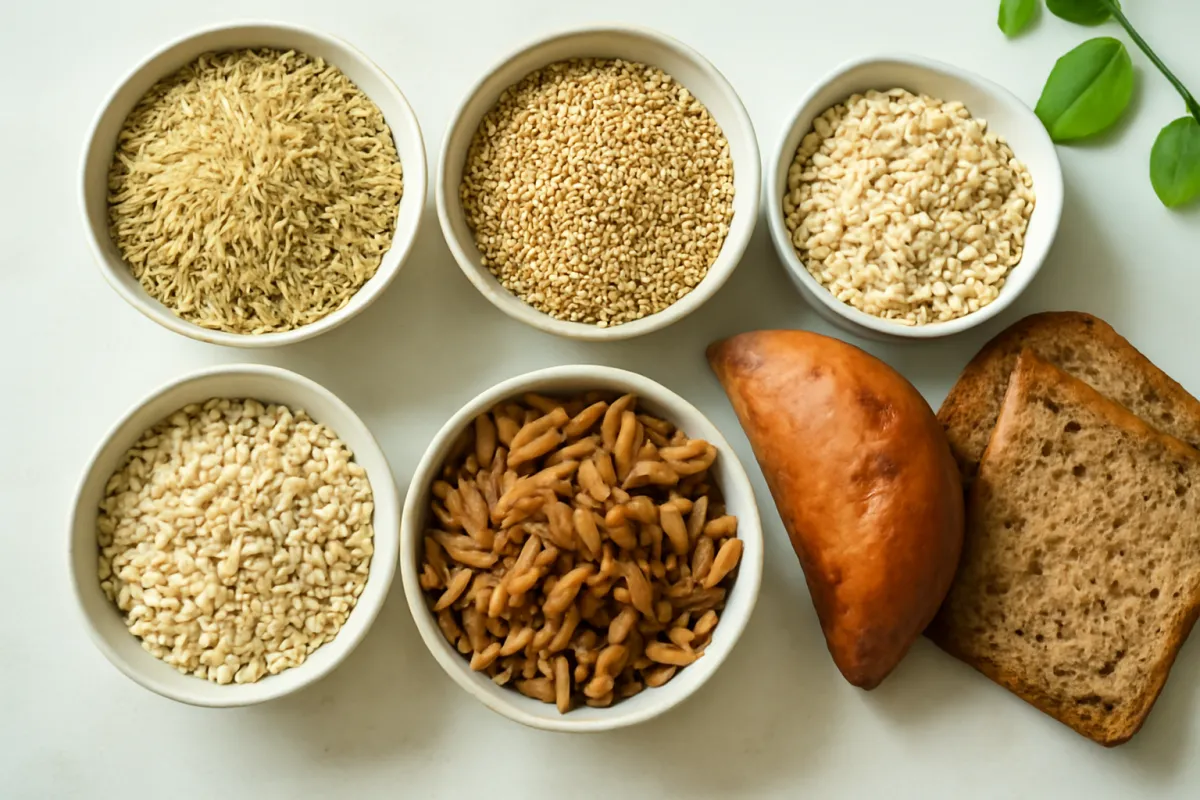
The breakfast and sandwich breads are where piece weights jump, and the figures deserve to be seen together. A plain medium bagel, about 103 grams of dense boiled-then-baked dough, is commonly cited near 290 calories, with large coffee-shop bagels passing 350. An English muffin, about 57 grams, lands near 130 calories, roughly half a bagel, largely because its dough is lighter and its interior full of air. Dinner rolls run near 85 calories for a standard 28 gram roll, hamburger buns near 145, and sub rolls commonly 200 to 280 depending on length.
The bagel deserves its arithmetic stated plainly, because it is the most underestimated piece in the aisle: one bagel equals roughly four slices of sandwich bread, and the standard schmear of cream cheese, commonly two tablespoons at near 100 calories, brings a bagel breakfast to about 390 before coffee. That is a perfectly reasonable breakfast when chosen deliberately; it is a miscount when logged as “bread with cream cheese”. The English muffin’s popularity in lighter eating patterns is exactly this math run the other way, a bagel-shaped experience at 130 calories. Sweetened and enriched versions, cinnamon raisin bagels, brioche buns, run 10 to 20 percent higher through added sugar and fat. These are commonly cited, illustrative figures; sizes vary by bakery more than by brand.
Pita, Tortillas, and Flatbreads
Flatbreads look light and often are not, because rolling a dough flat removes air, not calories. A large white pita, about 60 grams, is commonly cited near 165 calories; a large flour tortilla, about 70 grams, near 210, with burrito-size tortillas at 90-plus grams passing 250; corn tortillas, small and dense, near 50 to 60 each at about 25 grams; and naan, typically enriched with ghee or yogurt, commonly 260 to 320 for a standard restaurant piece.
Two features of flatbread counting matter. First, the per-gram rates run at or above loaf bread, near 275 for pita and 300 for flour tortillas, because flatbreads are dry and often carry oil in the dough; the softness that reads as “light” is thinness, not lightness. Second, flatbreads are wrappers, and wraps inherit the health glow of salads while commonly out-weighing two slices of bread: a burrito-size tortilla contributes more calories than the bread of most sandwiches before any filling. The practical figures to keep are pita 165, large tortilla 210, corn tortilla 55, naan 290, all give or take their bakery. Whole wheat versions of each match their white siblings on calories and add fiber, the same trade as the loaf aisle. These are commonly cited, illustrative figures that vary with diameter and enrichment.
Where the Calories in Bread Come From
Bread’s macronutrient profile explains both its role and its reputation. In a standard slice of white bread, carbohydrate supplies about three quarters of the calories, with modest protein from the wheat’s gluten and a little fat, some of it added in the dough.
Where the calories in a slice of white bread come from
Approximate calorie sources in a ~28 g slice at ~80 kcal, based on USDA-derived figures. Illustrative reference values.
Segments show each macronutrient's share of a white slice's calories. Whole wheat shifts a little carbohydrate to fiber and adds protein; enriched doughs grow the fat slice. Illustrative figures.
The chart shows a food that is, energetically, a starch delivery system: the carbohydrate slice dominates, and in white bread almost none of it is fiber, which is the substantive nutritional criticism of refined loaves. Whole wheat redraws the same bar subtly rather than dramatically, moving roughly 2 grams of the carbohydrate into fiber and nudging protein toward 4 grams per slice. The enriched breads redraw it visibly: croissant dough runs near half its calories from butter, and brioche and naan sit between. Bread also carries more sodium than its taste suggests, commonly 130 to 200 milligrams per slice, a quiet contributor for anyone watching salt. These are commonly cited, illustrative figures that vary by recipe and brand.
Does Toasting Change Bread Calories?
Toasting is the most persistent bread myth, so the answer deserves its own space: no, toasting does not reduce calories. The heat drives off water and browns the surface through the Maillard reaction, but the starch, protein, and fat that carry the slice’s energy do not leave the toaster. A 75 calorie slice emerges as a 75 calorie piece of toast that weighs a few grams less, which means the calories per gram actually rise slightly as the water departs.
The myth survives on plausible-sounding fragments. Toast feels lighter and drier, diet traditions serve it, and there is a technical grain of truth about digestibility: browning and the retrogradation of starch as bread cools or toasts can modestly change how quickly the starch digests, a cousin of the resistant starch story in cooled rice and potatoes, and some commonly cited work associates toasted or day-old bread with a somewhat gentler glucose rise. Gentler is not fewer, and the effect on usable calories is small enough to ignore in any count. The honest ledger for toast is the slice’s own figure plus its toppings, and toppings are where toast’s reputation as a light food actually goes to die, as the spread section below tallies. Count the slice, count the spread, ignore the toaster. These are commonly cited, illustrative points about food composition.
White vs Whole Wheat: What Actually Differs
Since the calorie race between white and whole wheat ends in a tie, the real comparison is everything else, and there whole wheat wins on most lines that matter. Whole wheat keeps the bran and germ that refining removes, so a slice carries about 2 grams of fiber against white’s fraction, roughly 4 grams of protein against 2.5, and meaningfully more magnesium, zinc, vitamin E, and B vitamins. White bread answers with enrichment, since regulations in many countries add back iron and several B vitamins, and with a softness and neutrality some eaters and recipes prefer.
The fiber difference is the one with daily consequences. Two grams per slice, four per sandwich, is a real contribution toward the daily intakes our review of how much fiber you need covers, and fiber plus intact grain structure slows digestion, which is why whole wheat is commonly associated with steadier blood sugar and better fullness per slice. Label reading is the skill that makes the choice real: “wheat flour” means white flour, “multigrain” counts grains rather than wholeness, and caramel coloring can costume a refined loaf; the phrase that matters is “100 percent whole wheat” or “whole grain” leading the ingredient list. Seeded whole grain loaves add nuts’ and seeds’ fat and run 90 to 120 calories per slice, a fair price for their package. On calories, choose freely; on nutrition, whole wheat is the better default. These are commonly cited, illustrative figures.

What Spreads Add
Bread is rarely eaten bare, and the spread ledger routinely outweighs the bread’s. The commonly cited figures per tablespoon: butter near 100 calories, peanut and other nut butters near 95, mayonnaise near 90, cream cheese near 50, jam and honey near 50 to 55, and mashed avocado near 80 per quarter avocado. Olive oil for dipping runs near 120 per tablespoon, which is how a restaurant bread course quietly outscores an appetizer.
Worked onto a slice, the arithmetic is immediate: toast with a generous two pats of butter lands near 150 calories, double the bread; peanut butter toast near 170 to 265 depending on the spoon; avocado toast on thick sourdough commonly 300 to 400 once the full half avocado arrives. None of this argues for dry toast. Fat-based spreads slow digestion and carry fat-soluble vitamins, nut butters add protein, and avocado brings fiber and unsaturated fat; a spread can be the difference between toast that holds until lunch and toast that does not. The argument is only for counting the spread as its own line, measured by the spoon rather than the swipe, because a “tablespoon” of peanut butter free-handed from the jar commonly weighs two. Sweet spreads stack onto the added sugar budget our review of how much sugar per day covers. These are commonly cited, illustrative figures.
Sandwich Math: A Worked Example
To pull the review together, here is one illustrative lunch priced line by line, chosen to show the method rather than to recommend a meal. The bread: two slices of 100 percent whole wheat at about 80 each, near 160 calories. The protein: 3 ounces of sliced turkey breast, near 90. The fat: a tablespoon of mayonnaise, near 90, and a slice of cheddar, near 110. The vegetables: lettuce and tomato, near 10. The sandwich lands near 460 calories, with roughly 34 grams of carbohydrate and 28 grams of protein.
The sensitivity analysis is where the lessons live. Swap the mayonnaise for mustard and the sandwich drops near 370. Swap the standard slices for thin-sliced bread and it drops another 40. Make it a bagel sandwich and the bread line alone jumps from 160 to 290; make it a wrap on a burrito-size tortilla and the “light” version quietly matches the original. Double the cheese, as delis do, and the total passes 570. Across every version, the bread stays a predictable, modest line, near a third of the sandwich, while the fats and the piece choice swing the total by 200 calories. That is bread counting in miniature: stable bread, volatile company. Build your own version in the companion below. All figures are illustrative, chosen to show the math.
Bread vs Rice, Potatoes, and Oatmeal
Set beside the other everyday starches, bread’s distinguishing feature is dryness. Per 100 grams, bread’s roughly 260 calories towers over cooked rice near 130, boiled potato near 87, and cooked oatmeal near 70, but per typical serving the field converges: two slices of bread near 155 calories, a cup of cooked rice near 205, a medium baked potato near 160, and a bowl of oatmeal near 165 all deliver a similar starch course.
| Starch serving | Portion | Calories, roughly | Carbs, roughly |
|---|---|---|---|
| Bread | 2 slices (~57 g) | ~155 kcal | ~29 g |
| White rice, cooked | 1 cup (~158 g) | ~205 kcal | ~45 g |
| Potato, baked | 1 medium (~173 g) | ~160 kcal | ~37 g |
| Oatmeal, cooked | 1 cup (~234 g) | ~165 kcal | ~28 g |
The columns worth reading are weight and fullness. Bread delivers its serving in the smallest, driest package, which is part of why bread calories accumulate so easily: a third and fourth slice disappear in a way a second potato does not, and satiety research has commonly ranked bread below boiled potatoes and oats per calorie. The water-rich starches carry more volume per calorie, and oatmeal and potatoes bring their fiber and satiety stories, told in our calories in oatmeal review and our calories in a potato reference. Bread answers with convenience, shelf life, and its role as the structural member of the portable meal. A varied rotation across all four, whole grain where possible, covers more nutritional ground than loyalty to any one. These are commonly cited, illustrative figures.
Bread and Weight Management
Bread is the most moralized food in the store, and the arithmetic supports neither the fear nor the free pass. No single food determines weight; calorie balance across the whole diet does, and plain bread at 75 to 80 calories per slice is a moderate food by any honest measure. The practical challenges are specific and manageable. Slices accumulate: a sandwich is two, toast is often two, the restaurant basket is one or three more, and at 75 to 150 calories per piece the day’s bread can pass 500 calories without a single rich choice. Company compounds: butter, mayonnaise, and cheese ride bread by default.
The levers are equally specific. Thin-sliced loaves cut every sandwich by 30 to 40 calories; whole grain versions add fiber that improves fullness per slice; open-faced sandwiches halve the bread line; and deciding the basket’s fate before it lands is worth more than any substitution. Low-carbohydrate patterns remove bread entirely and work for some people, but removal is one strategy, not a requirement, and many people maintain or lose weight with daily bread inside an honest count. The framework that decides it is the day’s total, the subject of our review of how many calories you need, not the presence of a loaf. Anyone pursuing weight change with a health condition should involve a doctor or registered dietitian; this section describes arithmetic, not a plan.
Bread and Blood Sugar
Bread is a concentrated starch, and refined white bread digests fast enough that commonly cited glycemic index tables have long used it as a reference food near the top of the scale. The starch arrives with little fiber or intact structure to slow it, so white bread raises blood glucose quickly relative to most whole foods. The bread aisle spans a real range, though: dense 100 percent whole grain and seeded loaves digest slower, sourdough’s fermentation is commonly associated with a gentler response, and pumpernickel and true rye breads commonly read lower than white.
Context moves the response as much as the loaf. Bread eaten inside a meal with protein, fat, and vegetables produces a flatter rise than bread alone; portion scales everything, since one slice’s 15 grams of carbohydrate behaves differently than a hoagie roll’s 60; and cooling or toasting shifts a little starch toward resistant forms, a modest effect noted earlier. Individual responses vary widely between people. For most eaters the practical translation is unremarkable: prefer intact whole grain versions, portion bread like the starch it is, and let the meal’s balance do the moderating, the pattern our balanced meal guide describes. Anyone managing diabetes or prediabetes should build carbohydrate choices with their own clinician or dietitian. This is educational context, not medical advice.
How Bread Fits Your Daily Calories
Bread’s calories only mean something against a daily total, and that total is personal, set by body size, activity, age, and goals, the territory of our review of how many calories you need. Against the 2,000 calorie day labels use for illustration, the common bread patterns span a wide band: two slices of toast near 155 calories is about 8 percent of such a day before spreads, a sandwich’s bread the same, a bagel breakfast near 290 close to 15 percent, and a bread-heavy day, toast at breakfast, a sandwich at lunch, rolls at dinner, can pass 500 calories of bread alone, a quarter of the illustrative day.
None of those patterns is wrong; they are different allocations of the same budget, and bread earns its share honestly in most eating cultures. The useful discipline is simply seeing bread as the meal’s starch serving, budgeted beside the day’s rice, potatoes, and oats rather than treated as packaging that does not count. On the carbohydrate side, two slices contribute near 29 grams toward whatever daily carbohydrate range applies to you, the frameworks our how many carbs per day review lays out, and our daily nutrient reference tabulates the commonly cited daily figures around it. Set your own target in the companion below and it will show your bread as a share of your day. These are illustrative reference points, not personal targets; your own numbers belong with a qualified professional.
How to Read a Bread Label
The bread aisle is where label-reading skills pay their clearest dividends, because the front of a loaf sells and the panel reports. Start with the serving size, since most packaged loaves define one slice but some define two, and every number scales from that line; the gram weight beside it, commonly 26 to 45 grams, is the honest measure of how substantial the slice is and the key to comparing brands fairly.
Then read four lines. Calories per slice, near 60 to 120, mostly track that gram weight. Fiber separates the aisle: 2 to 3 grams per slice marks a genuine whole grain loaf, under 1 marks a refined one whatever its color. Added sugar runs 1 to 4 grams per slice in commercial breads, higher in honey and brioche styles. Sodium, commonly 130 to 200 milligrams per slice, accumulates across a sandwich faster than most people expect. Finish with the ingredient list’s first line, where “whole wheat flour” or “whole grain” means the real thing and “enriched wheat flour” means white; the panel-reading method our review of how to read a nutrition label teaches applies slice for slice. These are general label-reading habits, and your loaf’s panel is the authority for that product.

Common Mistakes Counting Bread Calories
A short list of recurring errors explains most bread miscounts, and each is easy to fix once named.
- Counting every piece as “a slice”. Pieces run from 22 gram thin slices near 60 calories to 103 gram bagels near 290; the weight, not the name, sets the figure.
- Expecting whole wheat to save calories. Per equal weight it matches white; its advantages are fiber, protein, and minerals, not a lower number.
- Believing the toaster. Toasting removes water, not calories; a 75 calorie slice is 75 calorie toast.
- Letting spreads ride free. Butter, nut butters, and mayonnaise commonly add 90 to 100 calories per real tablespoon, often more than the bread beneath them.
- Logging wraps as light. A burrito-size tortilla near 250 calories outweighs the bread of most sandwiches.
- Missing the two-slice serving. Some panels define a serving as two slices; the per-serving figure then doubles the mental per-slice note.
- Forgetting the basket. Restaurant bread with oil or butter commonly adds 200 to 400 calories before the meal is ordered.
- Treating illustrative figures as exact. Every number here is a commonly cited, USDA-based reference that varies by loaf, bakery, and knife.
Each of these is a counting error rather than an eating error. Corrected, bread becomes one of the easiest foods to count in the kitchen: a stated per-slice figure on every package, and a stable 260 per 100 grams everywhere else.
The Bottom Line
The calories in bread come down to one steady rate and one unsteady unit: nearly every plain bread sits near 250 to 270 calories per 100 grams by USDA-based figures, and the pieces range from 22 gram thin slices near 60 calories through standard slices near 75 to 80, bakery sourdough near 150, and bagels near 290, so the weight of the piece, not the type of the bread, decides the number. White and whole wheat tie on calories, with whole wheat winning the nutrition package through its fiber and minerals; toasting changes nothing; and the spreads and fillings that ride the bread routinely outweigh it, which makes the sandwich, not the slice, the honest unit of bread counting. As a starch serving, two slices sit beside a cup of rice, a medium potato, and a bowl of oatmeal, converging near 155 to 205 calories per serving. Every figure here is a commonly cited, illustrative reference, not a personal target, so pair it with our calorie needs review for the day around the sandwich and our daily nutrient reference for the wider table, and confirm anything specific to your health with a qualified professional.
This evidence review is written for general education about the commonly cited, USDA-based composition of breads and their common companions, and nothing here is medical, dietetic, or weight-management advice for any reader, nor does it substitute for an evaluation by your own clinician. Every calorie, carbohydrate, fiber, sodium, and portion figure above is an illustrative approximation: loaves, bakeries, slice thicknesses, and recipes vary enough that your package’s stated panel, where one exists, should always outrank these references. Statements about satiety, glycemic response, and fermentation summarize commonly reported research associations in general populations rather than effects promised to any individual. This article does not tell anyone how much bread to eat. Anyone managing diabetes or prediabetes, celiac disease or non-celiac gluten sensitivity, a wheat allergy, hypertension sensitive to sodium, or any other condition that touches diet, and anyone setting personal calorie or carbohydrate targets, should make those decisions with a doctor or registered dietitian.
Frequently asked questions
How many calories are in a slice of bread?
A standard slice of commercial sandwich bread, about 28 to 30 grams, is commonly cited near 75 to 80 calories for white and near 80 for whole wheat, drawing on USDA food composition data of roughly 265 calories per 100 grams. The honest complication is that slices are not standard: thin sandwich slices run near 60 calories, while thick-cut bakery and Texas toast slices can reach 120 to 160 because they simply weigh more. The type of bread moves the figure far less than the size of the slice does. Treat these as commonly cited, illustrative references rather than an exact reading of your loaf, and check the label, since packaged bread states its own per-slice figure.
Does whole wheat bread have fewer calories than white?
No, and this surprises many people: per equal weight, whole wheat and white bread are nearly identical, both commonly cited in the range of 250 to 270 calories per 100 grams, and a typical slice of each lands near 75 to 85 calories. Whole wheat's advantage is not a lower number but a better package: roughly 2 grams of fiber per slice against well under 1 for white, more minerals, and a slower digestion that many people find more filling. Choosing whole wheat over white is a nutrition-quality decision, not a calorie-saving one. These are commonly cited, illustrative figures that vary by brand and slice weight.
How many calories are in sourdough bread?
Sourdough is commonly cited near 270 calories per 100 grams, essentially the same rate as other white breads, because fermentation changes the character of the bread more than its energy. The reason sourdough often feels heavier on a calorie count is the slice: bakery sourdough is usually cut thick from a large loaf, and a typical slice can weigh 50 to 60 grams, landing near 130 to 160 calories against 75 for a thin commercial slice. Per gram, there is nothing extra in it. The fermentation is commonly associated with a somewhat gentler blood sugar response and easier digestion for some people, which are separate questions from calories. These are illustrative, commonly cited figures.
How many calories are in a bagel?
A plain medium bagel, about 100 to 105 grams, is commonly cited near 280 to 300 calories, which makes the bagel arithmetic worth seeing plainly: one bagel equals roughly four slices of sandwich bread. Large coffee-shop bagels can pass 350, and that is before cream cheese, which commonly adds 100 to 150 calories for a standard schmear. The bagel's density is the whole explanation, since its dough is simply more bread per piece, not a richer recipe. An English muffin, near 130 calories, is the common lighter swap for the same breakfast slot. These are commonly cited, illustrative figures that vary by size and bakery.
Does toasting bread reduce calories?
No. Toasting removes water and browns the surface, but the calories in a slice come from its starch, protein, and fat, which do not evaporate. A 75 calorie slice is still about 75 calories toasted; it weighs slightly less because water left, which means the calories per gram technically rise even as the slice's total stays the same. The idea that toast is a diet food comes from habit rather than chemistry, though toast does hold less butter than soft bread absorbs for some spreaders. Count toast exactly as you would the same slice untoasted, plus whatever goes on it. These are commonly cited, illustrative points about food composition.
What do butter, peanut butter, and other spreads add to bread?
Usually more than the bread itself. A tablespoon of butter is commonly cited near 100 calories, peanut butter near 95 per tablespoon, cream cheese near 50, jam or honey near 50 to 55, and a quarter of an avocado near 80. Spread generously, any of the fat-based options can double or triple a 75 calorie slice, which is why toast with toppings commonly lands between 175 and 300 calories while the plain slice stays modest. None of these are bad additions; nut butters in particular add protein and healthy fats that make toast hold hunger longer. The counting rule is simply to log the spread as its own line, measured by the spoon rather than guessed. These are commonly cited, illustrative figures.
Is bread bad for weight loss?
Bread is neither required nor forbidden for weight management, because no single food determines weight; total calorie balance and the overall diet do. Plain bread is a moderate-calorie food, near 75 to 80 per slice, and the practical issues are portion count and company: slices accumulate quickly at 150 per sandwich before filling, restaurant bread baskets arrive before anyone counts, and the spreads and fillings routinely outweigh the bread. Choosing whole grain versions adds fiber that improves fullness per calorie, and thin-sliced loaves cut the per-sandwich cost by a third. People who lose weight while eating bread daily are common; the arithmetic simply has to include it honestly. Anyone pursuing weight change with a health condition should involve a doctor or registered dietitian.
How many carbs are in a slice of bread?
A standard slice carries roughly 14 to 15 grams of carbohydrate, drawing on USDA-based figures, with white bread delivering under 1 gram of that as fiber and around 1.5 to 2 grams as added sugar in many commercial loaves, while whole wheat delivers about 2 grams of fiber per slice. Two slices, the sandwich standard, therefore contribute near 28 to 30 grams of carbohydrate, comparable to a medium potato or two thirds of a cup of cooked rice. Bread is best budgeted as the meal's starch alongside those neighbors. How much total carbohydrate suits a day is individual, and anyone managing blood sugar should set targets with a doctor or registered dietitian. These are commonly cited, illustrative figures.

Hamza Hai is the editor of NourishMark. She holds an MBA and reviews the site's articles against our editorial standards, checking that every figure is labelled for what it is, that nothing is presented as verified fact without a source the reader can check, and that the writing stays useful to a non-specialist.

Dr. Shayaan Khan is the medical reviewer for NourishMark. He holds an MBBS from MGM Medical College, Navi Mumbai, and is the author of published research including a narrative review of postpartum anxiety and depression in Mental Health Science. He has taught physiology at university level. He reviews the site's health content for medical accuracy: that physiology and mechanisms are described correctly, that no claim is stated more strongly than the evidence behind it, and that anything specific to an individual reader is sent to that reader's own clinician.
Not medical advice. Dr. Khan reviews NourishMark's health content for medical accuracy. He is not a registered dietitian, he does not hold a United States practising licence, and he is not your doctor. His review does not make anything here medical advice. Always talk to a qualified health professional about your own situation, and never delay or stop care because of something you read here.