
What's in this review
- Before you start: what you need
- How a nutrition label is laid out
- Step 1: Start with the serving size
- Step 2: Check the calories per serving
- Step 3: Limit the nutrients to get less of
- Step 4: Get enough of the nutrients to get more of
- Step 5: Use the percent Daily Value
- Step 6: Read the ingredient list
- Step 7: Compare products and see past the claims
- A worked example: comparing two cereals
- Common mistakes when reading a nutrition label
- Troubleshooting and edge cases
- Your nutrition label reading checklist
- The bottom line
Short answer: Read a Nutrition Facts label top to bottom in a fixed order, starting with the serving size, because every other number is per serving. Then check calories, limit saturated fat, sodium, and added sugars, and look for more fiber and key vitamins and minerals. Use the % Daily Value as a shortcut: 5 percent or less is generally low and 20 percent or more is generally high. Front-of-package claims are marketing.
The Nutrition Facts panel on a package looks like a wall of small numbers, and most people either ignore it or fixate on one figure, usually calories, and miss what the label is actually trying to tell them. Read in the right order, it takes about twenty seconds and answers the questions that matter: how much is a serving, what am I getting a lot of, and is that a food I want more or less of in my week. The label is one of the few genuinely reliable, standardized sources of information in the grocery store, and learning to read it well means the front of the package can no longer talk you into anything the back does not support.
This evidence review is a step-by-step walkthrough for reading a nutrition label from the top down, turning that wall of numbers into a quick, repeatable check. It covers what to have on hand before you start, a short tour of how the standard Nutrition Facts panel is laid out, the seven steps in order, a worked example comparing two illustrative cereals, the common mistakes that lead people astray, the edge cases worth knowing, and a checklist to keep. For the calorie figure the label ties back to, see our calorie needs evidence review; for the nutrients that come up most, see our protein evidence review, fiber evidence review, and added sugar evidence review. Everything here is general information, not medical or dietary advice, and every number is a commonly cited illustrative reference rather than a personal target. Try the reading tool in the companion below as you go.
Key takeaways
- Read the label top to bottom in a fixed order, and always start with the serving size, because every other number on the panel is per serving.
- Split the nutrients into two groups: get less of saturated fat, sodium, and added sugars, and get more of fiber and key vitamins and minerals.
- The % Daily Value is a quick shortcut: 5 percent DV or less is generally low in a nutrient, and 20 percent DV or more is generally high.
- The single biggest mistake is ignoring the serving size, which quietly doubles or triples every number when your real portion is larger than the label's.
- The label and ingredient list are the reliable source; front-of-package claims are marketing, and every figure here is illustrative and general, so confirm specifics with a doctor or registered dietitian.
Before you start: what you need
Reading a nutrition label well takes almost nothing, and the first read of a new product takes about a minute while a familiar one takes a few seconds. The point of gathering a couple of things first is that a label only becomes useful when you compare it against something, either your own portion or a second product.
- Two labels, not one. A single label in isolation rarely tells you much. Reading is easiest when you have the product plus a comparison, whether that is a competing brand on the shelf or a mental benchmark for the category.
- An honest sense of your portion. Have a rough idea of how much of the package you actually eat in one sitting, since the label’s serving size may be smaller than your real portion.
- A phone calculator, or just the companion below. The only arithmetic involved is multiplying the per-serving numbers by how many servings you really eat, which the tool on this page does for you.
- A minute of unhurried attention. Labels are designed to be scanned, and the whole method is about reading them in the right order rather than doing anything hard.
Difficulty here is genuinely low: there is no math beyond simple multiplication, and no special knowledge required beyond what this walkthrough lays out. What matters is the order you read in and a willingness to turn the package over rather than trust the front. Everything below is a general educational framework, not a diet plan, and it does not replace guidance from a registered dietitian or doctor, especially if you manage a condition, are pregnant, or are feeding a child with specific needs.
How a nutrition label is laid out
Before the steps, a short tour, because the standard Nutrition Facts panel is not random: it is a defined format that always presents information in the same order, which is exactly what makes a top-to-bottom reading method possible. Once you know the shape, your eye can jump to the right line without hunting.
From the top, a standard panel shows the serving size and servings per container first, in bold, followed by Calories in large type. Below a dividing line come the nutrients, each with grams or milligrams and a % Daily Value in the right-hand column: Total Fat, then Saturated Fat and Trans Fat indented beneath it, then Cholesterol and Sodium, then Total Carbohydrate with Dietary Fiber, Total Sugars, and an indented Includes Xg Added Sugars line beneath it, and then Protein. Below another line sit key micronutrients the format highlights, commonly Vitamin D, Calcium, Iron, and Potassium. At the bottom, a footnote explains that the % Daily Value is based on a 2,000-calorie reference diet used for general labeling.
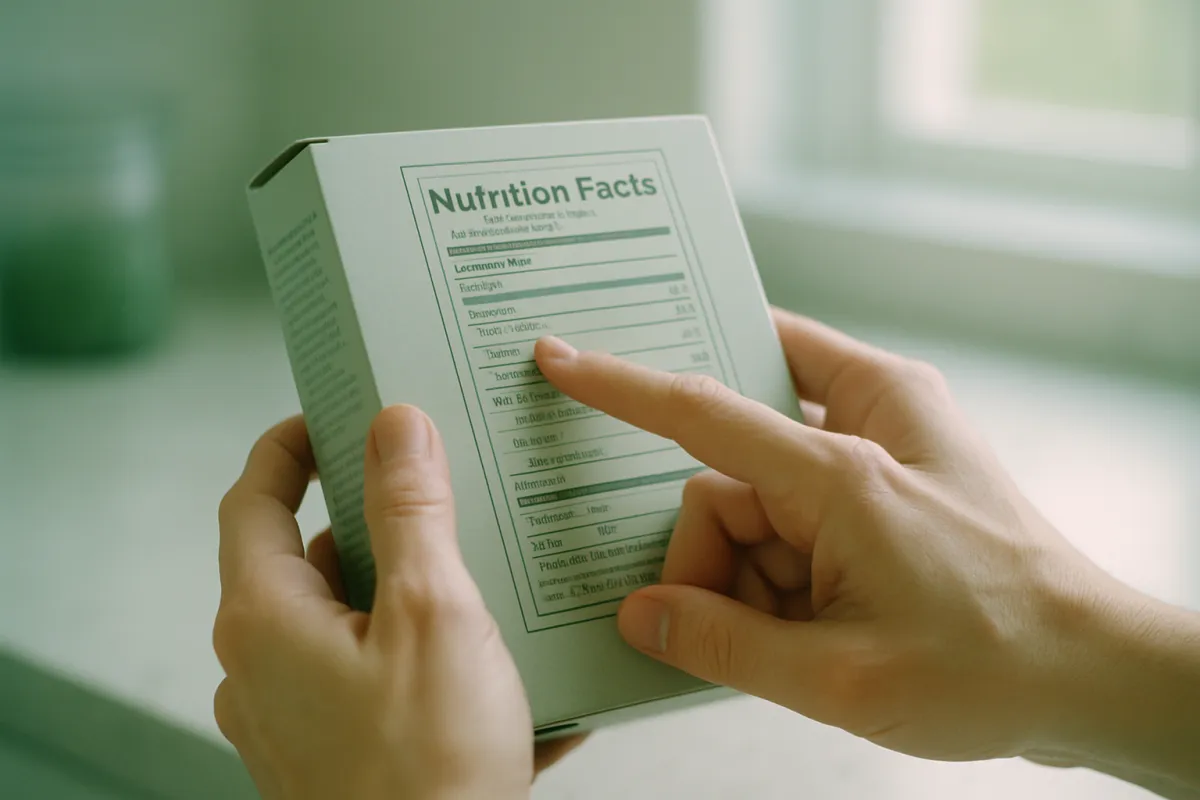
That fixed order is the reason this walkthrough works. The chart below shows the parts of the label worth checking first, in the sequence the seven steps follow, so you know where your attention is best spent before the small print pulls it elsewhere.
The parts of a nutrition label to check first
An illustrative reading order for the panel, from the anchor you check first to the details you finish with. Longer bars sit earlier in the sequence, not higher in nutritional importance.
Bars show a suggested reading sequence, not measured data or a ranking of health importance. Every reader's priorities differ, and this is a general guide rather than a personal recommendation.
Step 1: Start with the serving size
Start at the very top, with the serving size and the servings per container, because this single line is the anchor that every other number on the label hangs from. Calories, grams of saturated fat, milligrams of sodium, and the entire % Daily Value column all describe one serving, so until you know what a serving is and how it compares to what you actually eat, none of the numbers below mean what they appear to mean.
Read two things here. First, the serving size itself, given in a familiar measure like 1 cup, 2 tablespoons, or 3 pieces, along with a gram weight. Second, the servings per container, which tells you how many of those servings the whole package holds. A pint of ice cream might list a serving as two-thirds of a cup with three servings per container, and a bag of chips might list one ounce with several servings inside. The label is not saying that is all you should eat; it is a reference amount so different products can be compared fairly.
The move that makes everything honest is to compare the label’s serving to your real portion. If the serving is two-thirds of a cup and you eat a cup and a half, you are having a bit over two servings, so you multiply every number below by roughly two and a bit. Watch out for the packages that look single-serving but list two or more servings, since a small bottle or bag can quietly hold double what the panel first suggests. The companion below does this multiplication for you: enter the servings you eat and the calories per serving, and it shows the total you would actually take in.
Step 2: Check the calories per serving
With the serving size fixed in your mind, move down to calories, the figure printed in the largest type on the panel precisely because it is the headline number. Calories measure the energy the food provides per serving, and reading them in light of step one is what keeps them meaningful: the label’s calorie figure is per serving, so your real intake is that number times how many servings you eat.
Do the quick scaling before you judge anything. If a serving is 200 calories and you eat two servings, that is about 400 calories, not 200. This is where most calorie misreadings happen, because the eye lands on the big number and forgets the small serving line above it. A snack that advertises 100 calories can deliver 300 if the package holds three servings and you finish it. There is nothing wrong with that; the point is only to know the true figure rather than the per-serving one.
Calories are a useful gauge of energy, but they are not the whole story of a food, which is why the steps continue past this line. Two foods at the same calories can differ enormously in what else they bring, one rich in fiber and protein and the other mostly added sugar, and the later steps are what separate them. For how calorie needs are estimated in the first place, and why there is no single right number, see our calorie needs evidence review. Watch out for treating calories as the only thing that counts: they set the rough energy scale, but the quality behind them, which the next steps reveal, matters just as much. Every figure here is illustrative and general, not a personal calorie target.
Step 3: Limit the nutrients to get less of
The nutrient block splits cleanly into two groups, and this step covers the first: the nutrients general guidance suggests most people benefit from getting less of. On a standard panel these are saturated fat, sodium, and added sugars, the three the dietary guidance behind the label singles out to limit, along with trans fat, which many products now carry little or none of.
Read each in two ways, the amount and its % Daily Value. Saturated fat is listed in grams and indented under total fat; general guidance commonly frames a lower intake as better for most people. Sodium is listed in milligrams, and it adds up fast across a day from foods that may not even taste salty, so a single item contributing a large share of the day’s reference is worth noticing. Added sugars appears on its own indented line reading Includes Xg Added Sugars, and it is often the most revealing number on the whole panel, since it separates sugar put into the food from sugar that was naturally there. For the fuller picture on sugar, see our added sugar evidence review.
The practical habit is to aim for lower numbers here, especially lower % Daily Value, when choosing between similar products. Watch out for two traps. First, remember these are per serving, so scale them to your real portion as in step one, because a food that looks moderate per serving can be high once you eat two. Second, do not confuse total sugars with added sugars: a plain yogurt or a piece of fruit can show meaningful total sugars that are entirely natural, while a sweetened product shows added sugars that general guidance suggests watching. None of this is a limit prescribed for you; it is a general reading habit, and specific targets belong with a professional.
Step 4: Get enough of the nutrients to get more of
The second group in the nutrient block is the mirror image: the nutrients general guidance suggests many people benefit from getting more of. On the standard panel the ones to look for are dietary fiber and the highlighted micronutrients at the bottom, commonly vitamin D, calcium, iron, and potassium, with protein sitting in the block as a nutrient most people want to see a solid amount of.
Read these the opposite way from step three: here a higher number, and a higher % Daily Value, is generally the encouraging sign. Dietary fiber is listed in grams under total carbohydrate, and a higher figure is one quick marker that a carbohydrate food is closer to its whole form; our fiber evidence review covers why it matters and typical general ranges, and the Total Carbohydrate line itself reads more usefully once you know your own daily figure from our review of how many carbs a day you need. Protein is listed in grams, and while most labels do not show a % Daily Value for it, the gram figure lets you compare how much a food contributes, which our protein evidence review and the method in our macro walkthrough put in context. The highlighted vitamins and minerals round out the picture, with higher %DV meaning a more meaningful contribution.
The habit is simple: when two products are otherwise similar, the one with more fiber, more protein, and higher %DV on the key micronutrients is generally the more nourishing pick. Watch out for foods fortified to show impressive micronutrient numbers while still carrying heavy added sugars, since a high calcium or vitamin figure does not cancel out the get-less nutrients from step three. Read both groups together. As always, these are general reference points, not personal targets, and needs for any nutrient vary with age, health, and circumstance, so confirm yours with a professional.
Step 5: Use the percent Daily Value
By now you have been glancing at the right-hand column, and this step makes it explicit, because the % Daily Value is the shortcut that lets you judge a number without memorizing how many grams or milligrams of anything you need. The %DV tells you how much one serving of the food contributes to a general daily diet, based on a 2,000-calorie reference used for labeling, and it appears next to most nutrients on the panel.
The rule of thumb worth remembering is the 5 and 20 rule: 5 percent DV or less generally means the food is low in that nutrient, and 20 percent DV or more generally means it is high. That single pair of numbers turns the whole column into a fast read. Use it in both directions from the last two steps: for the get-less nutrients like saturated fat, sodium, and added sugars, low %DV is what you are generally looking for, while for the get-more nutrients like fiber, calcium, iron, and potassium, high %DV is the encouraging sign. A cereal at 20 percent DV for fiber and 5 percent DV for sodium reads very differently from one at 5 percent fiber and 20 percent sodium, even at the same calories.
The %DV also makes comparing products easier, since it puts everything on one percentage scale rather than a mix of grams and milligrams. Watch out for the reference itself: the 2,000-calorie basis is a general labeling standard, not your personal calorie need, so if you eat notably more or less, the percentages shift for you and should be read as a rough guide rather than an exact accounting. The companion below helps with the portion side of that adjustment. Treat the 5 and 20 rule as a quick heuristic, not a rule imposed on your diet, and leave personal targets to a professional.
Step 6: Read the ingredient list
Numbers tell you how much; the ingredient list tells you what, and reading it is the step that most often changes a first impression. By the standard, ingredients are listed in order of weight, from most to least, so the first few items make up the bulk of the food and the tail end is present only in small amounts. That ordering alone carries a lot of information once you know to use it.
Scan for a few things. First, what leads the list: a short run of recognizable whole foods near the top is generally reassuring, while a refined grain or a sweetener in the first two or three positions tells you what the food mostly is. Second, added sugars under their many names, since sugar can appear as cane sugar, corn syrup, high-fructose corn syrup, honey, molasses, fruit juice concentrate, dextrose, and more; several sweeteners spread through a list can add up even when none sits at the very top. Third, the fats and oils used, which appear throughout and tell you something the fat grams alone do not. A long list is not automatically bad and a short one not automatically good, but the pattern is informative.
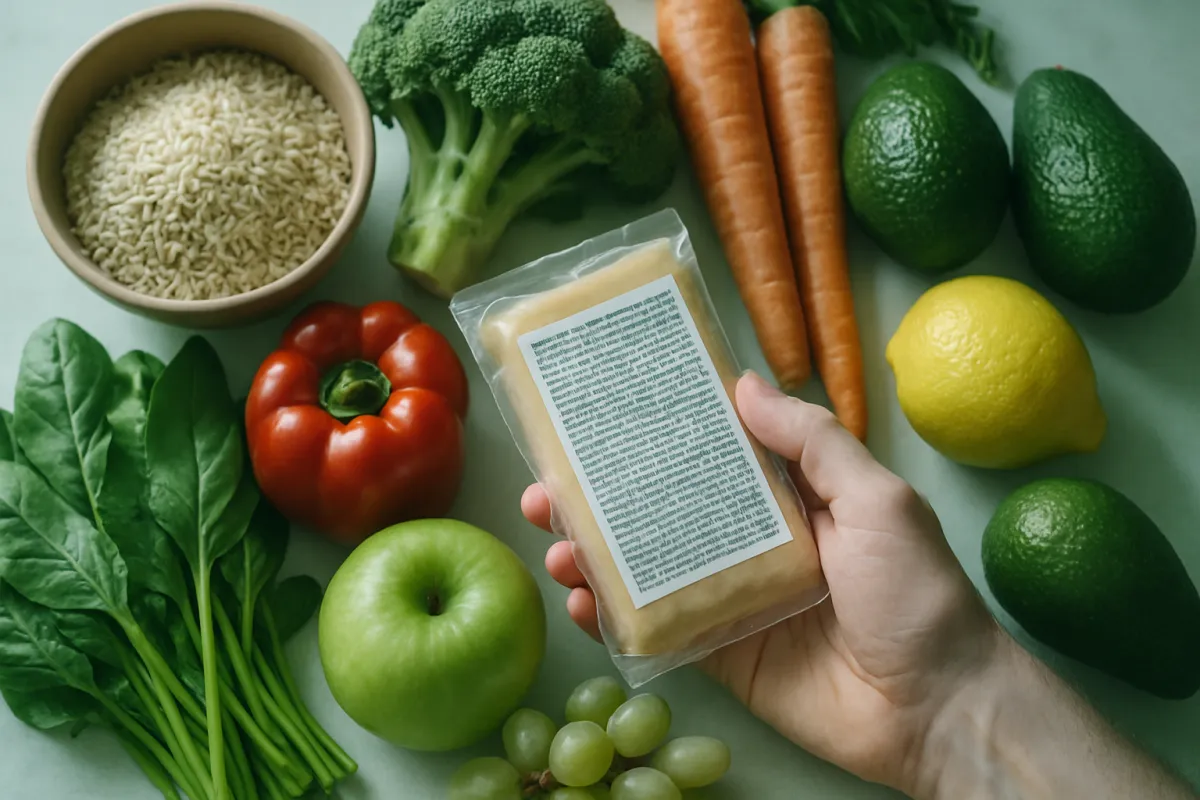
The ingredient list is also where the added sugars line from step three gets its context: if the panel shows added sugars and the list is led by a sweetener, the two agree. Watch out for reading only the first ingredient and stopping, since the real story often sits a few items in. And remember the list is a description, not a verdict: plenty of perfectly good foods have longer lists, and a short list can still be mostly sugar. This is a general reading habit for understanding what is in a food, not a rule about what you should eat, which remains a conversation for a professional.
Step 7: Compare products and see past the claims
The final step puts the first six to work, because a label is most powerful when you use it to compare two products and see past the marketing on the front. Front-of-package language like natural, made with whole grains, lightly sweetened, or a bold protein number is advertising: it highlights one flattering attribute and stays quiet about the rest. The Nutrition Facts panel and ingredient list on the back are the standardized, reliable counterweight, and turning the package over is the whole move.
Compare on the same basis, which is the one trick that makes comparisons fair. Two products can use different serving sizes that make a straight number-to-number look misleading, so compare per the same amount, for instance per 100 grams or per identical serving, then line up the nutrients you care about, commonly added sugars, sodium, fiber, and calories. The %DV column from step five helps here because it already puts everything on a common percentage scale. When you do this, a product with a proud front-of-package claim often turns out no better, or worse, than a plainer one beside it.
Watch out for letting a single good attribute decide it. A cereal can be genuinely high in fiber and also high in added sugars; a snack can be low in fat and high in sodium. Reading the whole panel, both the get-less and get-more groups, is what keeps one claim from carrying more weight than it should. This is a general, practical way to choose between foods on the shelf, not a personalized plan, and choices tied to a medical condition or specific goal should be confirmed with a registered dietitian. The chart below shows how the label reads top to bottom, which is the path this whole comparison follows.
Reading a label top to bottom
An illustrative map of the standard panel's zones in the order you meet them, as a share of the reading path from top to bottom. Shares sum to 100 percent.
Segments show an illustrative share of the reading path, not measured label geometry or nutritional importance. This is a general guide to the order of reading, not a personal recommendation.
A worked example: comparing two cereals
Pulling the seven steps together on a real decision shows how fast the method works. Meet two illustrative cereals side by side on a shelf, Cereal A with a big “made with whole grain” banner on the front, and plainer Cereal B beside it. Nothing here describes a real product; the numbers are invented for the walkthrough and are illustrative only.
Step 1, serving size: Cereal A lists a serving as three-quarters of a cup, while Cereal B lists a full cup. Already the labels are not directly comparable, so keep that gap in mind. Step 2, calories: Cereal A shows about 150 calories per its smaller serving and Cereal B about 160 per its larger one, which are closer than they look once you account for the different serving sizes. Step 3, get-less nutrients: here the front banner starts to fade, as Cereal A shows about 12 grams of added sugars per serving against Cereal B’s 4 grams, with similar sodium. Step 4, get-more nutrients: Cereal B shows about 5 grams of fiber and 5 grams of protein, while the whole-grain-branded Cereal A shows about 2 grams of fiber and 3 grams of protein.
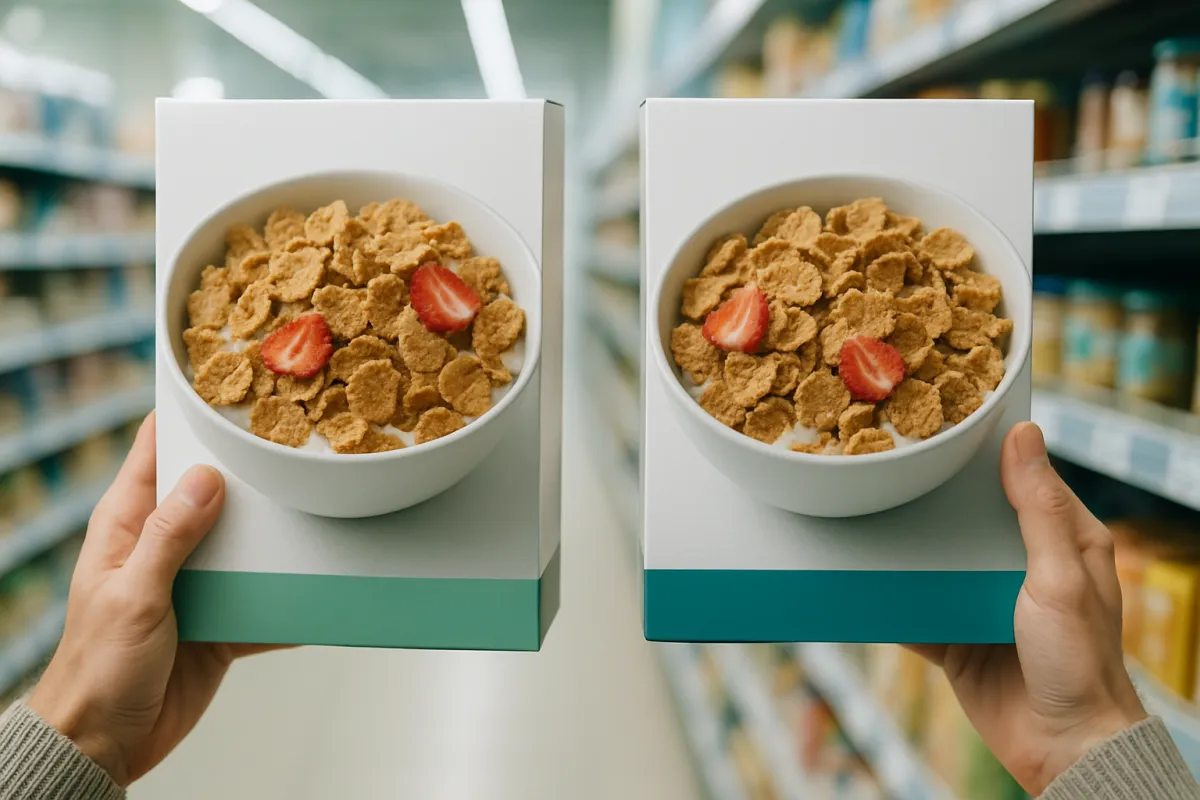
Step 5, % Daily Value: reading the column, Cereal A lands high on added sugars and low on fiber, while Cereal B is the reverse, low on added sugars and higher on fiber, exactly the pattern the 5 and 20 rule is built to flag. Step 6, ingredients: Cereal A’s list is led by whole grain but names sugar and a syrup within the first few items, while Cereal B is led by a whole grain with no sweetener near the top. Step 7, compare on the same basis: put both per 100 grams and Cereal B comes out ahead on the numbers that the front banner never mentioned. The whole-grain claim on Cereal A was true and still not the whole story, which is the entire lesson of reading the back. Run your own portion of either through the companion below to see what you would actually take in.
Common mistakes when reading a nutrition label
Most label misreadings are not about the numbers themselves but about which line the eye trusts, and each is easy to fix once named.
- Ignoring the serving size. This is the big one. Every number on the panel is per serving, so reading calories or sugar without checking the serving line quietly doubles or triples the figure when your real portion is larger.
- Trusting the front of the package. Claims like natural, made with whole grains, or lightly sweetened are marketing, not the standardized panel. Turn the package over and let the Nutrition Facts and ingredient list settle it.
- Fearing all fat equally. Total fat alone says little; the line that general guidance highlights is saturated fat. Driving every fat to zero is not the goal, and many nourishing foods carry fat worth having.
- Missing the added sugars line. The Includes Xg Added Sugars line is one of the most useful numbers on the panel, and it is easy to skip because it sits indented under total sugars.
- Confusing total sugars with added sugars. A plain yogurt or fruit can show real total sugars that are entirely natural, while a sweetened product’s sugars are added. Reading the added sugars line is what tells them apart.
- Comparing labels on different serving sizes. Two products with different serving sizes cannot be compared number to number; put them on the same basis, per 100 grams or per identical serving, first.
Clear these six and the panel does its job calmly, without any one line misleading you.
Troubleshooting and edge cases
A few common situations change the practical details, though never the top-to-bottom logic. What if a food has no label at all? Fresh produce, bulk bins, and deli or bakery items often carry no panel, which is not a problem, since single whole foods are the case where a label matters least. For bulk foods, many stores post the same information near the bins or online, and the ingredient list for a whole food is simply the food itself.
What if you have a dietary restriction or allergy? The ingredient list and the separate allergen statement, which commonly reads Contains followed by major allergens, are the lines to read first and carefully, since a claim on the front does not replace them. Cross-contamination advisories like made in a facility with are voluntary and vary, so anyone with a serious allergy should treat the label as a starting point and confirm with the manufacturer or a professional rather than relying on it alone.
What if you are reading labels for a child? The % Daily Value on a standard panel is based on a general 2,000-calorie adult reference, so it does not map onto a young child’s needs, and some products carry a separate panel for children under four. Use the label to compare products and spot added sugars and sodium, but leave a child’s actual portions and nutrition to a pediatrician or dietitian, since general adult references do not translate directly.
What if you follow a medical diet? This is the important one. Conditions like diabetes, kidney disease, high blood pressure, celiac disease, and others can make specific lines on the label, carbohydrates, sodium, potassium, or gluten-related ingredients, matter in ways a general reading cannot capture, and they call for individualized guidance that overrides any general habit here. If that is you, use this walkthrough as background only and set the numbers that matter with your doctor or a registered dietitian.
Your nutrition label reading checklist
Keep this short routine on hand to read any label quickly, whether you are choosing between two products or just checking one before it goes in the cart.
- Read the serving size and servings per container first, then compare the serving to how much you actually eat.
- Scale the numbers to your real portion, multiplying calories and nutrients by the servings you truly have.
- Check the get-less nutrients, aiming for lower saturated fat, sodium, and added sugars, and read the added sugars line specifically.
- Check the get-more nutrients, looking for solid fiber and protein and higher %DV on the key vitamins and minerals.
- Use the 5 and 20 rule on the % Daily Value column: 5 percent or less is generally low, 20 percent or more is generally high.
- Scan the ingredient list, remembering it runs from most to least, and watch for sweeteners under many names near the top.
- Compare products on the same basis, per 100 grams or per identical serving, and let the panel outrank the front-of-package claim.
Run your own portion through the companion below to turn a per-serving label into the amount you would really eat.
The bottom line
A nutrition label stops being a wall of numbers the moment you read it in order. Start with the serving size, because everything else is per serving; scale the calories to how much you actually eat; aim lower on the get-less nutrients of saturated fat, sodium, and added sugars, and higher on the get-more nutrients of fiber, protein, and key vitamins and minerals; use the 5 and 20 rule to read the % Daily Value at a glance; scan the ingredient list from most to least; and compare products on the same basis so the front-of-package claim can no longer decide for you. Run the two illustrative cereals through those steps and the plainer box beats the one with the proud banner, which is the whole point of turning the package over. The label is one of the most reliable tools in the store, and reading it well is a habit anyone can build in an afternoon. Every figure here is a commonly cited, illustrative reference rather than a personal prescription, so pair this walkthrough with our calorie, added sugar, fiber, and protein evidence reviews, and confirm anything specific to your health, goals, or conditions with a qualified professional.
This evidence review is published for general education and describes a commonly cited, illustrative way to read the standard Nutrition Facts panel, not medical, nutritional, or dietary advice, and reading it creates no clinician-patient relationship. Every calorie figure, gram amount, percentage, and product in the examples above is a general reference or invented illustration rather than a measurement or a personal recommendation, and real foods, labels, and needs vary widely. Nutrient needs and the lines that matter most differ from person to person with age, activity, and health, and some situations, including diabetes, kidney disease, high blood pressure, food allergies, pregnancy, and feeding young children, call for individually managed nutrition that overrides any general reading habit here. For food choices suited to your health, goals, medications, or any medical condition, consult a qualified health professional such as a doctor or registered dietitian.
Frequently asked questions
How do you read a nutrition label step by step?
The commonly cited approach reads the label from the top down in a fixed order. First check the serving size and how many servings the package holds, because every other number on the panel is per serving. Then look at calories, the nutrients to get less of like saturated fat, sodium, and added sugars, and the nutrients to get more of like fiber and certain vitamins and minerals. Use the % Daily Value column and the ingredient list to round out the picture. This is general educational information rather than a personal plan, and anyone with a health condition or specific dietary need should confirm the details with a registered dietitian.
What is the most important thing to look at on a nutrition label?
The serving size is the anchor for everything else, so it is the first thing worth reading. Every figure below it, calories, grams of fat, milligrams of sodium, and the whole % Daily Value column, describes one serving, not the whole package, and the serving size on the label may be smaller than the amount most people actually eat. If you skip this line, you can misread every other number by a factor of two or three without realizing it. Reading the serving size first, then multiplying by how much you really eat, is the single habit that makes the rest of the label honest. This is general information, not a personal recommendation.
What does % Daily Value mean on a food label?
The % Daily Value, or %DV, tells you how much a nutrient in one serving contributes to a general daily diet, based on a reference of 2,000 calories a day used for labeling. A common rule of thumb is that 5 percent DV or less is low in that nutrient and 20 percent DV or more is high. You can use it two ways: aim for lower %DV on the nutrients to limit like saturated fat, sodium, and added sugars, and aim for higher %DV on the nutrients to get more of like fiber, calcium, iron, and potassium. The 2,000-calorie reference is a general labeling standard, not your personal calorie target, so treat %DV as a quick comparison tool rather than a prescription.
What is the difference between total sugars and added sugars?
Total sugars on the label include both the sugars that occur naturally in a food, such as the lactose in plain milk or the fructose in fruit, and any sugars added during processing. Added sugars are listed separately on a line that reads Includes Xg Added Sugars, indented under total sugars, and this is the line general guidance suggests watching most closely. Two foods can show the same total sugars while one is nearly all added sugar and the other is all naturally occurring, which is why the added sugars line matters. This is general educational information, and specific sugar targets for a health condition should come from a professional.
How do you read the ingredient list on a food package?
Ingredients are listed in order of weight, from most to least, so the first few ingredients make up the bulk of the food. A short list of recognizable whole foods near the top is generally a reassuring sign, while a long list led by refined grains or a sweetener can tell you something the front of the package will not. Added sugars often appear under many different names, and fats and oils show up throughout, so scanning the whole list rather than just the first item gives a fuller picture. The ingredient list is a description of what is in the food, not a verdict on it, and this is general information rather than dietary advice.
Can you trust the health claims on the front of the package?
Front-of-package claims like natural, made with whole grains, or lightly sweetened are marketing language and are far less regulated and less specific than the Nutrition Facts panel and ingredient list on the back. A claim can be technically accurate while the product is still high in added sugars or sodium, because the claim highlights one attribute and stays silent on the rest. The reliable move is to treat the front of the package as an advertisement and turn it over to let the panel and ingredient list settle the question. This is a general reading habit, not a judgment on any specific product, and nutrition decisions tied to a medical condition belong with a professional.
Does the serving size on a label tell me how much I should eat?
No. The serving size is a reference amount used so that different products can be compared on the same basis, not a recommendation of how much you should eat. It reflects an amount people typically consume in one sitting for that type of food, but your own portion may be larger or smaller, and that is normal. The practical step is to read the label's serving size, then honestly estimate how many servings you are actually having, and scale the calories and nutrients accordingly. Portion guidance for a specific goal or condition is something a registered dietitian can tailor to you; the label alone does not do that.
How can I use nutrition labels to compare two products?
The key is to compare on the same basis, because two labels can use different serving sizes that make a direct number-to-number comparison misleading. A fair approach is to look at both labels per the same amount, for instance per 100 grams or per identical serving, then compare the nutrients you care about, often added sugars, sodium, fiber, and calories. The % Daily Value column helps here because it puts nutrients on a common percentage scale. This gives you a practical, general way to choose between products, though it is educational information rather than a personalized plan, and dietary choices for a health condition should be confirmed with a professional.

Hamza Hai is the editor of NourishMark. She holds an MBA and reviews the site's articles against our editorial standards, checking that every figure is labelled for what it is, that nothing is presented as verified fact without a source the reader can check, and that the writing stays useful to a non-specialist.

Dr. Shayaan Khan is the medical reviewer for NourishMark. He holds an MBBS from MGM Medical College, Navi Mumbai, and is the author of published research including a narrative review of postpartum anxiety and depression in Mental Health Science. He has taught physiology at university level. He reviews the site's health content for medical accuracy: that physiology and mechanisms are described correctly, that no claim is stated more strongly than the evidence behind it, and that anything specific to an individual reader is sent to that reader's own clinician.
Not medical advice. Dr. Khan reviews NourishMark's health content for medical accuracy. He is not a registered dietitian, he does not hold a United States practising licence, and he is not your doctor. His review does not make anything here medical advice. Always talk to a qualified health professional about your own situation, and never delay or stop care because of something you read here.