What's in this review
- How Much Protein Is in Greek Yogurt?
- Why Straining Concentrates the Protein
- What Leaves in the Whey and What Stays
- Greek Yogurt vs Regular Yogurt, Side by Side
- Protein per 100 Grams: The Comparable Number
- Protein in One Cup of Greek Yogurt
- Protein in a Single-Serve Container
- Protein by Serving Size: A Reference Table
- Full-Fat vs Low-Fat vs Nonfat Greek Yogurt
- Calories Alongside the Protein
- Plain vs Flavored: What Added Sugar Changes
- Greek-Style and Thickened Yogurts on the Shelf
- Skyr, Quark, and the Other Strained Cousins
- Casein and Whey: The Protein Type in Strained Yogurt
- Greek Yogurt vs Cottage Cheese and Other Snack Proteins
- Greek Yogurt Against Meat, Fish, and Eggs
- Is Greek Yogurt a Complete Protein?
- Lactose, Digestion, and Who Should Check First
- How Greek Yogurt Fits a Day’s Protein
- A Worked Example: A 30-Gram Breakfast
- How Much Greek Yogurt for 20, 30, or 40 Grams
- Reading the Label on Your Own Tub
- Common Mistakes Counting Yogurt Protein
- The Bottom Line
How much protein in Greek yogurt has a clean answer once the serving is pinned down: plain Greek yogurt typically carries around 10 grams of protein per 100 grams, which works out to roughly 23 grams in a one cup serving and about 15 grams in the common small container. Plain unstrained yogurt carries closer to half that per spoonful. The gap is not a marketing story. It comes from straining, a physical step that pours off liquid whey and leaves a denser curd behind, and that single step explains almost every number on this page.
This evidence review is the yogurt specific entry in a series that already covers eggs, chicken breast, tuna, and salmon, and it works through straining, protein per cup, per container and per 100 grams, the full fat versus nonfat question, and where strained yogurt sits against other protein foods. Everything here describes typical composition across a category rather than verified figures for any brand, because straining, milk, and recipe all move the numbers. It is educational and is not medical or dietary advice. For how much protein you personally need, see the protein needs review, and match a serving to a target in the companion below.
Key takeaways
- Plain Greek yogurt typically runs near 10 grams of protein per 100 grams, roughly double a plain unstrained yogurt, because straining removes liquid rather than adding anything.
- A one cup serving of about 227 grams lands near 23 grams of protein when plain and nonfat; the common 5.3 ounce container sits around 15 to 18 grams.
- Fat costs a little protein by weight, so whole milk versions usually show a gram or two less per 100 grams than nonfat, while the calorie gap is much wider.
- Per 100 grams is the only figure that compares cleanly across brands, since cup weights, container sizes, and straining levels all differ.
- Every number here is a typical range for a category, not a verified per brand fact; the panel on your own tub is the figure that applies to you.
How Much Protein Is in Greek Yogurt?
The direct answer is that plain Greek yogurt typically carries about 10 grams of protein per 100 grams, and a one cup serving of roughly 227 grams therefore lands near 23 grams. Those two figures answer most of what people are actually asking, whether they are planning a breakfast, comparing tubs in the aisle, or working out whether yogurt can carry a meal on its own.
It helps to place 23 grams. It is close to what a drained can of light tuna supplies, more than three large eggs, and a bit less than a 100 gram portion of cooked chicken breast. That puts a single cup of plain strained yogurt in genuine main protein territory rather than in the category of a light snack, which is unusual for something eaten with a spoon straight from the fridge.
The important caveat arrives immediately. Greek yogurt is not a standardized product with a fixed composition. How hard a producer strains, whether the milk was skimmed, and whether anything was added back all move the protein line, and the spread across the shelf is real. A figure near 10 grams per 100 grams is a reasonable centre of the range for a plain product, not a fact about the tub in your fridge. Set your own serving and product type in the companion below to see the arithmetic follow along as you read.
Why Straining Concentrates the Protein
Every yogurt starts the same way: milk is fermented by bacterial cultures until it thickens into a soft set. At that point the product contains a solid curd suspended in a large amount of watery liquid called whey. Regular yogurt is packaged as it is, whey included. Greek yogurt is strained, traditionally through cloth and industrially through centrifuges or membranes, so that much of the whey drains away and only the denser curd is packed.
Nothing is added to raise the protein. That is the part people most often get wrong. Straining is subtraction, and the concentration effect is arithmetic: if roughly 60 percent of the starting weight leaves as liquid, whatever protein stays behind is now packed into around 40 percent of the original weight. Protein per 100 grams roughly doubles for that reason alone.
Where a batch of yogurt goes when it is strained
Approximate share of starting weight kept as thick strained yogurt versus drained off as whey. Illustrative typical proportions.
Straining levels vary widely by producer and style, so these proportions are a typical illustration rather than a fixed recipe. Segments describe weight, not nutritional value.
The practical consequence is a yield ratio worth knowing. Because only around two fifths of the weight survives the strain, it takes somewhere in the region of two to three cups of ordinary yogurt to produce one cup of the strained kind. That is also why strained yogurt costs more per tub than its unstrained sibling: more milk went into the same container.
What Leaves in the Whey and What Stays
Whey is not pure water, which is why the concentration story needs one more layer. Milk protein comes in two broad families. Casein makes up the large majority, commonly cited as around four fifths of milk protein, and it is the fraction that coagulates into the curd. Whey protein makes up the remaining fifth or so and stays dissolved in the liquid. When a producer strains, most of the casein stays and most of the whey protein leaves with the drained liquid.
Run the numbers and the picture stays consistent. If a cup of plain unstrained yogurt holds something near 12 grams of protein, and roughly four in five of those grams remain in the curd while the weight falls to about 40 percent, the result is a thick yogurt sitting near 10 grams of protein per 100 grams. The concentration is real, but total protein per litre of milk used does not increase; it falls a little, and the whey stream is sold on for other uses rather than thrown away.
Lactose behaves the same way. Milk sugar is dissolved in the whey, so straining carries a large share of it out of the product, which is part of why plain strained yogurt tastes tart rather than sweet and why its sugar line is lower than a plain unstrained yogurt’s. Calcium, also partly dissolved, follows the whey out in the same way, which is the one nutritional trade the strained version makes. If calcium is what you are after from the dairy aisle, the calcium foods review covers where else it comes from.
Greek Yogurt vs Regular Yogurt, Side by Side
Set the two next to each other and the difference is stark on the protein line and modest almost everywhere else. Plain unstrained yogurt commonly runs somewhere in the range of 4 to 6 grams of protein per 100 grams. Plain strained yogurt commonly runs 8 to 11. Per cup, that is roughly 11 to 14 grams against roughly 19 to 25, depending on the fat level and how hard the product was strained.
| Per 100 grams, plain | Protein, typical | Calories, typical |
|---|---|---|
| Regular unstrained yogurt | ~4 to 6 g | ~60 to 65 |
| Greek yogurt, whole milk | ~8 to 9 g | ~95 to 100 |
| Greek yogurt, low fat | ~9 g | ~70 to 75 |
| Greek yogurt, nonfat | ~10 g | ~55 to 60 |
| Skyr and similar styles | ~11 g | ~60 to 65 |
The table makes a point that gets lost in the marketing. Strained yogurt is not a different food with special properties; it is the same food with much of the water taken out. Everything that follows from that, the thicker texture, the higher protein, the lower sugar, the higher price, and the slightly lower calcium, comes from the same single step.
Regular yogurt is not thereby a poor choice. It is looser, cheaper, milder, and better suited to drinking, pouring, and cooking, where strained yogurt can be too dense. It also carries more calcium per serving for the reason described above. The honest comparison is that they are different tools, and only one of the two is a protein workhorse.
Protein per 100 Grams: The Comparable Number
Anyone trying to compare tubs quickly discovers that label serving sizes are a mess. One brand declares 150 grams, another 170, another a full cup, and a fourth uses a two thirds cup that nobody actually eats. Comparing the protein figures on those panels compares serving sizes as much as products, which is how a weaker yogurt in a bigger cup can look stronger on the shelf.
Per 100 grams solves this. Most packages carry a per 100 gram column, and where they do not, the arithmetic takes a moment: divide the protein by the serving weight in grams and multiply by 100. A plain nonfat strained yogurt that clears about 10 on that measure is a genuinely high protein product. Anything drifting down toward 5 or 6 while still calling itself Greek is worth a second look at the ingredient list.
This is also the number to use when comparing yogurt with anything else. Per 100 grams, plain strained yogurt at around 10 sits below cooked chicken breast near 31, below cooked fish in the low to mid 20s, and above milk at around 3.5. Working in a single unit is what makes those comparisons meaningful, a habit the nutrition label review builds out in full.
Protein in One Cup of Greek Yogurt
A cup is the serving most people picture, and for plain nonfat Greek yogurt it typically lands near 23 grams of protein. The arithmetic is straightforward: a cup of the thick strained kind weighs somewhere around 227 grams, and at roughly 10 grams of protein per 100 grams that gives a shade under 23.
Twenty three grams in one bowl is a substantial amount from a food that requires no cooking. It is more protein than three large eggs supply, roughly what a standard drained can of light tuna provides, and enough on its own to anchor a breakfast that would otherwise be carbohydrate heavy. For people who struggle to get protein into the first meal of the day, a subject the eat more protein review treats directly, that single fact is most of the reason strained yogurt is recommended so often.
Two adjustments matter. First, cup weights are not exact; thicker products pack denser and a heaped cup can run well over 227 grams. Second, the 23 gram figure assumes plain and nonfat. A cup of whole milk strained yogurt lands closer to 19 or 20 grams, and a flavored cup lower again. Weighing the bowl once, rather than eyeballing cups forever, resolves the ambiguity permanently.
Protein in a Single-Serve Container
Single serve containers are where most strained yogurt is actually eaten, and the common size is about 5.3 ounces, near 150 grams. At roughly 10 grams of protein per 100 grams, a plain nonfat container of that size supplies something around 15 grams, and products strained harder than average reach 16 to 18. Larger 7 ounce containers, close to 200 grams, run nearer 20 grams.
| Container size | Approximate weight | Protein, typical plain nonfat |
|---|---|---|
| 4 oz cup | ~113 g | ~11 g |
| 5.3 oz cup | ~150 g | ~15 to 18 g |
| 6 oz cup | ~170 g | ~17 g |
| 7 oz cup | ~200 g | ~20 g |
| 1 cup scooped from a tub | ~227 g | ~23 g |
The category has drifted over the years, and single serve cups have not settled on one size. That is precisely why the protein figures on two cups sitting next to each other in the chiller can differ by 5 grams without either product being better or worse per spoonful. Reading the declared weight first, then the protein line, sorts this out in a few seconds.
There is a second effect worth naming. Because containers are portioned for one person, they cap the serving in a way a large tub does not. A tub encourages a scoop sized by appetite, which is often larger than 150 grams, so people frequently get more protein from a tub than from a cup without noticing. Neither pattern is better; they are simply different portions, and the protein per meal review covers how portion timing plays out across a day.
Protein by Serving Size: A Reference Table
Gathering the servings in one place makes the linear pattern obvious. Because plain nonfat strained yogurt runs near 10 grams of protein per 100 grams, the protein in any portion is simply its weight in grams divided by ten, which is about as easy as food arithmetic gets.
Protein by serving of plain nonfat Greek yogurt
Grams of protein at roughly 10 grams per 100 grams. Illustrative typical figures, not brand specific.
Bars scale to the 1.5 cup serving at 100 percent. Figures assume a plain nonfat product near 10 grams of protein per 100 grams and shift with fat level, flavoring, and how hard the yogurt was strained.
The even steps in the chart are the useful part. Unlike foods whose portions are hard to judge, yogurt is weighed by the container or scooped into a measured cup, so once the per 100 gram figure is known the total follows without guesswork. That predictability is why strained yogurt slots so neatly into anyone tracking intake.
Read the chart as a shape rather than a set of facts. A product running at 9 grams per 100 grams would shift every bar down by about a tenth, and one at 11 would lift them all by a tenth. The pattern holds; the exact heights belong to your own label.
Full-Fat vs Low-Fat vs Nonfat Greek Yogurt
Fat content is the second lever on the protein line, and its effect is smaller than most people assume. Every 100 grams of yogurt is a fixed budget of weight, and fat occupies part of it. Skim the milk and protein occupies proportionally more of what is left; leave the fat in and protein’s share falls slightly. Typical figures run near 10 grams per 100 grams for nonfat, around 9 for the 2 percent style, and roughly 8 to 9 for whole milk versions.
Across a full cup, that is a difference of perhaps 3 or 4 grams between the extremes, which matters if you are counting closely and does not if you are not. The calorie difference is the far larger one, since fat carries more than twice the energy per gram of protein. A cup of nonfat plain sits near 135 calories, while a cup of whole milk plain approaches 220.

Neither version is correct in general. Fat affects satiety, texture, and how the yogurt behaves in cooking, and the fat soluble vitamins that come with dairy fat travel with it. Someone who eats a small serving may prefer the whole milk kind for the same reason someone eating a large one may prefer nonfat. This review takes no position on which anyone should choose, and anyone managing fat intake for a medical reason should follow the individual guidance they were given rather than a general table.
Calories Alongside the Protein
Protein rarely arrives alone, and with strained yogurt the accompanying calories are unusually modest. Plain nonfat versions commonly sit near 55 to 60 calories per 100 grams, so a full cup lands around 135. Getting roughly 23 grams of protein for that energy cost is a strong ratio, comparable to lean fish and better than most convenience foods that are eaten cold with a spoon.
| Per 1 cup, ~227 g, plain | Protein, typical | Calories, typical |
|---|---|---|
| Nonfat Greek yogurt | ~23 g | ~135 |
| Low fat Greek yogurt | ~20 g | ~165 |
| Whole milk Greek yogurt | ~19 to 20 g | ~220 |
| Regular unstrained yogurt | ~11 to 14 g | ~150 |
Notice the row that surprises people: a cup of ordinary unstrained yogurt can carry more calories than a cup of nonfat strained yogurt while supplying roughly half the protein. That is the concentration effect running in both directions at once, and it is the clearest single argument for the strained version when protein is the goal.
What actually moves the calorie figure in real life is not the yogurt but what goes on top. Honey, granola, jam, and fruit preparations can add more energy than the yogurt itself contains, without adding meaningful protein. How that fits an overall day is the subject of the calorie needs review. These are typical ranges across a category, not measurements of any particular product.
Plain vs Flavored: What Added Sugar Changes
Flavored strained yogurt is where the category’s reputation and its actual composition drift apart. Adding fruit preparation, sugar, or a sweetened base uses up part of every 100 grams, so the protein figure usually falls by a gram or two per 100 grams relative to the plain version of the same line. That alone is minor. The sugar line is where the change is large, and some flavored tubs carry several teaspoons’ worth in a single serving.
The most useful habit is comparing the plain and flavored versions of the same product, since they share a base and differ only in what was added. Set the two panels side by side and the trade becomes visible in seconds: a few grams less protein, a substantial rise in sugars, and a meaningful rise in calories. Whether that trade is worth making is a personal call about enjoyment and overall diet, not something a table can settle.
There is a middle path many people land on, which is buying plain and adding a controlled amount of fruit, honey, or nut butter at home. That keeps the protein at its maximum and puts the sweetness under your control rather than the recipe’s. For working out where sugar hides on a panel, the hidden sugar review walks the label line by line, and the daily sugar review covers the wider context. No amount is prescribed here.
Greek-Style and Thickened Yogurts on the Shelf
A wrinkle worth knowing: not everything thick is strained. The words used on packaging vary by market, and in many places a product can be described as Greek style, or simply sold as thick and creamy, while achieving its texture through added milk protein concentrate, milk powder, starch, or stabilizing gums rather than through straining. Some of those additions raise protein and some do not.
This is not necessarily a problem. Adding milk protein concentrate genuinely raises the protein figure, sometimes to levels matching or exceeding strained products, and it uses less milk to do so. Adding starch or gum raises the thickness without raising the protein at all. The two look identical in the bowl, which is exactly why the texture cue is unreliable and the panel is not.
The resolution is quick. Read the ingredient list for thickeners and starches, then check the protein per 100 grams. A product whose thickness comes from starch will feel Greek and read like ordinary yogurt on the panel. A genuinely strained or protein fortified product will read high. Neither is dishonest, and both have their uses, but only one of them is the food this review is about. The grocery list review covers building this kind of check into a normal shop.
Skyr, Quark, and the Other Strained Cousins
Greek yogurt is one member of a wider family of strained fermented dairy foods, and the neighbours are worth knowing because several of them beat it on protein. Skyr, the Icelandic style, is traditionally strained harder and commonly shows around 11 grams of protein per 100 grams or more, with a correspondingly denser texture. Quark, common across central and northern Europe, sits in similar territory and is often used more like a soft cheese than a yogurt.
What separates these products is mostly the degree of straining and the starting milk, not any fundamentally different process. More straining means more whey removed, which means more protein per 100 grams, a thicker texture, and a tarter taste. The pattern is a single dial rather than a set of separate categories, which is why the numbers across the strained dairy shelf form a continuum rather than clean groups.
Labelling conventions add noise. In some markets a product legally named skyr must meet a specified standard, and in others the name is used loosely for style. That variability is another reason this review avoids naming brands or asserting per product figures. The reliable move is the same one every time: compare protein per 100 grams across the tubs actually in front of you, whatever the label calls them.
Casein and Whey: The Protein Type in Strained Yogurt
Straining does not only change how much protein is present; it changes the mix. Because casein stays in the curd and much of the whey protein drains away, strained yogurt is proportionally more casein than the unstrained yogurt it came from. Casein digests more slowly, forming a soft gel in the stomach that releases amino acids over a longer window, while whey protein is absorbed comparatively quickly.
This distinction is popular in sports nutrition, where slow digesting protein is sometimes chosen for longer gaps between meals and fast digesting protein around training. The evidence on how much this timing actually matters for most people is more mixed than the marketing suggests, and total daily protein is generally treated as the more consequential variable. That broader question is handled in the protein shakes review and the protein per meal review.
For general purposes the practical takeaway is modest and worth stating plainly: strained yogurt is a complete, well absorbed dairy protein whose amino acid profile is not compromised by straining. Anyone building a training or recovery plan around protein timing should get that plan from a qualified professional who knows their circumstances, since none of this is individual advice.
Greek Yogurt vs Cottage Cheese and Other Snack Proteins
The natural comparison in the chiller is cottage cheese, which occupies similar ground: a cold, spoonable dairy protein eaten without cooking. The two land close together, both commonly in the region of 10 to 11 grams of protein per 100 grams for plain versions, which puts a cup sized serving of either somewhere near 23 to 25 grams.
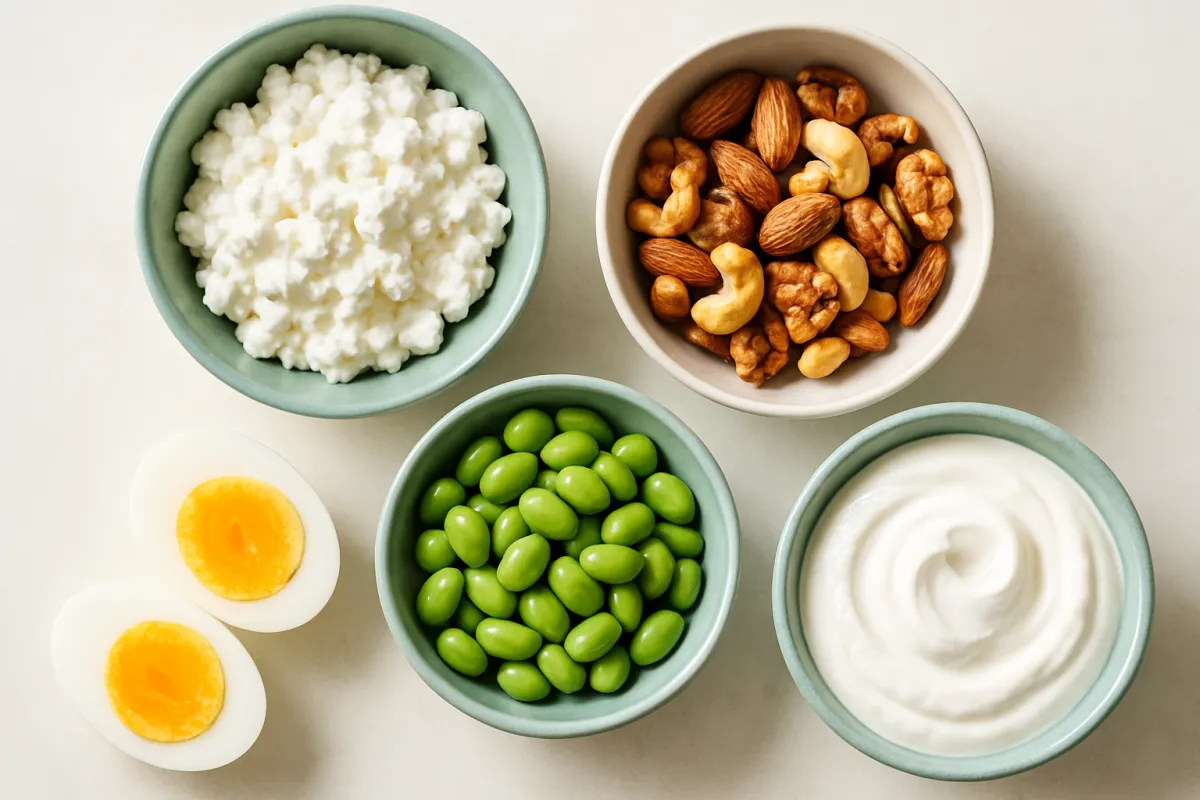
Where they part company is on the lines beside protein. Cottage cheese usually carries considerably more sodium, since salt is part of how it is made, while yogurt carries live cultures and generally more lactose. Texture decides most people’s preference, and the honest answer to which is higher in protein is that the variation between brands within each category is wider than the gap between the categories.
Against the other cold proteins, strained yogurt does well per serving. A cup beats a couple of eggs comfortably, beats a handful of nuts by a wide margin on protein per calorie, and roughly matches a drained can of tuna. The high protein snacks review lines up the wider set, and the common foods protein review puts dozens of staples on one scale.
Greek Yogurt Against Meat, Fish, and Eggs
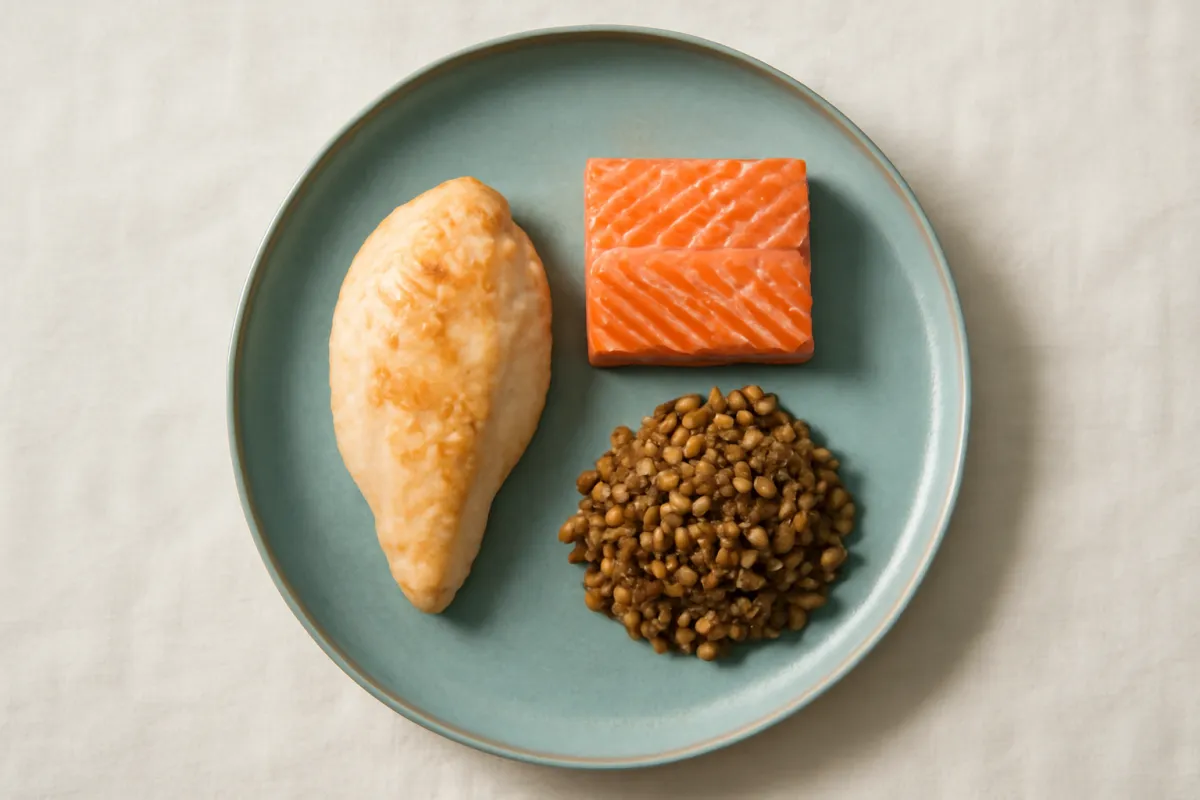
Set against cooked animal proteins on a per 100 gram basis, strained yogurt sits respectably but not at the top. Cooked chicken breast is commonly cited near 31 grams per 100 grams, cooked fish such as salmon and tuna lands in the low to mid 20s, lean cooked ground beef sits in the mid 20s, and plain strained yogurt sits near 10. Meat and fish are simply denser in protein once their water has cooked off.
The comparison flips once servings enter the picture. People eat a cup of yogurt, around 227 grams, far more readily than they eat 227 grams of chicken, so a cup at 23 grams competes with a modest cooked portion of meat or fish rather than losing to it. The chicken breast review, the salmon review, and the ground beef review give the per portion figures for each.
The other axis is effort. Yogurt needs no cooking, no timing, and no cleanup, which makes it a protein source people reach for on the days that meat planning collapses. Availability matters as much as density in practice, and a cup eaten is worth more than a chicken breast still in the freezer. None of this is a recommendation about what anyone should eat, only a placement of yogurt on the map.
Is Greek Yogurt a Complete Protein?
Yes. Dairy protein supplies all nine essential amino acids, the ones the body cannot manufacture and must obtain from food, in useful proportions within a single food. That places strained yogurt in the same completeness category as eggs, meat, fish, and soy, and it means a serving contributes usable protein rather than a partial profile that needs pairing.
Straining shifts the ratio toward casein without removing any amino acid from the picture, so the profile stays complete. Dairy protein also scores well on the measures nutrition scientists use to rank protein quality, which weigh the amino acid pattern together with how well the protein is digested and absorbed. Two foods declaring the same grams are not always equivalent in what the body can use, and dairy sits at the favourable end of that spectrum.
For people eating little or no meat, that completeness makes strained yogurt a particularly useful anchor, since it delivers a full profile in a form that needs no combining or planning. The protein without meat review covers how the rest of a vegetarian pattern fits together. This describes food composition and general nutrition science, not a health claim about any individual.
Lactose, Digestion, and Who Should Check First
Straining carries a large share of the lactose out with the whey, so plain strained yogurt generally contains less milk sugar per 100 grams than plain unstrained yogurt. Fermentation reduces it further, because the bacterial cultures consume some lactose in the process of making the yogurt in the first place. Those two effects together are why some people who find milk uncomfortable report tolerating yogurt more easily.
That is a general observation about composition, not a recommendation, and it comes with clear limits. Less lactose is not no lactose, individual tolerance varies enormously, and a milk allergy is a completely different matter from lactose intolerance and is not affected by straining at all. Anyone with a diagnosed dairy allergy should follow the guidance they were given rather than any general statement here.
Several other groups have good reason to check before making yogurt a staple. People managing kidney disease often have individual guidance about protein, phosphorus, and potassium. People on certain medications, people who are pregnant, and anyone with a condition affecting digestion or nutrient needs may have specific advice that overrides general nutrition information. All of those conversations belong with a doctor or registered dietitian who knows the full picture, not with a nutrition table.
How Greek Yogurt Fits a Day’s Protein
A serving’s protein only means something against a daily total, and this review does not set that total for anyone. Needs depend on body size, activity, age, and circumstances, a subject the protein needs review treats properly and the daily nutrient reference tabulates alongside other nutrients. What can be said cleanly is how a serving scales against whatever figure applies to you.
Take an illustrative daily figure of 90 grams, chosen purely to make the arithmetic visible. A cup of plain nonfat strained yogurt at about 23 grams covers roughly a quarter of it in one bowl. A single 150 gram container at about 15 grams covers around a sixth. Against a lower figure the same servings cover proportionally more, and against a higher one proportionally less; the relationship is simple division. Enter your own target in the companion below to see the share update.
The structural advantage strained yogurt offers is breakfast. Protein most often goes missing at the first meal, and yogurt is one of very few high protein foods that require no preparation at all. Front loading a quarter of a day’s protein before leaving the house makes the rest of the day considerably easier to balance, which is the practical logic behind its popularity. Your own target is best confirmed with a qualified professional, particularly if you have any medical condition.
A Worked Example: A 30-Gram Breakfast
To pull the figures together, here is an illustrative breakfast built to land near 30 grams of protein. It is chosen to show the arithmetic, not to recommend a number for anyone.
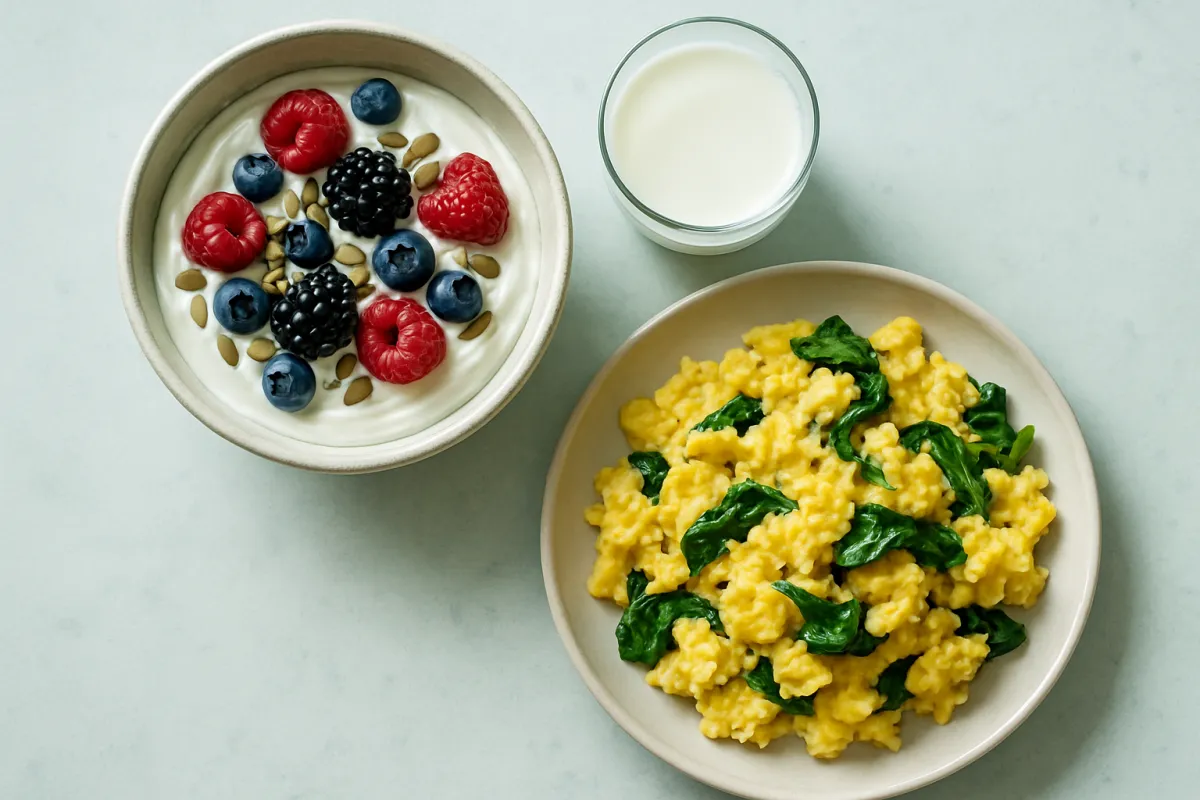
Start with one cup of plain nonfat strained yogurt, about 227 grams, for roughly 23 grams of protein and about 135 calories. That single bowl already carries more protein than most conventional breakfasts. Add a small handful of almonds, about an ounce or 28 grams, for roughly 6 grams more and about 165 calories. The running total is near 29 grams. Add a half cup of mixed berries for another gram or so and about 40 calories, and the breakfast lands right around 30 grams of protein for roughly 340 calories.
Two things stand out in that arithmetic. First, the yogurt does the overwhelming majority of the work, supplying more than three quarters of the protein for under half the calories. Second, the toppings are where the calories concentrate, which is the reverse of what most people assume when they look at a topped bowl. Swapping the almonds for a spoonful of seeds, or the berries for a drizzle of honey, moves the calorie total far more than it moves the protein.
Build your own version, with your serving size, product type, and target, in the companion below. The 30 gram figure is illustrative, chosen because it is a round number that makes the math legible, not a target this review advises anyone to hit.
How Much Greek Yogurt for 20, 30, or 40 Grams
Running the arithmetic backwards from a goal is often more useful than running it forwards from a serving. Because plain nonfat strained yogurt sits near 10 grams of protein per 100 grams, the weight needed is roughly the goal multiplied by ten, in grams.
| Protein goal | Plain nonfat yogurt alone | A more realistic mix |
|---|---|---|
| ~20 g | ~200 g, one 7 oz container | one container plus fruit |
| ~30 g | ~300 g, about 1 1/3 cups | 1 cup yogurt plus an ounce of nuts |
| ~40 g | ~400 g, about 1 3/4 cups | 1 cup yogurt, 2 eggs, and an ounce of nuts |
The left column makes the ceiling visible. Reaching 40 grams from yogurt alone means eating close to 400 grams of it in one sitting, which is a large bowl by any standard and more than most people want in one go. The right column shows the pattern people actually use, which is one generous serving of yogurt plus one or two other protein foods. A cup of yogurt at 23 grams, two large eggs at about 12, and an ounce of almonds at about 6 clears 40 grams comfortably.
The same logic applies at every level. Yogurt is an excellent anchor and a poor sole source, exactly like eggs, and combining it with one other protein food reaches a meaningful total more comfortably than stacking a single food high. These are illustrative planning figures, and any specific target belongs with a professional rather than a table.
Reading the Label on Your Own Tub
Everything above is a category typical range, and the only figures that describe your yogurt are on your yogurt. Four lines settle it. Find the declared serving size in grams. Find the protein line for that serving. Divide protein by serving weight and multiply by 100 to get the comparable per 100 gram number. Then check whether the product is plain or flavored, because that alone explains most of the differences between two tubs of similar size.
The ingredient list adds the last piece. A short list running milk, live cultures, and nothing else describes a straightforward strained yogurt. A longer list including milk protein concentrate suggests protein was raised by fortification, which is fine and effective. A list featuring starches or gums high up suggests thickness was achieved without adding protein at all. None of these are hidden; they are simply printed in small type.
One thing a label cannot tell you is how hard the product was strained, since that is a process rather than an ingredient. The protein per 100 gram figure is the observable consequence, which is why it is the number worth relying on. The nutrition label review walks the whole panel in order for readers who want the full method.
Common Mistakes Counting Yogurt Protein
A handful of recurring errors account for most of the confusion in this category, and each is easy to correct once named.
- Assuming thickness means protein. Texture can come from straining, from added milk protein, or from starch and gums, and only the first two raise the protein figure. The panel settles it, the spoon does not.
- Comparing servings instead of products. Two tubs with different declared serving sizes cannot be compared on their protein lines directly. Converting both to protein per 100 grams is the only fair comparison.
- Treating flavored and plain as interchangeable. Flavored versions usually carry slightly less protein and considerably more sugar and calories than the plain version of the same line.
- Overrating the fat penalty. Whole milk versions carry a gram or two less protein per 100 grams than nonfat, not half as much. The real difference between them is calories.
- Reading a category figure as a product fact. Every number in this review is a typical range across a wide category. Straining levels, milk, and recipe move them, and only your own label applies to you.
Each of these is a counting error rather than an eating error, and clearing them up makes the simple per 100 gram rule reliable. The arithmetic only works when you know which product and which serving you are dealing with.
The Bottom Line
How much protein in Greek yogurt reduces to one figure that scales cleanly: plain strained yogurt typically carries around 10 grams of protein per 100 grams, so a one cup serving of roughly 227 grams lands near 23 grams and a common 5.3 ounce container near 15 to 18. The reason is straining, which pours off most of the watery whey and leaves a curd holding most of the casein in about 40 percent of the original weight, roughly doubling protein per spoonful compared with unstrained yogurt while carrying out lactose and some calcium as well. Fat level moves the protein line by only a gram or two per 100 grams while moving calories far more, flavored versions trade a little protein for a lot of sugar, and thickness on its own proves nothing, since starch and gums can imitate the texture of straining without the protein. Against other foods, a cup competes with a can of tuna and beats three eggs, and it does so with no cooking at all. Every figure here is a typical range for a broad category rather than a verified fact about any brand, so pair it with the protein needs review for how much you need, read your own tub’s panel for what you actually bought, and confirm anything specific to your health with a qualified professional.
Published by NourishMark for general education, this evidence review describes the typical composition of strained and unstrained yogurt and broad nutrition science. It is not medical, dietetic, or dietary advice, it has not been reviewed by a clinician or registered dietitian, and reading it creates no professional relationship of any kind. Yogurt is not a standardized product: straining level, milk, fat content, added ingredients, and container size all move the numbers, so every protein, calorie, and weight figure above is a typical range across a category rather than a measurement of any brand or tub. Where a precise per product number would have been convenient, this review declines to invent one and points to your own label instead. Nothing here tells anyone how much yogurt to eat. For a protein target or eating pattern suited to your body, goals, medications, pregnancy, allergies, digestion, kidney function, or any medical condition, speak with a doctor or registered dietitian.
Frequently asked questions
How much protein is in a cup of Greek yogurt?
A one cup serving of plain Greek yogurt, roughly 227 grams, commonly lands near 23 grams of protein when the product is a nonfat plain one. Cups of the low fat and whole milk versions sit a little lower, generally in the high teens to about 20 grams, because fat takes up some of the weight that protein would otherwise occupy. Flavored tubs usually come in lower again once added sugar is part of the mix. These are typical ranges rather than facts about any particular tub, so the protein line on your own label is the figure that actually applies to what you bought.
How much protein is in a single-serve container of Greek yogurt?
The most common single serve size is about 5.3 ounces, near 150 grams, and a plain nonfat one at that size typically supplies somewhere around 15 to 18 grams of protein. Larger 7 ounce containers, close to 200 grams, run correspondingly higher, often near 20 grams. Smaller 4 ounce cups and children's pouches fall well below both. Container sizes are not standardized across the category, so the only reliable way to know your number is to read the serving size and the protein line together on the package in front of you.
Why does Greek yogurt have more protein than regular yogurt?
Greek yogurt is strained, which means much of the watery whey is separated out and poured off after fermentation. What is left behind is a denser curd, so the protein that remains is packed into far less weight and volume. The mechanism is concentration rather than addition: nothing is added to raise the protein, a large share of the liquid is simply removed. That is why plain Greek yogurt typically shows roughly double the protein per 100 grams of a plain unstrained yogurt, and why it is so much thicker in the bowl.
Does full-fat Greek yogurt have less protein than 0%?
Slightly less by weight, yes, but the gap is smaller than most people expect. Fat occupies some of the space in every 100 grams, so a whole milk Greek yogurt usually shows a protein figure a gram or two per 100 grams below a nonfat one, which works out to a few grams across a full cup. The calorie difference is the larger one, since fat is energy dense. Neither version is the correct choice in any general sense, and which one suits a particular person depends on their whole diet, a question for a qualified professional rather than a nutrition table.
How much protein is in 100 grams of Greek yogurt?
Plain nonfat Greek yogurt is commonly cited at around 10 grams of protein per 100 grams, with plain low fat and whole milk versions running closer to 8 or 9. Very heavily strained styles can reach 11 or more. Per 100 grams is the most useful figure to compare with, because it strips out the differences in cup sizes and container sizes that make label numbers hard to line up. Treat these as typical ranges across the category and confirm the value for your own product on its panel.
Is Greek yogurt higher in protein than cottage cheese?
The two are close enough that neither wins cleanly. Both plain Greek yogurt and plain cottage cheese commonly land somewhere around 10 to 11 grams of protein per 100 grams, and both are therefore near 23 to 25 grams in a cup sized serving. Where they differ more is sodium, which is usually higher in cottage cheese, and texture, which decides most people's preference. Brand to brand variation within each category is wide enough that a specific tub of either can beat a specific tub of the other, so comparing the two labels is more informative than comparing the two categories.
Does flavored Greek yogurt have less protein than plain?
Usually a little less, because added sugar, fruit preparation, and other ingredients take up part of every 100 grams, leaving proportionally less room for the strained yogurt itself. The more visible change is in calories and sugars, which can climb substantially compared with the plain version of the same product line. The protein drop is often modest, perhaps a gram or two per 100 grams, while the sugar difference can be large. Reading both lines on the panel, protein and added sugars together, gives a truer picture than either one alone.
Is Greek yogurt a complete protein?
Yes. Dairy protein supplies all nine essential amino acids, the ones the body cannot make for itself, in useful proportions, so Greek yogurt counts as a complete protein in the same way milk, eggs, and meat do. Straining shifts the balance toward casein, the slower digesting fraction, because much of the faster whey protein leaves with the liquid, but the amino acid profile stays complete. This describes food composition and general nutrition science rather than any claim about health outcomes for an individual.

Hamza Hai is the editor of NourishMark. She holds an MBA and reviews the site's articles against our editorial standards, checking that every figure is labelled for what it is, that nothing is presented as verified fact without a source the reader can check, and that the writing stays useful to a non-specialist.