What's in this review
- Salmon Protein: The Direct Answer
- Protein by Salmon Portion: A Quick Table
- How Much Protein in 3 oz of Salmon?
- How Much Protein in 100g of Salmon?
- How Much Protein in a Salmon Fillet?
- Protein by Weight and Serving: A Reference Table
- Raw vs Cooked Salmon Protein
- Wild vs Farmed Salmon: Protein, Fat, and Omega-3
- Calories Alongside the Protein
- Omega-3 Fats: What Comes With the Protein
- Other Nutrients in Salmon
- Is Salmon a Complete Protein?
- Canned Salmon Protein
- Salmon vs Chicken vs Beef Protein
- Salmon vs Other Fish and Seafood
- How Salmon Fits a High-Protein Diet
- How Salmon Fits Your Daily Protein Needs
- How Much Salmon for 30, 50, or 100 Grams of Protein?
- Does the Cooking Method Change the Protein?
- A Worked Example: A Day That Hits a Protein Target
- Common Mistakes Counting Salmon Protein
- The Bottom Line
Short answer: Cooked salmon is commonly cited at about 22 to 25 grams of protein per 100 grams, based on USDA food composition data, with roughly 25 grams a useful reference rate. That puts a 3 ounce cooked serving near 22 grams, a 4 ounce portion near 28, and a 6 ounce fillet portion close to 40. Raw salmon reads lower, near 20 grams per 100 grams, because water cooks off.
If you want to know how much protein is in salmon, here is the direct answer: a cooked serving carries roughly 22 to 25 grams of protein per 100 grams, so a common 3 ounce portion lands near 22 grams and a larger 6 ounce fillet portion reaches close to 40 grams. The reference rate to remember is about 25 grams of protein per 100 grams of cooked salmon, drawn from USDA food composition data, and everything else scales from there by weight. That makes salmon a high-quality protein that also brings omega-3 fats and vitamin D along with it.
This evidence review is the salmon-specific answer, distinct from our broader protein in common foods review that covers dozens of staples at once. It works through the protein per 3 ounces, per 100 grams, and per fillet, why raw and cooked numbers differ, how wild and farmed salmon compare on protein, fat, and omega-3, the calories and other nutrients that come with the protein, canned salmon, and how salmon stacks up against chicken and beef. It is educational, describes food composition and general nutrition science only, and is not medical or dietary advice. For how much protein you personally need, see our protein needs review, and you can match a portion to your own target in the companion below.
Key takeaways
- Cooked salmon is commonly cited at about 22 to 25 grams of protein per 100 grams, based on USDA food composition data, with roughly 25 grams as a useful reference rate.
- A 3 ounce cooked serving carries around 22 grams of protein, a 4 ounce portion about 28 grams, and a 6 ounce fillet portion close to 40 grams.
- Raw salmon reads lower, near 20 grams per 100 grams, because raw fish holds water that cooks off and concentrates the protein; the total in the actual piece barely changes.
- Wild and farmed salmon are close on protein; the difference is mostly fat, calories, and omega-3, with farmed usually fattier and wild leaner.
- Every figure here is a commonly cited, illustrative reference for food composition, not a personal target or medical advice; confirm your own needs with a professional.
Salmon Protein: The Direct Answer
The direct answer is that cooked salmon carries roughly 22 to 25 grams of protein per 100 grams, and it is a small range rather than a single number because the figure shifts a little with the species, whether the fish is wild or farmed, and how it is weighed. The rate most food databases converge on, drawing on USDA food composition data, is about 25 grams of protein per 100 grams of cooked salmon. Multiply that rate by the weight of your portion and you have the total.
It helps to anchor the range. A common 3 ounce cooked serving carries close to 22 grams of protein, a 4 ounce portion lands near 28 grams, and a larger 6 ounce fillet portion reaches about 40 grams. Even a moderate portion is a substantial amount of protein from one food, and unlike leaner proteins, salmon delivers that protein alongside omega-3 fats, vitamin D, and vitamin B12. The rest of this review breaks that rate down by portion, sorts out the raw-versus-cooked confusion, and sets salmon against chicken, beef, other fish, and canned salmon. Set your own portion and a target in the companion below to see the arithmetic update as you read. As with everything here, these are commonly cited, illustrative references rather than an exact reading of any particular fillet.
Protein by Salmon Portion: A Quick Table
Because salmon is sold and served in such a wide range of portion sizes, the protein per portion is best shown as a small table rather than a single number. The figures below assume cooked salmon at the commonly cited rate of about 25 grams of protein per 100 grams, grounded in USDA-based food composition data, and they give a quick sense of how much the portion on your plate matters.
| Portion | Weight (cooked) | Protein, roughly |
|---|---|---|
| Small | ~3 oz (~85 g) | ~22 g |
| Medium | ~4 oz (~113 g) | ~28 g |
| Fillet portion | ~6 oz (~170 g) | ~42 g |
| Large | ~8 oz (~227 g) | ~57 g |
Protein by salmon portion
Grams of protein in cooked salmon at about 25 g per 100 g, based on USDA-derived figures. Illustrative reference values.
Bars scale to a large 8 oz portion at 100 percent. Figures assume cooked salmon and shift with the exact weight; they are illustrative references, not a target.
The chart makes the point that a word like “salmon” can mean anything from about 22 to nearly 60 grams of protein depending on the portion, which is a wide spread when you are counting closely. A restaurant fillet or a generous home portion often sits at the fillet-to-large end rather than the small one. The practical takeaway is to weigh or eyeball the actual portion rather than assuming a fixed number per serving. These are commonly cited averages, and the exact protein in any single piece varies with the species and the cut.
How Much Protein in 3 oz of Salmon?
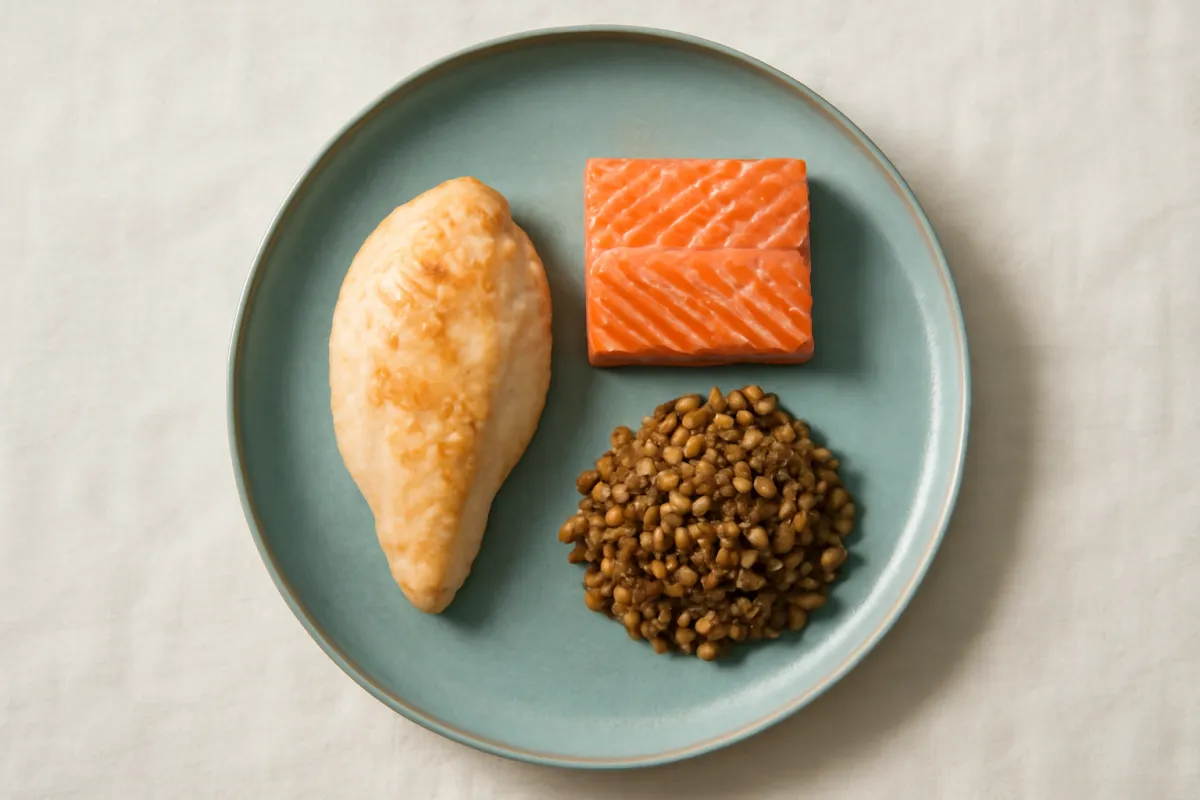
Three ounces of cooked salmon is about 85 grams, which carries roughly 22 grams of protein at the commonly cited rate of 25 grams per 100 grams, and USDA figures put a standard cooked serving in that range. Three ounces is the portion many dietary references use as a single serving of fish, often described as about the size of a deck of cards or the palm of a hand, so it is a useful anchor to keep in mind.
To put 22 grams in context, it is comparable to the protein in nearly four large eggs, from one modest piece of fish, and it comes bundled with a serving of omega-3 fats and vitamin D that eggs do not match. For many people a 3 ounce cooked portion covers a solid share of a meal’s protein on its own, with room to add a side. One detail worth flagging: if you weigh the 3 ounces raw rather than cooked, the protein per ounce is a little lower, because raw fish holds more water, and the same raw portion shrinks after cooking. So a 3 ounce cooked serving and a 3 ounce raw serving are not quite the same thing. This is an illustrative reference figure rather than an exact measurement of any specific portion. Enter your own portion in the companion below to see the protein update.
How Much Protein in 100g of Salmon?
The cleanest way to state salmon protein is per 100 grams, because that removes the guesswork about portion size. Cooked salmon is commonly cited at about 22 to 25 grams of protein per 100 grams, drawing on USDA food composition data, and that is the reference rate this whole review builds on. It is a strong figure among whole foods, a little below the leanest poultry but paired with a package of omega-3 fats and micronutrients that leaner proteins lack.
The one thing to watch is whether the 100 grams is weighed raw or cooked, because the two give different numbers. Cooked salmon is near 25 grams per 100 grams, while raw salmon is closer to 20 grams per 100 grams. That is not because cooking adds protein; it is because raw fish holds more water, so a raw 100 gram sample is partly water that cooks away. The raw-versus-cooked section below handles this in detail, but the short version is that the higher figure applies to cooked fish. There is also a small spread between wild and farmed salmon on this basis, though it is minor for protein specifically. These are illustrative reference values that vary a little with the species and the preparation.
How Much Protein in a Salmon Fillet?
A salmon fillet is where portion size matters most, because fillets are sold in very different weights, from a small individual piece to a large center-cut slab. A typical cooked fillet portion of about 6 ounces, roughly 170 grams, carries close to 40 grams of protein at the commonly cited rate, which is why a fillet is often described as delivering around 40 grams. Six ounces sits right in the middle of what many people plate as a single serving.
Fifty grams and up is possible from a large fillet: an 8 ounce cooked portion, roughly 227 grams, reaches about 57 grams of protein, a very large single serving. There is an important weighing caveat at these sizes, because salmon is usually sold and labeled by its raw weight, and a fillet loses some weight as it cooks, mostly water. So an 8 ounce raw fillet cooks down to a somewhat smaller cooked piece, and its protein total settles nearer the cooked figure than the raw label suggests. If you want the full 40-or-more-gram figure, weigh the portion after cooking or use the raw rate on the raw weight. These are illustrative references for planning rather than a prescribed portion for anyone. Match a fillet portion to your target in the companion below.
Protein by Weight and Serving: A Reference Table
This is the table that answers the common weight-based questions in one place: how salmon protein scales across the portions people actually search for. All figures assume cooked salmon at about 25 grams of protein per 100 grams, based on USDA-derived data, with calories alongside so you can see the full picture. The calorie figures lean toward farmed Atlantic salmon, which is the type most people buy; wild salmon runs a little lower.
| Serving | Weight (cooked) | Protein, roughly | Calories, roughly |
|---|---|---|---|
| 3 oz | ~85 g | ~22 g | ~175 kcal |
| 4 oz | ~113 g | ~28 g | ~230 kcal |
| 6 oz | ~170 g | ~42 g | ~350 kcal |
| 8 oz | ~227 g | ~57 g | ~470 kcal |
| 100 g | 100 g | ~25 g | ~206 kcal |
The table shows how cleanly the protein scales with weight, because the rate per 100 grams is fixed: double the weight and you double the protein. It also shows that salmon carries more calories per gram than a lean protein like chicken breast, because of its healthy fat content, a point the calories and omega-3 sections return to. Use whichever row matches your usual portion and you have the protein figure without a scale. Every number here is a commonly cited reference for cooked salmon, so adjust for wild versus farmed or a raw weight and treat the totals as illustrative rather than exact.
Raw vs Cooked Salmon Protein
The most common confusion about salmon protein is the gap between raw and cooked figures, so it is worth slowing down on it. Cooked salmon shows about 25 grams of protein per 100 grams, while raw salmon shows closer to 20 grams per 100 grams. The instinct is to think cooking somehow adds protein, but it does not. Cooking cannot create protein.
What actually happens is that raw fish holds a lot of water, and heat drives much of that water off. A salmon fillet loses a meaningful share of its weight as it cooks, mostly water, which shrinks the piece and concentrates the protein into a smaller mass. So the protein per gram rises even though the total protein in the fish barely changes. A raw fillet weighing 150 grams holds about 30 grams of protein; after cooking it might weigh 120 grams, still holding close to 30 grams of protein, now at a higher concentration per 100 grams. The practical rule is to be consistent: use the cooked rate for cooked fish and the raw rate for raw fish, and never mix them. Since salmon is usually sold by raw weight, this matters when you weigh before cooking. This is especially relevant for salmon eaten raw, as in sushi or sashimi, where the lower raw rate is the correct one to apply. These are illustrative reference figures for general information.
Wild vs Farmed Salmon: Protein, Fat, and Omega-3
Wild and farmed salmon are the two versions people compare most, and on protein the difference is small. Both land near the commonly cited 22 to 25 grams of protein per 100 grams cooked in USDA-based figures, so protein is rarely the deciding factor between them. If you are choosing salmon for its protein, either one does the job about equally well.
Where the two really diverge is fat and calories. Farmed salmon, most often farmed Atlantic, carries more total fat, which pushes its calories higher for the same weight, commonly near 206 calories per 100 grams cooked versus lower figures for leaner wild species like sockeye or pink. That extra fat is also why farmed salmon often supplies somewhat more total omega-3 grams per serving, even though the balance of different fats differs between the two. Wild salmon is leaner, with fewer calories and a different fat profile, and some people prefer it for that reason, while others choose farmed for its wider availability, milder flavor, and lower cost. Neither is nutritionally wrong: both are excellent protein sources, and the choice comes down to taste, budget, and which nutrients you are prioritizing, not to protein content. These are commonly cited, illustrative figures that vary with species, diet, and preparation.
Calories Alongside the Protein
Salmon carries more calories per gram than a lean protein like skinless chicken breast, and that is entirely down to its fat content. A 100 gram cooked portion of farmed Atlantic salmon carries about 206 calories with its roughly 25 grams of protein, along with a healthy dose of fat. Leaner wild species run lower, often nearer 180 calories per 100 grams cooked. So salmon is protein-dense, but it is not a low-fat food, and that is a feature rather than a flaw for most people, because the fat is largely the omega-3 kind.
Salmon's macros (protein / fat / other)
Approximate makeup by weight of 100 g of cooked farmed Atlantic salmon, based on USDA-derived figures. Illustrative reference values.
Segments show each part's share of 100 g of cooked farmed salmon by weight. Wild salmon is leaner, with less fat and a higher water share. Illustrative figures.
The chart shows why salmon reads higher in calories than a lean white meat: it is about a quarter protein by weight and carries a real amount of fat, with the rest mostly water. That fat is what sets salmon apart, since much of it is the long-chain omega-3 fats that are the whole point of eating oily fish. The calorie figure climbs, of course, with how you cook it, because oil, butter, and rich sauces add energy without adding protein. How this fits your overall day is a matter for our calorie needs review, which handles daily energy directly. These are commonly cited, illustrative figures that vary with the species and preparation.
Omega-3 Fats: What Comes With the Protein
The reason salmon is treated as more than just a protein source is its omega-3 content. Alongside its 25 grams of protein per 100 grams, cooked salmon commonly supplies somewhere around 1.5 to 2.5 grams of the long-chain omega-3 fats EPA and DHA per 100 grams, which is among the highest of any common food. These are the specific fats that most nutrition guidance points people toward oily fish to obtain, since the body makes them only poorly from plant sources.
This is what makes salmon’s protein different from the protein in a lean meat: the two nutrients come bundled. A single serving of salmon a couple of times a week is a commonly cited way to reach the general intake many dietary guidelines suggest for oily fish, though the exact recommendation varies by country and by individual health circumstances. Farmed salmon tends to carry more total omega-3 grams per serving because it is fattier, while wild salmon delivers its omega-3 in a leaner overall package. Either way, when you count salmon’s protein, it is worth remembering you are also getting a nutrient that pure protein foods do not provide. This is a description of food composition and general nutrition science, not a claim that salmon treats or prevents any condition; anyone managing a heart or other health condition should follow their clinician’s guidance.
Other Nutrients in Salmon
Salmon’s protein arrives with more than omega-3. It is one of the few naturally rich food sources of vitamin D, a nutrient many people fall short on, with a serving supplying a large share of a commonly cited daily reference. It is also very high in vitamin B12, which supports nerve and blood cell health, and a single serving typically exceeds the daily reference on its own. That combination is unusual among protein foods and is part of why salmon is so often recommended.
Beyond those headline nutrients, salmon carries a useful amount of selenium, an antioxidant mineral, along with potassium, niacin, and vitamin B6. The pink-orange color of the flesh comes from astaxanthin, a natural antioxidant pigment. None of this changes the protein figure, but it explains why salmon is valued as a nutrient-dense food rather than a protein-only one: the same portion that gives you roughly 25 grams of protein per 100 grams also covers a meaningful slice of several vitamins and minerals. As always, this describes the general composition of the food and is not a statement about anyone’s individual nutrient needs, which depend on diet, health, and other factors best reviewed with a professional.
Is Salmon a Complete Protein?
Yes. Salmon is a complete protein, which means it supplies all nine essential amino acids, the building blocks the body cannot make and must obtain from food, in useful proportions within a single food. Like other animal foods, it clears that bar on its own, without needing to be paired with a complementary protein the way some individual plant foods do. That completeness is part of what makes salmon such a reliable protein choice.
Salmon is also highly digestible, so most of the protein listed for it is available to the body in usable form. On the scoring systems nutrition scientists use to rank protein quality, which weigh both the amino-acid profile and how well a protein is absorbed, fish and seafood score near the top alongside eggs, dairy, poultry, and other high-quality animal proteins. This means the roughly 25 grams per 100 grams is not just present but well used. On top of that, salmon brings the omega-3 fats and vitamin D that set it apart from leaner proteins. That said, this is a factual description of food composition and general nutrition science rather than a health claim or an instruction to eat any particular amount. For how salmon stacks up against other high-quality proteins, our protein in common foods review lays out the wider comparison, and our egg protein review covers the classic reference protein in detail.
Canned Salmon Protein
Canned salmon deserves its own note, because it is a cheap, shelf-stable way to get salmon’s protein and is easy to overlook. Canned salmon, usually pink or sockeye, carries roughly 19 to 22 grams of protein per 100 grams, close to fresh salmon on a per-weight basis, and USDA data on canned varieties supports that range. A standard drained serving of about 85 grams lands near 18 to 20 grams of protein, so a can covers a solid protein serving for very little money and no cooking.
Canned salmon has one bonus that a boneless fillet does not: many cans include the soft, edible bones, which add a meaningful amount of calcium that dissolves into an easily eaten form. That makes canned salmon a rare protein food that is also a real calcium source. The main variable to watch is the packing liquid, since salmon canned in oil carries more calories than salmon canned in water, though the protein is similar either way. Draining the can and checking the label for added sodium are the two practical steps. For everyday high-protein eating on a budget, canned salmon is one of the most efficient options available. These are commonly cited, illustrative figures that vary by brand and packing.
Salmon vs Chicken vs Beef Protein
Salmon, chicken, and beef are the three proteins people most often weigh against each other, and the differences are worth stating plainly. Per 100 grams cooked, salmon sits near 22 to 25 grams of protein, chicken breast is higher at about 31 grams, and lean beef lands around 26 grams. So chicken breast is the most protein-dense of the three by weight, with salmon and beef close to each other and a step below.
| Food | Serving | Protein, roughly |
|---|---|---|
| Chicken breast | 100 g cooked | ~31 g |
| Lean beef | 100 g cooked | ~26 g |
| Salmon | 100 g cooked | ~25 g |
| Canned tuna | 100 g | ~26 g |
| Large egg | 1 egg | ~6 g |
Where salmon wins is not raw protein density but the package it comes in. Chicken breast is leaner and slightly higher in protein per gram, which our chicken breast review covers in full, and beef brings iron and zinc, which our ground beef review details. Salmon brings the omega-3 fats and vitamin D that neither chicken nor beef supplies in any real amount. So the honest comparison is that salmon trades a little protein density for a nutrient profile the others cannot match. A rotation that includes salmon, poultry, and lean red meat covers more ground than leaning on any single one. This review takes no position on which anyone should eat; it only places salmon accurately on the map. All figures are commonly cited references that vary by cut, species, and preparation.
Salmon vs Other Fish and Seafood
Among fish and seafood, salmon is a middle-of-the-pack protein source by weight but a standout for its fat profile. Leaner white fish like cod, haddock, and tilapia actually carry slightly more protein per 100 grams than salmon, often near 26 to 28 grams cooked, because they hold almost no fat, so nearly all their weight that is not water is protein. Canned tuna is similar, around 26 grams per 100 grams, which is why tuna is such a popular lean protein.
What separates salmon from those leaner options is, again, the omega-3 fats. Cod and tilapia are excellent low-calorie proteins, but they carry only a fraction of salmon’s omega-3, so they do not fill the oily-fish role that most dietary guidance points to. Other oily fish such as mackerel, sardines, and trout are closer to salmon in that respect, delivering both solid protein and a strong omega-3 dose. The practical framing is that if you want maximum protein per calorie from seafood, a lean white fish edges out salmon, while if you want protein plus omega-3 in one food, salmon and its oily-fish cousins are the choice. These are commonly cited, illustrative figures that vary by species and preparation.
How Salmon Fits a High-Protein Diet
Salmon earns a regular place in a high-protein diet not by being the single densest protein but by being a high-quality one that also covers other nutritional bases. A 6 ounce fillet portion putting around 40 grams of protein on the plate at once makes salmon an efficient centerpiece for a protein-forward meal, in the same league as a chicken breast, while adding omega-3 and vitamin D that the chicken does not.
The usual way salmon fits a high-protein plan is as one of several protein anchors across the week rather than an everyday staple, both for variety and because many people eat oily fish a couple of times a week rather than daily. Built around a salmon dinner, the rest of the day fills in with other proteins: eggs and yogurt at breakfast, a poultry or plant protein at lunch, and smaller sources across snacks. That approach reaches a meaningful daily protein total while spreading the nutritional benefits across foods. For a broader look at assembling protein across foods, our protein in common foods review is the wider companion to this salmon-specific one. See how a salmon portion fits your own target in the companion below. This describes general eating patterns, not a prescription for anyone.
How Salmon Fits Your Daily Protein Needs
A salmon portion’s protein only means something against a daily target, and that target is a separate question this review does not try to set for you. Daily protein needs depend on body size, activity, age, and goals, which our protein needs review walks through in detail. A common reference point is that many adults aim for somewhere in a wide range of grams per day, and a single salmon fillet portion can supply a large fraction of it, often a third or more, in one meal.
That density is what makes salmon a useful lever for anyone who keeps falling short on protein, with the bonus that the same portion advances omega-3 and vitamin D intake at the same time. A 6 ounce fillet at dinner puts around 40 grams on the plate at once, which can be a third to half of a daily target for many people, leaving the rest to fill in with smaller sources across the day. Because salmon also brings nutrients that pure protein foods lack, it does double duty in a way plain protein does not. The point is not that everyone should eat a specific amount of salmon, but that it slots neatly into whatever target applies to you. Your personal target is best confirmed with a qualified professional, particularly if you have any medical condition.
How Much Salmon for 30, 50, or 100 Grams of Protein?
A practical way to use the 25-grams-per-100-grams figure is in reverse: starting from a protein goal and working out how much cooked salmon it takes. Because the rate is fixed, the arithmetic is simple, and here are the common round-number targets people search for.
| Protein goal | Cooked salmon | In everyday terms |
|---|---|---|
| ~30 g | ~120 g (~4 oz) | one moderate portion |
| ~50 g | ~200 g (~7 oz) | one large fillet portion |
| ~100 g | ~400 g (~14 oz) | roughly two large portions |
The table shows how efficiently salmon delivers protein: a moderate portion covers 30 grams, and one large fillet portion gets you to about 50. Reaching 100 grams from salmon alone means roughly two large portions, which is a lot of fish for one day, so in practice most people spread a high target across salmon plus other protein foods rather than eating it all from one source. That is usually more comfortable, more affordable, and more balanced than piling on salmon, and it also keeps the day’s fat and calorie load in a sensible place. These are illustrative reference figures for planning, and any specific target belongs with a professional rather than a table. Build your own version in the companion below.
Does the Cooking Method Change the Protein?
A frequent worry is that baking, grilling, pan-searing, poaching, or smoking somehow changes how much protein a salmon fillet delivers. It does not, at least not meaningfully. The protein in the fish is essentially fixed; what the cooking method changes is mostly the water content, which affects the per-100-gram figure, and the added fat, which affects calories.
All cooking drives off some water, which is what concentrates the protein into the roughly 25-grams-per-100-grams cooked figure regardless of method. A drier method like grilling or roasting removes a bit more water than a moist method like poaching, so grilled salmon can read a touch higher per 100 grams simply because it is more concentrated, but the total protein in the piece is about the same. Salmon eaten raw, as in sushi or sashimi, keeps the higher water content and so reads at the lower raw rate near 20 grams per 100 grams. Where methods really differ is added fat: pan-frying in oil or finishing with butter or a sweet glaze adds calories without adding protein, while baking, grilling, poaching, and broiling keep it closer to the plain figure. So the protein is stable across methods, and the calorie figure is what you make it. These are general nutrition points and illustrative figures, not a personal recommendation.
A Worked Example: A Day That Hits a Protein Target
To pull the numbers together, here is an illustrative day built to reach about 120 grams of protein, chosen only to show the arithmetic rather than to recommend a figure for anyone. Anchor dinner with a 6 ounce cooked salmon fillet for roughly 42 grams, already a third of the day’s total from one food, and one that brings omega-3 and vitamin D along with it. That is the centerpiece the rest of the day builds around.
Add three eggs at breakfast for about 18 grams, a cup of Greek yogurt for around 17 grams, a 4 ounce portion of chicken or a second protein at lunch for roughly 30 to 35 grams, and a handful of smaller sources across snacks, and the day clears 120 grams comfortably. The lesson mirrors the reverse-target table: salmon does a real share of the heavy lifting because it is protein-dense and nutrient-rich, but spreading the rest across a few other foods reaches a meaningful target more easily and with better balance than stacking salmon alone. Build your own version, with your portion and target, in the companion below. The 120-gram figure here is illustrative, chosen to show the math, not a number this review advises anyone to hit.

Common Mistakes Counting Salmon Protein
A handful of recurring errors explain most of the confusion around salmon protein, and each is easy to fix once named.
- Mixing raw and cooked figures. Cooked salmon is about 25 grams per 100 grams and raw is about 20; using the cooked rate on a raw weight, or the reverse, throws the count off, which matters for sushi and sashimi.
- Assuming every fillet is the same size. Portions range from about 22 to nearly 60 grams of protein each; weighing or eyeballing the actual portion beats a fixed per-fillet number.
- Forgetting the cooking shrink. A fillet loses some weight cooking, so a large raw piece is smaller cooked, and its protein total settles nearer the cooked figure than the raw label suggests.
- Expecting salmon to match chicken breast per gram. Salmon is slightly lower in protein per 100 grams than chicken breast; what it adds is omega-3 and vitamin D, not more protein.
- Treating illustrative figures as exact. Every number here is a commonly cited reference, based on USDA food composition data, that varies with the species, the cut, and the preparation.
Each of these is a counting error rather than an eating error, and clearing them up makes the simple 25-grams-per-100-grams rule far more reliable. The arithmetic only works when you know which weight, raw or cooked, and which portion size you are dealing with.
The Bottom Line
How much protein is in salmon comes down to one rate and one caveat: about 25 grams of protein per 100 grams of cooked salmon, based on USDA food composition data, and it all depends on the size of the portion. A 3 ounce serving carries near 22 grams, a 4 ounce portion about 28, and a 6 ounce fillet portion close to 40, so a typical serving lands in a wide 22-to-42-gram range. Raw salmon reads lower per 100 grams, near 20 grams, only because raw fish holds water that cooks off and concentrates the protein; the total in the actual piece barely changes. Wild and farmed salmon are close on protein, with the real differences in fat, calories, and omega-3, and salmon overall trades a little protein density against chicken for a nutrient package, omega-3 and vitamin D, that leaner proteins do not offer. Every figure here is a commonly cited, illustrative reference for food composition, not a personal prescription, so pair it with our protein needs review for how much you need and confirm anything specific to your health with a qualified professional.
This evidence review is published for general education and describes the commonly cited, USDA-based composition of salmon and broad nutrition science, not medical, dietetic, or dietary advice, and reading it creates no clinician-patient relationship. Every protein figure, calorie figure, omega-3 estimate, and portion weight above is an illustrative, widely referenced approximation rather than an exact measurement, and real salmon varies with the species, whether it is wild or farmed, the cut, and the preparation. This article does not tell anyone how much salmon to eat, and its comparisons between fish, poultry, and other foods describe general food composition rather than guidance for any individual. Anyone with questions about mercury, pregnancy, fish allergies, or how oily fish fits a heart or other health condition should speak with a qualified professional. For a protein target or eating plan suited to your body, goals, medications, or any medical condition, consult a doctor or registered dietitian.
Frequently asked questions
How much protein is in salmon?
A cooked serving of salmon carries roughly 22 to 25 grams of protein per 100 grams, and USDA food composition data is the basis most databases use for that figure. A common 3 ounce cooked portion, about 85 grams, lands near 22 grams of protein, while a larger 6 ounce fillet portion reaches closer to 40 grams. The exact number shifts a little with wild versus farmed salmon and with raw versus cooked weight, but the protein content is broadly similar across salmon types. Treat these as commonly cited, illustrative reference figures for food composition rather than an exact reading of any particular fillet.
How much protein is in 3 oz of salmon?
Three ounces of cooked salmon, about 85 grams, carries roughly 22 grams of protein at the commonly cited rate of about 25 grams per 100 grams, and USDA figures put a standard cooked serving in that range. Three ounces is the portion size many dietary references use as a single serving of fish, often described as about the size of a deck of cards. That makes a 3 ounce portion a solid, moderate serving of high-quality protein. If the 3 ounces is weighed raw rather than cooked, the protein reads a little lower per ounce because raw fish holds more water. This is an illustrative reference figure rather than an exact measurement of any specific portion.
How much protein is in 100g of salmon?
Cooked salmon is commonly cited at about 22 to 25 grams of protein per 100 grams, drawing on USDA food composition data, which is the cleanest way to state the figure because it removes any guesswork about fillet size. Raw salmon is lower on the same 100 gram basis, closer to 20 grams, because raw fish holds more water that cooks off and concentrates the protein. The number is broadly similar for wild and farmed salmon, since the protein content of the flesh does not change much between them. These are illustrative reference values that vary a little with the species, the cut, and the exact preparation.
How much protein is in a whole salmon fillet?
A salmon fillet portion covers a wide range because fillets are sold in very different sizes, but a typical cooked portion of about 6 ounces, roughly 170 grams, carries close to 40 grams of protein at the commonly cited rate. A smaller 4 ounce portion lands nearer 28 grams, and a large 8 ounce piece can reach around 55 grams. Because salmon is usually sold and weighed raw, and a fillet loses some weight as it cooks, the cooked portion and its protein settle a little lower than the raw label suggests. These are commonly cited, illustrative figures that shift with the exact size of the fillet.
Is wild or farmed salmon higher in protein?
Wild and farmed salmon are very close in protein, both landing near the commonly cited 22 to 25 grams per 100 grams cooked in USDA-based figures, so protein is rarely the deciding factor between them. The bigger difference is fat: farmed salmon usually carries more total fat and calories, while wild salmon is leaner. That extra fat in farmed salmon also means it often supplies somewhat more total omega-3 grams per serving, though the overall fat profile differs between the two. For protein specifically, the two are close enough that either is an excellent high-quality source. These are illustrative reference figures that vary with species, diet, and preparation.
How much protein is in canned salmon?
Canned salmon carries roughly 19 to 22 grams of protein per 100 grams, close to fresh salmon on a per-weight basis, and USDA data on canned varieties supports that range. A standard drained serving of about 85 grams lands near 18 to 20 grams of protein, making canned salmon a convenient, shelf-stable protein source. Canned salmon packed with the soft edible bones also adds a meaningful amount of calcium that a boneless fillet does not provide. Because some cans are packed in oil and others in water, the calories vary more than the protein does. These are commonly cited, illustrative figures that vary by brand and packing.
Does salmon have as much protein as chicken?
Salmon has slightly less protein per 100 grams than chicken breast, with cooked salmon near 22 to 25 grams and cooked chicken breast closer to 31 grams, so chicken breast is the more protein-dense of the two by weight. What salmon adds that chicken does not is a substantial dose of omega-3 fats and vitamin D, so the comparison is not simply about which has more protein. Both are complete, highly digestible proteins that fit easily into a high-protein diet. For a closer look, our chicken breast review covers poultry in detail, and this comparison describes food composition rather than telling anyone which to choose. These are commonly cited, illustrative figures.
Is salmon a complete protein?
Yes, salmon is a complete protein, meaning it supplies all nine essential amino acids, the ones the body cannot make and must obtain from food, in useful proportions within a single food. Like other animal foods, it clears that bar on its own, without needing to be combined with a complementary protein. Salmon is also highly digestible, so most of the protein it lists is available to the body in usable form. On top of that completeness, it brings omega-3 fats, vitamin D, and vitamin B12 that many other proteins lack. This is a description of food composition and general nutrition science, not a recommendation about how much anyone should eat; those with specific needs should consult a doctor or registered dietitian.

Hamza Hai is the editor of NourishMark. She holds an MBA and reviews the site's articles against our editorial standards, checking that every figure is labelled for what it is, that nothing is presented as verified fact without a source the reader can check, and that the writing stays useful to a non-specialist.

Dr. Shayaan Khan is the medical reviewer for NourishMark. He holds an MBBS from MGM Medical College, Navi Mumbai, and is the author of published research including a narrative review of postpartum anxiety and depression in Mental Health Science. He has taught physiology at university level. He reviews the site's health content for medical accuracy: that physiology and mechanisms are described correctly, that no claim is stated more strongly than the evidence behind it, and that anything specific to an individual reader is sent to that reader's own clinician.
Not medical advice. Dr. Khan reviews NourishMark's health content for medical accuracy. He is not a registered dietitian, he does not hold a United States practising licence, and he is not your doctor. His review does not make anything here medical advice. Always talk to a qualified health professional about your own situation, and never delay or stop care because of something you read here.