What's in this review
- How Much Potassium per Day? The Direct Answer
- The Potassium Daily Target by Age and Sex
- Adequate Intake, Not RDA: What That Distinction Means
- Why the Old 4,700 mg Figure Still Circulates
- What Potassium Does in the Body
- Potassium and Sodium: The Ratio That Matters Most
- Why Most People Fall Short of the Target
- Why Potassium Now Appears on the Nutrition Facts Label
- Reading the Percent Daily Value for Potassium
- Food Sources of Potassium: A Reference Table
- Which Foods Have the Most Potassium per Serving
- The Banana Myth: What Actually Beats It
- Beans and Lentils: The Quiet Leaders
- Potatoes and Starchy Vegetables
- Leafy Greens and What Cooking Volume Does
- Dairy, Yogurt and Fortified Alternatives
- Fish, Meat and Poultry
- Fruit Beyond Bananas: Dried Fruit, Citrus and Melon
- How Cooking Method Changes Potassium Retention
- Deliberate Leaching Is a Medical Technique, Not a Kitchen Tip
- A Day of Eating That Hits the Target
- Who Needs to Be Careful With Potassium
- Salt Substitutes Are Usually Potassium Chloride
- Supplements and the 99 mg Tablet
- What Falling Short Looks Like, in General Terms
- Sweat, Sports Drinks and Cramps
- Potassium in Context With Other Nutrients
- Common Mistakes When Counting Potassium
- A Short Potassium Shopping List
- Does Potassium Lower Blood Pressure
- How to Read Potassium Units: mg and mmol
- The Bottom Line
Potassium is the nutrient almost nobody tracks and most people fall short of. The commonly cited daily figures for adults sit around 3,400 milligrams for men and 2,600 for women, and survey estimates of what people actually eat have consistently landed below those numbers for most groups. That is unusual. Protein, sodium and calories are all things the average diet supplies in abundance, and potassium is the mineral quietly running the other direction.
This evidence review covers the daily target and how it varies by age and sex, what potassium does in the body, the potassium and sodium relationship that matters more than either number by itself, why potassium suddenly started appearing on the Nutrition Facts panel, which foods carry it in realistic portions, how cooking method changes what survives, and, importantly, who should not increase their intake without a clinician’s involvement. For the wider set of reference figures our daily nutrient intake reference sits alongside this piece, and you can sketch your own rough day in the companion below. Everything here is general education describing approximate figures, not medical or dietary advice.
Key takeaways
- The commonly cited Adequate Intake figures are about 3,400 mg a day for adult men and about 2,600 mg for adult women, with roughly 2,900 mg in pregnancy and 2,800 mg while breastfeeding.
- The 4,700 mg number that still circulates is the older reference value, and it is also the Daily Value used for percentages on the Nutrition Facts label, which is why label percentages read low.
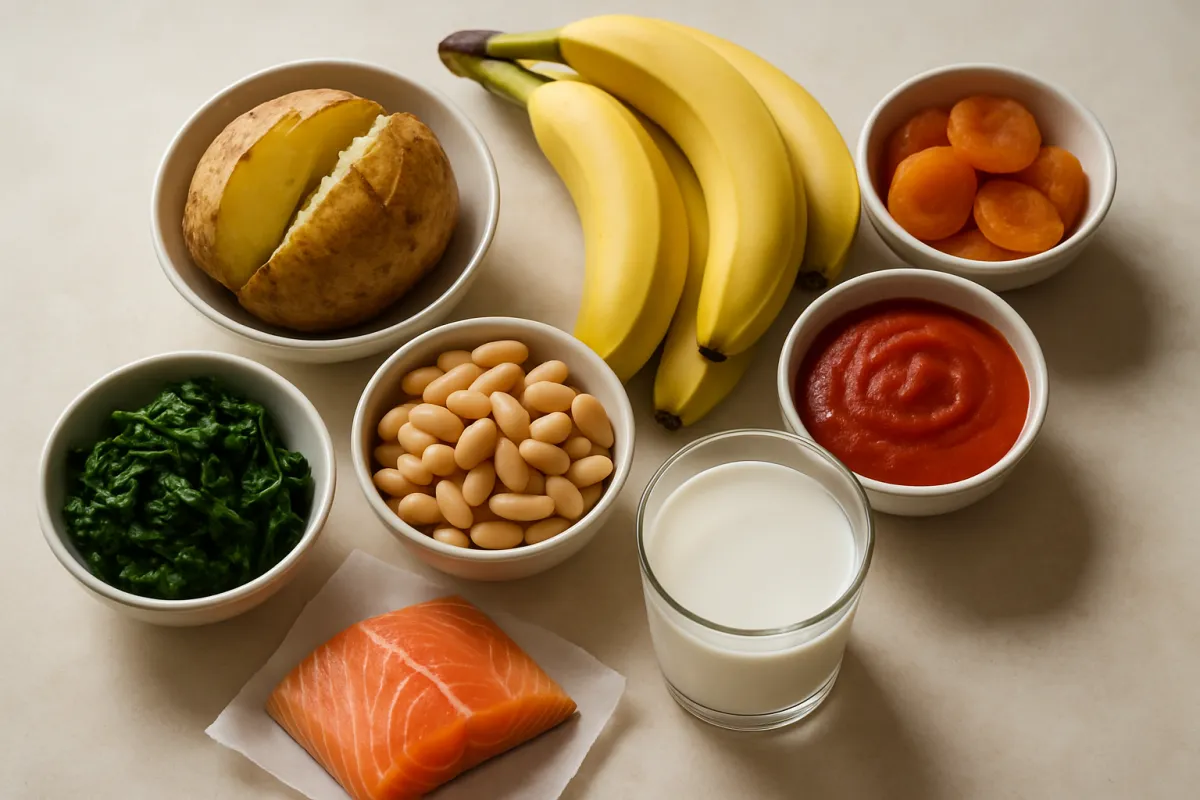
- Bananas are middling: half a cup of dried apricots (~1,100 mg), a cup of canned white beans (~1,000 mg), a baked potato with skin (~900 mg) and a cup of cooked spinach (~840 mg) all beat one.
- Potassium works against sodium in the body, so raising potassium while lowering sodium is the pairing that dietary guidance keeps pointing at, rather than either number alone.
- Chronic kidney disease and medications including ACE inhibitors, ARBs and potassium-sparing diuretics make extra potassium genuinely risky. Salt substitutes are usually potassium chloride. Those readers need their clinician, not a food list.
How Much Potassium per Day? The Direct Answer
For healthy adults, the commonly cited daily figures are about 3,400 milligrams for men and about 2,600 milligrams for women. These are Adequate Intake values published by the Food and Nutrition Board of the National Academies of Sciences, Engineering, and Medicine as part of the Dietary Reference Intakes. Pregnancy is commonly cited near 2,900 milligrams a day and breastfeeding near 2,800.
Two things make potassium different from most nutrients with a daily number attached. First, it is an Adequate Intake rather than a Recommended Dietary Allowance, a distinction covered in its own section below, and one that changes how confidently the figure should be read. Second, no tolerable upper intake level has been set for potassium from food, because in people with normal kidney function the body clears what it does not need. That absence of a ceiling does not extend to supplements, salt substitutes or people whose kidneys or medications limit excretion, and that exception is important enough that this review gives it two full sections. Set your group in the companion below to see which reference figure applies and how a rough day of food compares.
The Potassium Daily Target by Age and Sex
The full reference table runs from infancy through adulthood. The values below are the commonly cited Adequate Intakes in milligrams per day, and they are population reference figures rather than personal quotas.
| Group | Potassium, mg per day |
|---|---|
| Infants 0 to 6 months | 400 |
| Infants 7 to 12 months | 860 |
| Children 1 to 3 years | 2,000 |
| Children 4 to 8 years | 2,300 |
| Boys 9 to 13 years | 2,500 |
| Girls 9 to 13 years | 2,300 |
| Teen boys 14 to 18 | 3,000 |
| Teen girls 14 to 18 | 2,300 |
| Adult men 19 and older | 3,400 |
| Adult women 19 and older | 2,600 |
| Pregnancy, adult | 2,900 |
| Breastfeeding, adult | 2,800 |
Two features of the table are worth noticing. The childhood figures are not small the way childhood vitamin figures usually are: a four year old’s reference sits at 2,300 milligrams, which is the same number as an adult woman minus a few hundred. Potassium is an intracellular mineral present throughout body tissue, so requirements scale with lean mass rather than with anything exotic, and children carry a surprising share of the adult figure. The other feature is the gap between adult men and adult women, roughly 800 milligrams, which is larger in absolute terms than most nutrients show and reflects the same body-size logic.
Adequate Intake, Not RDA: What That Distinction Means
Most daily nutrient numbers people encounter are Recommended Dietary Allowances, derived from evidence about how much intake meets a measurable requirement in nearly all healthy people. Potassium does not have one. It has an Adequate Intake, which is the fallback the National Academies use when the evidence is not strong enough to set an RDA. An Adequate Intake is typically anchored on the intake level observed in apparently healthy populations, or on the intake associated with a desirable outcome, rather than on a demonstrated requirement.
That distinction should change how the number is read. An RDA carries the implication that falling below it for a sustained period means a genuine shortfall. An Adequate Intake carries no such implication with the same force. It is a reasonable target drawn from the best available evidence, and it is honest about being less certain than it looks.
The practical effect is that the potassium figures are best treated as a direction rather than a line. Someone eating 2,900 milligrams against a 3,400 reference is not deficient in any clinical sense, and someone hitting 3,400 exactly has not earned a specific health outcome. What the evidence more consistently supports is that diets richer in potassium-bearing whole foods, and lower in sodium, are associated with better blood pressure patterns at the population level. That association, not the milligram, is the useful part.
Why the Old 4,700 mg Figure Still Circulates
Search for potassium and a figure of 4,700 milligrams a day appears constantly, often stated with more confidence than the current one. It is not invented. It was the previous Adequate Intake for adults, and it stood for years before the National Academies revised the potassium and sodium reference values, lowering the adult potassium figures to the 3,400 and 2,600 in use today.
The revision reflected a reassessment of the evidence base rather than a decision that potassium had become less important. The older figure had been set with an eye toward blood pressure benefit at intakes considerably above what populations typically eat, and the review that followed concluded the evidence did not support setting a requirement at that level. Older articles, older textbooks, and a great deal of supplement marketing still carry the 4,700.
There is a second reason the number persists, and it is the more consequential one for anyone reading a package: 4,700 milligrams is also the Daily Value used for potassium percentages on the United States Nutrition Facts label. So the old figure did not disappear, it moved. That mismatch between the label denominator and the current reference intake is covered in detail two sections below, and it is the single most common source of confusion about potassium percentages.
What Potassium Does in the Body
Potassium is an electrolyte, meaning it carries an electrical charge in solution, and it is the principal positively charged ion inside cells. Sodium plays the equivalent role outside cells. That arrangement is not incidental. The difference in concentration across the cell membrane, maintained continuously by a pump that trades sodium out for potassium in, is what creates the electrical gradient cells use to do work.
Three consequences follow from that gradient. Nerve cells depend on it to generate and transmit signals, since a nerve impulse is essentially a controlled, traveling collapse and restoration of that gradient. Muscle cells, including cardiac muscle, depend on it to contract and relax on cue. And the balance of potassium inside cells against sodium outside them is central to how the body distributes fluid, which is where the blood pressure conversation begins.
Potassium also participates in carbohydrate metabolism and in maintaining acid-base balance, and the kidney’s handling of potassium is tightly coupled to its handling of sodium and water. That coupling is why the mineral cannot really be discussed in isolation, and why the sodium relationship gets its own section rather than a footnote. This is a general description of physiology offered as background, not a health claim about any supplement or food.
Potassium and Sodium: The Ratio That Matters Most
The practical heart of potassium is not its own number. It is the relationship between potassium and sodium, because the two work in opposition in the systems that govern fluid volume and vascular tone. Higher sodium intake tends to be associated with higher blood pressure at the population level; higher potassium intake tends to be associated with the opposite, and part of the mechanism involves potassium promoting sodium excretion in the kidney.
That is why dietary guidance keeps arriving at the same paired advice: eat less sodium, eat more potassium. Doing only one of them leaves benefit on the table, and the research picture consistently suggests that the ratio between the two describes dietary patterns better than either figure alone. A day carrying 3,400 milligrams of potassium against 4,500 of sodium is a different day from 3,400 against 2,300, even though the potassium line is identical.
The commonly cited sodium reference for adults is to stay below about 2,300 milligrams a day, and typical intakes in the United States are commonly described as running well above that. Set against potassium intakes that typically fall short of the reference, the average ratio ends up inverted from what guidance points at. None of this is a treatment claim, and blood pressure management is a clinical matter rather than an arithmetic one.
Why Most People Fall Short of the Target
The reason potassium intakes run low is not mysterious, and it is not about bananas. Potassium is concentrated in whole plant foods, dairy, fish and unprocessed meat, and it is diluted heavily by refining. A cup of cooked white rice carries somewhere near 55 milligrams. A slice of whole wheat bread lands near 80. Foods built from refined flour, refined oils and added sugar contribute almost nothing per calorie, while contributing a great deal of sodium.
So potassium shortfall and sodium excess have the same cause, which is one of the tidier facts in nutrition. A diet that leans on packaged and restaurant food gets both problems at once, and a diet built more on vegetables, fruit, legumes, dairy and minimally processed protein fixes both at once without either being the explicit goal. Our balanced meal method is the same move approached from the plate side.
The other contributor is portion reality. Reaching 3,400 milligrams requires several hundred milligrams from most meals rather than one heroic food. Nobody hits the target with a single banana, and the framing that suggests otherwise has probably done more harm to potassium intakes than any other piece of nutrition folklore.
Why Potassium Now Appears on the Nutrition Facts Label
For a long stretch, potassium was a voluntary line on the United States Nutrition Facts panel. Manufacturers could declare it, and many did not, which is why potassium simply does not appear on a lot of older packaging. That changed with the label overhaul that also introduced the added sugars line and revised serving sizes: potassium became mandatory, alongside vitamin D, while vitamins A and C moved the other way and became voluntary.
The reasoning given for the change was that potassium and vitamin D were nutrients of public health concern because typical intakes fell short, while vitamins A and C were no longer in that category. Compliance was phased in over several years by manufacturer size, so packages carrying the newer format became the norm gradually rather than overnight.
The practical result for a shopper is that potassium is now findable at the shelf, which it previously was not. That is a genuine improvement, and it is what makes label reading a usable tool for this particular mineral. Our nutrition label walkthrough covers the panel as a whole. Labeling rules are set by the FDA and can be revised, so check the agency’s own current guidance rather than treating any article as the authority on what must be declared.
Reading the Percent Daily Value for Potassium
Here is where the two numbers collide. The Daily Value used for the potassium percentage on the Nutrition Facts panel is 4,700 milligrams, the older reference figure, while the current Adequate Intakes are 3,400 and 2,600. A percentage on a package is therefore calculated against a denominator larger than the target most adults are working toward.
Work an example. A food declaring 470 milligrams of potassium shows 10 percent Daily Value. Against an adult man’s 3,400 milligram reference that same food is supplying closer to 14 percent of the day, and against an adult woman’s 2,600 it is about 18 percent. The label is not wrong, it is answering a different question, and the gap runs in the direction that makes potassium-rich foods look less impressive than they are.
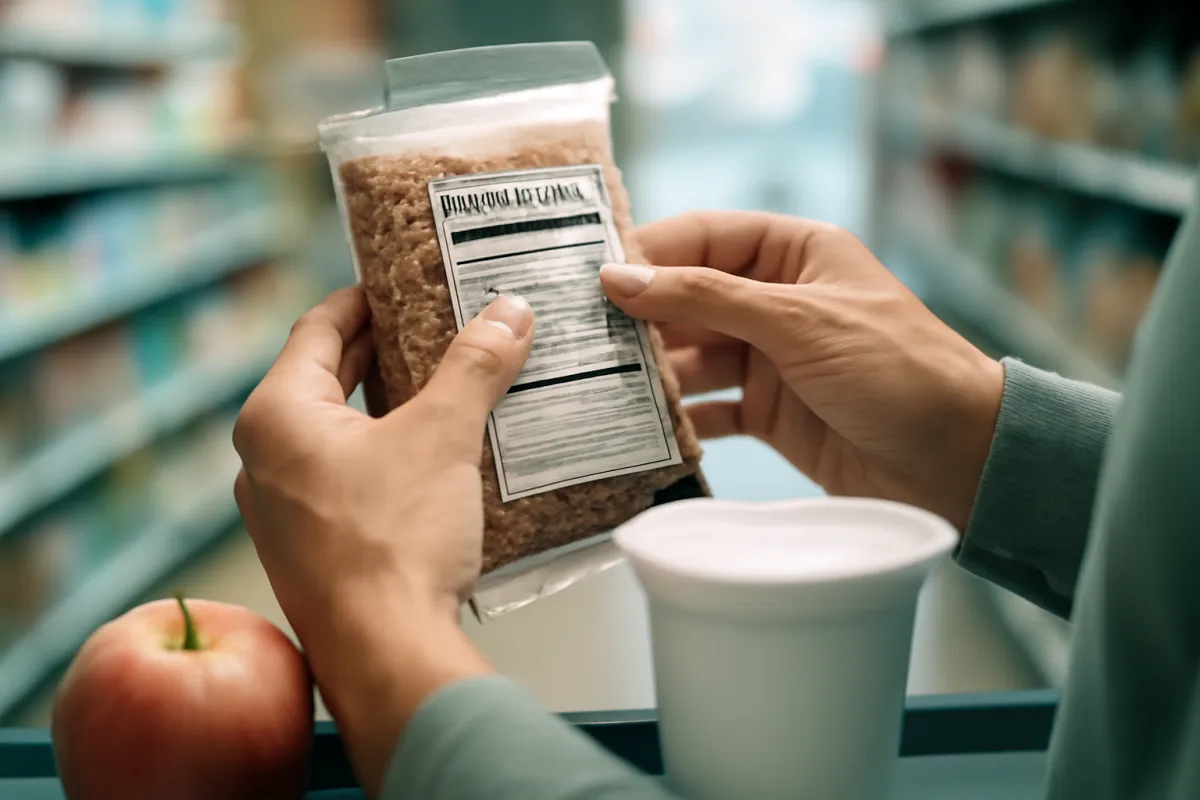
The clean fix is to read the milligram figure and ignore the percentage. Milligrams are absolute, comparable across products, and directly addable against whichever reference figure applies to you. Percent Daily Value is useful for the quick screening rule many people already use, where 5 percent or less is low and 20 percent or more is high, but for building toward a target it introduces an unnecessary conversion. Daily Values are set by the FDA and are subject to change.
Food Sources of Potassium: A Reference Table
The figures below are commonly cited, approximate values for ordinary servings. They vary with variety, size, growing conditions and preparation, so treat them as reference approximations rather than measurements.
| Food | Serving | Potassium, roughly |
|---|---|---|
| Dried apricots | 1/2 cup | ~1,100 mg |
| White beans, canned | 1 cup | ~1,000 mg |
| Baked potato, with skin | 1 medium | ~900 mg |
| Spinach, cooked | 1 cup | ~840 mg |
| Lentils, cooked | 1 cup | ~730 mg |
| Prunes, dried | 1/2 cup | ~700 mg |
| Acorn squash, mashed | 1 cup | ~640 mg |
| Raisins | 1/2 cup | ~620 mg |
| Kidney beans, canned | 1 cup | ~600 mg |
| Plain yogurt | 1 cup | ~570 mg |
| Sweet potato, baked | 1 medium | ~540 mg |
| Tomato juice | 1 cup | ~525 mg |
| Salmon, cooked | 3 oz | ~500 mg |
| Orange juice | 1 cup | ~500 mg |
| Tomato sauce | 1/2 cup | ~450 mg |
| Halibut, cooked | 3 oz | ~450 mg |
| Soybeans, cooked | 1/2 cup | ~440 mg |
| Cantaloupe | 1 cup | ~430 mg |
| Banana | 1 medium | ~420 mg |
| Milk | 1 cup | ~370 mg |
| Avocado | 1/2 fruit | ~345 mg |
| Chicken breast, cooked | 3 oz | ~330 mg |
| Spinach, raw | 2 cups | ~330 mg |
| Beef, cooked | 3 oz | ~320 mg |
| Watermelon | 2 cups | ~320 mg |
| Pistachios | 1 oz | ~290 mg |
| Mushrooms, cooked | 1/2 cup | ~280 mg |
| Broccoli, cooked | 1/2 cup | ~230 mg |
| Almonds | 1 oz | ~200 mg |
| Tuna, canned | 3 oz | ~200 mg |
| Coffee, brewed | 1 cup | ~115 mg |
| Whole wheat bread | 1 slice | ~80 mg |
| White rice, cooked | 1 cup | ~55 mg |
The table’s shape carries the lesson. Nothing at the top is exotic, nothing is expensive, and the two foods everyone associates with potassium sit in the middle rather than the top. The bottom of the list matters too, because it shows how little the refined staples contribute despite occupying a large share of many people’s calories.
Which Foods Have the Most Potassium per Serving
Potassium per common serving
Milligrams per typical portion, against adult reference intakes of 2,600 to 3,400 mg a day. Illustrative, commonly cited figures.
Bars scale to dried apricots at 100 percent. Figures are commonly cited approximations that vary with variety, size, growing conditions and preparation, and they are not personal targets.
The chart makes the point that a list alone does not. The banana bar is real but modest, and it sits below six ordinary foods that rarely get mentioned in the same sentence as potassium. It also shows why a target of several thousand milligrams is reachable without effort once the top of the chart is in normal rotation: three servings from the upper half clear an adult woman’s reference figure on their own.
There is a portion caveat worth stating. Serving sizes here are not equalized, and they should not be, because the useful question is what a realistic portion delivers rather than what 100 grams delivers. Half a cup of dried apricots is a substantial snack, a cup of cooked spinach starts as a very large pile of raw leaves, and a cup of canned beans is most of a can. The bars answer a practical question, not a laboratory one.
The Banana Myth: What Actually Beats It
The banana association is so strong that it functions as a substitute for knowing anything else about potassium. It is not baseless: a medium banana carries roughly 420 milligrams, which is a solid contribution for a portable, inexpensive food nobody has to cook. The problem is the ceiling it creates. Someone who believes bananas are the potassium food will eat one, consider the matter handled, and land somewhere around 12 percent of an adult man’s reference figure.
Six categories beat it per serving, and none of them are unusual. Beans and lentils, covered next, run from roughly 600 to 1,000 milligrams a cup. Potatoes and winter squash sit between 540 and 900 per medium potato or cup. Cooked leafy greens land near 840 a cup. Dairy, at roughly 370 for milk and 570 for a cup of plain yogurt, contributes more than people expect from a food nobody classifies as a potassium source. Fish, at roughly 450 to 500 for a three ounce portion, does the same. And dried fruit, at 620 to 1,100 per half cup, tops the list outright.
Why bananas won the association is a reasonable question. They are one of the few potassium-dense foods that is portable, requires no preparation, is available year round, and was heavily marketed. Convenience made the reputation, not concentration.
Beans and Lentils: The Quiet Leaders
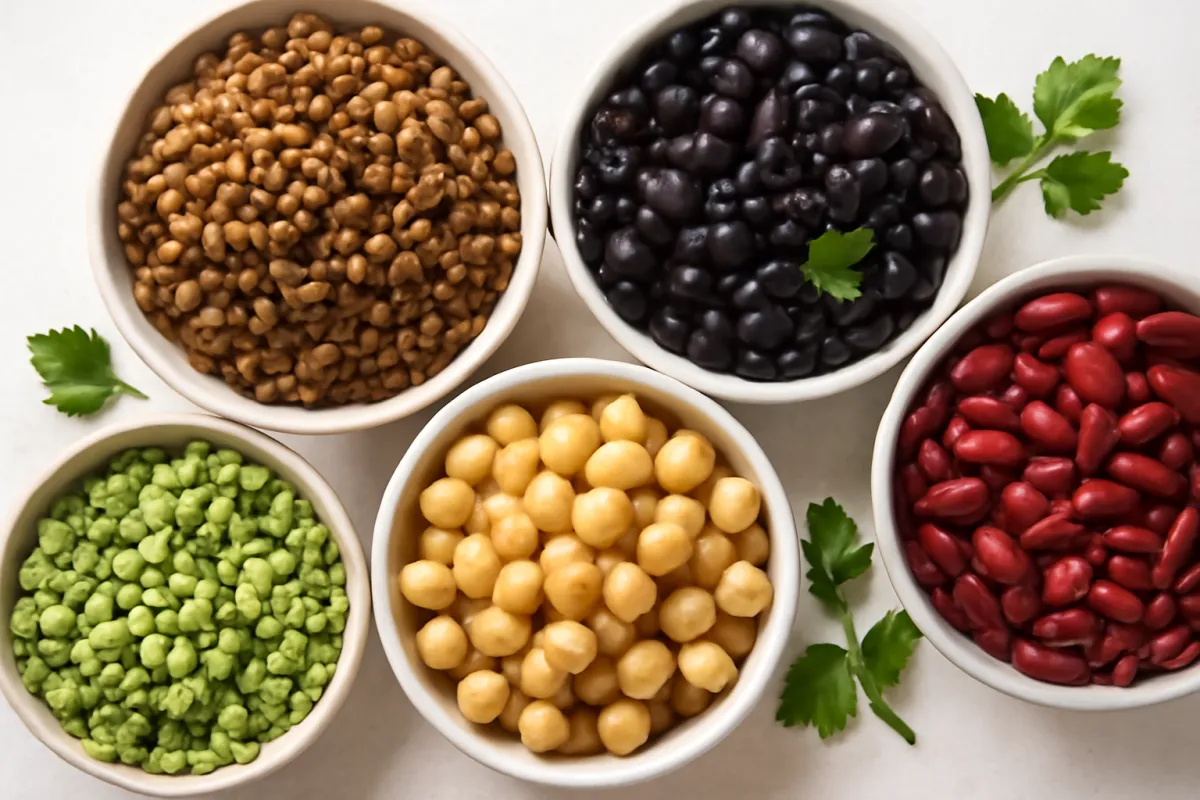
Legumes are the most efficient potassium purchase available. Canned white beans lead at roughly 1,000 milligrams a cup, kidney beans land near 600, and cooked lentils sit near 730. They are also cheap, shelf stable, and already in most kitchens for other reasons. A single cup of white beans supplies roughly 29 percent of an adult man’s reference figure and about 38 percent of an adult woman’s.
The overlap with other nutritional goals is unusually good. Legumes carry substantial fiber, plant protein and non-heme iron in the same serving, which is why they appear near the top of our high-fiber foods list and in the foods high in iron reference as well. Very few foods pay into three columns at once.
Two practical notes. Canned beans are a legitimate shortcut and their potassium survives canning, though draining and rinsing, which is commonly suggested to reduce sodium, will also carry away a modest amount of potassium in the liquid. Whether that trade is worth it depends on which number you are working on, and for someone reducing sodium the rinse usually still makes sense. Second, the potassium is in the bean rather than the liquid to any large degree, so the loss from rinsing is real but not dramatic.
Potatoes and Starchy Vegetables
The potato deserves better than its reputation. A medium baked potato eaten with the skin carries roughly 900 milligrams, which puts it third on the chart above and ahead of every fruit except dried apricots. Sweet potatoes land near 540 for a medium one, and mashed acorn squash near 640 a cup. Our potato calorie breakdown covers the energy side of the same food.
The skin matters more here than in most foods. Potassium in a potato is distributed through the flesh and concentrated toward the outer layers, so peeling a potato removes a meaningful share of it, commonly described as leaving the flesh alone at somewhere near 600 milligrams for a medium one. Peeling and then boiling removes considerably more, because the exposed surface leaches into the water. Baking or roasting a potato whole, skin on, is the version that preserves the most.
The reason potatoes carry a poor nutritional reputation has little to do with the potato and a great deal to do with what usually accompanies it. Frying medium and salt are the variables that changed, not the tuber. A plain baked potato is one of the highest-potassium, lowest-cost items in an ordinary supermarket.
Leafy Greens and What Cooking Volume Does
Cooked spinach at roughly 840 milligrams a cup is one of the strongest entries on the list, and the number tells a story about volume rather than about spinach being unusual. Raw spinach carries roughly 330 milligrams for two full cups of leaves, because two cups of raw leaves is a small amount of actual plant material. Cooking collapses the volume dramatically, so a cup of cooked spinach represents a great deal more spinach than a cup of raw.
That is not a trick, and it is not a reason to distrust the figure. It is a reason to check which state a listed serving refers to, because raw and cooked entries for the same green can differ by a factor of several. The same applies to chard, beet greens, kale and collards, all of which are meaningful potassium sources when cooked and modest ones when measured raw by volume.
The practical translation is that greens count most when they are cooked down and eaten in quantity: wilted into a pan, folded into a soup, or added to a stew where the leaching goes into liquid that stays on the plate. A large salad is a fine thing for other reasons, but as a potassium strategy it delivers less than the same weight of greens in a skillet.
Dairy, Yogurt and Fortified Alternatives
Dairy is the potassium source almost nobody names. A cup of milk carries roughly 370 milligrams, comparable to a banana, and a cup of plain yogurt lands near 570, comfortably ahead of one. For anyone who already drinks milk with breakfast or eats yogurt regularly, that is several hundred milligrams a day arriving without any deliberate decision.
Plain versions are the relevant ones. Sweetened yogurts add sugar without adding potassium, which shifts the food’s overall value even though the mineral line stays similar. Our sugar reference covers that tradeoff in its own right. Greek yogurts vary because straining removes some of the whey, so the potassium per cup differs between styles and brands, and the label is the reliable source for any specific tub.
Plant-based alternatives are genuinely variable. Some are fortified with potassium and some are not, and the amount is a formulation decision rather than a property of the ingredient, so a soy or oat beverage may carry anything from very little to an amount similar to dairy milk. This is one of the clearest cases where reading the panel beats assuming, since two cartons sitting next to each other on the same shelf can differ by several hundred milligrams.
Fish, Meat and Poultry
Animal protein contributes steadily rather than spectacularly. A three ounce serving of cooked salmon carries roughly 500 milligrams, halibut lands near 450, chicken breast near 330, and beef near 320. Canned tuna sits lower, near 200 for a three ounce serving, which surprises people who expect it to track other fish.
The value here is consistency. Most people eat a protein portion at one or two meals a day, so several hundred milligrams arrive reliably rather than occasionally. Potassium is present in muscle tissue because that is where the mineral lives in any animal, including us, which is also why unprocessed meat carries more than processed products where water, salt and fillers change the composition.
Preparation matters less for meat than for vegetables, though the same leaching principle applies to anything simmered in liquid that gets discarded. Poaching a fillet and pouring off the liquid loses some; searing it does not. Our review of protein in salmon approaches the same food from the protein side, and the two nutrients travel together in most of these portions.
Fruit Beyond Bananas: Dried Fruit, Citrus and Melon
Dried fruit is the highest-potassium fruit category by a wide margin, for the same reason it is the highest in sugar per bite: water has been removed and everything else concentrated. Half a cup of dried apricots carries roughly 1,100 milligrams, prunes near 700, and raisins near 620. Those are large numbers in small portions, and they come with a corresponding calorie and sugar density that is worth knowing rather than fearing.
Among fresh fruit, cantaloupe at roughly 430 milligrams a cup and watermelon at roughly 320 for two cups do well, largely because people eat them in volume. Orange juice at roughly 500 milligrams a cup is one of the more concentrated liquid sources, and whole oranges contribute meaningfully too. Avocado, at roughly 345 for half a fruit, is a strong entry that our avocado calorie breakdown covers from the other direction.
The general rule for fruit is that potassium tracks with how much fruit actually gets eaten rather than with any particular species being special. Two cups of melon beats one banana. Half a cup of dried apricots beats almost anything. Nothing here needs to be optimized, it just needs to be present.

How Cooking Method Changes Potassium Retention
Potassium is not destroyed by heat, which distinguishes it from vitamin C and several B vitamins. It is water soluble, so the only real loss mechanism in a kitchen is leaching: potassium dissolving out of the food and into the surrounding liquid. That single fact explains every practical rule about potassium and cooking.
Boiling causes the most loss, and the loss grows with three variables. Smaller pieces mean more surface area, so diced vegetables lose more than whole ones. More water means a lower concentration gradient at equilibrium, so a large pot loses more than a small one. Longer cooking means more time to reach that equilibrium. Boiling small potato cubes in a large pot for a long time is close to the worst case.
Methods with no cooking water lose very little. Roasting, baking, air frying, grilling and microwaving all keep the potassium in the food, since nothing is carrying it away. Steaming sits in between and is closer to the retentive end, because the food is not submerged. And soups, stews, chilis and braises are effectively lossless in practice: potassium moves into the liquid, but the liquid is part of the dish and gets eaten.
Deliberate Leaching Is a Medical Technique, Not a Kitchen Tip
There is a mirror image of the above worth naming carefully. Because boiling reliably removes potassium, deliberate leaching is used in some medically supervised low-potassium diets. It usually involves peeling and cutting vegetables small, soaking them, then boiling them in a large volume of fresh water that gets discarded, sometimes twice.
That technique exists for people whose clinicians have told them to restrict potassium, most often in the context of kidney disease. It is prescribed alongside a broader plan, with monitoring, and the specifics vary by person. It is included here only so that readers who have encountered it understand what it is and why it works, and so that nobody applies it accidentally in the wrong direction.
For readers trying to increase potassium, the instruction runs the other way and is simple: bake or roast rather than boil, keep pieces large when boiling is unavoidable, eat the skins, and let soups and stews carry their own liquid. For readers who have been told to restrict potassium, none of the food figures in this review apply to you as targets, and the technique above belongs to your renal dietitian rather than to an article.
A Day of Eating That Hits the Target
Here is one illustrative day, built entirely from the reference table above, that clears the adult reference figures comfortably. It is an example of the arithmetic, not a meal plan and not a recommendation.
| Meal | Foods | Potassium |
|---|---|---|
| Breakfast | 1 cup plain yogurt (~570) plus 1 medium banana (~420) | ~990 mg |
| Lunch | 1 cup lentil soup (~730) plus a 2 cup raw spinach salad (~330) | ~1,060 mg |
| Snack | 1/4 cup dried apricots (~550) | ~550 mg |
| Dinner | 3 oz salmon (~500), 1/2 cup tomato sauce (~450), 1/2 cup cooked broccoli (~230) | ~1,180 mg |
| Total | ~3,780 mg |
That day reaches roughly 3,780 milligrams, which clears an adult man’s 3,400 reference and sits well above an adult woman’s 2,600. Nothing on the list is unusual, expensive or portion-inflated, and the banana contributes about 11 percent of the total despite being the food most associated with the mineral.
Where an illustrative 3,780 mg day comes from
Shares of the worked day above, by meal. Reference approximations, not a meal plan.
Segments sum to 100 percent of the illustrative 3,780 mg day, against adult reference intakes of 3,400 mg for men and 2,600 mg for women. Commonly cited approximate figures, not a personal target.
The distribution is the useful part. No single meal carries more than about a third of the day, which is what reaching a potassium target actually looks like: four moderate contributions rather than one dramatic food. Build your own version in the companion below and the same arithmetic runs against whichever reference figure applies to you.
Who Needs to Be Careful With Potassium
Potassium is one of the few nutrients where more is not simply better, and the reason is worth stating plainly rather than burying. The body keeps blood potassium inside a narrow range, and the kidneys do most of that work. When kidney function is reduced, or when a medication reduces how much potassium the body excretes, potassium can accumulate in the blood to levels that are genuinely dangerous, a state clinicians call hyperkalemia. It can affect heart rhythm.
The groups this concerns are not rare. People with chronic kidney disease or otherwise reduced kidney function are the largest. People taking ACE inhibitors or angiotensin receptor blockers, two of the most widely prescribed families of blood pressure and heart medication, are another. So are people taking potassium-sparing diuretics such as spironolactone, eplerenone, amiloride or triamterene, which are designed to hold potassium back. Certain other medications and some adrenal conditions are also relevant, which is why the full list belongs with a prescriber rather than an article.
If you are in any of those groups, the food figures throughout this review are background information rather than targets, and increasing potassium intake is a decision to make with your clinician. This is not a reason for alarm and it is not a warning to avoid vegetables. It is a reason to have the conversation before changing anything, because the usual advice to eat more potassium is written for people whose kidneys clear it normally.

Salt Substitutes Are Usually Potassium Chloride
This is the specific trap that catches people, and it is worth its own section because the mechanism is so quiet. Products sold as salt substitutes, lite salt, low-sodium salt or no-salt seasoning are commonly potassium chloride, either alone or blended with ordinary sodium chloride. Someone reducing sodium on medical advice may be handed exactly this product, use it liberally because it seems like the healthy choice, and take in a large amount of concentrated potassium without ever registering that they are doing so.
For a healthy adult with normal kidney function, that is not usually a problem. For someone with chronic kidney disease, or someone on an ACE inhibitor, an ARB or a potassium-sparing diuretic, it can be. The dose is what separates a salt substitute from a plate of beans: a teaspoon delivers a concentrated amount quickly and can be repeated across a day without any of the fullness that limits how much spinach anyone eats.
Two habits address this. Read the ingredient list on anything sold as a salt alternative and look for potassium chloride, which is usually the first ingredient when present. And if any kidney condition or any of the medications named above applies to you, ask your clinician or pharmacist before using one, including the low-sodium versions of packaged foods and seasoning blends that may use it as well. Nothing in this section is a diagnosis or a direction to stop any medication.
Supplements and the 99 mg Tablet
This evidence review does not recommend potassium supplements, and the regulatory picture around them is itself informative. Over-the-counter potassium supplements sold in the United States are commonly limited to 99 milligrams per tablet, an amount that looks almost comically small against a 3,400 milligram reference figure. That limit exists because concentrated potassium is a genuine risk for the groups described above, and because a small tablet cannot easily deliver a dangerous single dose.
Higher-dose potassium exists as a prescription product, used for specific medical situations, and it is prescribed with blood testing rather than guessed at. That distinction is the whole story: the difference between food potassium and supplemental potassium is not the molecule, it is the speed and concentration of delivery, and the presence or absence of someone monitoring the result.
A related point applies to multivitamins and to products marketed for cramps, hydration or electrolytes, some of which contain potassium in amounts worth knowing about. Reading the supplement facts panel on anything you take is a reasonable habit for the same reason reading a nutrition label is, and telling your pharmacist about every supplement, not only prescriptions, is the standard advice. If you suspect your potassium is low, that is a blood test and a clinical conversation rather than a purchase.
What Falling Short Looks Like, in General Terms
There are two different things people mean by low potassium, and separating them clears up most of the confusion. The first is a dietary intake below the reference figure, which is common and describes a large share of adults in countries where refined and packaged foods dominate. The second is low blood potassium, which is a laboratory finding with a narrow definition and is a medical matter.
They are not the same, and diet alone is an uncommon cause of the second. Low blood potassium more often arises from fluid losses, from certain diuretic medications, from some gastrointestinal illnesses, or from other clinical situations that shift or remove potassium faster than intake replaces it. That is why the honest answer to “am I low in potassium” is that an article cannot tell you and a blood test can.
What this review can say is the general principle: a diet consistently below the reference intake is a reasonable thing to improve on its own terms, because the foods that fix it are foods worth eating anyway, and because the potassium and sodium pattern that comes with a whole-food diet is what dietary guidance keeps pointing at. Deliberately, this section contains no symptom list. Matching yourself to a list of general symptoms is how people arrive at wrong conclusions about their own health, and the appropriate step for anyone concerned is an appointment.
Sweat, Sports Drinks and Cramps
Potassium is lost in sweat, though considerably less than sodium is, and the sweat concentration of potassium is low enough that ordinary exercise rarely creates a meaningful potassium problem for someone eating normally. Endurance events in heat, very long durations and unusually high sweat rates are the situations where electrolyte replacement gets discussed seriously, and even then sodium is generally the larger consideration.
Sports drinks typically contain modest amounts of potassium, often well under 100 milligrams per serving, which is a small contribution against a daily figure in the thousands. They are formulated primarily around fluid, carbohydrate and sodium, and the potassium line is closer to a rounding item. Anyone using them as a potassium strategy would do better with a banana, and considerably better with a cup of beans. Our hydration reference covers the fluid question in its own right.
The cramp connection deserves a careful word. Muscle cramps are widely attributed to potassium, and while potassium is genuinely involved in muscle function, the causes of exercise-associated cramping are not settled and are commonly discussed as involving several factors including fatigue and neuromuscular control. Treating cramps as a reliable signal of potassium status is not supportable, and persistent cramping is a reason to see a clinician rather than to buy a supplement.
Potassium in Context With Other Nutrients
Potassium rarely travels alone, and that is one of the most useful things about it. The foods carrying it also carry fiber, magnesium and, in the plant sources, non-heme iron. Beans deliver all four at once. Leafy greens do the same. This is why single-nutrient thinking tends to be less useful than pattern thinking, and why our daily nutrient intake reference is organized around the table as a whole rather than around any one line.
The vitamin C comparison is instructive on the other side. Vitamin C has a Recommended Dietary Allowance in the range of 75 to 90 milligrams and a tolerable upper limit of 2,000, so the safe range spans more than twentyfold and typical intakes clear the reference without effort. Our vitamin C review walks through that arithmetic. Potassium is the opposite case on both counts: typical intakes fall short of a much larger number, and the safety question is real for identifiable groups rather than theoretical.
The practical synthesis is that potassium is a pattern nutrient rather than a target nutrient. Chasing the milligram figure with unusual foods is a poor use of attention. Shifting the general shape of what gets eaten, so that beans, greens, potatoes, dairy, fish and fruit appear regularly, moves potassium, fiber, magnesium and sodium in the right directions simultaneously without anyone counting anything.
Common Mistakes When Counting Potassium
The first mistake is the banana shortcut, covered above, which sets a ceiling around 420 milligrams and closes the question prematurely. The second is reading percentages instead of milligrams on labels, which understates potassium-rich foods because the Daily Value denominator of 4,700 is larger than the current reference intakes of 3,400 and 2,600.
The third is peeling and boiling. A peeled, boiled, cubed potato is a substantially different food from a whole baked one for this specific mineral, and the difference is entirely a preparation decision. The fourth is comparing raw and cooked servings of the same green as if they were equivalent, when a cup of cooked spinach represents several times as much spinach as a cup of raw leaves.
The fifth is the reverse of all the others: over-tracking. Potassium has no upper limit set for food intake in people with normal kidney function, no daily total worth logging, and no benefit that arrives at a threshold. Building a spreadsheet for it is effort spent on the wrong problem, since the honest instruction fits in one sentence. Eat beans, greens, potatoes, dairy, fish and fruit regularly, and lower the packaged foods that supply sodium without potassium.
A Short Potassium Shopping List
A compact list beats a comprehensive one. For the high end, a few cans of white beans and kidney beans, a bag of lentils, potatoes and sweet potatoes, frozen or fresh spinach, and a bag of dried apricots or prunes cover almost everything at the top of the chart. That is six items, all inexpensive, all shelf stable except the greens.
For the middle, plain yogurt, milk or a fortified alternative you have checked the label on, canned or fresh salmon, tomato sauce or tomato juice with the sodium line read, cantaloupe or watermelon in season, avocados and bananas. For the incidental additions, pistachios, almonds, mushrooms and broccoli all contribute a couple of hundred milligrams per serving without being the reason for the trip.
That basket overlaps almost entirely with a fiber-forward and iron-forward one, so our grocery list method can be run alongside this without adding a second shop. The only item on the list that requires any real thought is the tomato products, where sodium varies enormously between brands and the potassium is fairly consistent, so the label decides which one to buy.
Does Potassium Lower Blood Pressure
This is the question underneath most potassium searches, and it deserves a careful answer rather than a confident one. Higher dietary potassium is associated with lower blood pressure in population research, and dietary patterns rich in potassium-bearing foods and lower in sodium are among the most consistently recommended approaches in blood pressure guidance. The mechanism proposed involves potassium’s role in sodium excretion and in vascular tone.
What that does not mean is that potassium is a treatment. Blood pressure is a clinical matter, managed with measurement, individual assessment and, when appropriate, medication, and no food article can tell any particular person what their blood pressure needs. The association observed across populations does not translate into a promised result for an individual, and dietary change is one part of a picture that includes weight, activity, alcohol, sleep, genetics and medication.
There is also a direct irony worth flagging. Many people whose blood pressure is being managed are taking exactly the medications, ACE inhibitors and ARBs, that make unsupervised potassium increases inadvisable. So the group most likely to read that potassium helps blood pressure overlaps heavily with the group that needs to ask a clinician first. That is not a contradiction in the evidence, it is a reason the conversation belongs in a consulting room.
How to Read Potassium Units: mg and mmol
One small source of confusion is worth clearing up. Food labels and nutrition references express potassium in milligrams, while blood test results usually express it in millimoles per liter. They are not interchangeable, and the numbers look nothing alike: a blood potassium result is a small number with a decimal, while a daily intake figure is in the thousands.
The conversion for intake, when it appears, is that one millimole of potassium weighs about 39 milligrams, since that is the atomic weight of the element. So a figure quoted as 100 millimoles a day corresponds to roughly 3,900 milligrams. Older literature and some clinical materials use millimoles for intake as well, which is why the same recommendation can appear as two very different-looking numbers.
None of this is arithmetic anyone needs at a grocery store. It is here only so that a reader who encounters a millimole figure in a clinical context does not try to compare it directly against a label. Blood test values in particular are a measure of concentration in blood, not a measure of what was eaten, and interpreting them belongs entirely with a clinician.
The Bottom Line
How much potassium per day comes down to two commonly cited figures and a strong hint about where to find them. The Adequate Intakes published by the National Academies are about 3,400 milligrams a day for adult men and about 2,600 for adult women, with roughly 2,900 in pregnancy and 2,800 while breastfeeding. The 4,700 milligram number that still circulates is the older reference value, and it survives as the Daily Value behind label percentages, which is why those percentages read lower than they should against the current targets.
The food answer is not bananas. Half a cup of dried apricots at roughly 1,100 milligrams, a cup of canned white beans near 1,000, a baked potato with its skin near 900, a cup of cooked spinach near 840 and a cup of lentils near 730 all beat a banana’s 420, and so do plain yogurt and salmon. Bake rather than boil, keep the skins, and let soups carry their own liquid. Four ordinary meals reach roughly 3,780 milligrams without anything unusual on the table.
The one caution that overrides everything else: if you have kidney disease or reduced kidney function, or take an ACE inhibitor, an angiotensin receptor blocker or a potassium-sparing diuretic, extra potassium is not automatically good for you, salt substitutes are usually potassium chloride, and the decision to increase intake belongs with your clinician rather than with any reference table, this one included.
This evidence review is published for general education and describes commonly cited, approximate nutrition figures. It is not medical, dietary or nutritional advice, does not diagnose, treat or manage any condition, and creates no clinician-patient relationship. Every milligram value above is a rounded reference approximation rather than a measurement of any particular food, and potassium content shifts with variety, size, growing conditions, brand and preparation, so a specific product’s own label is the better source for that product. Reference intakes and labeling Daily Values are set by public bodies, are periodically reviewed, and can change, so confirm anything consequential against the current official source. Potassium is a mineral where increasing intake is not universally safe: reduced kidney function and several common medications, including ACE inhibitors, angiotensin receptor blockers and potassium-sparing diuretics, can allow blood potassium to rise to dangerous levels, and salt substitutes are usually potassium chloride. Nothing here recommends any supplement. If any of those conditions or medications apply to you, if you are pregnant or breastfeeding, or if you are considering a change to what you eat for any health reason, speak with a doctor, pharmacist or registered dietitian who knows your full history before acting on anything in this article.
Frequently asked questions
How much potassium per day do adults need?
The Adequate Intake figures published by the National Academies of Sciences, Engineering, and Medicine are commonly cited as about 3,400 milligrams a day for adult men and about 2,600 milligrams a day for adult women. Pregnancy is commonly cited near 2,900 milligrams and breastfeeding near 2,800. These are population reference values built to describe the intake typically seen in healthy people, not personal prescriptions, and they replaced a single older figure of 4,700 milligrams that still circulates widely. Anyone with kidney disease or taking medication that affects potassium should not use a general reference number at all and should ask their own clinician what applies to them.
Is a banana really a good source of potassium?
A medium banana carries roughly 420 milligrams, which is a genuine contribution but sits well below the foods people rarely think of. Half a cup of dried apricots lands near 1,100 milligrams, a cup of canned white beans near 1,000, a medium baked potato eaten with its skin near 900, and a cup of cooked spinach near 840. A cup of plain yogurt at roughly 570 milligrams and a three ounce serving of cooked salmon near 500 also beat a banana per serving. Bananas are convenient and worth eating, but treating them as the answer to potassium tends to keep people short, because it obscures the beans, greens, dairy, fish, tomato products and dried fruit that carry considerably more.
Why does potassium appear on the Nutrition Facts label now?
Potassium was made a mandatory line on the United States Nutrition Facts panel as part of the label overhaul that also added added sugars, with manufacturers phasing the new format in over several years. It had previously been voluntary, which is why older packages often showed no potassium at all. The Daily Value used for the percentage on the panel is 4,700 milligrams, a figure that is higher than the current adequate intakes, so a food showing 10 percent Daily Value is supplying roughly 470 milligrams. Reading the milligram figure rather than the percentage avoids that mismatch entirely, and the FDA is the authority to check for the current labeling rules.
Can you get too much potassium from food?
For healthy people with normal kidney function, potassium from ordinary food is not generally considered a concern, and no tolerable upper intake level has been set for potassium from food for that reason. Healthy kidneys excrete what the body does not need. The picture is entirely different for people whose kidneys do not clear potassium normally and for people taking certain blood pressure medications, where blood potassium can rise to dangerous levels. Supplements, salt substitutes and potassium-containing medications are where problems typically arise rather than meals, and anyone in those groups needs individual medical guidance rather than a general food article.
Who should be careful about increasing potassium?
People with chronic kidney disease, reduced kidney function, or adrenal conditions affecting potassium handling should not increase potassium intake without their clinician's direction. The same applies to people taking ACE inhibitors, angiotensin receptor blockers, or potassium-sparing diuretics such as spironolactone, since these medications reduce how much potassium the body excretes. Some other medications are also relevant, which is why the conversation belongs with a prescriber or pharmacist who can see the whole list. If you are in any of these groups, treat the food figures in this evidence review as background information and take the actual decision to your own clinician before changing anything.
Are salt substitutes a safe way to get more potassium?
Most products sold as salt substitutes or low-sodium salt are potassium chloride, either alone or blended with ordinary sodium chloride, and a single teaspoon can carry a large amount of potassium in a concentrated form. That is a very different thing from eating beans and spinach, because the dose arrives quickly and is easy to repeat. For people with kidney disease or on ACE inhibitors, angiotensin receptor blockers or potassium-sparing diuretics, salt substitutes are a recognized route to dangerously high blood potassium, and they are often used without anyone realizing they contain potassium at all. Read the ingredient list, and if any of those conditions or medications apply to you, ask your clinician or pharmacist before using one.
Does boiling vegetables reduce their potassium?
Yes. Potassium is water soluble and leaches into cooking water, so boiling reduces the amount left in the food, with more loss when the pieces are small, the water volume is large and the cooking time is long. Roasting, baking, steaming and microwaving retain considerably more, and a soup or stew keeps the leached potassium in the broth where it still gets eaten. Deliberate leaching, sometimes described as double cooking, is a technique used in some medically supervised low-potassium diets and should only be followed under a clinician's direction. For anyone trying to increase intake, the practical version is to bake or roast potatoes rather than boil them, and to eat the skin.
Should I take a potassium supplement?
This evidence review does not recommend supplements, and potassium is one of the clearest cases where that caution is warranted. Over-the-counter potassium supplements in the United States are commonly limited to 99 milligrams per tablet, a small fraction of a daily target, largely because concentrated potassium carries real risk for people whose kidneys or medications limit excretion. Higher-dose potassium is available by prescription for specific medical reasons and is monitored with blood tests. If you believe your potassium is low, that is a laboratory and clinical question rather than a shopping question, and a doctor or registered dietitian is the right place to take it.

Hamza Hai is the editor of NourishMark. She holds an MBA and reviews the site's articles against our editorial standards, checking that every figure is labelled for what it is, that nothing is presented as verified fact without a source the reader can check, and that the writing stays useful to a non-specialist.