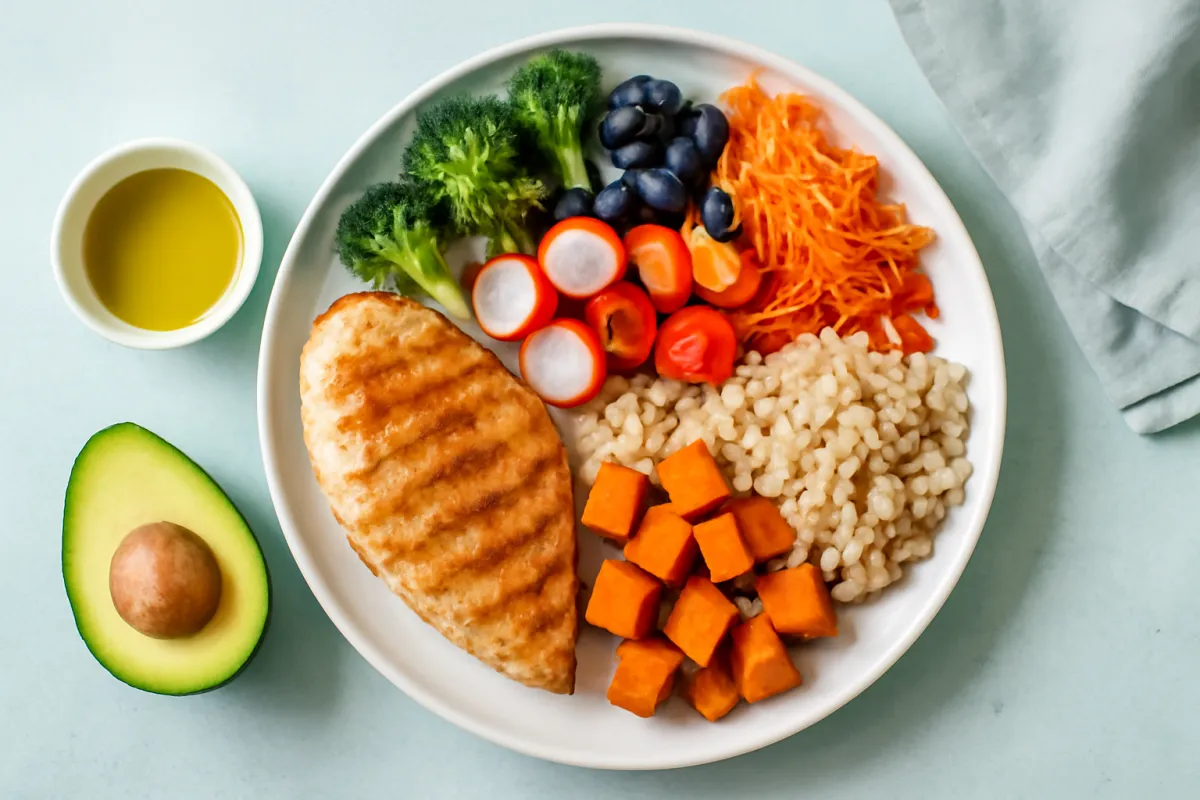
What's in this review
- Before you start: your goal, calories, and dietary needs
- The plate method in one picture: proportions over counting
- Step 1: Start with the plate method
- Step 2: Pick a quality protein
- Step 3: Choose smart carbs and fiber
- Step 4: Add healthy fats in moderation
- Step 5: Fill half the plate with vegetables and fruit
- Step 6: Adjust portions to your calorie needs and goals
- A worked example: building one balanced dinner plate
- Building balanced meals across a whole day
- Common mistakes when building a balanced meal
- Troubleshooting and edge cases
- Your balanced-meal checklist
- The bottom line
Short answer: Build a balanced meal with the plate method: fill about half the plate with vegetables and fruit, a quarter with a protein food, and a quarter with whole grains or starchy carbohydrate, then add a little healthy fat. It works from proportions rather than counting, so no arithmetic is needed. Vegetables are the step that does the most and is most often skipped; portion size is what you scale to your needs.
Most healthy-eating advice arrives as a list of foods to eat and foods to avoid, which is easy to nod along to and hard to actually use at dinner. The plate method flips that around. Instead of memorizing rules, you build the meal from a picture: a plate divided into a few simple zones, each one a rough share rather than an exact measurement. Get the proportions in the right neighborhood and most of the work of eating well, enough vegetables, enough protein, sensible portions, plenty of fiber, is done for you without a single number to track. It is one of the few nutrition tools that is genuinely doable in a real kitchen, on a real plate, tonight.
This evidence review is a step-by-step walkthrough for building a balanced meal using the commonly cited plate method, and then adjusting it to fit you. It covers what to decide before you start, the six steps in order, a worked example that assembles one full dinner plate, how the idea scales across a whole day, the mistakes that quietly unbalance a plate, and the edge cases worth knowing. For the numbers that sit underneath the plate, see our calorie needs evidence review, our protein evidence review, our carbohydrate evidence review, our fiber evidence review, and our walkthrough on calculating your macros. Everything here is general information, not medical or dietary advice, and every proportion and portion is a commonly cited illustrative guideline rather than a personal prescription. Try your own numbers in the companion below as you read.
Key takeaways
- The plate method builds a meal from proportions, not counting: about half the plate vegetables and fruit, a quarter protein, and a quarter whole-grain or starchy carbohydrate, plus a little healthy fat.
- You do the six steps in order, but the whole thing is a flexible general guideline, not an exact rule, and it works without any arithmetic.
- Vegetables are the anchor: filling half the plate with them is the single change that does the most, and it is also the step people most often skip.
- The one adjustment that matters is portion size, which you scale up or down to fit your own calorie needs and goals rather than to a fixed serving.
- This is a general educational framework, and every proportion here is a commonly cited illustrative guideline, so confirm anything specific to your health with a doctor or registered dietitian.
Before you start: your goal, calories, and dietary needs
Building a balanced plate takes no special equipment and only a couple of minutes of thought the first few times, after which it becomes automatic. Before you assemble a meal, it helps to have three things loosely in mind, none of which requires precision.
- Your goal. Whether you want to lose fat, maintain your weight, gain, or simply eat more steadily changes almost nothing about the proportions and almost everything about the portion sizes. Decide roughly which direction you are heading.
- A calorie ballpark. You do not need an exact figure, but a rough sense of your daily calorie needs tells you how big the plate should be. Our calorie needs evidence review and the companion below both give an illustrative estimate.
- Any dietary needs. Food allergies, a vegetarian or vegan pattern, cultural or religious food practices, or a medical condition all shape which foods fill each zone, even though the zones themselves stay the same.
Difficulty here is genuinely low. If you can picture a plate split into a half and two quarters, you can do this, and no scale, app, or measuring cup is required, though a set of measuring cups can calibrate your eye at first. The one thing worth being honest about is your own portions and your own hunger, because the plate method approximates rather than measures, and it works best when you let real appetite fine-tune it. Everything below is a general educational framework, and none of it substitutes for guidance from a registered dietitian or doctor, particularly if you manage a health condition, take medication, are pregnant, or have any history of disordered eating.
The plate method in one picture: proportions over counting
Before the steps, one foundation, because the whole method rests on it. The plate method is a way of building a meal by dividing the surface of your plate into zones by area, then filling each zone with a category of food. It trades the precision of counting for the speed of a picture, and for most everyday meals that is a good trade, because a reasonable plate you actually build beats a perfect macro split you skip.
The commonly cited proportions are simple. Half the plate is vegetables and fruit, with vegetables doing most of the work and fruit taking a smaller corner. One quarter is a protein food. The last quarter is a whole-grain or starchy carbohydrate. A small amount of healthy fat, from cooking oil, nuts, seeds, or avocado, is folded in rather than given its own zone, and the drink is water or another low-calorie option. That is the entire model, and it is deliberately loose: the point is a workable ratio, not a ruler.
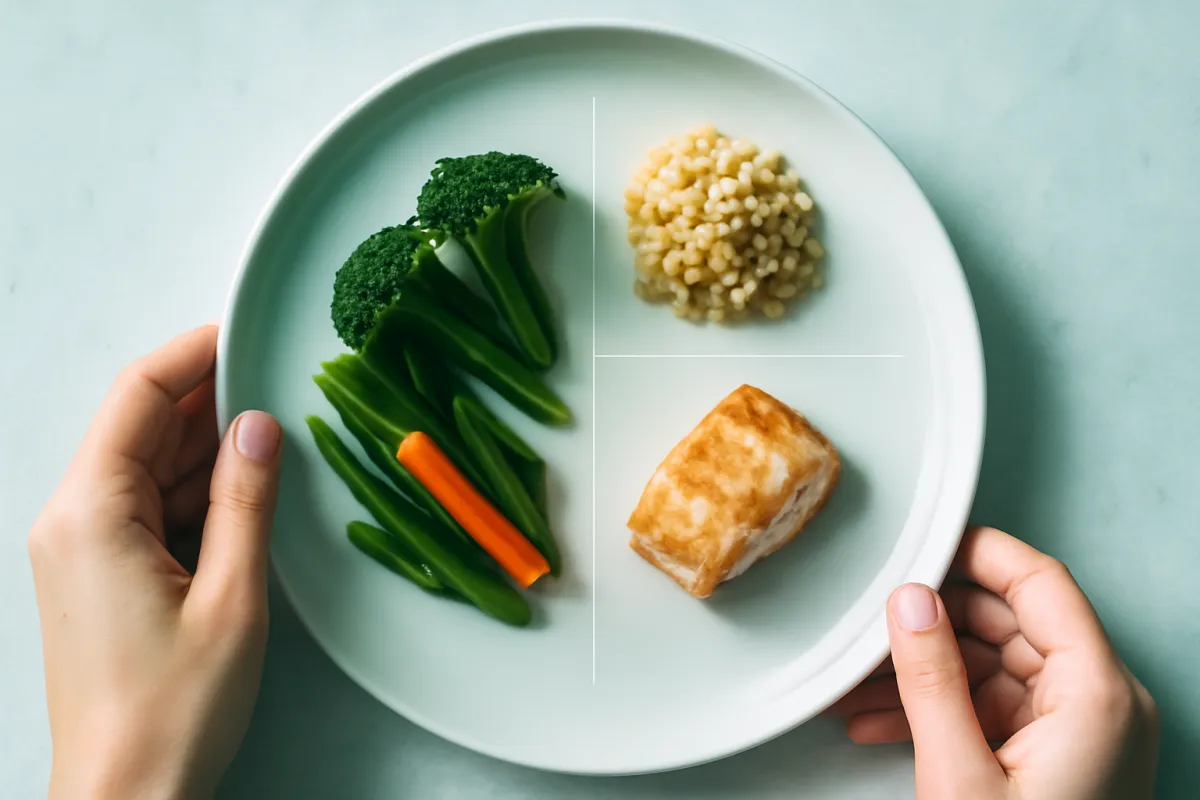
Why proportions instead of grams? Because the ratio itself does useful work. Making vegetables half the plate crowds out larger portions of calorie-dense foods, adds fiber and water that help you feel full, and lands most people near a reasonable calorie total without any counting. The chart below lays out the three zones by their share of the plate, since those shares are the hinge the whole method turns on.
The balanced plate by proportion
The commonly cited plate method by share of the plate's surface. These are general illustrative guidelines meant to be flexible, not exact measurements for any one meal.
Bars scale to the vegetable-and-fruit half at 100 percent. Proportions are commonly cited general guidelines; a real plate flexes with your appetite, activity, and goals.
Step 1: Start with the plate method
Begin by picturing the finished plate before you put anything on it, because the proportions are the plan and everything else is just filling in. Take a standard dinner plate, roughly nine to ten inches across, and mentally draw a line down the middle, then split one of those halves in two. You now have one large half and two quarters, which are the three zones you will fill: the half for vegetables and fruit, one quarter for protein, and one quarter for a whole-grain or starchy carbohydrate.
The reason to start here, rather than by deciding what to cook, is that the ratio does the heavy lifting. When vegetables occupy half the plate by area, they naturally limit how much room is left for denser foods, which moderates portions and adds fiber and water without any measuring. A useful illustration: on a ten-inch plate, that vegetable half might hold two or three loose cups of vegetables, the protein quarter a palm-sized portion, and the grain quarter about a cupped handful of cooked grains. Those are rough visual anchors, not measured servings.
Watch out for one thing at this stage: plate size quietly changes everything. The same proportions on a large twelve-inch platter deliver far more food than on a nine-inch plate, so an oversized plate can undo the method even when the ratios look right. If you are aiming to eat a little less, a smaller plate keeps the proportions honest, and if you are very active and need more, a larger one scales the whole meal up together. The proportions are a starting frame you then adjust in step six, and they are a general guideline rather than a rule, so treat the half-and-two-quarters picture as a helpful default, not a measurement you must hit exactly. If a specific medical diet applies to you, follow that plan over this general shape.
Step 2: Pick a quality protein
With the plate mapped, fill the first quarter with a protein, because protein anchors a meal: it is the most filling of the three macronutrients for many people, it supports muscle, and giving it a defined quarter keeps it from being crowded out by the starch. Aim for roughly a palm-sized portion, which is a handy visual stand-in for a moderate serving and scales naturally with body size.
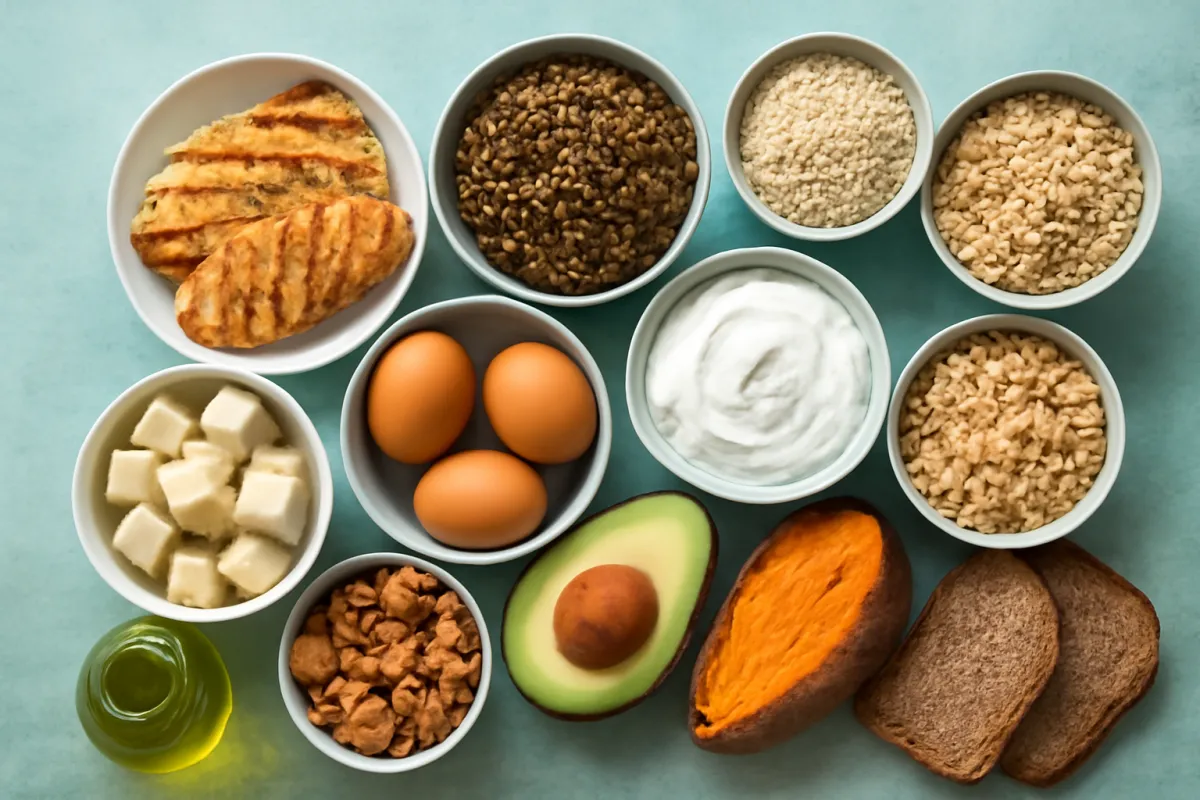
Quality here means leaning toward less-processed sources most of the time. Common everyday choices include poultry such as chicken or turkey, fish and seafood, eggs, lean cuts of meat, and dairy such as Greek yogurt or cottage cheese, alongside plant proteins such as beans, lentils, chickpeas, tofu, tempeh, and edamame. Variety across the week matters more than any single “best” protein, and mixing animal and plant sources suits most patterns. Some plant proteins, such as beans and lentils, also carry meaningful carbohydrate, so they can partly overlap the grain quarter, which is fine and even convenient.
A rough illustration ties it together: a palm-sized portion of cooked chicken, fish, or tofu, or roughly three quarters of a cup of cooked beans, sits comfortably in that quarter of the plate for many adults. Larger and more active people generally need a bigger portion, and smaller or less active people less, which is exactly the kind of adjustment step six handles.
Watch out for two things. First, do not let the protein quarter become the whole meal: a plate that is mostly a large steak or chicken breast with a token vegetable is a common imbalance, not a high-protein win. Second, more protein is not endlessly better, and the goal is a solid, sensible portion rather than a maximal one. Our protein evidence review covers the commonly cited ranges in depth. These are general figures, and protein needs differ with age, activity, and kidney health, so anyone with a relevant condition should set their target with a professional.
Step 3: Choose smart carbs and fiber
Fill the second quarter with a carbohydrate, and make the quality of that carbohydrate the thing you focus on, because this is the zone where the biggest easy upgrade lives. The plate method does not ask you to fear or cut carbohydrate, it asks you to keep it to about a quarter of the plate and to choose mostly whole, fiber-rich forms rather than heavily refined ones.
Smart choices for this quarter include whole grains such as brown rice, quinoa, oats, barley, whole-grain pasta, and whole-grain bread, along with starchy vegetables and legumes such as potatoes with the skin, sweet potatoes, corn, beans, and lentils. What these share is fiber, which slows digestion, supports fullness and steadier energy, and feeds the gut, and which most people fall short of. A rough visual portion is about a cupped handful of cooked grains or one fist-sized starchy item, which for many adults is in the neighborhood of half a cup to a cup cooked.
The reason to prioritize fiber and whole forms is that a refined carbohydrate and its whole-grain cousin can look identical on the plate while behaving quite differently in the body, with the whole version generally bringing more fiber and a gentler effect on blood sugar. You do not have to be perfect about it, just aim for whole grains and legumes to be the usual pick and refined grains the occasional one. Our carbohydrate evidence review and our fiber evidence review go deeper on both the amounts and the sources.
Watch out for portion creep in this zone, which is where it most often happens: rice, pasta, and bread are easy to over-serve, and a grain portion that spills past its quarter and covers half the plate is one of the most common ways a meal quietly unbalances. Keep this quarter to about a quarter. These are general guidelines rather than personal targets, and anyone managing diabetes or blood-sugar concerns should follow their clinician’s advice on carbohydrate over any general shape here.
Step 4: Add healthy fats in moderation
Fat does not get its own zone in the plate method, but it is not an afterthought either, so this step is about folding a small amount of healthy fat into the meal you have started to build. Dietary fat is essential: it supports the absorption of certain vitamins, adds flavor and satiety that make a plate satisfying, and matters for overall health. The plate method simply keeps it in a supporting role rather than letting it dominate.
In practice, healthy fats usually arrive in one of three ways: as the oil you cook or dress with, such as olive or avocado oil; as a topping or mix-in, such as nuts, seeds, avocado, or a spoonful of a seed or nut butter; or built into a protein you already chose, such as salmon, eggs, or full-fat dairy. A common visual guide for added fat is about a thumb-sized portion, for example a tablespoon of oil or a small handful of nuts, though this is a rough anchor rather than a limit to police.
The phrase “in moderation” carries real weight because fat is calorie-dense, supplying more than twice the calories per gram of protein or carbohydrate, so small amounts add up quickly. That density is exactly why a drizzle of oil, a scatter of nuts, or a few slices of avocado is usually plenty, and why fat is the zone where a little restraint keeps the whole plate in a sensible calorie range.
Watch out for the opposite error too, which is fearing fat and driving it too low. Cutting fat to near zero to save calories tends to leave meals bland and less satisfying and is rarely worth it, so the aim is a sensible middle rather than avoidance. As with every part of this method, the amount is a general guideline, not a prescription, and anyone managing cholesterol, heart conditions, or another concern where the type and amount of fat matter should follow their clinician’s guidance over any general figure.
Step 5: Fill half the plate with vegetables and fruit
Now fill the largest zone, the half of the plate reserved for vegetables and fruit, and treat this as the step that does the most, because it is. Making produce half the plate is the single move that most reliably improves an ordinary meal: it adds fiber, water, vitamins, and volume while crowding out larger portions of denser foods, all without any counting. It is also, not coincidentally, the step people most often shortchange.
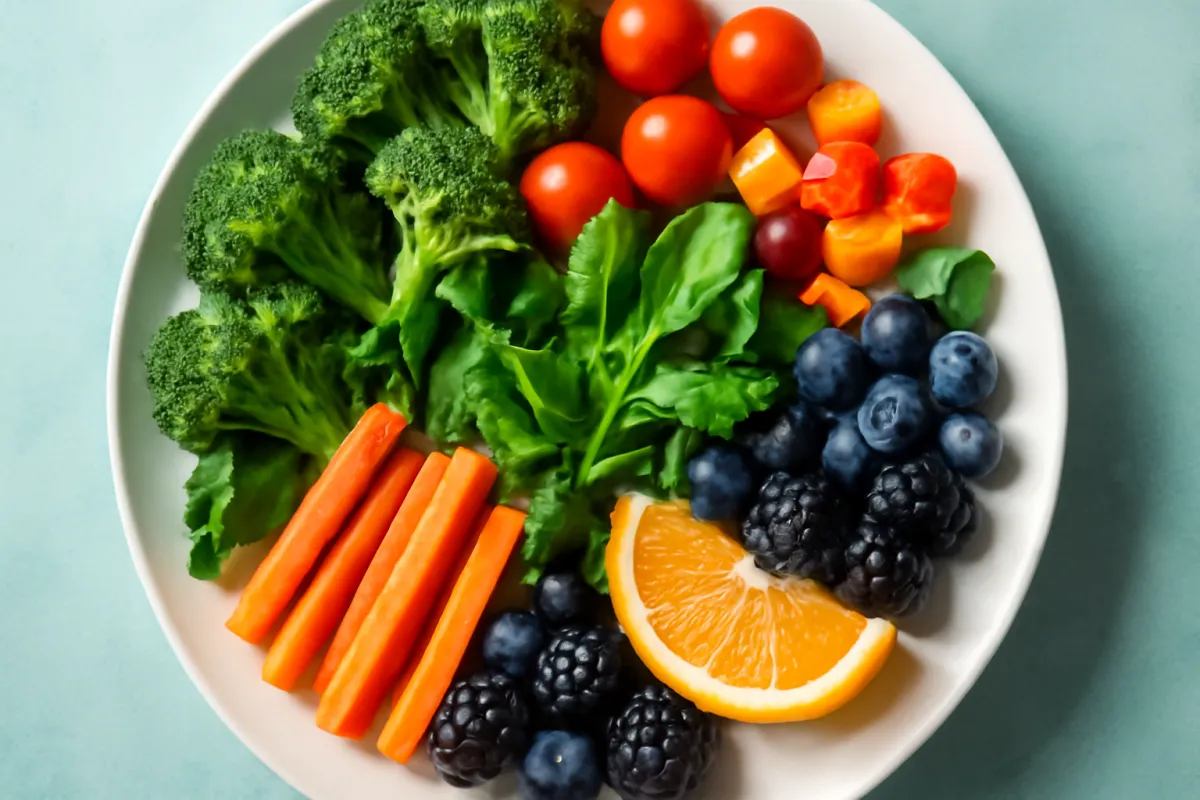
Lean the balance toward vegetables, with fruit as the smaller share of this half. Aim for variety and color across the week, since different vegetables and fruits bring different nutrients, and mix cooked and raw as you like: a pile of roasted vegetables, a big salad, steamed greens, or a mix all count. A rough visual target is two or more fist-sized servings of vegetables filling that half, with fruit adding a modest portion rather than taking over. Frozen and canned vegetables count fully and are often cheaper and just as nutritious, so convenience is no excuse to skip this zone.
Why does volume matter so much here? Because vegetables are generally low in calories for the space they take up, filling half the plate with them tends to make a meal both more filling and lower in calorie density, which helps with fullness and, for those who want it, with managing weight. This is the mechanism behind much of the plate method’s benefit, which is why the vegetable half is the anchor rather than a garnish.
Watch out for the habit of treating vegetables as a token side, a few pieces of broccoli beside a plate dominated by protein and starch. That is the most common way the method fails in practice. If half a plate of vegetables feels like a lot at first, build up gradually, and remember that soups, stews, and stir-fries can pack the vegetable half right into the main dish. This is general guidance, and for most people more vegetables is a safe direction, but anyone on a specialized medical diet should follow that plan.
Step 6: Adjust portions to your calorie needs and goals
The final step is the one that turns a generic plate into your plate: keep the proportions the same, but scale the portion sizes to fit your own calorie needs and goals. The half-and-two-quarters ratio is a shape, and step six sizes that shape up or down so it feeds you the right amount rather than a one-size-fits-all serving.
Start from a rough sense of your daily calorie needs, which depend on your body size, activity, age, and sex, and which our calorie needs evidence review and the companion below can estimate illustratively. A larger, very active person simply builds a bigger plate, keeping the same proportions, while a smaller or less active person builds a smaller one. Your goal then nudges the size: eating a little less than you burn tends to support gradual fat loss, matching it maintains, and a modest surplus supports gain. Crucially, you adjust the whole plate together rather than distorting the ratios, so the vegetable half and protein quarter scale up and down in step.
If you want more precision than proportions can give, this is where the plate method meets the numbers. You can pair the plate with a rough calorie target, or step up to gram-level targets using our walkthrough on calculating your macros, which works out protein, fat, and carbohydrate in grams. Most people never need that level of detail for everyday eating, but it is there when a specific goal calls for it.
Watch out for two temptations. First, do not confuse a bigger plate with a better one: scale to genuine need and appetite, not to habit or the size of the serving dish. Second, do not chase precision you do not need, since the plate method is meant to approximate, and obsessing over exact portions defeats its purpose. Every figure here is a commonly cited illustrative reference rather than a personal target, and anyone pursuing weight change with a health condition, on medication, or with any history of disordered eating should set their plan with a doctor or registered dietitian.
A worked example: building one balanced dinner plate
Pulling the six steps together on one plate shows how quickly the method assembles a real meal. Meet an illustrative dinner for a moderately active adult who wants to eat well and maintain their weight. Nothing here is a recommendation for any real person, it is one plate built through the steps so the proportions are concrete.
Step 1, the plate: a ten-inch dinner plate, mapped into one half and two quarters. Step 2, protein: a palm-sized portion of grilled chicken breast fills one quarter, roughly four to five ounces cooked for this illustrative eater. Step 3, carbohydrate: a cupped handful of cooked quinoa, about three quarters of a cup, fills the other quarter, chosen as a whole grain for its fiber. Step 4, fat: the vegetables are roasted in about a tablespoon of olive oil, and a few slices of avocado are added, folding in a thumb-sized amount of healthy fat. Step 5, vegetables and fruit: the whole half fills with roasted broccoli, peppers, and cherry tomatoes plus a handful of leafy greens, with a small side of berries for the fruit share. Step 6, adjust: feeling this is about right for their needs, the eater keeps the portions as is, and a hungrier or more active day would simply scale the whole plate up.
The finished plate reads cleanly: half a plate of colorful vegetables with a little fruit, a quarter of lean protein, a quarter of a whole grain, and a modest amount of healthy fat woven through. As shares of the plate that is roughly 50 percent vegetables and fruit, 25 percent protein, and 25 percent grain, exactly the proportions the plate chart above lays out. Change one input, say the eater is training hard and hungrier, and the whole plate scales up together while the proportions hold. That is the point of building it this way: the shape stays constant and only the size moves.
Building balanced meals across a whole day
One balanced plate is the unit, but eating well happens across a whole day, and the plate method scales up naturally when you think of the day as a series of plates. You do not need every meal to be a textbook plate, and few real days look like that, but using the proportions as a loose default across your meals keeps the day balanced without a spreadsheet.
Breakfast is where the plate shape bends most, and that is fine. A morning meal might lean on protein and whole grains, such as eggs with oats and fruit, with vegetables playing a smaller role than they do at dinner, and you can nudge vegetables in over time with additions like spinach in eggs or a side of fruit. Lunch and dinner tend to fit the half-and-two-quarters picture more comfortably. Snacks, if you have them, are a chance to fill gaps the main meals missed, often protein and produce, such as yogurt and fruit or vegetables and hummus.
How the day’s food spreads across meals is personal, and there is no single correct pattern, only what fits your schedule, hunger, and preferences. The chart below shows one illustrative way a day’s calories might distribute across meals and snacks, purely to show the idea that no single meal has to carry the whole day. Some people prefer three larger meals, others four or five smaller ones, and both can be perfectly balanced.
A day of balanced meals
One illustrative way a day's calories might spread across meals and snacks. This is a general example of distribution, not a target; the right pattern is the one that fits your schedule and appetite.
Segments are one illustrative distribution of a day's calories across meals and sum to 100 percent. Meal timing and number are personal; this is a general example, not a recommendation.
Across a day, aim for balance on the whole rather than perfection on each plate. A lighter breakfast and a vegetable-heavy dinner can offset each other, and one less-balanced meal does not undo a reasonable day.
Common mistakes when building a balanced meal
Most plate-method errors are not exotic, they are a handful of predictable slips, and each is easy to sidestep once named.
- Skipping the vegetables. The single most common mistake is treating the vegetable half as a small side rather than the anchor. If half the plate is not produce, the method’s biggest benefit is lost, so this is the zone to protect first.
- Oversized grain portions. Rice, pasta, and bread are easy to over-serve, and a grain portion that swells to cover half the plate is a frequent quiet imbalance. Keep the starch to about its quarter.
- Fearing all fat. Cutting fat to near zero to save calories usually backfires, leaving meals bland and less satisfying. A small amount of healthy fat is part of a balanced plate, not the enemy of one.
- Building a protein-only meal. A plate dominated by a large piece of meat with token everything else is not a balanced meal, even though it feels virtuous. Protein earns a quarter, not the whole plate.
- Drinking your calories. A carefully balanced plate paired with a large sugary soda, juice, or blended coffee drink can quietly add substantial calories that the plate never accounts for. Favor water or other low-calorie drinks, and remember the plate method assumes the drink adds little.
- Ignoring plate size. Perfect proportions on an oversized platter still deliver a lot of food. Match the plate to your needs rather than filling whatever is largest.
Clear these six and the method does its job calmly, delivering a reasonable meal without any counting.
Troubleshooting and edge cases
A few common situations change the practical details, though never the underlying half-and-two-quarters logic. What if you are vegetarian or vegan? The method is identical, you simply fill the protein quarter from plant sources such as tofu, tempeh, beans, lentils, edamame, or seitan, some of which also carry carbohydrate that overlaps the grain quarter. Getting enough protein from a variety of sources across the day is the main thing worth planning, and our protein evidence review covers plant options.
What if you are eating out? Apply the proportions by eye to whatever arrives. Aim to make vegetables or a salad about half of what you actually eat, keep protein to roughly a palm-sized portion, and treat large servings of rice, pasta, bread, or fries as the quarter rather than the centerpiece. Asking for an extra vegetable side and boxing half of an oversized portion before you start both help, and treating the method as a flexible guide rather than a strict rule keeps it realistic.
What if you meal-prep or eat in a bowl or wrap? The proportions still apply, they just look different when foods are mixed. For a stir-fry, grain bowl, wrap, or soup, aim for the same rough balance of ingredients, about half vegetables, a quarter protein, a quarter grain, before it all gets combined. Building the components to plate-method proportions and then assembling them works exactly the same.
What if you have a medical condition? This is the important one. Diabetes, kidney disease, heart conditions, digestive disorders, pregnancy, food allergies, eating disorders, and other situations can call for a specialized eating plan that overrides this general shape, sometimes in ways that change the proportions themselves. If any of these apply to you, treat this walkthrough as background reading only and follow the plan set by your doctor or registered dietitian.
Your balanced-meal checklist
Keep this short routine on hand to build a plate any time, whether you are cooking at home or assembling one on the fly.
- Picture the plate first, mapped into one half and two quarters, before you decide what goes on it.
- Fill a quarter with a quality protein, roughly a palm-sized portion, leaning toward less-processed sources.
- Fill a quarter with a smart carbohydrate, favoring whole grains, legumes, and other fiber-rich forms over refined ones.
- Fold in a little healthy fat, about a thumb-sized amount, from oil, nuts, seeds, or avocado.
- Fill the whole other half with vegetables and fruit, leaning toward vegetables and plenty of color.
- Choose a low-calorie drink, usually water, so the meal does not carry hidden liquid calories.
- Scale the whole plate to your needs, keeping the proportions and adjusting only the size for your calories and goals.
Run your own calorie target and meals per day through the companion below to see an illustrative per-plate portion guide.
The bottom line
Building a balanced meal is far simpler than most nutrition advice makes it sound, because the plate method replaces rules and counting with a picture you can build tonight. Map the plate into a half and two quarters, give a quarter to a quality protein and a quarter to a smart, fiber-rich carbohydrate, fold in a little healthy fat, fill the whole other half with vegetables and fruit, and then scale the portions to your own calorie needs and goals. Get those proportions in the right neighborhood and most of the work of eating well is done for you, no arithmetic required. Keep the vegetable half as the anchor, watch the starch portion and the plate size, and treat one less-balanced meal as nothing to fix over a reasonable day. Every proportion and portion here is a commonly cited, illustrative general guideline rather than a personal prescription, so pair it with our calorie, protein, carbohydrate, and fiber evidence reviews and our macros walkthrough, and confirm anything specific to your health, goals, or conditions with a qualified professional.
This evidence review is published for general education and describes the commonly cited plate method as an illustrative framework for building meals, not medical, nutritional, or dietary advice, and reading it creates no clinician-patient relationship. Every proportion, portion size, and calorie figure above is a general guideline or worked example rather than a measurement or a personal recommendation, and real bodies, appetites, foods, and needs vary widely. Nutritional needs differ from person to person with body size, activity, age, and health, and some situations, including diabetes, kidney disease, heart conditions, digestive disorders, food allergies, pregnancy, and any history of disordered eating, call for an individually managed eating plan that overrides any general shape here. For meals suited to your body, goals, medications, or any medical condition, and before making significant changes to how you eat, consult a qualified health professional such as a doctor or registered dietitian.
Frequently asked questions
What are the steps to build a balanced meal?
The commonly cited plate method works as a simple set of proportions rather than a count. Picture your plate, fill about half of it with vegetables and fruit, give roughly a quarter to a quality protein, give the last quarter to a whole-grain or starchy carbohydrate, then add a small amount of healthy fat and a drink that adds few or no calories. The final step is to scale the portions up or down to fit your own calorie needs and goals. This is a general educational framework rather than a personal prescription, and anyone with a health condition or specific goal should confirm the details with a registered dietitian.
What does a balanced plate look like?
A common way to picture it is to divide the plate into three zones by area, not by weight or calories. Half the plate is vegetables and fruit, with vegetables doing most of the work and fruit filling a smaller corner. One quarter is a protein food such as chicken, fish, eggs, tofu, beans, or lentils. The last quarter is a whole-grain or starchy carbohydrate such as brown rice, quinoa, whole-grain pasta, or a potato. A little healthy fat, from olive oil, nuts, or avocado, rounds it out. These proportions are a general guideline meant to be flexible, not an exact rule for any one meal.
Do I have to count calories to eat balanced meals?
No. The whole appeal of the plate method is that it approximates a reasonable balance through proportions on the plate rather than through counting, so many people use it without tracking a single number. Filling half the plate with vegetables, a quarter with protein, and a quarter with a whole-grain carbohydrate naturally moderates portions and adds fiber, which is much of what counting is trying to achieve. If you have a specific calorie or macronutrient goal, our companion and our related reviews can help you scale the plate, but the method itself is designed to work without arithmetic. This is general information, not a personal target.
How big should each portion on the plate be?
The plate method sets portions by the share of the plate rather than by exact grams, which is part of why it is forgiving. A rough hand-based guide many people find useful is a palm-sized portion of protein, a cupped-handful of cooked grains or starch, two or more fist-sized servings of vegetables, and about a thumb-sized amount of added fat such as oil or nut butter. Larger and more active people generally need larger portions, and smaller or less active people generally need less. These are illustrative general estimates rather than measured prescriptions, and a registered dietitian can tailor portion sizes to your body and goals.
Can vegetarians and vegans use the plate method?
Yes, the plate method works for any eating pattern because it is built on proportions rather than on specific foods. The protein quarter is simply filled from plant sources such as tofu, tempeh, beans, lentils, edamame, or seitan instead of meat, and some of those foods also carry carbohydrate that overlaps with the grain quarter. Plant-forward plates often make it easy to fill the vegetable half generously. The main thing worth planning is getting enough protein across the day from a variety of sources. This is general guidance, and anyone following a restrictive pattern who is unsure about meeting their needs should work with a registered dietitian.
How do I build a balanced meal when eating out?
The same proportions apply, you just apply them by eye to whatever is in front of you. A practical approach is to mentally divide the plate, aim to make vegetables or a salad about half of what you eat, keep the protein to roughly a palm-sized portion, and treat large servings of rice, pasta, bread, or fries as the part to keep to about a quarter rather than the centerpiece. Asking for an extra side of vegetables and boxing half of an oversized portion before you start both help. Restaurant meals are often larger and richer than home cooking, so treating the plate method as a flexible guide rather than a strict rule is realistic. This is general information, not dietary advice.
Is the plate method good for weight loss?
It can be a helpful structure for many people because filling half the plate with lower-calorie, high-fiber vegetables and keeping starches to a quarter tends to moderate overall calories and improve fullness without counting. The plate method is a tool for building reasonable meals, not a weight-loss program in itself, and results depend on your overall energy balance, activity, sleep, and many other factors. Some people pair it with a rough calorie target, which our calorie review can help estimate. Weight management is individual, and anyone pursuing it with a health condition, on medication, or with any history of disordered eating should set a plan with a doctor or registered dietitian rather than from a general rule.
How is the plate method different from counting macros?
They are two ways of aiming at a similar target from opposite directions. Counting macros works from numbers, setting gram targets for protein, fat, and carbohydrate and then choosing foods to hit them, which is precise but takes tracking. The plate method works from the plate, using visual proportions to land in a reasonable neighborhood without any arithmetic, which is simpler but less exact. Many people start with the plate method for everyday eating and only reach for macro counting when they have a specific performance or body-composition goal. Both are general educational tools rather than prescriptions, and our evidence review on calculating macros covers the numbers side in detail.

Hamza Hai is the editor of NourishMark. She holds an MBA and reviews the site's articles against our editorial standards, checking that every figure is labelled for what it is, that nothing is presented as verified fact without a source the reader can check, and that the writing stays useful to a non-specialist.

Dr. Shayaan Khan is the medical reviewer for NourishMark. He holds an MBBS from MGM Medical College, Navi Mumbai, and is the author of published research including a narrative review of postpartum anxiety and depression in Mental Health Science. He has taught physiology at university level. He reviews the site's health content for medical accuracy: that physiology and mechanisms are described correctly, that no claim is stated more strongly than the evidence behind it, and that anything specific to an individual reader is sent to that reader's own clinician.
Not medical advice. Dr. Khan reviews NourishMark's health content for medical accuracy. He is not a registered dietitian, he does not hold a United States practising licence, and he is not your doctor. His review does not make anything here medical advice. Always talk to a qualified health professional about your own situation, and never delay or stop care because of something you read here.