What's in this review
- Where the 8 glasses actually came from
- What reference intakes actually say
- Your body’s water budget
- Food: the fifth of your intake nobody counts
- Coffee, tea, and the diuretic myth
- Exercise: the multiplier that dwarfs the baseline
- Heat, illness, altitude: the other multipliers
- Older adults: when the thirst signal fades
- Too much: the overhydration risk that is actually real
- The signals that beat the formulas
- The daily numbers, assembled
- How much water should you drink based on your weight?
- The multipliers, side by side
- Making it effortless: environment beats willpower
- Children: smaller bodies, faster budgets
- Hydrating around a workout, step by step
- A hot working day, hour by hour
- Electrolytes: when water alone is not enough
- Common hydration mistakes
- The bottom line
Short answer: Commonly cited reference intakes describe total water from all sources as roughly 3.7 liters a day for men and 2.7 liters for women, with drinks supplying about 80 percent and food about 20. The 8-glasses rule is a simplification that already counted food, so as a drinks-only mandate it overstates the need for many people. Coffee and tea count. For healthy adults, thirst plus pale-yellow urine beats any counting scheme.
How much water should you drink a day? Ask that question and the reply comes back instantly: eight glasses, the most successful piece of health advice ever to be both universally known and substantially wrong, or at least wrongly told. The number is not where hydration science landed; it is a fragment of decades-old guidance with its most important caveat, that food supplies much of the total, sanded off by repetition. Meanwhile the actual evidence on water needs is more interesting, more forgiving, and occasionally more demanding than the slogan suggests.
This article reviews it the way we reviewed protein in our protein needs review: what the reference intakes actually say, where the popular numbers came from, how the total splits between drinks and food, what genuinely changes your needs, exercise, heat, age, illness, pregnancy, and the simple body signals that outperform every formula. As always, this is education rather than medical advice, and the more your health departs from average, the more the right answer becomes a conversation with your clinician.
Key takeaways
- Reference intakes describe total water from all sources: commonly cited figures are roughly 3.7 liters a day for men and 2.7 for women, with drinks supplying about 80 percent and food about 20.
- The 8-glasses rule is a simplification of old guidance that already counted food's contribution; as a drinks-only mandate it overstates the requirement for many people.
- Coffee and tea count toward intake; their mild diuretic effect does not cancel their fluid, especially in habitual drinkers.
- Exercise, heat, illness, pregnancy, and age change needs meaningfully, sweat alone can cost a liter an hour, and older adults should not wait for a weakening thirst signal.
- For healthy adults, thirst plus pale-yellow urine beats any counting scheme, and overdrinking during endurance exercise carries its own real risk.
Where the 8 glasses actually came from
The slogan has a traceable ancestry, and the paper trail is the debunking. Mid-twentieth-century nutrition guidance suggested a water allowance of roughly one milliliter per calorie of food, which for a typical adult diet of around 2,000 to 2,500 calories yields 2 to 2.5 liters, conveniently near eight 8-ounce cups. The same guidance continued, in the sentence history forgot, that most of this quantity is already contained in prepared foods. Drop the second sentence, round the first into glassware, and you have the modern rule: a drinks-only mandate distilled from a total-intake estimate that never was one.
The sticky version survived because it is memorable, actionable, and harmless-sounding, three qualities evidence rarely competes with. But it quietly reshaped behavior around a misreading: generations of people treating tap-water arithmetic as a health obligation, carrying tallies and guilt the underlying science never asked of them. None of this means water does not matter, everything below establishes how much it does. It means the right starting point is the one the original guidance actually took: the body needs a total amount of water, it is agnostic about the container, and food was always part of the answer. From here forward, this review talks in totals, and translates back to glasses only at the end, where the translation belongs.
What reference intakes actually say
Modern nutrition bodies publish adequate intakes for total water, and the commonly cited adult figures are roughly 3.7 liters per day for men and 2.7 liters for women, larger than the slogan, but measuring a different thing: all beverages of every kind plus all the water in food. In observed diets, drinks supply around 80 percent of the total and food around 20, which nets out to roughly 3 liters of fluids for men and 2.2 for women, call it about 12 to 13 cups and about 9 cups respectively, from all beverages combined, water, coffee, tea, milk, and the rest.
Two properties of these numbers matter more than the numbers. First, they are adequate intakes, derived from what healthy populations actually consume, not experimentally determined requirements; the evidence base was never strong enough to declare a true minimum, which is itself informative about how flexible the system is. Second, the accompanying guidance says plainly that healthy adults regulate hydration well by letting thirst guide them, with needs varying so much across body sizes, climates, and activity levels that a single prescription would mislead as many people as it helped. The reference intake is a population’s center of gravity, not your personal invoice, and the bodies that publish it say so. What personalizes the number is the list of modifiers this review spends its middle sections on, and the signals it ends with.
Your body’s water budget
Understanding why the totals sit where they do takes one paragraph of physiology. Water leaves an adult body through four channels, illustratively: urine, commonly 1 to 2 liters a day, the kidneys’ adjustable dial; insensible losses through skin and breath, roughly 0.7 to 0.9 liters, felt by no one but continuous; sweat, near zero at a desk and over a liter per hour in hard exercise or heat; and a small amount in stool. Steady state demands the same total back in, and it arrives through three: beverages, the dominant share; food, the forgotten fifth; and a small bonus the body manufactures itself, metabolic water produced by burning fuel, a few hundred milliliters a day.
The budget explains the whole subject’s shape. The baseline outflows sum to the neighborhood of the reference intakes, which is no coincidence. The kidneys’ wide dial explains the system’s forgiveness: drink somewhat more and urine simply rises, drink somewhat less and it concentrates, which is why healthy adults tolerate a broad range without harm. And the sweat line, the only channel that can multiply overnight, explains every “it depends” in the sections ahead: exercise, heat, fever, and altitude all operate through it. Hydration advice is bookkeeping for this budget, and the personalized answer is always the same question: what are your outflows today?
Food: the fifth of your intake nobody counts
The water in food is not a rounding error; it is roughly a fifth of typical intake and more in produce-forward diets. By weight, watermelon, cucumber, lettuce, and tomatoes are over 90 percent water; oranges, apples, and berries close behind; yogurt, milk-based dishes, soups, and stews are majority water by construction; even cooked rice and pasta absorb their weight in it. A day that includes fruit with breakfast, a salad at lunch, soup or vegetables at dinner, delivers several cups of water before a single glass is poured, which is precisely the food contribution the original guidance counted and the slogan forgot.
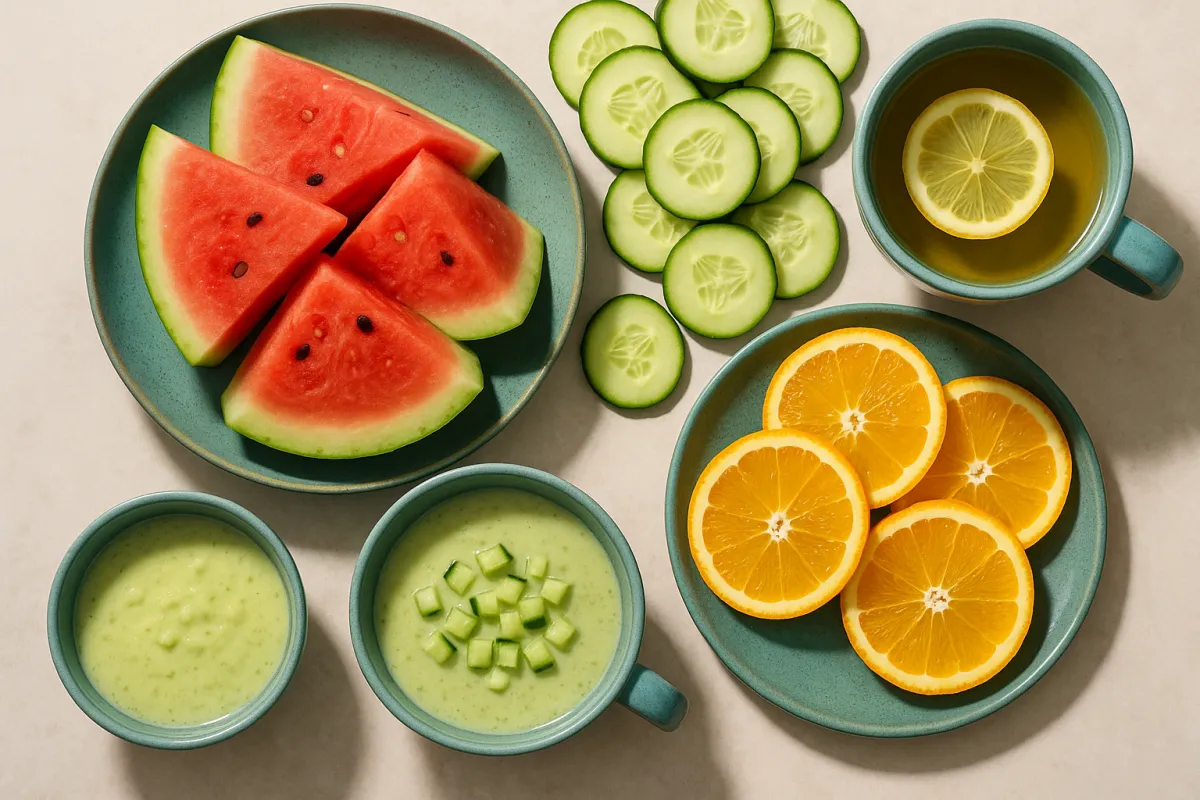
The practical consequences run in both directions. If your diet leans on fruits, vegetables, and cooked meals, rigid glass-counting will overshoot your actual need, and the surplus, while harmless, is obligation you never owed. If your diet leans processed and dry, packaged snacks, bread-and-cheese lunches, minimal produce, your food contribution shrinks toward 10 percent and your beverages carry more of the budget than average guidance assumes. This is also the honest answer to hydration in appetite-poor stretches, illness, age, heat: soups, fruit, and yogurt hydrate people who do not feel like drinking, a fact eldercare and pediatrics lean on daily. Food is not a hydration hack; it is a fifth of the system, and counting it correctly is what makes the rest of the numbers make sense.
Coffee, tea, and the diuretic myth
The other stubborn subtraction in folk hydration is caffeine: the belief that coffee and tea dehydrate, so their cups count against you rather than for you. The evidence says otherwise. Caffeine has a mild, short-lived diuretic effect, but the effect is far smaller than the fluid the drink delivers: a cup of coffee is overwhelmingly water, and the net contribution is solidly positive. Habitual drinkers, most of the population, develop tolerance to the diuretic effect besides, shrinking it further. Reference intakes accordingly count all beverages toward the total, caffeinated or not, and controlled comparisons find regular coffee drinkers no worse hydrated than water drinkers matched cup for cup.
The genuine cautions around beverages are different ones. Sugared drinks hydrate but carry calorie loads with health consequences of their own, which is a nutrition problem rather than a hydration one; water’s real superiority as a default is being free of them. Alcohol is the actual dehydrating exception, suppressing the hormone that tells kidneys to conserve water, hence its familiar aftermath, and it deserves counting against the budget rather than toward it. And energy drinks bundle caffeine doses with sugar in amounts worth separate scrutiny. But the morning coffee and the afternoon tea are hydration, full stop, and anyone forcing extra glasses to “make up for” them is settling a debt that does not exist.
Exercise: the multiplier that dwarfs the baseline
Nothing moves water needs like sweat, and the magnitudes surprise people calibrated to glass-counting. Sweat rates during vigorous exercise commonly run 0.5 to 1.5 liters per hour, with hot conditions and high intensities pushing past 2 in heavy sweaters: a single hard hour outdoors in summer can equal half a sedentary day’s entire fluid budget. The practical rhythm, echoed across sports-medicine guidance, is three-phase: arrive hydrated, drinking normally in the hours before; sip regularly during activity rather than gulping at the end, roughly matching comfort and thirst; and rehydrate afterward, where the reliable trick is weighing, each pound lost during a session is roughly half a liter of fluid to replace.
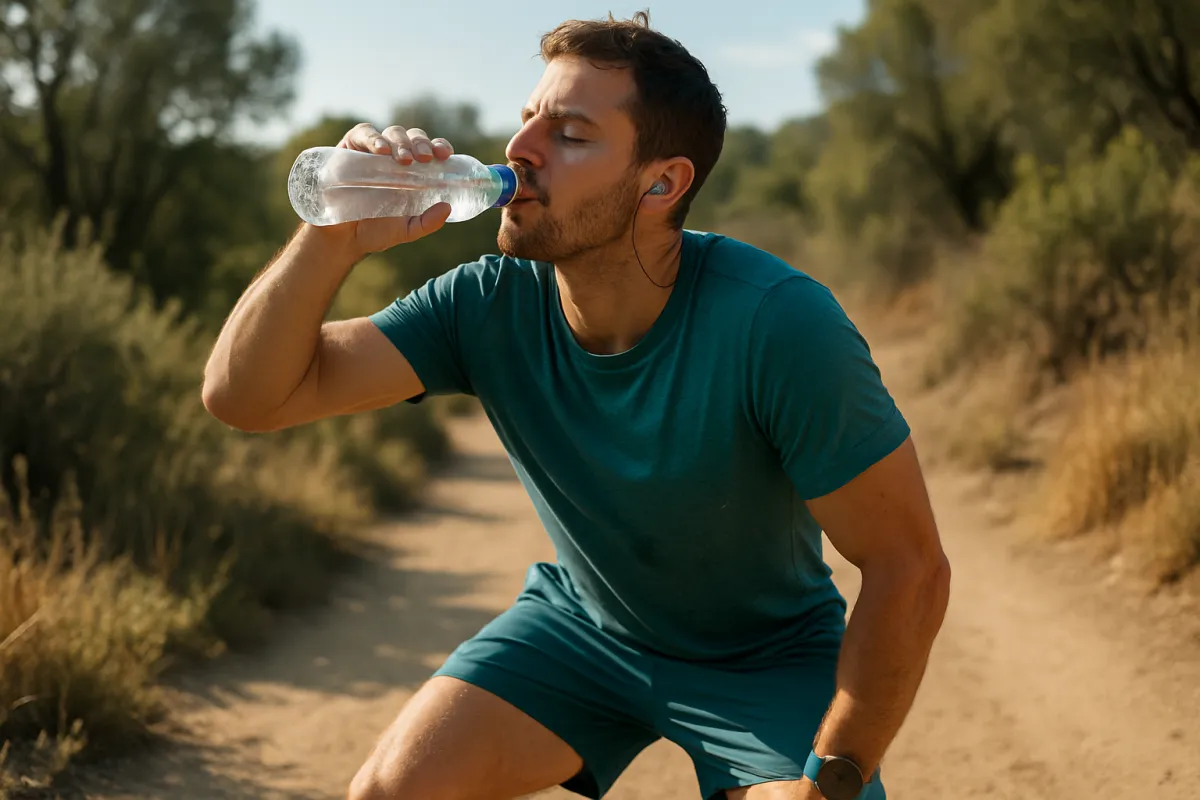
Past roughly an hour of continuous effort, or any duration in real heat, electrolytes join the story, because sweat is salty: replacing large sweat losses with plain water alone dilutes blood sodium, which at the extreme becomes the hyponatremia discussed below. Sports drinks, electrolyte tablets, or simply salted food alongside water all solve it; the point is sodium accompanying volume on long efforts. And a note of proportion for the other 95 percent of gym visits: a half-hour moderate session needs nothing elaborate, water to thirst covers it, and the supplement aisle’s enthusiasm for hydration products scales with its margins rather than your sweat rate, the same skepticism our protein review applied to powders.
Heat, illness, altitude: the other multipliers
Exercise is the largest routine multiplier but not the only one, and the others deserve their line items because they arrive uninvited. Heat raises sweat losses even at rest, an ordinary hot day adds meaningful outflow before you move, and humidity compounds it by making sweat less efficient, so summer baselines simply run higher, particularly for outdoor workers whose days combine both multipliers for hours. Illness is the underrated one: fever accelerates fluid loss through skin and breath, and vomiting or diarrhea can dump liters in a day, which is why rehydration, often with electrolytes, sits at the center of home care for stomach bugs and why fluid intake is standard sick-day advice for fevers, echoing the sodium-plus-volume logic of the endurance section.
Altitude adds a quieter tax, faster breathing in dry air costs extra water through the lungs, and mountain travelers dehydrate ahead of their thirst. Dry aircraft cabins do a small version of the same. Pregnancy and breastfeeding raise needs physiologically rather than environmentally: commonly cited adequate intakes rise to roughly 3 liters of total water in pregnancy and 3.8 while breastfeeding, milk being mostly water the body must source. None of these situations requires formulas, the thirst-plus-urine-color signals below scale with all of them, but knowing the multipliers exist converts them from mysterious bad days into predictable bookkeeping, and flags the two, illness in the vulnerable and sustained heat, where falling behind carries real risk.
Older adults: when the thirst signal fades
Every reassurance in this article about trusting thirst carries one demographic asterisk, and it is important enough for its own section. Thirst sensitivity declines with age: older adults given identical fluid deficits report less thirst and drink less to correct them, while aging kidneys simultaneously conserve water less efficiently. Common medications, diuretics for blood pressure among them, add outflow, and mobility or continence concerns quietly suppress intake by making drinking inconvenient. The combination makes dehydration one of the most frequent reasons older adults land in trouble, presenting as confusion, fatigue, or falls rather than anything that announces itself as thirst.
The countermeasure is routine in place of signal. Fluids anchored to existing habits, a full glass with each meal and each round of medication, already builds a floor of five or six cups; drinks kept visible and within reach, filled bottles by the chair rather than empty cups by the sink, close much of the rest; and the food channel earns its keep here more than anywhere, soups, fruit, yogurt, and tea hydrating people for whom plain water holds no appeal. Caregivers watching for the urine-color signal, and for sudden confusion in hot weather, catch what the faded thirst signal misses. The one balancing caution: heart and kidney conditions can require fluid restriction, so for anyone managing those, the individual target, in both directions, belongs to their clinician, not to any general article.
Too much: the overhydration risk that is actually real
Hydration culture treats more as safer, and for everyday drinking the kidneys’ dial does forgive a wide surplus: the routine cost of overdrinking is nothing worse than frequent bathroom trips. But there is a genuine ceiling, and endurance sport is where it gets found. Drinking far past what the kidneys can excrete, roughly a liter per hour at the extreme, dilutes blood sodium, and the resulting hyponatremia runs from nausea and headache through confusion to, rarely, seizures and worse. The classic case is not the elite racer but the cautious back-of-pack marathoner, forcing fluids at every station for hours out of dehydration fear, sweating modestly, and finishing heavier than they started, weight gain during long exercise being the tell-tale sign of net overdrinking.
The protections are simple and mostly attitudinal. During long events, drink to thirst rather than to schedule; thirst under-corrects slightly, which is the safe direction when the alternative error is dilution. Include sodium on multi-hour efforts, per the exercise section. Treat “clear urine always” as the misreading it is, pale yellow is the target, clear all day just means surplus. And retire the folk belief that if some water is good, forcing more is better: the body runs a budget, not a virtue ledger, and both directions of large error have costs. For everyday life, none of this warrants worry; it warrants exactly the calibrated respect this evidence review has given every other number.
The signals that beat the formulas
Everything above personalizes the population numbers; the body then offers two free instruments that integrate all of it in real time. Thirst, first: long dismissed as a lagging alarm, it is in healthy adults a reasonably calibrated prompt, arriving with mild deficits and scaling with them, and drinking when thirsty plus a little routine covers the enormous majority of days with no arithmetic at all. Urine color, second: pale straw yellow signals a hydrated system, consistently dark amber signals the kidneys conserving hard and a genuine need for more fluid, and the check costs nothing several times a day. Add the endurance athlete’s scale trick, session weight change as sweat-loss measurement, and the aging asterisk from earlier, routine replacing signal where thirst fades, and you hold the entire practical toolkit.
Symptoms complete the instrument panel at the edges: headache, fatigue, dizziness, and poor concentration accompany meaningful dehydration, cognitive and mood effects appear in studies at even mild deficits, which is a fair argument for keeping water visible on desks, and the serious signs, confusion, minimal dark urine, rapid heartbeat in heat or illness, are medical-attention territory rather than another-glass territory. The honest summary of decades of hydration research is almost anticlimactic: for healthy adults in ordinary life, drink when thirsty, keep urine pale, build a little routine so the signal never has to shout, and spend the attention you save on the sleep and diet questions where effort buys more.
The daily numbers, assembled
Translating everything into the units people actually pour, with every figure illustrative and the signals above outranking all of them. A typical adult woman’s reference total of about 2.7 liters, minus food’s fifth, suggests roughly 2.2 liters of fluids, about 9 cups from all beverages combined; a typical man’s 3.7 total suggests roughly 3 liters, about 12 to 13 cups. Coffee and tea count toward those. A produce-heavy diet trims the pour target; a dry, processed one raises it. Heat, exercise, fever, pregnancy, and breastfeeding add from there, sweat sessions by the half-liter to liter per hour, and hard sweat past an hour brings sodium into the plan.
Where a typical day's water actually comes from
Illustrative shares of total intake for an average adult diet.
The total is what matters, and it arrives through more channels than the slogan counted: all beverages contribute, and food quietly supplies around a fifth before anything is poured.
Held against the slogan, the verdict lands in the middle: eight cups of fluids is not wrong as a ballpark for smaller or less active adults, it is simply not a law, not drinks-only physiology, and not personalized. The number was always a population average wearing a slogan’s confidence, and the upgrade is not a better number; it is the budget, the modifiers, and the two signals, which is what this review has handed you.
How much water should you drink based on your weight?
A frequently repeated shortcut skips the reference-intake math and ties water directly to body weight instead: drink half your body weight in ounces. For a 140-pound adult that works out to 70 ounces, about 2.1 liters; for a 200-pound adult it is 100 ounces, about 3 liters. The appeal is obvious, no reference table required, and for an adult near an average weight the result lands close to the reference-intake fluids figures above, close enough to serve as a rough starting point.
Where it breaks is the same place the 8-glasses rule breaks: it scales with a single variable, weight, and ignores sweat, climate, diet composition, and health status entirely. A tall, heavily built, sedentary office worker and a smaller, lean adult training outdoors in the heat can weigh the same and need very different amounts of fluid; the rule gives both the same number. It also has no reference-intake body behind it, and circulates the same way the 8-glasses figure did, by repetition rather than by publication. Treat it the way this review treats every fixed number: an illustrative starting estimate worth checking against thirst and urine color, not a target to hit exactly, and one worth abandoning on a hot day, a hard workout, or a fever, when the multipliers above matter more than the arithmetic.
The multipliers, side by side
Seeing the modifiers on one scale makes this review’s central point, that circumstances move the number more than any slogan does, impossible to unsee. Take an illustrative 2.7 liter baseline and stack the day’s possible additions against it.
How circumstances move a day's water needs
Illustrative additions to a 2.7 liter adult baseline.
The gap between a desk day and a hot working day is larger than the entire 8-glasses debate: circumstances, not slogans, set the requirement, which is why the thirst and urine signals, which track circumstances automatically, outperform every fixed number.
The chart also explains why fixed-number advice fails in both directions at once: the same 2 liters that over-serves a small sedentary adult in winter genuinely under-serves anyone on the chart’s lower rows. Every fixed prescription is correct for one row and wrong for the rest, while the body’s own instruments read the row you are actually on, today, for free.
Making it effortless: environment beats willpower
For everyone who leaves this article intending to drink a little more, the evidence on habit design has one clear message: visibility and convenience outperform intention. People drink dramatically more from a bottle sitting on the desk than from a tap two rooms away, more from a filled glass at the table than from an empty one in the cupboard, more of whatever is cold and pleasant than of whatever is virtuous. The interventions that actually move intake in practice are embarrassingly mundane: a bottle that lives where your eyes rest, water put at the table before the meal rather than after, a glass anchored to existing routines, waking, meals, medications, the kettle going on, so the behavior rides habits that already run themselves.
Taste objections deserve engineering rather than argument: filtered or chilled water, a slice of citrus or cucumber, sparkling instead of still, herbal tea in cold months, all count fully toward the budget and cost nothing against it, and the food channel, soups, fruit, yogurt, hydrates the people no beverage strategy reaches. What does not help is gamified overreach, apps and gallon jugs marching intake far past any row of the chart above, which buys bathroom trips rather than health. The target is modest: cover the baseline without thinking, so that thirst only needs to speak when a multiplier shows up. A visible bottle, a glass with each meal, and preferences honestly accommodated get almost everyone there, no tracking required.
Children: smaller bodies, faster budgets
A brief word on the household’s smallest members, because their water budgets run on different physics. Children carry more surface area per pound, sweat systems that mature over years, and activity patterns that ignore weather, which together make them faster to deplete and slower to notice: a child absorbed in play reliably outruns their thirst signal in exactly the situations, hot playgrounds, sports practices, beach days, where losses peak. Commonly cited adequate intakes scale with age, illustratively from around 1.3 liters of total water for toddlers to 2.4 or more for teens, but as with adults, the numbers matter less than the practice: scheduled drink breaks during activity rather than waiting for requests, water bottles that travel with them, and water-rich snacks, fruit, yogurt, doing double duty.
Two child-specific notes earn their place. Illness again leads the real risk list, vomiting and diarrhea dehydrate small bodies quickly, and pediatric guidance leans on oral rehydration solutions rather than plain water for exactly the sodium reasons the endurance section covered; persistent signs, few wet diapers, listlessness, no tears, are clinician territory promptly. And habit formation pays compound interest here: children who grow up with water as the default table drink, rather than sweetened alternatives, carry the cheapest health habit in this entire review into adulthood, no slogan required.
Hydrating around a workout, step by step
The three-phase rhythm sounds abstract until you run it through a real session, so here is one illustrative example, chosen to show the method rather than to prescribe amounts for anyone. Picture a 75-minute bike ride on a warm afternoon.
In the hours before, the rider drinks normally with lunch and tops up with a glass of water about half an hour before rolling out, arriving hydrated rather than trying to catch up mid-ride. During the ride, instead of gulping at the end, they sip regularly, roughly a few mouthfuls every fifteen minutes, guided by thirst rather than a rigid schedule. After finishing, they use the reliable check: stepping on a scale before and after. Say the scale shows two pounds lighter despite drinking during the ride. Since each pound lost is roughly half a liter of fluid, that is about a liter still to replace over the next few hours, sipped steadily rather than forced down at once.
The weigh-in trick is what turns guesswork into feedback, because it measures the one thing no formula can predict for you: your actual sweat rate on this day, in this weather, at this effort. A light indoor session on a cool day might show almost no change and need nothing beyond normal drinking, while the same rider in summer heat could lose far more. The lesson is that the session itself sets the number, which is why a fixed daily glass count cannot capture exercise days. Anyone with a heart or kidney condition should confirm their approach to exercise fluids with a clinician rather than a general routine.
A hot working day, hour by hour
Sustained heat combined with physical work is the situation where falling behind on fluids carries the most real risk, so it earns a worked scenario of its own. Consider an illustrative outdoor worker on a hot summer day, on their feet and moving for most of an eight-hour shift.
The morning starts easy, with a bottle emptied over the first couple of hours and a glass at breakfast, keeping ahead of thirst before the heat builds. By midday the sun is high and the sweat rate climbs, so the sensible pattern is smaller, frequent drinks at every break rather than a single large one, because the body absorbs steady fluid better than an occasional flood. Through the afternoon, when losses are highest, plain water alone starts to fall short, since heavy sweat carries sodium out with it, so salted food at lunch or an electrolyte drink helps hold the balance. Urine color glanced at during breaks is the simplest running gauge, with pale yellow the target and dark amber a prompt to catch up.
Stacked across the shift, a hot working day can easily call for well over double a quiet desk day’s fluids, which is exactly the gap the multiplier chart earlier made visible. The genuine danger signs, dizziness, headache, confusion, or a racing heart in the heat, are medical-attention territory rather than another-glass territory, and heat illness in a working person is not something to push through. For anyone on medications that affect fluid balance, or with a health condition, the right approach to heat and hydration is a conversation with a clinician.
Electrolytes: when water alone is not enough
Most of the time plain water is the right and only tool, but a few situations call for sodium and other electrolytes alongside it, and knowing which ones prevents both under- and over-reacting. Electrolytes are the minerals, sodium chief among them, that the body loses in sweat and other fluids and that help regulate how water is distributed inside and outside cells. Replacing large fluid losses with water alone, and nothing else, can dilute blood sodium, which is the mechanism behind the overhydration risk covered earlier.
The practical triggers are specific rather than constant. Prolonged, heavy sweating past roughly an hour of hard effort, or any sustained activity in real heat, is the main one, since that is when sodium losses grow large enough to matter. Illness that causes vomiting or diarrhea is another, which is why oral rehydration solutions, not plain water, sit at the center of home care for stomach bugs, and why pediatric guidance leans on them for children. The solutions need not be commercial: salted food and water together cover most cases, and electrolyte tablets or sports drinks are a convenience rather than a necessity.
For ordinary life, though, electrolyte products are oversold. A half-hour gym session, a normal day, or light sweating needs nothing beyond water and a normal diet, which already supplies plenty of sodium for most people. Reaching for a colorful electrolyte mix after a gentle walk or a desk day solves a problem that was never there, and the sugar that some of these drinks carry is its own small cost. The supplement aisle’s enthusiasm for hydration mixes scales with its margins rather than your need, the same skepticism our calorie needs review applied to tracking gadgets. The simple test is whether you have been sweating hard for a sustained stretch or losing fluid to illness; if not, water and ordinary meals almost always cover it. Anyone with high blood pressure, kidney or heart conditions, or a sodium-restricted diet should be especially careful with added electrolytes and follow their clinician’s guidance.
Common hydration mistakes
The recurring errors, gathered for prevention.
- Counting only plain water. All beverages count, and food carries a fifth; the total is the physiology, the container is culture.
- Docking coffee and tea from the tally. Their fluid outweighs their mild diuretic effect; only alcohol genuinely counts against.
- Chasing perfectly clear urine. Pale yellow is the target; permanently clear just means surplus and bathroom mileage.
- Ignoring the multipliers. An hour of summer exercise can outweigh the whole baseline; fever and stomach bugs drain quietly.
- Forcing fluids during endurance events. Weight gain mid-race signals dilution; thirst is the safer pacer, with sodium on long efforts.
- Trusting thirst in older age. The signal fades; routine, visible drinks, and water-rich foods replace it.
- Buying hydration complexity. For ordinary life, the toolkit is a glass at meals, thirst answered, urine glanced at, free, complete, evidence-aligned.
Each mistake comes from treating a population slogan as personal physiology; each fix comes from the budget-and-signals model that actually describes how bodies run.
The bottom line
Hydration science, read honestly, is liberating: the body publishes its requirements in real time, thirst and urine color integrate every variable the formulas fumble, and the famous eight glasses turns out to be a decent ballpark for some people, an overshoot for others, and a law for no one.
Anchor on the totals, roughly 2.7 and 3.7 liters from all sources for typical women and men, remember that every beverage and a fifth of your food already count, scale up honestly for sweat, heat, illness, and life stages, build routine where age fades the signal, and respect the ceiling during long exercise. Then let the system run itself, the way it has been trying to all along. For the same evidence-first treatment of the day’s other big number, our protein review is the companion piece, and our calculator turns both into your numbers.
NourishMark evidence reviews exist to educate, and this one is no exception: nothing in it is medical advice for any individual reader. The intake figures, loss rates, and every other number here are illustrative population estimates, and real hydration needs can diverge from them materially with medical conditions, medications, pregnancy, and age. Talk with a qualified health professional about your own situation, above all if you manage heart, kidney, or any other condition that affects fluid balance.
Frequently asked questions
Is the 8 glasses of water a day rule true?
Not as commonly told. The rule traces to mid-century guidance that suggested roughly a milliliter of water per calorie of food, which lands near 8 cups for a typical diet, but the same guidance noted that much of this amount already comes from food, a caveat the slogan dropped. Modern reference intakes describe total water from all sources, beverages and food together, and treat thirst as a generally reliable guide for healthy adults.
How much water do adults actually need per day?
Commonly cited adequate intakes for total water, meaning all beverages plus the water in food, are roughly 3.7 liters a day for adult men and 2.7 liters for adult women, of which drinks typically supply around 80 percent and food around 20 percent. That translates to roughly 8 to 12 cups of fluids for many adults, but the figures are population averages, not personal requirements: needs vary with body size, activity, climate, and health.
Does coffee or tea count toward my water intake?
Yes. Caffeinated drinks have a mild, short-lived diuretic effect, but the fluid they deliver outweighs it, and habitual drinkers develop tolerance to the effect besides. Coffee, tea, milk, and other beverages all contribute to total water intake in the research. That said, water remains the best default because it hydrates without added sugars or calories, which is the real caution behind beverage choices, not hydration failure.
Does food really count toward hydration?
Substantially. Food typically supplies around 20 percent of total water intake, and more in produce-heavy diets: fruits and vegetables like watermelon, cucumber, oranges, and lettuce are mostly water by weight, and soups, yogurt, and cooked grains carry meaningful amounts too. This is one reason rigid drink-counting overstates what you need to pour: a person eating plenty of produce arrives partly hydrated before the first glass.
How do I know if I am drinking enough water?
For most healthy adults, two simple signals cover it: thirst, which is a reasonably reliable prompt rather than a lagging alarm, and urine color, with pale yellow suggesting adequate hydration and consistently dark yellow suggesting you need more fluid. Persistent fatigue, headache, and dizziness can accompany meaningful dehydration. If you drink when thirsty and your urine stays pale, elaborate tracking adds little for everyday life.
Do I need more water when I exercise or in hot weather?
Yes, and the increase can be large. Sweat losses during vigorous exercise or heat commonly run from half a liter to well over a liter per hour, and both conditions together compound the need. Practical guidance is to drink before activity, sip regularly during it, and rehydrate after, and for long or intense sessions over roughly an hour, especially in heat, electrolytes matter alongside plain water because sweat carries sodium out with it.
Can you drink too much water?
Yes. Drinking far beyond what the body can excrete, especially quickly during endurance events, can dilute blood sodium, a condition called hyponatremia that ranges from unpleasant to genuinely dangerous. It is rare in everyday life and mostly a risk of aggressive overdrinking during long exercise. The practical rules: let thirst lead during endurance activity, include electrolytes on long efforts, and be skeptical of any advice to force fluids far past comfort.
Do older adults need to pay more attention to hydration?
Generally yes. The thirst signal weakens with age, kidney water conservation declines, and some common medications increase fluid loss, so older adults can drift into dehydration without feeling thirsty. Building fluids into routine, a glass with each meal and medication, drinks visible and within reach, is more reliable than waiting for thirst. Anyone with heart or kidney conditions should ask their clinician about the right individual fluid target, in both directions.

Hamza Hai is the editor of NourishMark. She holds an MBA and reviews the site's articles against our editorial standards, checking that every figure is labelled for what it is, that nothing is presented as verified fact without a source the reader can check, and that the writing stays useful to a non-specialist.

Dr. Shayaan Khan is the medical reviewer for NourishMark. He holds an MBBS from MGM Medical College, Navi Mumbai, and is the author of published research including a narrative review of postpartum anxiety and depression in Mental Health Science. He has taught physiology at university level. He reviews the site's health content for medical accuracy: that physiology and mechanisms are described correctly, that no claim is stated more strongly than the evidence behind it, and that anything specific to an individual reader is sent to that reader's own clinician.
Not medical advice. Dr. Khan reviews NourishMark's health content for medical accuracy. He is not a registered dietitian, he does not hold a United States practising licence, and he is not your doctor. His review does not make anything here medical advice. Always talk to a qualified health professional about your own situation, and never delay or stop care because of something you read here.