What's in this review
- Rice Calories: The Direct Answer
- Calories in Rice by Type and Portion: A Quick Table
- How Many Calories in a Cup of Cooked Rice?
- How Many Calories in 100g of Rice?
- How Many Calories in a Quarter Cup of Dry Rice?
- Cooked vs Uncooked Rice Calories
- White Rice vs Brown Rice Calories
- Calories by Rice Portion: A Reference Table
- Jasmine Rice Calories
- Basmati Rice Calories
- Where the Calories in Rice Come From
- Carbs in Rice and How They Fit
- White vs Brown Rice: Fiber and Nutrients
- Rice and Weight Management
- Portion Control Tips for Rice
- How Rice Fits a Balanced Diet
- How Rice Fits Your Daily Calories
- A Worked Example: A Rice Meal by the Numbers
- Rice vs Other Grains
- Common Mistakes Counting Rice Calories
- How to Count Rice Calories Accurately
- The Bottom Line
Short answer: Using USDA figures, cooked white rice lands near 130 calories per 100 grams, so a one-cup cooked serving of about 158 grams sits close to 205 calories, a half cup near 100, and a heaped two-cup bowl near 410. Dry rice reads far higher, near 360 calories per 100 grams, because it holds almost no water. White and brown rice are nearly identical per equal weight; brown's edge is fiber, not fewer calories.
The calories in rice come down mostly to two things: how much cooked rice is in the bowl and whether you are weighing it cooked or dry. Using figures from the United States Department of Agriculture, cooked white rice lands near 130 calories per 100 grams, so a common one-cup cooked serving of about 158 grams sits close to 205 calories, and a half cup near 100. Brown rice is almost identical gram for gram, near 120 to 125 calories per 100 grams, and reads a little higher only by the cup because a packed cup of brown rice weighs more. The number that surprises people is dry rice, which is near 360 calories per 100 grams before it absorbs its cooking water, because cooked rice is diluted by that water. The figure is not mysterious once you know which portion you are holding and whether it is cooked or dry.
This evidence review is a plain-language reference for the calories in rice, organized so you can find the variety and portion you have and understand the figure once you do. It is narrower than our broader reference on calories in common foods, which covers dozens of staples at once, and it pairs with our review of how many carbs per day for the wider carbohydrate picture, since rice is mostly carbohydrate. It works through USDA calories by type and portion, the cooked-versus-dry difference that trips up nearly everyone, white against brown, jasmine and basmati, the carbohydrate that makes up most of the calories, portion control, and how rice fits weight management and a balanced diet. It is educational, describes food composition only, and is not diet or medical advice. You can also tally your own portion in the companion below.
Key takeaways
- USDA figures put cooked white rice near 130 calories per 100 grams, so a one-cup cooked serving is near 205 calories, a half cup near 100, and a heaped two-cup bowl near 410.
- Dry rice reads far higher, near 360 calories per 100 grams, because dry grains hold almost no water; cooked rice is the same calories diluted through absorbed water, so never mix the two figures.
- White and brown rice are nearly the same on calories per equal weight; brown reads a little higher by the cup only because a cup of it weighs more, and its real edge is fiber and micronutrients, not a lower calorie count.
- Rice is a starchy grain, so most of its calories are carbohydrate: about 45 grams in a cup of cooked white rice, with brown carrying more of that as fiber.
- Every figure here is a commonly cited, USDA-based reference, not an exact measurement or a personal target; for anything tied to your health, consult a doctor or registered dietitian.
Rice Calories: The Direct Answer
The direct answer is that cooked white rice carries roughly 130 calories per 100 grams, and it is a small range rather than a single number because the figure shifts a little with the grain length, the variety, and how firmly a cup is packed. That figure, drawn from USDA food composition data, is the anchor for everything that follows, and it applies to plain rice cooked in water without added fat. Multiply that rate by the weight of your cooked portion and you have the base calories.
It helps to anchor the range in portions people actually eat. A one-cup cooked serving of white rice, about 158 grams, carries close to 205 calories, a half cup lands near 100, and a generous heaped bowl of two cups reaches about 410. Brown rice sits within a hair of white on a per-gram basis, so its per-cup figure looks slightly higher mainly because a cup of cooked brown rice weighs more. What defines rice is not a high calorie figure on its own but that almost all of those calories are carbohydrate, roughly 45 grams in a cup of white rice, which is why rice is treated as an energy staple rather than a protein or fat source. The rest of this review breaks that rate down by type and portion, sorts out the cooked-versus-dry confusion, compares white with brown, and sets rice against other grains. Set your own portion in the companion below to see the arithmetic update as you read. As with everything here, these are commonly cited, illustrative references rather than an exact reading of any particular bowl.
Calories in Rice by Type and Portion: A Quick Table
Because rice comes in several varieties and is served in such a wide range of portion sizes, the calories are best shown as a small table rather than a single number. The figures below draw on USDA-based food composition data for plain rice cooked in water, with carbohydrate alongside so you can see that most of the calories are starch. They give a quick sense of how much the type matters (a little) and how much the portion matters (a lot).
| Rice | Portion | Calories, roughly | Carbs, roughly |
|---|---|---|---|
| White, long grain (cooked) | 1 cup (~158 g) | ~205 kcal | ~45 g |
| White (cooked) | 100 g | ~130 kcal | ~28 g |
| Jasmine, white (cooked) | 1 cup (~158 g) | ~205 kcal | ~45 g |
| Basmati, white (cooked) | 1 cup (~158 g) | ~200 kcal | ~44 g |
| Brown, long grain (cooked) | 1 cup (~195 g) | ~218 kcal | ~46 g |
| Brown (cooked) | 100 g | ~123 kcal | ~26 g |
| White (dry, uncooked) | 1/4 cup (~45 g) | ~160 kcal | ~36 g |
| Brown (dry, uncooked) | 1/4 cup (~46 g) | ~170 kcal | ~35 g |
The table shows the two lessons this review keeps returning to. First, the varieties are close together on calories: white, jasmine, basmati, and brown all land in a narrow band per cup, so the type of rice is a minor lever compared with the amount. Second, the dry rows sit far above the cooked rows per 100 grams because dry rice has not yet absorbed its water. Use whichever row matches what you have, and remember that a restaurant or takeout serving is often two to three of the one-cup rows stacked together. Every number here is a commonly cited reference for plain rice, so add for any oil, butter, or sauce, and treat the totals as illustrative rather than exact.
How Many Calories in a Cup of Cooked Rice?
One cup of cooked white rice is about 158 grams, which carries roughly 205 calories at the commonly cited rate of 130 calories per 100 grams, and USDA figures put a standard cooked cup in that range. A cup is the portion many recipes and dietary references picture as one to two servings of rice, so it is a useful anchor to keep in mind, though many real bowls hold more.
To put 205 calories in context, nearly all of it is carbohydrate, roughly 45 grams, with only about 4 grams of protein and almost no fat. That is what makes rice an energy food rather than a protein or fat source: it delivers steady, easily digested carbohydrate with very little else. A cup of cooked brown rice runs a little higher by the cup, often near 218 calories and sometimes cited up to about 248, but the difference is mostly because a packed cup of brown rice weighs more, close to 195 grams, not because brown rice is richer gram for gram. Jasmine rice, a fragrant white long-grain, is essentially the same as plain white rice per cup, and basmati, another long-grain, is a touch lower for some batches. The practical takeaway is that a cup of any of these lands somewhere around 200 to 220 calories, and the bigger question is how many cups are actually in the bowl. Enter your own portion in the companion below to see the calories update. This is an illustrative reference figure rather than an exact measurement of any specific serving.
How Many Calories in 100g of Rice?
The cleanest way to state rice calories is per 100 grams, because that removes the guesswork about how a cup was packed. Cooked white rice is commonly cited at about 130 calories per 100 grams, drawing on USDA food composition data, and that is the reference rate this whole review builds on. Cooked brown rice is very close on the same basis, near 120 to 125 calories per 100 grams, so per equal weight the two varieties are effectively the same.
The one thing to watch is whether the 100 grams is weighed cooked or dry, because the two give wildly different numbers. Cooked white rice is near 130 calories per 100 grams, while dry, uncooked white rice is near 360 calories per 100 grams. That is not because cooking removes energy; it is because dry rice holds almost no water, and the grains soak up a large amount of it as they cook, roughly tripling in weight. So a cooked 100 gram sample is mostly absorbed water by weight, which spreads the same calories through a heavier serving. The cooked-versus-dry section below handles this in detail, but the short version is that the low 130 figure applies to cooked rice and the high 360 figure applies to dry rice, and mixing them is the most common rice-counting error there is. These are illustrative reference values that vary a little with the variety and preparation.
How Many Calories in a Quarter Cup of Dry Rice?
Because rice is usually measured dry before cooking, a very common question is how many calories are in a quarter cup of uncooked rice, which is a typical single-serving scoop. A quarter cup of dry white rice weighs about 45 grams and carries roughly 160 calories, at the commonly cited dry rate near 360 calories per 100 grams, with about 36 grams of carbohydrate. A quarter cup of dry brown rice is similar, near 170 calories, since dry brown and white rice are close per gram.
Here is the key point that confuses people: that quarter cup of dry rice does not stay a quarter cup. As it cooks it absorbs water and roughly triples in volume, so a quarter cup of dry rice becomes close to three quarters of a cup of cooked rice, still holding the same 160 calories, now spread through a much larger, heavier serving. This is why the same calories can look like a small scoop dry and a generous mound cooked. If you portion your rice dry, use the dry figure on the dry weight; if you weigh it after cooking, use the cooked figure. Either way, be consistent and never apply one to the other. These are illustrative references for planning, not a prescribed portion for anyone. See how a dry scoop translates to cooked calories in the companion below.
Cooked vs Uncooked Rice Calories
The most common confusion about rice calories is the gap between dry and cooked figures, so it is worth slowing down on it. Dry white rice shows about 360 calories per 100 grams, while cooked white rice shows closer to 130 calories per 100 grams. The instinct is to think cooking somehow removes calories, but it does not. Cooking cannot destroy energy.
What actually happens is that dry rice holds almost no water, and the grains absorb a large amount of it during cooking. Rice roughly triples in weight as it cooks, so the calories that were concentrated in the dry grain get diluted through the absorbed water. A 100 gram scoop of dry rice, near 360 calories, becomes about 300 grams of cooked rice holding those same 360 calories, which works out to near 120 to 130 calories per 100 grams cooked. So the calories per 100 grams fall sharply even though the total energy is unchanged. The practical rule is to be consistent: use the cooked rate for cooked rice and the dry rate for dry rice, and never mix them. Because rice is bought and measured dry but eaten cooked, this is the single most common reason people either badly over- or undercount their rice. These are illustrative reference figures for general information.

White Rice vs Brown Rice Calories
Whether to eat white or brown rice is the comparison people ask about most, and on calories alone the answer surprises many: they are nearly the same. Cooked white rice sits near 130 calories per 100 grams, while cooked brown rice sits near 120 to 125 calories per 100 grams, a difference small enough to disappear into how any single batch is cooked. Per equal weight, in other words, choosing brown over white barely changes the calorie count.
Two things create the impression that brown rice is different. First, a cup of cooked brown rice often reads a little higher, near 218 calories against about 205 for white, but that is because a cup of cooked brown rice weighs more, closer to 195 grams versus 158, not because it is denser in energy. Second, and more importantly, brown rice keeps the bran and germ that white rice has milled away, so it carries several times more fiber, more magnesium, and more of certain B vitamins. That is the real difference: brown rice is not meaningfully lower in calories, it is higher in fiber and micronutrients, and its extra fiber can make it a little more filling and gentler on blood sugar. So the honest framing is that white and brown rice are close on calories and that brown rice’s advantage is nutritional quality rather than a lower number. Neither is nutritionally wrong, and our high-fiber foods list puts brown rice’s fiber in context. These are commonly cited, illustrative figures that vary with the variety and preparation.
Calories by Rice Portion: A Reference Table
This is the table that answers the common portion-based questions in one place: how rice calories scale across the servings people actually eat. All figures assume plain cooked white rice at about 130 calories per 100 grams, based on USDA-derived data, with carbohydrate alongside so you can see the full picture of why portion size drives the number.
| Portion (cooked white) | Weight | Calories, roughly | Carbs, roughly |
|---|---|---|---|
| 1/4 cup | ~40 g | ~50 kcal | ~11 g |
| 1/2 cup | ~79 g | ~100 kcal | ~22 g |
| 1 cup | ~158 g | ~205 kcal | ~45 g |
| 1.5 cups | ~237 g | ~308 kcal | ~68 g |
| 2 cups | ~316 g | ~410 kcal | ~90 g |
The table shows how cleanly the calories scale with the amount, because the rate per 100 grams is fixed: double the rice and you double the calories. This is exactly why portion size, not variety, is the main lever on rice calories. A half-cup side and a heaped two-cup bowl are the same food but a fourfold difference in calories, from about 100 to about 410. Use whichever row matches your usual serving and you have the figure without a scale. Every number here is a commonly cited reference for plain rice, so add for any oil, butter, or sauce, and treat the totals as illustrative rather than exact. How this fits your whole day is the job of our calorie needs review, which handles daily energy directly.
Calories by rice portion (cooked white rice)
Calories in plain cooked white rice at about 130 kcal per 100 g, based on USDA-derived figures. Illustrative reference values.
Bars scale to a heaped two-cup bowl at 100 percent. Figures assume plain cooked white rice and shift with any added fat or sauce; they are illustrative references, not a target.
The chart makes the point that a phrase like “some rice” can mean anything from about 100 to over 400 calories depending on the portion, which is a wide spread when you are counting closely. A restaurant portion or a generous home serving often sits at the one-and-a-half to two-cup end rather than the half-cup one. The practical takeaway is to measure or eyeball the actual amount rather than assuming a fixed number per bowl. These are commonly cited averages, and the exact calories in any single serving vary with the variety and how firmly it is packed.
Jasmine Rice Calories
Jasmine rice is a fragrant long-grain white rice popular in Southeast Asian cooking, and because it is a white rice its calories track plain white rice closely. A cup of cooked jasmine rice carries roughly 205 calories, near the same 130 calories per 100 grams as ordinary white rice, with about 45 grams of carbohydrate. The aroma and slightly sticky texture come from the variety, not from any meaningful difference in energy.
Because jasmine rice is milled white, it has had the bran and germ removed like other white rice, so it is lower in fiber than brown rice and digests quickly. Some people notice jasmine and other sticky white rices feel less filling than an equal weight of brown rice, which is a fiber and texture effect rather than a calorie one. For counting purposes you can treat jasmine rice as white rice: about 205 calories per cooked cup, scaled to your portion. As always, anything added in cooking, from oil to coconut milk in a fragrant pilaf, counts on top of the plain figure. These are commonly cited, illustrative references that vary a little by batch.
Basmati Rice Calories
Basmati is a long-grain aromatic rice common in South Asian and Middle Eastern cooking, sold as both white and brown. White basmati carries roughly 200 calories per cooked cup, close to but sometimes a touch below ordinary white rice, near 125 to 130 calories per 100 grams, with about 44 grams of carbohydrate. Brown basmati sits near the brown-rice figures, similar in calories per gram but higher in fiber.
Basmati often gets attention because its grains stay separate and it tends to have a lower glycemic response than short-grain sticky rices, meaning it can raise blood sugar a little more gently, though it is still a starchy carbohydrate and the effect varies by person and meal. On calories, though, the difference from other white rice is minor, so the same rule applies: about 200 calories per cooked cup, scaled to your portion, plus anything you add. Choosing brown basmati over white swaps in more fiber for a nearly identical calorie count, the same trade as white versus brown rice generally. These are illustrative, commonly cited figures rather than an exact reading of any particular variety.
Where the Calories in Rice Come From
To understand why rice reads the way it does, it helps to see what the calories are actually made of. In plain cooked rice, almost all of the calories come from carbohydrate, with a small amount from protein and essentially none from fat. Per cup of cooked white rice, that is roughly 45 grams of carbohydrate and about 4 grams of protein, with the rest of the cup being water.
What a cup of cooked white rice is made of (by weight)
Approximate makeup by weight of a 158 g cup of cooked white rice, based on USDA-derived figures. Illustrative reference values.
Segments show each part's share of a 158 g cup of cooked white rice by weight. Dry rice holds far less water, which is why it reads higher per 100 g. Illustrative figures.
The chart shows why cooked rice is not as calorie-dense per gram as its reputation suggests: more than two thirds of a cooked cup is water the grain absorbed, and the carbohydrate that carries the calories is under a third by weight. Because carbohydrate and protein each carry about 4 calories per gram and rice has almost no fat, the calorie figure tracks the carbohydrate closely. This is also why dry rice reads so much higher: strip out the absorbed water and the same carbohydrate is packed into a far smaller weight. Brown rice has a similar makeup, with a slightly larger slice of that carbohydrate being fiber. These are commonly cited, illustrative figures that vary with the variety and how much water the rice took up.
Carbs in Rice and How They Fit
Rice is, above all, a carbohydrate food, and that is neither good nor bad on its own: it is simply what rice is for in a meal. A cup of cooked white rice carries roughly 45 grams of carbohydrate, and cooked white rice is commonly cited near 28 grams per 100 grams, based on USDA-derived data. In a plain serving almost all of that is starch, with only a trace of sugar and, in white rice, very little fiber.
That carbohydrate is why rice is such an efficient energy source and also why portion matters for anyone watching their carbohydrate intake. A large restaurant serving of two to three cups can carry 90 to 135 grams of carbohydrate before anything else on the plate, which is a substantial share of a day for many people. Brown rice carries a similar total carbohydrate but delivers more of it as fiber, which is digested more slowly, so it tends to raise blood sugar a little more gently than white. How much total carbohydrate suits a day depends on the person and their goals, which our review of how many carbs per day walks through, and rice is one contributor among many. These are illustrative reference figures, and anyone managing diabetes or blood sugar should confirm their own carbohydrate targets with a doctor or registered dietitian.
White vs Brown Rice: Fiber and Nutrients
Since white and brown rice are so close on calories, the meaningful comparison is nutritional, and here brown rice pulls clearly ahead. Brown rice is a whole grain: it keeps the fibrous bran layer and the nutrient-rich germ that milling strips away to make white rice. As a result, a cup of cooked brown rice carries roughly 3 to 3.5 grams of fiber, against well under a gram in white rice, along with more magnesium, phosphorus, and several B vitamins.
That fiber is the practical difference most people feel. It slows digestion a little, which can make brown rice more filling per calorie and gentler on blood sugar, and dietary fiber supports regularity and gut health, themes our high-fiber foods list covers in depth. White rice is not without merit: it is easier to digest, which some people prefer around exercise or with a sensitive gut, and in many countries white rice is enriched, meaning certain B vitamins and iron are added back after milling. So the choice is not white bad, brown good, but a trade between brown rice’s fiber and micronutrients and white rice’s lighter, quicker-digesting texture, at nearly the same calorie cost. Rotating both, or mixing them, is a perfectly reasonable pattern. These are commonly cited, illustrative figures that vary with the variety and processing.
Rice and Weight Management
Rice turns up in conversations about weight because it is calorie-dense once you get past a small portion, but it is worth being clear that no single food causes or prevents weight change on its own. Weight is governed by overall calorie balance, the whole diet, activity, sleep, and a range of individual factors, not by whether rice is on the plate. The practical issue with rice is almost always portion size rather than the grain itself, since a heaped bowl can quietly hold two to three reference servings.
Where rice can help or hinder a weight goal is through fullness and what accompanies it. Brown rice’s extra fiber can make a portion a little more satisfying, and pairing any rice with protein and vegetables tends to make a meal more filling than rice alone. On the other side, the additions are where rice dishes gain calories fast: butter, oil, coconut milk, and fried preparations can add more than the rice itself. So a sensible approach is to treat rice as one measured component of a balanced plate rather than the whole meal, an idea our guide to building a balanced meal develops. This describes general nutrition principles, not a weight-loss plan; anyone pursuing weight change, especially with a health condition, should work with a doctor or registered dietitian.

Portion Control Tips for Rice
Because portion size is the main lever on rice calories, a few simple habits make it much easier to keep a serving where you intend. The most useful is to measure cooked rice with a cup once or twice so you can see what a half-cup and a one-cup serving actually look like in your usual bowl; after that you can eyeball it with reasonable accuracy. A half cup of cooked rice is often pictured as about the size of a cupped handful, and a cup as roughly a tennis ball’s worth, though these are rough guides.
Serving rice in a smaller bowl, plating it before sitting down rather than eating from the pot, and filling half the plate with vegetables first all nudge the rice portion down without any counting. Measuring rice dry before cooking is another reliable method, since a quarter cup of dry rice near 160 calories cooks up to a satisfying three-quarter-cup serving. And because the additions often outweigh the rice, going easy on butter, oil, and rich sauces controls more calories than shaving the rice itself. None of this requires treating rice as a food to avoid; it simply keeps a starchy staple at a portion that fits the rest of the meal. Set a portion you can picture in the companion below. These are general strategies, not a prescription for anyone.
How Rice Fits a Balanced Diet
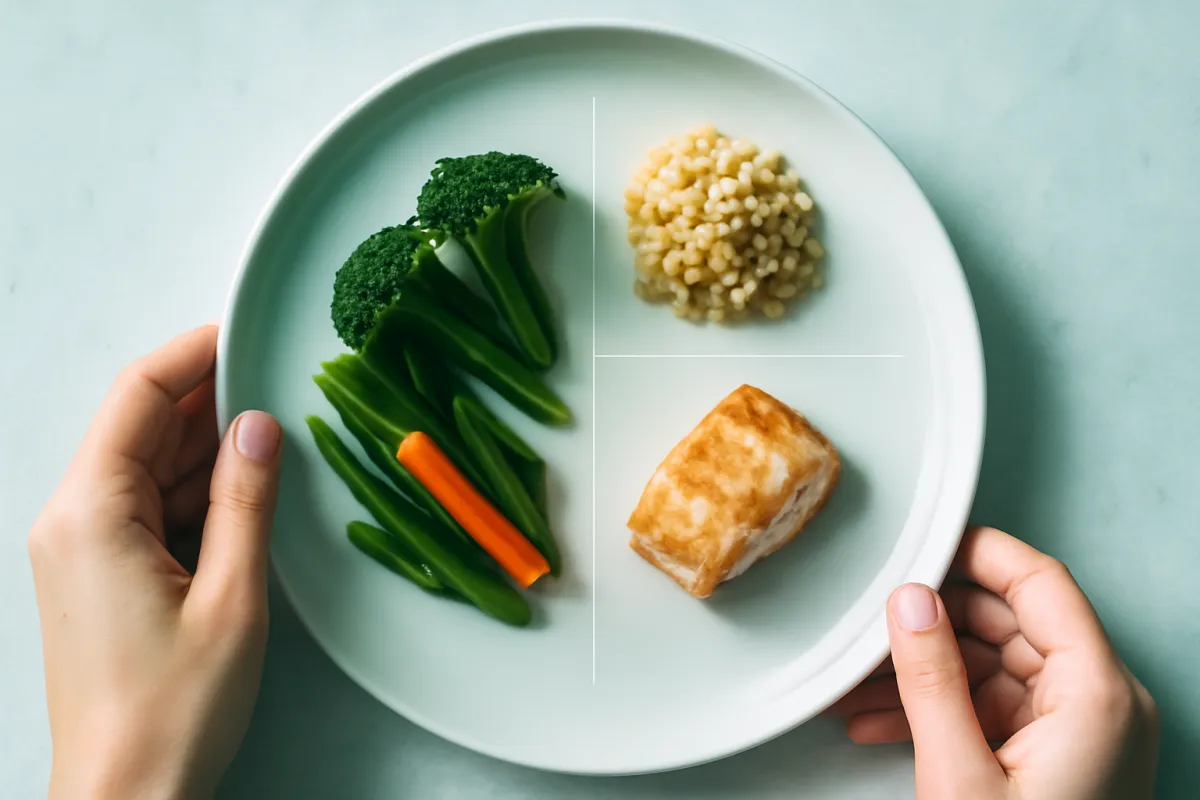
Rice has fed a large share of the world for millennia, and it fits a balanced diet easily when it plays its natural role: the carbohydrate anchor of a plate that also carries protein and vegetables. A common visual reference is to keep starches like rice to about a quarter of the plate, protein to another quarter, and vegetables to the remaining half, which naturally caps the rice portion while rounding out the meal. Our guide to building a balanced meal works through that plate model in detail.
In that context rice is doing a useful job: it provides quick, digestible energy, it is inexpensive and widely available, and it pairs with almost any cuisine. Choosing brown rice, or mixing brown and white, adds fiber and micronutrients for nearly the same calories, while white rice offers a lighter texture and, when enriched, added B vitamins and iron. The key is balance across the plate and across the week rather than any judgment about rice itself. For a broader look at how everyday staples compare on calories, our calories in common foods review sets rice alongside dozens of others. This describes general eating patterns, not a prescription for anyone.
How Rice Fits Your Daily Calories
A rice portion’s calories only mean something against a daily total, and that total is a separate question this review does not try to set for you. Daily calorie needs depend on body size, activity, age, and goals, which our calorie needs review walks through in detail. A common reference point many people use for illustration is a 2,000-calorie day, though individual needs run well above and below that.
Against a figure like that, a one-cup cooked serving of white rice at about 205 calories is a modest slice of the day, roughly a tenth, while a heaped two-cup bowl at about 410 is closer to a fifth before anything else on the plate. That is the practical reason portion matters: the same food can be a light side or a heavy centerpiece depending only on the amount. The picture also shifts with what rice is served with, since a plain side behaves very differently from a fried or coconut-rich dish. The point is not that everyone should eat a specific amount of rice, but that a measured portion slots neatly into whatever calorie total applies to you. Your personal target is best confirmed with a qualified professional, particularly if you have any medical condition.
A Worked Example: A Rice Meal by the Numbers
To pull the numbers together, here is an illustrative meal built around rice, chosen only to show the arithmetic rather than to recommend figures for anyone. Start with a one-cup cooked serving of white rice for roughly 205 calories and about 45 grams of carbohydrate. That single cup is the carbohydrate anchor of the plate, and on its own it is a modest share of a day.
Add a 4-ounce cooked chicken breast for roughly 185 calories, a large serving of stir-fried vegetables for about 90, and a tablespoon of oil used in cooking for around 120, and the plate lands near 600 calories with a balanced mix of carbohydrate, protein, and vegetables. The lesson is the one this review keeps returning to: a sensible cup of rice is a reasonable slice of the meal, and the additions, here the oil most of all, account for a large share of the rest. Swap the single cup for a heaped two-cup bowl and fry the rice in extra oil, and the total climbs sharply, which shows how much the portion and the preparation, not the grain, drive the final number. Build your own version, with your portion and type, in the companion below. The figures here are illustrative, chosen to show the math, not a meal this review advises anyone to eat.
Rice vs Other Grains
Set against other cooked grains, rice is a fairly typical starchy staple on calories, sitting in the same general band as most cooked grains per cup. Cooked white rice is near 205 calories per cup and brown near 218; cooked quinoa lands near 222 per cup with more protein and fiber; cooked pasta runs near 200 per cup; and cooked oats are lower per cup, near 150, largely because oats hold more water.
| Grain (cooked) | Portion | Calories, roughly | Carbs, roughly |
|---|---|---|---|
| White rice | 1 cup (~158 g) | ~205 kcal | ~45 g |
| Brown rice | 1 cup (~195 g) | ~218 kcal | ~46 g |
| Quinoa | 1 cup (~185 g) | ~222 kcal | ~39 g |
| Pasta | 1 cup (~140 g) | ~200 kcal | ~43 g |
| Oats | 1 cup cooked (~234 g) | ~150 kcal | ~27 g |
What the calorie figure alone does not capture is what each grain brings alongside. Quinoa carries more complete protein and fiber than rice, whole-grain pasta and brown rice add fiber over their refined versions, and oats bring a soluble fiber linked to other benefits. So rice is not the highest or lowest grain on calories; it is a middle-of-the-pack staple whose main variable is the portion. A varied week that rotates rice with other whole grains covers more nutritional ground than leaning on any single one. For the wider staple comparison, our calories in common foods review lays out the field. These figures are commonly cited references that vary by variety and preparation.
Common Mistakes Counting Rice Calories
A handful of recurring errors explain most of the confusion around rice calories, and each is easy to fix once named.
- Mixing dry and cooked figures. Cooked white rice is about 130 calories per 100 grams and dry rice is about 360; applying the dry rate to a cooked weight, or the reverse, throws the count off wildly, and this is the single most common rice error.
- Forgetting rice triples as it cooks. A quarter cup of dry rice becomes about three quarters of a cup cooked, so a scoop that looks small dry becomes a generous mound cooked, holding the same calories.
- Underestimating the portion. A restaurant or takeout bowl often holds two to three reference cups, so the calories can be double or triple what a one-cup figure suggests.
- Ignoring the additions. Butter, oil, coconut milk, and frying can add more calories than the rice itself, especially in fried rice and rich pilafs.
- Treating illustrative figures as exact. Every number here is a commonly cited reference, based on USDA food composition data, that varies with the variety, the grain length, and how firmly the cup is packed.
Each of these is a counting error rather than an eating error, and clearing them up makes the simple 130-calories-per-100-grams cooked rule far more reliable. The arithmetic only works when you know whether you are dealing with dry or cooked rice and how many cups are really in the bowl.
How to Count Rice Calories Accurately
If you want a number you can trust, a few habits make rice one of the easier foods to count. The most reliable approach is to measure the rice dry before cooking and apply the dry rate, since dry rice is stable and does not lose or absorb water on the shelf: a quarter cup of dry rice near 160 calories is a clean, repeatable serving. Portioning dry also lets you decide the amount before it expands into a tempting mound.
If it is easier to weigh cooked rice, that works too, as long as you use the cooked rate near 130 calories per 100 grams on the cooked weight rather than the dry rate. Either way, be consistent and do not mix the two. Then account separately for anything you add: the butter or oil stirred in, the coconut milk in a curry, the oil in fried rice, and any sauces, all of which are counted on top of the plain grain. These additions are the easiest thing to forget and can add more than the rice in some dishes. Done this way, plain rice is a stable, predictable base, and the only real variables are the portion and what you add to it. These remain illustrative references; for a plan matched to your own needs, a qualified professional is the right source.
The Bottom Line
How many calories are in rice comes down to one rate and one big caveat: about 130 calories per 100 grams of cooked white rice, based on USDA food composition data, scaled to the size of the portion, and never confused with the near-360 figure for dry rice. A one-cup cooked serving lands near 205 calories, a half cup near 100, and a heaped two-cup bowl near 410, so the portion is by far the main lever. White and brown rice are nearly the same on calories per equal weight; brown reads a little higher by the cup only because a cup of it weighs more, and its real advantage is fiber and micronutrients rather than a lower number. Rice is a carbohydrate food, roughly 45 grams in a cup of white rice, which is why portion matters for anyone watching their intake. Every figure here is a commonly cited, illustrative reference for food composition, not a personal prescription, so pair it with our calorie needs review for how much you need and our how many carbs per day review for the carbohydrate side, and confirm anything specific to your health with a qualified professional.
This evidence review is published for general education and describes the commonly cited, USDA-based composition of rice and broad nutrition science, not medical, dietetic, or dietary advice, and reading it creates no clinician-patient relationship. Every calorie figure, carbohydrate figure, and portion weight above is an illustrative, widely referenced approximation rather than an exact measurement, and real rice varies with the variety, the grain length, whether it is weighed dry or cooked, and what is added in cooking. This article does not tell anyone how much rice to eat, and its comparisons between white, brown, and other grains describe general food composition rather than guidance for any individual. Anyone managing diabetes, blood sugar, kidney disease, a food sensitivity, or any other health matter that touches diet should follow their own clinician’s guidance. For a calorie target, a carbohydrate target, or an eating plan suited to your body, goals, medications, or any medical condition, consult a doctor or registered dietitian.
Frequently asked questions
How many calories are in a cup of rice?
One cup of cooked white rice, about 158 grams, is commonly cited near 205 calories, drawing on USDA food composition data of roughly 130 calories per 100 grams cooked. A cup of cooked brown rice runs a little higher by the cup, often near 215 to 248 calories, mostly because a packed cup of brown rice weighs more than a cup of white, not because brown rice is richer gram for gram. Alongside those calories a cup of white rice carries roughly 45 grams of carbohydrate. Treat these as commonly cited, USDA-based references rather than an exact reading of the bowl in front of you, since grain length, how firmly the cup is packed, and cooking all move the figure. These are illustrative reference values, not a personal target.
How many calories are in 100g of rice?
Cooked white rice is commonly cited near 130 calories per 100 grams, based on USDA food composition data, which is the cleanest way to state the figure because it removes any guesswork about how a cup was packed. Cooked brown rice is very close on the same 100 gram basis, often near 120 to 125 calories, so per equal weight the two are nearly the same. The number climbs steeply if you weigh the rice dry rather than cooked, because dry rice holds almost no water: uncooked white rice is closer to 360 calories per 100 grams. That is why the raw-versus-cooked distinction matters so much for rice. These are illustrative, USDA-based references that vary a little with the variety and preparation.
Does white rice or brown rice have more calories?
By equal weight the calories are almost identical: cooked white rice is commonly cited near 130 calories per 100 grams and cooked brown rice near 120 to 125, a difference small enough to be within the noise of how any single batch is cooked. By the cup, brown rice can read a little higher, often 215 to 248 calories against about 205 for white, but that gap is mostly because a cup of cooked brown rice weighs more, not because brown rice is inherently more calorie-dense. Where brown rice clearly differs is fiber and micronutrients: it keeps the bran and germ, so it carries several times more fiber and more of certain minerals. So the honest summary is that the two are close on calories and that brown rice's advantage is nutritional quality, not a lower calorie count. These are commonly cited, illustrative figures.
Why does dry rice have so many more calories than cooked rice?
Cooking does not add or remove calories from the rice itself, but it adds a large amount of water, which changes the calories per gram dramatically. Rice roughly triples in weight as it cooks because the grains absorb water, so a quarter cup of dry rice near 160 calories becomes close to three quarters of a cup of cooked rice with the same 160 calories now spread through a much larger, heavier serving. That is why cooked rice reads near 130 calories per 100 grams while dry rice reads near 360: the cooked figure is diluted by absorbed water. The practical rule is to be consistent and never apply a dry-rice figure to a cooked weight or the reverse. These are commonly cited, illustrative points about food composition rather than a personal target.
How many carbs are in rice?
Rice is a starchy grain, so most of its calories come from carbohydrate. A cup of cooked white rice carries roughly 45 grams of carbohydrate, and cooked white rice is commonly cited near 28 grams per 100 grams, based on USDA-derived data. Brown rice is similar in total carbohydrate but a larger share of it is fiber, since brown rice keeps the bran: a cup provides several grams of fiber against well under a gram in white rice. For how carbohydrate fits a day overall, our review of how many carbs per day covers the general principles. These are illustrative reference figures, not a prescription, and anyone managing blood sugar or a health condition should work with a doctor or registered dietitian.
Is rice good or bad for weight loss?
Rice is neither good nor bad for weight on its own, because no single food causes or prevents weight change; overall calorie balance, the whole diet, activity, and individual factors matter far more. Rice is calorie-dense once you get past a small portion, so the practical issue for many people is portion size rather than the food itself, since a restaurant or takeout serving can be two to three cups. Brown rice can help with fullness because its extra fiber slows digestion a little, but the calories per gram are close to white. A sensible approach is to treat rice as one component of a balanced plate, measured to a portion that fits your day. Anyone pursuing weight change, especially with a health condition, should work with a doctor or registered dietitian rather than lean on any single food.
What is a normal portion of rice?
Many dietary references describe a single serving of cooked rice as roughly half a cup to one cup, often pictured as about the size of a cupped handful or a tennis ball for a half cup, though real servings vary widely with the meal and the person. That half-cup to one-cup range lands near 100 to 205 calories of cooked white rice for illustration. The gap between that reference portion and what often arrives on a plate is the main reason rice calories surprise people, since a heaped bowl can hold two or three times a reference serving. Measuring cooked rice once or twice with a cup makes the portion easier to eyeball afterward. These are illustrative reference portions, not a target anyone must hit; a portion suited to you is best set with a qualified professional.
Does rinsing or the cooking method change rice calories?
Rinsing rice and choosing boiling, steaming, or a rice cooker do not meaningfully change the calories in the grain itself, since the energy is in the starch and that does not wash away. What can change the calories on your plate is anything you add: butter, oil, coconut milk, or a fatty sauce all count on top of the plain rice and can add more calories than the rice in some dishes. Fried rice is the clearest example, because the frying oil and mix-ins push a serving well above plain steamed rice. There is a modest, still-researched idea that cooling and reheating rice raises its resistant starch, which may slightly lower the digestible calories, but the effect is small and not a reason to rely on it. Treat these as general food-composition points rather than a personal recommendation.

Hamza Hai is the editor of NourishMark. She holds an MBA and reviews the site's articles against our editorial standards, checking that every figure is labelled for what it is, that nothing is presented as verified fact without a source the reader can check, and that the writing stays useful to a non-specialist.

Dr. Shayaan Khan is the medical reviewer for NourishMark. He holds an MBBS from MGM Medical College, Navi Mumbai, and is the author of published research including a narrative review of postpartum anxiety and depression in Mental Health Science. He has taught physiology at university level. He reviews the site's health content for medical accuracy: that physiology and mechanisms are described correctly, that no claim is stated more strongly than the evidence behind it, and that anything specific to an individual reader is sent to that reader's own clinician.
Not medical advice. Dr. Khan reviews NourishMark's health content for medical accuracy. He is not a registered dietitian, he does not hold a United States practising licence, and he is not your doctor. His review does not make anything here medical advice. Always talk to a qualified health professional about your own situation, and never delay or stop care because of something you read here.