
What's in this review
- What counts as a Mediterranean-style breakfast
- Core principles carried over from the full pattern
- Why breakfast is often the easiest meal to start with
- Yogurt and fruit as the breakfast anchor
- Eggs, the Mediterranean way
- Whole grains at breakfast
- Nuts and seeds for staying power
- Olive oil at breakfast (yes, really)
- Vegetables at breakfast, an underused idea
- A practical Mediterranean breakfast food list
- Illustrative breakfast structures, by minutes available
- A sample week of Mediterranean-style breakfasts
- Sweeteners and what to do about traditional pastries
- Coffee, tea, and what to drink at breakfast
- Protein at Mediterranean breakfasts
- Fiber at Mediterranean breakfasts
- Make-ahead and meal-prep breakfast ideas
- Breakfast on a budget
- Breakfast on the go and travel
- How Mediterranean-style breakfasts vary across the region
- Pairing breakfast with the rest of the day
- Hydration alongside breakfast
- Tracking your own breakfast pattern over a few weeks
- A grocery list for a week of Mediterranean breakfasts
- Swapping out a typical processed breakfast, step by step
- Energy levels through the morning
- A note on dairy alternatives
- Common mistakes with Mediterranean-style breakfasts
- Kids and family breakfasts, Mediterranean-style
- Who should be cautious or check with a professional
- Weekend versus weekday Mediterranean breakfasts
- Building your own Mediterranean breakfast
- The bottom line
Short answer: Mediterranean diet breakfast ideas commonly center on plain yogurt or eggs, fruit, and a whole grain, with nuts, seeds, or a small amount of olive oil adding staying power, in place of sugary cereal, pastries, or processed breakfast meats eaten daily. Nothing is forbidden, and the pattern adapts easily to a two-minute morning or a slower weekend one; the consistent thread across commonly cited descriptions is pairing fruit and a whole grain or dairy base with a protein source rather than relying on refined carbohydrate alone.
Breakfast is often the easiest place to start when shifting toward Mediterranean-style eating, mostly because it involves fewer moving pieces than lunch or dinner and because the swap is usually additive rather than a full rebuild: add fruit, add a protein source, add nuts or olive oil, rather than replacing an entire meal. For the full pattern this article draws from, see our Mediterranean diet explained review; this piece focuses specifically on the morning meal.
This review walks through what a Mediterranean-style breakfast commonly includes, a practical food list, structures for different amounts of morning time, a sample week, and the honest caveats around protein, kids, and who should check with a professional. Build your own illustrative breakfast in the companion below.
Key takeaways
- A Mediterranean-style breakfast commonly pairs yogurt or eggs, fruit, and a whole grain, with nuts, seeds, or olive oil for staying power.
- Nothing is forbidden; sugary cereal, pastries, and daily processed breakfast meats simply sit further from the pattern's emphasis than a daily default would.
- Vegetables at breakfast, often skipped entirely in a conventional breakfast, fit naturally alongside eggs in Mediterranean-style combinations.
- Several components, hard-boiled eggs, portioned nuts, washed fruit, hold up well to a small amount of advance prep for busy mornings.
- These structures and frequencies are illustrative references for reasoning about a breakfast pattern, not a personal prescription; anyone with a medical condition should confirm changes with a doctor or registered dietitian.
What counts as a Mediterranean-style breakfast
There is no single, official Mediterranean breakfast, since the pattern spans many countries, households, and personal habits rather than a fixed menu. What recurs across commonly cited descriptions is a structure more than a specific dish: a dairy or egg-based protein source, fruit, and a whole grain or bread component, generally finished with olive oil, nuts, or a small amount of honey rather than refined sugar.
Some Mediterranean-region breakfasts are genuinely simple, yogurt and fruit, or bread with olive oil and a tomato, while others, particularly on weekends or for guests, are more elaborate. Both fit the pattern; the common thread is the ingredient list, not the complexity.
Core principles carried over from the full pattern
The principles covered in our Mediterranean diet explained review apply directly at breakfast: plants and whole grains as the base, olive oil in place of butter where a fat is used, moderate dairy and eggs, and minimal reliance on refined grains and added sugar. Breakfast is simply the first meal where these principles get applied each day.
The main adjustment specific to breakfast is practical rather than nutritional: most people have less time and patience for breakfast than for other meals, so the ideas in this review lean toward structures that assemble quickly rather than dishes that require active cooking every morning, with the slower, more involved options reserved for days when there is actually time to enjoy them.
Why breakfast is often the easiest meal to start with
Breakfast tends to be the most repetitive meal in a typical week, the same two or three options on rotation for most people, which makes it an efficient place to change habits: a handful of swaps, done consistently, cover most mornings without requiring daily decision-making. Compare that with dinner, which varies more from night to night and is harder to standardize around a small set of go-to options.
This is also why breakfast is a commonly recommended starting point in general dietary change advice, not specific to the Mediterranean pattern: fewer variables, more repetition, and a meal that is frequently eaten alone or quickly, reducing the social friction that can come with changing a shared family dinner.
Yogurt and fruit as the breakfast anchor
Plain yogurt topped with fruit is one of the most consistently cited Mediterranean-region breakfast combinations, valued for pairing a protein and calcium source with fruit’s fiber and sweetness, without the added sugar load of flavored, pre-sweetened yogurt cups. Berries, sliced stone fruit, citrus segments, or a spoon of fruit compote all work, and a drizzle of honey is a common traditional addition when a touch of sweetness is wanted.
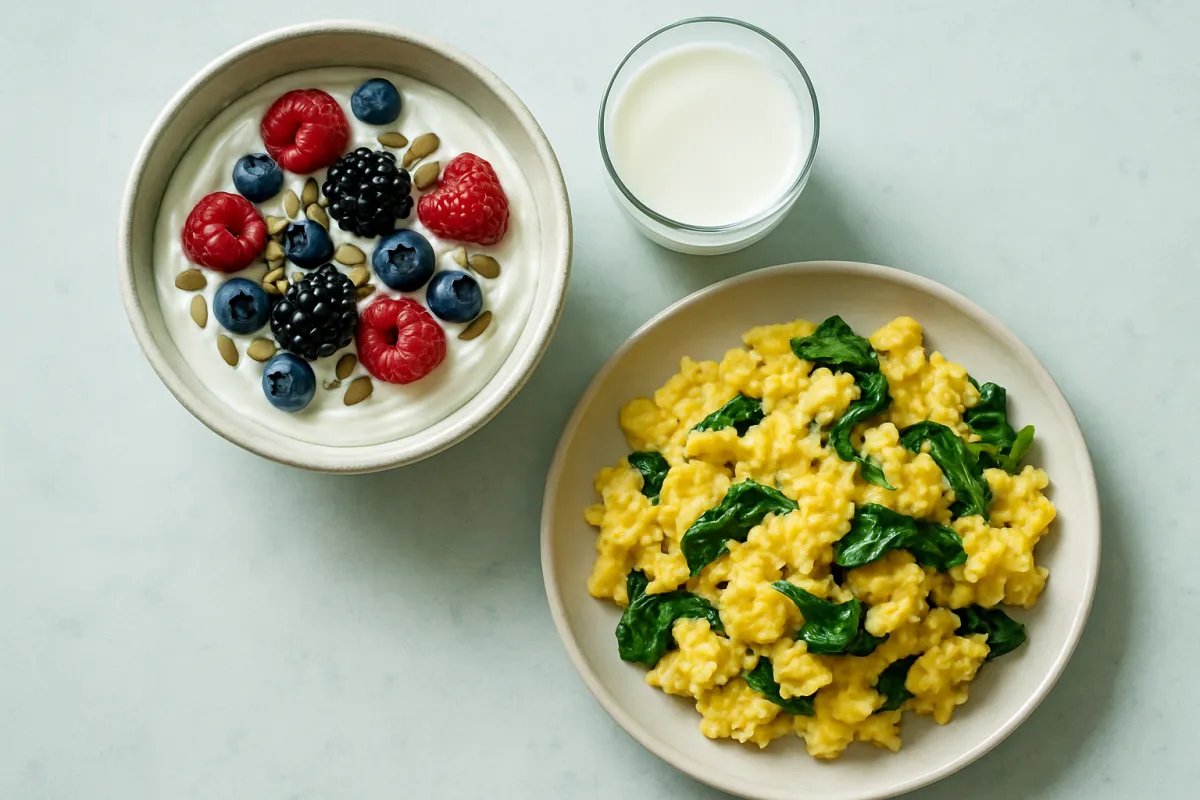
A small handful of nuts or seeds on top, almonds, walnuts, or pumpkin seeds, rounds this combination out with some additional staying power between breakfast and lunch, a detail covered further in the nuts and seeds section below.
Eggs, the Mediterranean way
Eggs are a commonly cited Mediterranean breakfast protein, generally prepared simply, scrambled, soft-boiled, or as part of a dish like shakshuka, a tomato and pepper based dish with eggs poached in the sauce, which is a useful example of how the pattern folds vegetables into what might otherwise be a vegetable-free meal. Adding spinach, tomato, or peppers to scrambled or fried eggs is a straightforward way to apply the same idea without a specific recipe.
Frequency matters more than preparation method here: eggs a few times a week, rather than as the automatic default at every breakfast, is more consistent with commonly cited Mediterranean-pattern frequencies than eggs at every single breakfast, though neither extreme is forbidden.
Whole grains at breakfast
Whole grain bread, and in some households whole grain cereal or a grain-based porridge, is the other recurring base alongside dairy and eggs. Whole wheat bread with olive oil, sometimes rubbed with tomato, is a traditional Mediterranean-region breakfast in its own right, and oats, though not specific to the Mediterranean region historically, satisfy the same whole-grain, fiber-forward principle when prepared with minimal added sugar.
The relevant distinction, as in the rest of the pattern, is whole versus refined: whole grain bread or oats instead of white bread or a sugary cereal, which our fiber guide covers from the fiber side specifically.
Nuts and seeds for staying power
A small portion of nuts or seeds, almonds, walnuts, or sesame, commonly appears at Mediterranean-region breakfasts either on their own, scattered over yogurt, or as part of a bread-based breakfast. Nuts contribute unsaturated fat and a modest amount of protein and fiber, a combination commonly associated with better fullness through the morning compared with a breakfast of refined carbohydrate alone.
Portion matters here specifically because nuts are calorie-dense; a small handful, roughly a small palmful, rather than an unmeasured bowlful, is the commonly cited reference amount for this kind of addition to a meal, not a strict rule but a reasonable guideline for a food this energy-dense.
Olive oil at breakfast (yes, really)
Olive oil at breakfast can feel unfamiliar outside Mediterranean-region households, but it is a genuinely traditional use, most commonly drizzled over whole grain bread, sometimes with a rubbed tomato, in place of butter or a sugary spread. The amount used at a single breakfast is typically small, closer to a teaspoon or so worked into a slice of bread than a measured tablespoon, since the goal is flavor and a thin coating rather than a saturated piece of bread.
This is a direct extension of olive oil’s role as the pattern’s primary fat, covered in more depth in our Mediterranean diet explained review, simply applied to the first meal of the day rather than lunch or dinner specifically.
Vegetables at breakfast, an underused idea
Vegetables are the single most commonly skipped food group at a typical Western breakfast, and Mediterranean-region breakfasts are a useful counterexample: tomatoes, cucumbers, and peppers alongside eggs, bread, and cheese are a standard combination in several Mediterranean-region countries’ morning meals.

This does not require a full salad at seven in the morning. A few cucumber or tomato slices next to eggs, or peppers folded into a scramble, is enough to apply the idea without turning breakfast into a production.
A practical Mediterranean breakfast food list
- Dairy or egg protein: plain yogurt, a modest portion of feta or another cheese, or eggs prepared simply.
- Fruit: berries, citrus, stone fruit, melon, or dried fruit in small amounts.
- Whole grains: whole wheat or whole grain bread, oats, or a grain-based porridge.
- Nuts and seeds: almonds, walnuts, pistachios, or sesame, in a small portion.
- Vegetables: tomato, cucumber, peppers, or spinach, especially alongside eggs.
- Fat: olive oil, used sparingly on bread or in cooking eggs.
- Sweetener, if used: a small amount of honey, rather than refined sugar or syrup, used thoughtfully rather than liberally.
- Beverage: water, coffee, or tea, generally without large amounts of added sugar or cream.
Illustrative breakfast structures, by minutes available
Rather than fixed recipes, here are structures scaled to how much time a morning allows, built from the food list above.
Illustrative weekly frequency of breakfast building blocks
Bars show how many mornings out of seven a component commonly appears across Mediterranean-style breakfast descriptions. An illustrative reference, not a fixed schedule.
Bars scale to a 7 day week. Illustrative, commonly cited frequencies for reasoning about a breakfast pattern, not a fixed schedule.
A two-minute morning might pair plain yogurt, a handful of berries, and a few walnuts. A five-minute morning might add a slice of whole grain toast with olive oil. A slower weekend morning has room for eggs cooked with vegetables alongside bread and fruit, closer to a full version of the pattern in a single sitting.
A sample week of Mediterranean-style breakfasts
An illustrative Mediterranean breakfast, by component
Approximate share of a typical Mediterranean-style breakfast. Illustrative structure, not a fixed recipe or nutrition claim.
Segments are an illustrative structure for reasoning about proportions, not a measured nutrition breakdown or a prescribed recipe.
Rotating a small number of combinations tends to be more sustainable than planning seven distinct breakfasts: yogurt with fruit and nuts on most mornings, eggs with vegetables on one or two, and whole grain toast with olive oil and tomato on another, repeated across the week rather than reinvented daily.
An illustrative week built this way might look like yogurt, berries, and walnuts on Monday, Wednesday, and Friday; eggs with spinach and tomato alongside whole grain toast on Tuesday and Saturday; oats soaked overnight with fruit on Thursday for a no-cook option; and a slightly more elaborate shared breakfast, eggs, bread, olives, and cheese, on Sunday when there is more time. None of this is a required menu; it is one worked example of how the building blocks above might rotate across a week without requiring a new plan each morning.
Sweeteners and what to do about traditional pastries
Mediterranean-region countries do have traditional sweet breakfast pastries, and this review is not claiming otherwise; the pattern does not forbid them. What commonly cited guidance distinguishes is daily default versus occasional treat: a pastry as a regular weekday breakfast sits differently than the same pastry on a weekend or special occasion, similar to how red meat and sweets are treated as occasional elsewhere in the pattern.
When a small amount of sweetness is wanted at a normal breakfast, honey drizzled lightly over yogurt or bread is the more commonly cited traditional choice than refined sugar or heavily processed syrup, though honey is still a sugar and is used in small amounts rather than freely.
Coffee, tea, and what to drink at breakfast
Coffee and tea are standard Mediterranean-region breakfast beverages, generally without large amounts of added sugar or cream. Water is the other default, and fruit juice, while traditional in some households, is generally discussed as an occasional addition rather than a daily default, since whole fruit provides similar nutrients alongside fiber that juice does not retain.

Anyone managing blood sugar, caffeine sensitivity, or another condition affecting what they drink in the morning should follow guidance from their own doctor or registered dietitian rather than general breakfast beverage suggestions.
Protein at Mediterranean breakfasts
Protein at breakfast is not a strict requirement of the Mediterranean pattern specifically, but it is commonly discussed as supporting fullness through the morning, which indirectly supports some of the pattern’s other goals, like reducing reliance on refined snacks later in the day. Yogurt, eggs, and nuts are the three main breakfast protein sources within the pattern, and rotating between them, rather than relying on only one, is a reasonable way to keep breakfast varied across a week.
Our protein needs review covers overall daily protein targets if a personal reference point is useful, though no single breakfast protein amount is being asserted as a fact here. For people who find yogurt or eggs alone insufficient, pairing either with a whole grain and a small portion of nuts, rather than increasing the protein portion itself without limit, is a more consistent way to extend fullness, since the combination of protein, fiber, and a modest amount of fat tends to matter more for staying power than protein quantity on its own.
Fiber at Mediterranean breakfasts
Fruit, whole grains, and nuts together make a Mediterranean-style breakfast a relatively fiber-rich meal compared with a breakfast built around refined cereal or a pastry alone. Fiber at breakfast is commonly associated with steadier fullness into the late morning, a detail our fiber guide covers in more depth for anyone wanting the mechanism behind it.
This is simply a byproduct of the ingredient choices already described in this review rather than a separate goal to plan around specifically; choosing whole fruit over juice and whole grains over refined ones largely takes care of it, without needing to track fiber grams at breakfast separately from the rest of the day.
Make-ahead and meal-prep breakfast ideas
Several components of a Mediterranean-style breakfast hold up well to batch preparation. Hard-boiled eggs keep for several days refrigerated and can be portioned out each morning. Washing and portioning fruit once, rather than daily, removes a small but real barrier on busy mornings. Nuts and seeds can be pre-portioned into small containers for the week. Oats can be soaked overnight in yogurt or milk with fruit for a no-cook option ready by morning.
Our meal prep guide covers the general mechanics of batch preparation in more depth, and the same approach applies directly to building a repeatable Mediterranean-style breakfast rotation.
Breakfast on a budget
A Mediterranean-style breakfast is generally affordable, since plain yogurt, eggs, oats, and seasonal fruit are consistently among the lower-cost items in a grocery store compared with packaged cereal, breakfast pastries, or pre-made yogurt cups with added flavoring and sugar. Buying fruit in season, eggs by the dozen, and plain yogurt in a larger container rather than individual cups all reduce cost further.
Our budget grocery list guide covers stretching a grocery budget in more detail, and the breakfast components described in this review fit comfortably within that broader approach.
Breakfast on the go and travel
Mediterranean-style breakfast components travel reasonably well. A small container of yogurt with fruit and nuts packed the night before, or hard-boiled eggs carried in a bag, both work for a breakfast eaten at a desk or during a commute. Hotel breakfasts, even ones leaning heavily toward pastries and processed options, almost always include plain yogurt, fruit, and eggs in some form, which makes it realistic to stay close to the pattern while traveling without a special effort.
How Mediterranean-style breakfasts vary across the region
It is worth being clear that “the Mediterranean breakfast” is a simplification of considerable regional variety. A Greek household’s typical breakfast, yogurt, honey, and fruit, or bread with cheese, looks different from a Spanish household’s, which might lean on bread with tomato and olive oil, or an Italian one built around coffee with a smaller amount of food. Levantine and North African Mediterranean-region breakfasts often include eggs, flatbread, olives, and a wider range of vegetables and dips than the dairy-and-fruit combination more associated with Greece specifically.
None of these regional versions is more correct than another, and this review deliberately draws on the common structure across them, protein, fruit, whole grain, modest fat, rather than presenting any single country’s breakfast as the definitive version. That variety is also useful practically: it means there is no one “right” way to assemble a Mediterranean-style breakfast, and a household can lean toward whichever regional style fits its own taste and ingredient access.
Pairing breakfast with the rest of the day
Breakfast does not operate in isolation, and a Mediterranean-style breakfast is most useful as part of a day that carries the same principles into lunch and dinner, covered directly in our Mediterranean diet explained review. A strong Mediterranean-style breakfast followed by a lunch and dinner built around refined, processed defaults will not deliver the same picture the broader pattern describes, since the research behind the pattern examines the full day and week, not breakfast in isolation.
That said, breakfast still matters as a starting point, since habits built in the morning, choosing fruit over a pastry, yogurt over a sugary cereal, often carry a kind of momentum into the rest of the day for many people, even though this review is not asserting that as a guaranteed mechanism for every individual.
Hydration alongside breakfast
Morning is a natural point to start the day’s water intake, since several hours have typically passed without fluid since the previous evening. Water, coffee, or tea alongside breakfast is the commonly cited Mediterranean-region default, and our hydration guide covers a practical daily approach if building a consistent habit around this is useful.
This is a supporting habit rather than a core principle of the breakfast pattern itself, but it pairs naturally with the meal and is worth mentioning alongside the food choices above, particularly for anyone who currently skips fluids until later in the morning.
Tracking your own breakfast pattern over a few weeks
For anyone genuinely unsure whether their current breakfast lines up with the ideas in this review, a simple two or three week log, just noting what was eaten each morning without any other tracking, tends to reveal the pattern clearly: how many mornings included fruit, a protein source, or a whole grain, versus how many defaulted to a pastry, sugary cereal, or nothing at all.
This kind of loose tracking is not about judgment or a score to hit; it is a practical way to see where small, repeatable swaps, yogurt instead of a sweetened cereal, fruit added to an existing breakfast, would have the most effect, which is often more useful than guessing at a plan without first seeing the current baseline clearly.
A grocery list for a week of Mediterranean breakfasts
A short, repeatable grocery list covers most of a week’s Mediterranean-style breakfasts without much planning. A workable core list runs through a large container of plain yogurt, a dozen eggs, two or three kinds of fruit depending on season, a bag of a preferred nut or seed, whole grain bread or oats, a bottle of olive oil for everyday use, and a jar of honey for occasional use.

This list repeats well from week to week with minor rotation, buying whatever fruit is in season or on sale, and it overlaps heavily with a broader Mediterranean grocery list, since yogurt, eggs, whole grains, nuts, and olive oil are staples across the full pattern, not breakfast-specific purchases.
Swapping out a typical processed breakfast, step by step
For anyone starting from a breakfast built mostly around sugary cereal, a pastry, or nothing at all, a gradual sequence of swaps tends to work better than an abrupt overhaul. A reasonable first step is adding fruit to whatever is already being eaten, a banana alongside cereal, berries with a pastry, simply to introduce the habit without removing anything yet. A second step swaps the base itself, plain yogurt or eggs in place of the sugary cereal or pastry, while keeping the fruit addition from the first step. A third step adds a whole grain and a small portion of nuts or seeds, arriving at something close to the full structure described earlier in this review.
Spacing these steps out, a week or two apart rather than all at once, mirrors the gradual approach commonly suggested for adopting the broader Mediterranean pattern, and it tends to produce a change that sticks rather than one that reverts after a few days of enthusiasm. There is no fixed timeline that applies to everyone; some people move through these steps in days, others over several months, and either pace is reasonable.
Energy levels through the morning
A commonly cited rationale for a protein-and-fiber breakfast over a refined-carbohydrate one is steadier energy and fullness into the late morning, since a breakfast built mostly around refined grains and added sugar is more often associated with an earlier return of hunger and, for some people, a mid-morning energy dip. A Mediterranean-style breakfast, with protein from yogurt or eggs and fiber from fruit and whole grains, is commonly discussed as supporting a steadier pattern through the late morning compared with that refined-carbohydrate alternative.
This is a generalized, commonly cited association rather than a guarantee for any specific individual, since energy levels are also affected by sleep, hydration, and overall daily eating pattern, among other factors this review cannot evaluate for a given reader. Anyone with a specific energy, blood sugar, or fatigue concern should raise it with their doctor rather than attributing it to breakfast composition alone.
A note on dairy alternatives
Not everyone eats dairy, whether by preference, lactose intolerance, or a broader dietary choice, and the Mediterranean-style breakfast structure in this review still works without it. Plant-based yogurt alternatives, when chosen plain and unsweetened, can generally substitute for dairy yogurt in the combinations described above, though their protein content varies considerably by brand and base ingredient, soy-based versions tend to carry more protein than coconut or almond-based ones, which is worth checking on the label rather than assuming.
Eggs remain an option for anyone avoiding dairy specifically rather than all animal products, and for a fully plant-based breakfast, a combination of a plant-based yogurt or a tofu scramble, fruit, whole grains, and nuts covers the same structural roles. Our guide to getting protein without meat goes further into building complete plant-based meals, including at breakfast.
Common mistakes with Mediterranean-style breakfasts
A handful of patterns undercut this approach more often than any single food choice does.
- Choosing flavored, pre-sweetened yogurt and assuming it counts the same as plain yogurt. Many flavored cups carry meaningful added sugar; adding your own fruit to plain yogurt keeps more control over that.
- Treating nuts as a free, unmeasured topping. A small handful is the commonly cited reference amount; nuts are calorie-dense enough that an unmeasured bowlful changes the picture.
- Skipping vegetables entirely because breakfast “isn’t a vegetable meal.” A few tomato or cucumber slices next to eggs takes little extra effort and fits the pattern’s own emphasis.
- Relying on juice as a fruit substitute. Whole fruit retains fiber that juice does not, and juice is generally discussed as occasional rather than a daily default.
- Expecting a dramatic, fast outcome from breakfast changes alone. Breakfast is one meal in a broader pattern; it supports the whole, it does not replace attention to lunch, dinner, and snacks.
Kids and family breakfasts, Mediterranean-style
Most components here, yogurt, fruit, eggs, whole grain bread, are already standard kid-friendly foods, which makes a Mediterranean-style breakfast realistic for a family table without separate meals for children and adults. Whole nuts carry a choking risk for young children specifically, so nut butter or finely chopped nuts are the safer substitution for that age group rather than whole nuts.
Portion sizes for children differ from adult portions, and any specific allergy, growth, or medical concern should go to a pediatrician or registered dietitian rather than a general nutrition article, which cannot evaluate an individual child’s needs.
Who should be cautious or check with a professional
This general breakfast structure is appropriate for most people, but a few situations call for individualized guidance. Anyone managing diabetes or blood sugar should discuss fruit portions and timing with their doctor or a registered dietitian, since fruit still affects blood sugar even though it is a whole, fiber-containing food. Anyone with an egg or tree nut allergy should substitute accordingly rather than following the specific examples in this review literally. Anyone with a medical condition affecting fat intake, cholesterol, or digestion should confirm olive oil and nut amounts with their own healthcare provider.
Weekend versus weekday Mediterranean breakfasts
It is worth separating two different breakfast occasions rather than planning one approach for both. A weekday breakfast, eaten under real time pressure, benefits most from the quick, pre-prepped structures covered earlier: yogurt with fruit and nuts, or hard-boiled eggs grabbed on the way out. A weekend breakfast, with more time and often more people at the table, is a more natural setting for the slower, more elaborate versions of the pattern, a vegetable and egg dish like shakshuka, fresh bread with olive oil and cheese, or a spread of several small dishes shared among a household.
This distinction matters because trying to replicate a slow weekend breakfast on a rushed Tuesday morning is a common reason people abandon a new breakfast pattern within the first couple of weeks; matching the structure to the actual time available, rather than to an idealized version seen in a photo, keeps the habit realistic across an entire week rather than only on the days with the most time.
Building your own Mediterranean breakfast
Bringing the pieces together: start with a protein source, yogurt or eggs; add fruit; add a whole grain if time and appetite allow; and finish with a small amount of nuts, seeds, or olive oil for staying power. Rotate a small number of combinations across the week rather than planning something new each day, and bring in vegetables alongside eggs when the structure allows.
Use the companion below to set your own weekly yogurt, egg, fruit, and nut frequency and see how closely an illustrative week lines up with the pattern described here.
The bottom line
A Mediterranean-style breakfast commonly pairs yogurt or eggs, fruit, and a whole grain, with nuts, seeds, or a small amount of olive oil for staying power, built on the same principles as the full pattern but scaled to however much time a morning allows. Nothing is forbidden, vegetables fit naturally alongside eggs, and a small amount of advance prep, boiled eggs, portioned nuts, washed fruit, makes the rotation realistic on busy mornings. Pair this review with our Mediterranean diet explained review for the full pattern this breakfast structure is drawn from.
This evidence review is published for general education about how a Mediterranean-style breakfast is commonly described in nutrition sources, and it is not medical or dietary advice, and reading it creates no clinician-patient relationship. Every frequency, portion, and plate composition above is an illustrative, commonly cited reference for reasoning about a breakfast pattern, not a personal prescription, a guaranteed outcome, or a measured nutrition claim about any specific food or dish. This article does not diagnose any condition. Anyone with diabetes, an allergy, another medical condition, or who is feeding a young child, should confirm specific choices with a doctor or registered dietitian.
Frequently asked questions
What is a typical Mediterranean breakfast?
There is no single official Mediterranean breakfast, since the pattern spans many countries and households, but a structure that recurs across common descriptions includes plain yogurt or a small amount of cheese, fruit, whole grain bread or a grain-based dish, and sometimes eggs, with olive oil and nuts appearing more often than butter or sugary spreads. Some Mediterranean-region breakfasts are lighter than a typical Western cooked breakfast, leaning on simple combinations like yogurt and fruit or bread with olive oil, while others, especially on weekends, are more substantial.
Can you eat eggs on the Mediterranean diet?
Yes. Eggs are a commonly cited part of the pattern, generally described as appropriate a few times a week rather than as a forbidden or unlimited food. They fit well at breakfast specifically because they pair easily with vegetables, like the spinach and tomato combinations common in Mediterranean-region cooking, which helps bring a vegetable-forward principle into a meal that often skips vegetables entirely in a more conventional breakfast.
Is oatmeal part of the Mediterranean diet?
Oats are a whole grain, and whole grains are a core, near-daily component of the Mediterranean pattern, so oatmeal fits comfortably within it, particularly when topped with fruit, nuts, and a drizzle of olive oil or a spoon of yogurt rather than large amounts of added sugar or syrup. Oatmeal is not a traditional dish specific to Mediterranean-region countries the way, say, Greek yogurt with honey is, but it satisfies the same whole-grain, fiber-forward principle the pattern emphasizes.
What should you avoid for a Mediterranean-style breakfast?
Nothing is strictly forbidden, but the foods least consistent with the pattern's own emphasis are heavily processed cereals and pastries high in added sugar and refined flour, breakfast meats like bacon and sausage eaten daily, and breakfast drinks with large amounts of added sugar. These are not banned; they simply sit further from the pattern's base of yogurt, fruit, whole grains, eggs, and nuts than a daily default would suggest.
Is Greek yogurt part of the Mediterranean diet?
Yogurt in general, not specifically the Greek strained style, is the more traditional Mediterranean-region breakfast dairy, though Greek yogurt's higher protein content per serving, covered in our protein in Greek yogurt review, makes it a popular modern choice within Mediterranean-style eating in many households. Either plain regular yogurt or plain Greek yogurt fits the pattern; the more relevant detail in commonly cited guidance is choosing a plain, unsweetened version and adding fruit yourself rather than a pre-sweetened flavored cup.
How much protein should a Mediterranean breakfast have?
There is no single official target specific to this pattern, and presenting one as a fact would overstate the evidence. What is commonly discussed is pairing a protein source, eggs, yogurt, or nuts, with the fruit and whole grain portion of breakfast, since protein at breakfast is generally associated with better fullness through the morning compared with a breakfast built mostly around refined carbohydrate alone. Our protein needs review covers overall daily targets if you want a personal reference point to build toward.
Can kids eat a Mediterranean-style breakfast?
Generally, yes, since the building blocks, yogurt, fruit, eggs, whole grain bread, and nuts in age-appropriate forms, are standard foods already familiar to most families, not unusual or restrictive items. Portions, whole nuts as a choking risk for very young children, and any individual allergies or medical needs should still be considered, and a pediatrician or registered dietitian is the right resource for specific questions about a child's diet rather than a general-audience nutrition article.
How do you make a Mediterranean breakfast quickly on a busy morning?
Several components hold up well to minimal morning effort: plain yogurt with pre-washed fruit and a handful of nuts takes under two minutes to assemble, hard-boiled eggs can be prepared several days ahead and grabbed cold, and whole grain bread with olive oil or a mashed avocado takes about as long as toasting. The common thread across quick options is doing a small amount of prep, boiling eggs, washing fruit, portioning nuts, once every few days rather than from scratch each morning.

Hamza Hai is the editor of NourishMark. She holds an MBA and reviews the site's articles against our editorial standards, checking that every figure is labelled for what it is, that nothing is presented as verified fact without a source the reader can check, and that the writing stays useful to a non-specialist.

Dr. Shayaan Khan is the medical reviewer for NourishMark. He holds an MBBS from MGM Medical College, Navi Mumbai, and is the author of published research including a narrative review of postpartum anxiety and depression in Mental Health Science. He has taught physiology at university level. He reviews the site's health content for medical accuracy: that physiology and mechanisms are described correctly, that no claim is stated more strongly than the evidence behind it, and that anything specific to an individual reader is sent to that reader's own clinician.
Not medical advice. Dr. Khan reviews NourishMark's health content for medical accuracy. He is not a registered dietitian, he does not hold a United States practising licence, and he is not your doctor. His review does not make anything here medical advice. Always talk to a qualified health professional about your own situation, and never delay or stop care because of something you read here.