What's in this review
- Before you start: what you need to stay hydrated
- Staying hydrated is a routine, not a matter of force
- Step 1: Know your daily water target
- Step 2: Spread your fluids across the day
- Step 3: Check your urine color
- Step 4: Watch for the signs of dehydration
- Step 5: Eat your water with water-rich foods
- Step 6: Drink extra for exercise and heat
- Step 7: Add electrolytes only when you need them
- Step 8: Make hydration effortless with your environment
- A worked example: a full day of staying hydrated
- Common mistakes when trying to stay hydrated
- Troubleshooting and edge cases
- Your stay-hydrated checklist
- The bottom line
Short answer: Staying hydrated is a routine rather than a feat of willpower. Attach drinking to fixed points in the day such as waking, meals, and medications, keep a bottle in sight, and let thirst cover the rest. Two free signals beat any counting scheme: thirst, and urine color, with pale yellow the target and dark amber a nudge to catch up. Heat and exercise raise the target; electrolytes matter only after heavy fluid loss.
Staying hydrated is one of those health goals that sounds like it should require willpower and a marked-up water bottle, when in practice it comes down to a short routine that runs itself. Most people who feel chronically low on water are not failing at discipline, they simply never built drinking into the shape of their day, so thirst has to do all the work and often loses. This walkthrough fixes that with a handful of small, repeatable habits rather than a quota to hit.
This evidence review walks through how to stay hydrated as a daily practice: what to sort out before you start, an eight-step routine you can put in place today, a worked example that carries one ordinary day from patchy to well hydrated, the mistakes that quietly keep people short, and the edge cases worth knowing. If your question is instead the pure number, how many liters or cups you technically need, our evidence review on how much water you need covers that in depth, and our gallon and bottle converter review handles the unit math. Keep this one as the practical habits companion to those. Everything here is general education rather than medical advice, and the more your health departs from average, the more the right answer becomes a conversation with your clinician. Try your own day in the companion below as you read.
Key takeaways
- Staying hydrated is a routine, not a feat of willpower: attach drinking to meals, waking, and medications, keep a bottle in sight, and let thirst cover the rest.
- The National Academies of Sciences, Engineering, and Medicine set adequate intakes for total water of about 3.7 liters a day for men and 2.7 for women, counting all drinks plus the roughly 20 percent that comes from food.
- Two free signals beat any counting scheme: thirst, a reasonably reliable prompt in healthy adults, and urine color, with pale yellow the target and dark amber a nudge to catch up.
- Water-rich foods, heat, exercise, and illness all move the target, and electrolytes matter only when you lose a lot of fluid fast, not on an ordinary day.
- This is a general educational walkthrough, every figure is a commonly cited illustrative estimate, and anyone with a heart, kidney, or other fluid-sensitive condition should confirm their approach with a doctor.
Before you start: what you need to stay hydrated
Staying hydrated takes no equipment, no app, and no tracking, and the habits below settle into place within a week or two of doing them. Before you build the routine, it helps to have two loose things in mind, neither of which needs to be exact.
- A rough daily sense of scale. You do not need a precise figure, only a ballpark so you can tell whether you are far short or nearly there. Our how much water you need review and the companion below both give an illustrative total from your profile, and the short version is that reference totals sit near 2.7 liters for many women and 3.7 for many men, food included.
- A quick look at your current day. Notice when you actually drink and where the gaps sit. For most people the dry stretches are the busy mid-morning, the afternoon slump, and any long task that swallows attention, and knowing your own gaps tells you where these steps will pay off fastest.
Difficulty here is genuinely low, and there is nothing to buy beyond a glass or a bottle you already own. The one thing worth being honest about is your starting point, because it is easy to assume you drink plenty when a look at a typical day tells a different story. Everything below is a general educational framework rather than a prescription, and a few situations change the picture in ways this walkthrough cannot: heart failure and some kidney conditions can require deliberately limiting fluids, certain medications alter fluid balance, and pregnancy and breastfeeding raise needs. If any of those apply to you, treat this as background and follow the target your clinician sets, in either direction.
Staying hydrated is a routine, not a matter of force
Before the steps, one idea makes all of them easier, because the whole approach rests on it. Staying hydrated is not a willpower contest and not a matter of forcing down glass after glass to a schedule. It is a set of small, repeatable defaults that keep fluid arriving steadily, so your body’s own thirst signal only has to speak up when something unusual, a hot day or a hard workout, moves the target. Change a few defaults and your daily intake climbs on its own, without any single moment feeling like a chore.
The reason this works is that most under-hydrated days are not under-hydrated because someone is avoiding water, they are patchy because drinking was never anchored to anything. Mornings get busy, an absorbing task pushes past lunch, and by the time real thirst arrives the day is already behind. The steps below anchor fluids to events that happen anyway, waking, meals, medications, moving between tasks, so the behavior rides habits that already run themselves. That is the entire trick, and it is why environment and routine beat intention every time.
It also helps to picture how a well-hydrated day is shaped, because the goal is not a single large drink but a steady trickle spread across the waking hours. The chart below shows one illustrative way a day’s fluids might distribute, purely to make the pattern visible rather than to prescribe amounts.
One way to spread fluids across a day
An illustrative distribution of a day's drinking across the waking hours. This is a general example of pacing, not a target; the right pattern is the one that fits your schedule.
Segments are one illustrative way to pace a day's fluids and sum to 100 percent. Easing off in the last hour or two before bed can spare your sleep the extra trips; this is a general example, not a rule.
Step 1: Know your daily water target
Begin by giving yourself a rough number to aim at, because staying hydrated is much easier when you have a sense of the scale rather than a vague more. Without any target, it is hard to know whether you are far short or comfortably close, and a loose figure turns each glass into a small step toward a total you can picture.
The clearest reference figures come from the National Academies of Sciences, Engineering, and Medicine, which through its Dietary Reference Intakes sets adequate intakes for total water of about 3.7 liters a day for adult men and 2.7 liters for adult women. Two things about those numbers matter more than the numbers themselves. First, they describe total water from all sources, every beverage plus the water in food, not the amount to pour from a tap, and since food commonly supplies around 20 percent, the fluid you actually drink is smaller, roughly 3 liters for a typical man and 2.2 for a typical woman, call it about 8 to 12 cups. Second, they are adequate intakes drawn from what healthy populations consume, deliberately wide, and the same guidance says plainly that healthy adults regulate hydration well by drinking to thirst. Our how much water you need review traces where these figures come from in detail.
The value of the target is direction and scale, not precision. It tells you roughly how many drinking occasions your day needs, and whether your current pattern is well short or nearly there. Watch out for treating it as a quota to force past comfort, since the routine in the steps ahead, plus your own thirst, will do the real work. Run your own profile through the companion below to see an illustrative total, and remember that heat, exercise, illness, pregnancy, and age all move it, sometimes a lot.
Step 2: Spread your fluids across the day
With a rough total in mind, the highest-leverage habit is to spread your drinking across the whole day rather than relying on a big catch-up glass or, worse, on thirst alone during busy stretches. A steady trickle is easier on the body to absorb and far easier to sustain than any large scheduled dose, and it keeps you from ever falling far enough behind that thirst has to shout.
In practice, spreading fluids means anchoring drinks to events that already happen. A glass of water when you wake, one with each meal, one whenever you take any medication, and a few sips each time you move between tasks or refill at a fountain already builds a floor of six or more cups before you have thought about it. Attach the behavior to routines that run on their own and you stop relying on memory, which is exactly why the pacing in the chart above lands naturally once the anchors are set. For anyone who eats on a regular rhythm, meals alone can carry a large share of the day’s fluids.
An illustrative day makes the scale concrete. If your fluid aim is around 2.2 liters, about 9 cups, and you anchor to three meals, waking, and a couple of task breaks, that is roughly a cup at each of six or seven moments, an unremarkable amount at any one of them. Nothing here requires a large single drink. Watch out for the opposite pattern of drinking almost nothing until the evening and then downing several glasses at once, which mostly buys nighttime trips to the bathroom rather than steady hydration, and can disrupt sleep. Ease off in the last hour or two before bed, and let the daytime anchors carry the load.
Step 3: Check your urine color
The single most useful self-check for staying hydrated costs nothing and takes a second: glance at the color of your urine through the day. It integrates everything, your drinking, the weather, your food, and your activity, into one honest readout that no fixed glass count can match, which is why it outperforms arithmetic for everyday life.
The rule of thumb is simple. Pale straw yellow, the color of lemonade, suggests you are adequately hydrated. A consistently dark amber, closer to apple juice, suggests your kidneys are conserving water and you would benefit from more fluid soon. Completely clear all day is not a better score, it usually just means you are drinking beyond what you need and topping up your bathroom schedule rather than your health. First-morning urine is normally darker after a night without fluids, so judge the pattern across the day rather than any single reading, and aim for pale rather than clear.
A few honest caveats keep this from misleading you. Some vitamins, especially B vitamins, can turn urine bright yellow regardless of hydration, and certain foods, medications, and medical conditions change its color too, so the signal is a guide rather than a lab test. Blood in the urine, persistent unusual colors, or pain are reasons to see a clinician rather than to drink more. Used with thirst, though, the urine-color check is most of the practical toolkit: drink when thirsty, keep the color pale, and you are staying hydrated without counting a thing.
Step 4: Watch for the signs of dehydration
Learning what dehydration actually feels like turns a vague worry into a small set of signals you can act on, and it keeps you from either ignoring a real shortfall or over-reacting to nothing. Most everyday dehydration is mild and easily corrected, and knowing the early signs lets you catch it before it affects how you feel and function.
The common early signs are ordinary and easy to miss: thirst and a dry or sticky mouth, urine that is darker and less frequent, tiredness, headache, difficulty concentrating, and mild lightheadedness. Research consistently finds that even modest fluid shortfalls can dent mood, focus, and perceived energy before you feel dramatically thirsty, which is a fair argument for keeping water in sight during long mental tasks. In most cases the fix is simply to drink and, if you have been sweating hard or are ill, to include some sodium, after which these signs ease within a reasonable stretch.
The serious signs are different and deserve respect rather than another glass. Confusion or unusual irritability, a rapid heartbeat, sunken eyes, very little or no urine, fainting, or dizziness that does not pass point to significant dehydration and are reasons to seek medical care promptly. Certain groups reach that point faster and with fewer warnings: infants and young children, older adults whose thirst signal has faded, and anyone losing fluid to vomiting, diarrhea, or a high fever. For those situations, and for anyone whose mild signs do not improve with fluids, err toward medical advice rather than pushing through, because heat illness and serious dehydration are not things to tough out.
Step 5: Eat your water with water-rich foods
One of the most overlooked ways to stay hydrated is not to drink at all but to eat, because food commonly supplies around a fifth of total water intake, and more in a produce-heavy diet. Counting this channel correctly takes pressure off the glass and gives you a reliable route to fluids on days when plain water holds little appeal.
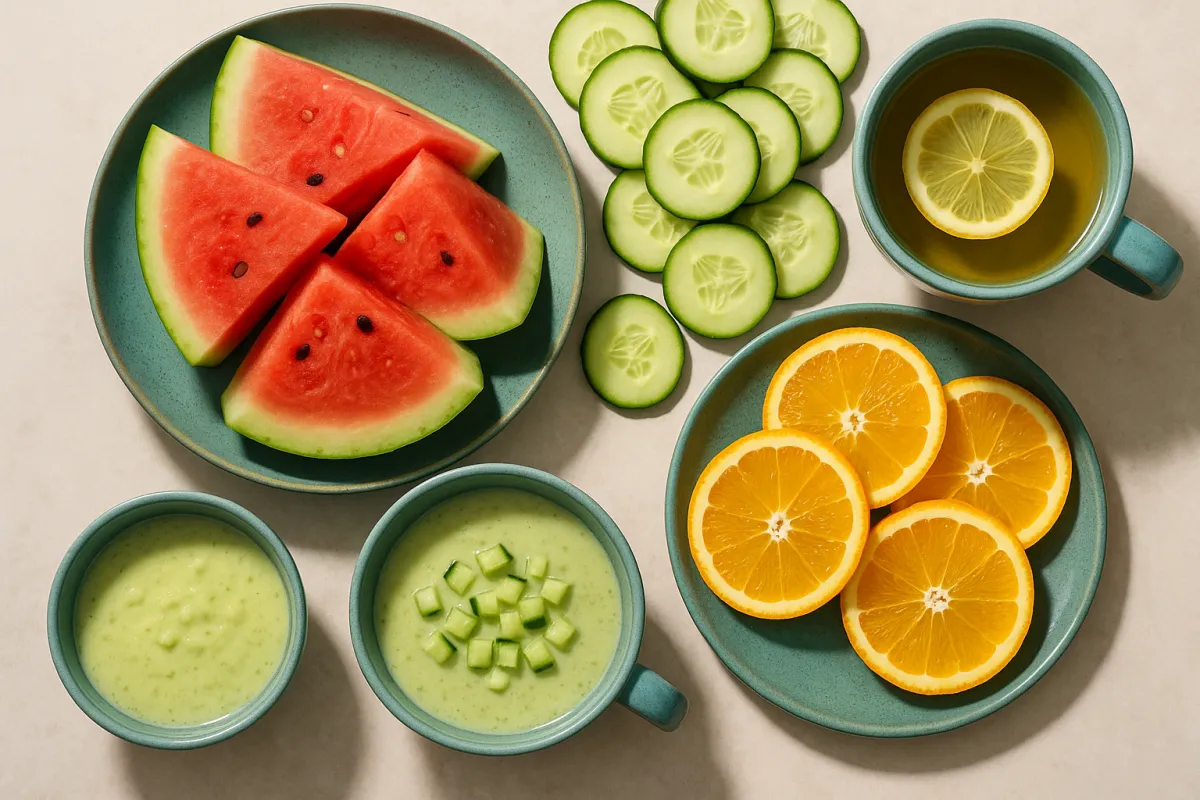
The numbers behind the idea are striking. By weight, watermelon, cucumber, lettuce, and tomatoes run over 90 percent water, oranges, apples, and berries are close behind, and yogurt, milk-based dishes, soups, and stews are majority water by construction, with even cooked rice and pasta absorbing their weight in it. A day that includes fruit with breakfast, a salad at lunch, and soup or vegetables at dinner delivers several cups of water before a single glass is poured. This is exactly the food contribution that the reference totals already count, which is why the amount you need to drink is smaller than the headline liter figure suggests.
The practical uses run in two directions. If your diet leans on fruits, vegetables, and cooked meals, you are already partway hydrated and rigid glass-counting will overshoot. If it leans dry and processed, packaged snacks and bread-and-cheese lunches, your food contribution shrinks and your drinks have to carry more of the load. Water-rich foods are also the honest answer to hydration during illness, poor appetite, and older age, where soups, fruit, and yogurt hydrate people who do not feel like drinking, a fact eldercare and pediatrics lean on daily. Watch out for treating this as license to skip fluids entirely, since food is a fifth of the system, not the whole of it.
Step 6: Drink extra for exercise and heat
Nothing moves your fluid needs like sweat, so staying hydrated on active or hot days means deliberately adding to your baseline rather than trusting the same routine that covers a desk day. Sweat losses during vigorous exercise or heat commonly run from half a liter to well over a liter per hour, so a single hard hour outdoors can equal a large share of a quiet day’s entire fluid budget.
The reliable approach is a three-phase rhythm rather than a fixed number. Arrive hydrated by drinking normally in the hours before activity. Sip regularly during it, guided by thirst rather than gulping everything at the end, roughly a few mouthfuls at a time. And rehydrate afterward, where the dependable trick is weighing yourself before and after, because each pound lost during a session is roughly half a liter of fluid to replace over the next few hours. That weigh-in is what turns guesswork into feedback, since it measures the one thing no formula can predict, your actual sweat rate on this day, in this weather, at this effort.
Heat adds its own multiplier even at rest, and humidity compounds it by making sweat less efficient, so summer baselines simply run higher, especially for outdoor workers whose days stack heat and exertion for hours. The chart below sets a few kinds of day side by side to show how far circumstances move the target. Past roughly an hour of hard effort, or any long stretch in real heat, plain water alone starts to fall short because sweat carries sodium out with it, which is where the next step comes in. For a half-hour moderate session on a mild day, though, water to thirst covers it, and the elaborate hydration products marketed for exercise scale with their margins more than your sweat rate.
How different kinds of day change the target
Illustrative additions to a 2.7 liter adult baseline. Bars scale to the hottest, hardest day at 100 percent; every figure is a commonly cited estimate, not a personal requirement.
The gap between a desk day and a hot working day is larger than any glass-counting debate, which is why the thirst and urine signals, which track circumstances automatically, beat every fixed number.
Step 7: Add electrolytes only when you need them
Electrolytes have become a marketing category, so the useful skill is knowing the few situations where they genuinely help and ignoring the rest. Electrolytes are minerals, sodium chief among them, that the body loses in sweat and other fluids and that help control how water is distributed inside and outside your cells. Replacing large, fast fluid losses with plain water and nothing else can dilute blood sodium, which is the mechanism behind the rare but real risk of overhydration during endurance events.
The triggers for adding electrolytes are specific rather than constant. Prolonged, heavy sweating past roughly an hour of hard effort, or any sustained activity in real heat, is the main one, because that is when sodium losses grow large enough to matter. Illness with vomiting or diarrhea is the other, which is why oral rehydration solutions rather than plain water sit at the center of home care for stomach bugs, and why pediatric guidance leans on them for children. In both cases the point is simply sodium accompanying the fluid, and the solution need not be commercial: salted food alongside water covers most situations, with tablets or sports drinks a convenience rather than a necessity.
For ordinary life, though, electrolyte products are oversold. A half-hour gym session, a normal day, or light sweating needs nothing beyond water and a normal diet, which already supplies plenty of sodium for most people, and reaching for a colorful mix after a gentle walk solves a problem that was never there while adding sugar you did not need. The simple test is whether you have been sweating hard for a sustained stretch or losing fluid to illness. If not, water and ordinary meals almost always cover it. Anyone with high blood pressure, or a kidney, heart, or sodium-restricted condition, should be especially careful with added electrolytes and follow their clinician’s guidance, since more sodium is not a neutral choice for everyone.
Step 8: Make hydration effortless with your environment
The last step is the one that makes all the others stick: shape your surroundings so the hydrated choice is the easy one, because on the evidence, visibility and convenience beat intention every time. People drink dramatically more from a bottle sitting on the desk than from a tap two rooms away, more from a filled glass at the table than an empty one in the cupboard, and more of whatever is cold and pleasant than of whatever merely feels virtuous.
The interventions that actually move intake are mundane by design. Keep a filled bottle where your eyes rest, put water on the table before the meal rather than after, and station a glass at the spots your day already passes through, the kettle, the desk, the bedside. Taste objections deserve engineering rather than argument: filtered or chilled water, a slice of citrus or cucumber, sparkling instead of still, or herbal tea in colder months all count fully toward your fluids and cost nothing against them. The point is to remove every small friction between you and a drink, so the behavior needs no willpower to survive a busy day.
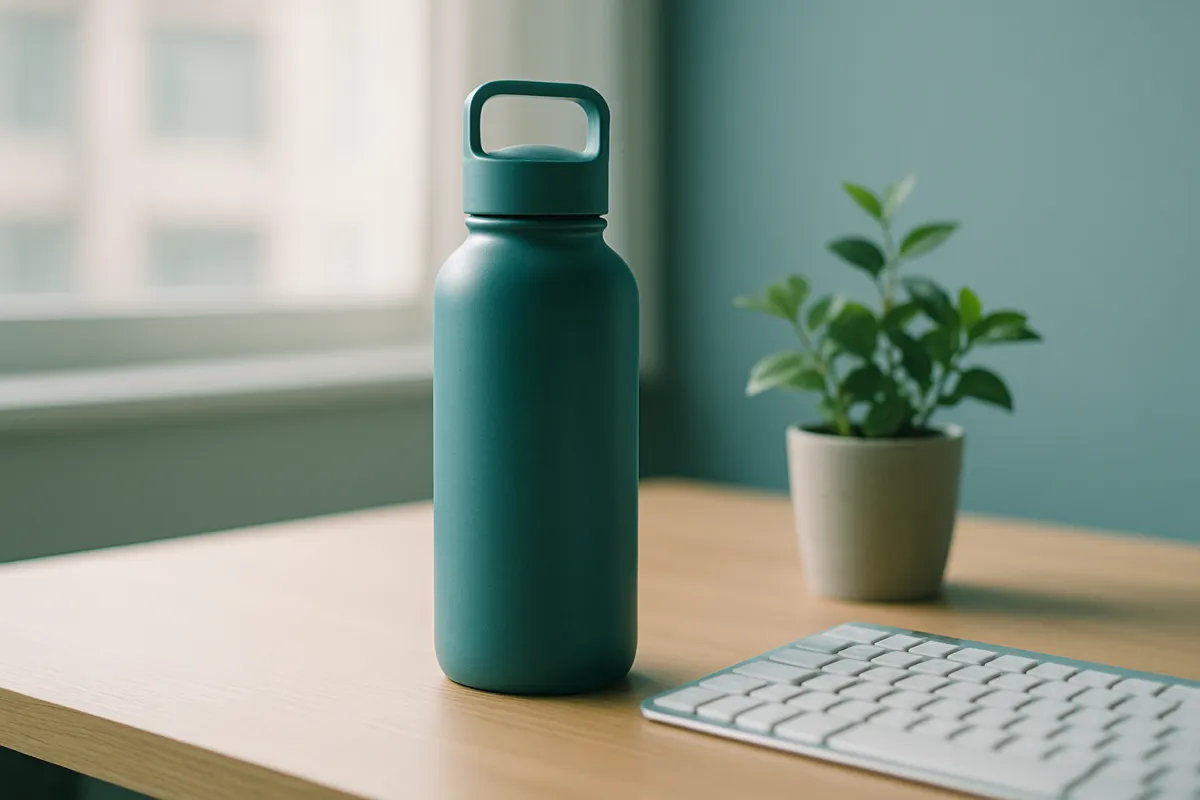
Watch out for the gamified overreach at the other extreme, the apps and gallon jugs that push intake far past any row of the chart above, which buy bathroom trips rather than health. The target is modest: cover your baseline without thinking, so that thirst only has to speak when a genuine multiplier, heat, exercise, or illness, shows up. A visible bottle, a glass with each meal, and your own preferences honestly accommodated get almost everyone there, no tracking required. For older adults, whose thirst signal fades, this environmental approach matters most of all, since routine and visible drinks reliably replace a signal that can no longer be trusted to prompt.
A worked example: a full day of staying hydrated
Pulling the eight steps together on one day shows how little effort a well-hydrated day actually takes. Meet an illustrative moderately active adult woman whose reference total sits near 2.7 liters, of which food covers roughly a fifth, leaving about 2.2 liters, near 9 cups, to drink on an ordinary day. Nothing here is a recommendation for any real person, it is one day walked through the steps so the pattern is concrete, and every figure is a commonly cited illustrative estimate.
The patchy starting day. As it stands, she wakes and goes straight to coffee, skips water through a busy morning, drinks a little at lunch, forgets again through an absorbing afternoon, and only notices real thirst by evening, when she drinks two large glasses at once. Her urine runs dark for much of the day, she blames the mid-afternoon headache on her screen, and she tops up too late to feel right before bed. The total lands well under her rough aim, and it arrives in the wrong shape besides.
The same day, on the routine. She keeps the morning coffee, which counts, but adds a glass of water when she wakes and another with breakfast. A filled bottle sits on her desk, so a few sips ride along with each task. Water comes to the table at lunch, and a piece of fruit and a small salad quietly add to the food channel. A glass at a mid-afternoon break heads off the slump before it starts. Because it is a warm day, she nudges up her intake a little, and a glance at pale-yellow urine by late afternoon confirms she is on track. Dinner brings soup and vegetables, water on the table again, and she eases off in the last hour before bed. The day lands near her aim, spread evenly, with no forcing and no counting, and the headache never arrives.
The point of the example is not the exact figures, which are illustrative, but the shape of the change: the same person, the same schedule, and only the anchors and the environment moved. Warm days, exercise, or illness would raise the target from here, and the thirst and urine signals would track those automatically. Run your own profile and conditions through the companion below to see an illustrative version of this day for you.
Common mistakes when trying to stay hydrated
Most attempts to stay better hydrated stall for a handful of predictable reasons, and each is easy to sidestep once named.
- Relying on thirst alone during busy stretches. Thirst is reliable when you can answer it, but an absorbing task drowns it out, so a routine anchored to meals and moves keeps fluid arriving when attention does not. The fix is anchors, not more willpower.
- Saving it all for the evening. Drinking almost nothing until night and then downing several glasses mostly buys bathroom trips and disrupted sleep. Spread the same total across the day and ease off before bed.
- Chasing perfectly clear urine. Pale yellow is the target; permanently clear usually just means surplus and extra trips. Aim for pale, not clear, and judge the pattern rather than the first-morning reading.
- Forgetting that food and every drink count. Coffee, tea, and milk all hydrate, and water-rich foods cover a fifth of the total, so counting only plain water overstates the gap. Only alcohol genuinely works against you.
- Reaching for electrolytes on ordinary days. Colorful mixes solve a problem that only exists after heavy sustained sweating or illness. On a normal day, water and meals already carry the sodium you need.
- Buying complexity instead of building habits. Apps, gallon jugs, and gadgets push intake past any sensible row of the chart above. A visible bottle, a glass at meals, and thirst answered is the whole toolkit.
Each mistake comes from treating hydration as a number to force rather than a routine to build, and each fix comes from the same anchors-and-signals model that describes how the body actually manages water.
Troubleshooting and edge cases
A few common situations change the practical details, though never the underlying idea of anchoring fluids to your day and reading the signals. What if you simply forget to drink? This is the most common problem, and it is an environment problem rather than a memory one: keep a filled bottle in sight, tie drinks to fixed events like meals and medications, and let visibility carry the habit until it runs on its own.
What if you dislike the taste of plain water? Engineer around it rather than arguing with yourself. Chilled or filtered water, a slice of citrus or cucumber, sparkling water, and herbal or fruit teas all count fully toward your fluids, as do water-rich foods, so there is a pleasant route to hydration for almost every palate without reaching for sugary drinks.
What if you are older, or caring for someone who is? The thirst signal weakens with age, kidneys conserve water less efficiently, and some medications add fluid loss, so older adults can drift into dehydration without feeling thirsty. Routine matters more than signal here: a glass with each meal and medication, drinks kept visible and within reach, and water-rich soups, fruit, and yogurt all help, and a caregiver watching urine color and sudden confusion catches what faded thirst misses.
What if you have a heart or kidney condition, or take medication that affects fluids? This is the important exception. Some conditions require deliberately limiting fluids, and some medications, including diuretics, change the balance in ways a general routine can get wrong. If any of these apply, treat this walkthrough as background only and follow the individual fluid target your clinician sets, in both directions, rather than any figure here.
Your stay-hydrated checklist
Keep this short routine on hand to stay hydrated without tracking or fuss, whether you are planning a day or just moving through it.
- Know your rough target, a ballpark total from your profile, so you have a sense of scale rather than a vague more.
- Spread fluids across the day, anchoring a drink to waking, each meal, each medication, and your task breaks, and easing off before bed.
- Glance at your urine color, aiming for pale straw yellow through the day rather than dark amber or perfectly clear.
- Know the signs of dehydration, catching thirst, dark urine, headache, and fatigue early, and treating the serious signs as medical.
- Eat your water too, leaning on fruit, vegetables, soups, and yogurt that quietly cover a fifth of the total.
- Add for heat and exercise, using the before, during, and after rhythm and replacing what the scale says you lost.
- Use electrolytes only when earned, after heavy sustained sweating or illness, not on an ordinary day.
- Keep a bottle in sight, since a visible, pleasant drink within reach is the single most effective habit of all.
Run your own profile, a hot day, and any exercise through the companion below to see an illustrative daily fluid target and how far circumstances move it.
The bottom line
Staying hydrated, read honestly, is far easier than the marked-up bottles and app reminders suggest, because the body publishes its needs in real time and asks only for a little routine in return. Anchor a drink to the events that already fill your day, keep a bottle in sight, glance at your urine color, and let thirst handle the rest, and an ordinary day stays hydrated on its own. Lean on water-rich foods, add deliberately for heat, exercise, and illness, and reach for electrolytes only when a hard sustained sweat or a stomach bug has actually earned them.
The reference totals, near 2.7 liters for many women and 3.7 for many men from the National Academies, are a starting frame that already counts every drink and a fifth of your food, not a quota to force past comfort. For the full picture of the underlying number, our how much water you need review is the companion piece, our gallon and bottle converter review handles the unit math, and the companion below turns all of it into an illustrative version for your own day.
This evidence review is published for general education and describes commonly cited, illustrative ways to stay hydrated day to day, not medical advice, and reading it creates no clinician-patient relationship. Every liter figure, sweat-loss rate, and worked example above is a general population estimate or illustration rather than a measurement or a personal recommendation, and real hydration needs vary widely with body size, activity, climate, and health. Some situations override this general routine entirely: heart failure and certain kidney conditions can require deliberately limiting fluids, some medications alter fluid balance, and pregnancy, breastfeeding, infancy, and older age each change what is appropriate. For a fluid target suited to your own body, medications, or any medical condition, and before making significant changes, consult a qualified health professional such as a doctor or registered dietitian.
Frequently asked questions
What is the easiest way to stay hydrated?
The simplest habit for most healthy adults is to attach drinking to things you already do: a glass of water with each meal, one when you take any medication, and one when you first wake, then sip from a bottle you keep in sight the rest of the day. That routine builds a floor of several cups before thirst ever has to prompt you, and thirst then covers the rest. You do not need to count ounces or force fluids on a schedule. This is general educational information rather than a personal plan, and anyone managing a heart, kidney, or other condition that affects fluid balance should confirm their own approach with a doctor.
How much water should I drink a day to stay hydrated?
The National Academies of Sciences, Engineering, and Medicine, through its Dietary Reference Intakes, sets adequate intakes for total water of about 3.7 liters a day for adult men and 2.7 liters for adult women. Those totals count all beverages plus the water in food, and food commonly supplies around 20 percent, so the amount to actually drink is smaller, roughly 8 to 12 cups of fluids for many adults. These are population averages that already include a wide range, not personal requirements, and needs rise with body size, activity, heat, and illness, so treat the figure as a starting frame rather than a quota.
How can I tell if I am properly hydrated?
Two free signals cover most days. The first is thirst, which in healthy adults is a reasonably reliable prompt rather than a late alarm, so drinking when thirsty handles the majority of situations. The second is urine color: pale straw yellow suggests you are hydrated, while consistently dark amber suggests your kidneys are conserving water and you could use more fluid. Persistent fatigue, headache, or dizziness can accompany meaningful dehydration. If you drink when thirsty and your urine stays pale through the day, detailed tracking adds little, though these signals shift with medications and some vitamins.
What are the signs of dehydration?
Common early signs include thirst, a dry mouth, dark yellow urine and less of it, tiredness, headache, poor concentration, and lightheadedness, and mild fluid shortfalls can affect mood and focus before you feel truly thirsty. More serious signs, such as confusion, a rapid heartbeat, sunken eyes, very little urine, or fainting, point to significant dehydration that needs prompt medical attention rather than another glass. Infants, older adults, and anyone with vomiting, diarrhea, or a fever are more vulnerable and can decline faster. If serious signs appear, or mild ones do not improve with fluids, seek medical care.
Do coffee and tea count toward staying hydrated?
Yes. Caffeinated drinks have a mild, short-lived diuretic effect, but the fluid they deliver clearly outweighs it, and habitual drinkers develop tolerance to that effect besides. Coffee, tea, milk, and other beverages all contribute to your total water, which is why reference intakes count them. Water is still the best everyday default because it hydrates without added sugar or calories, so the real caution around beverages is nutritional, not a hydration failure. Alcohol is the genuine exception, since it suppresses the hormone that tells the kidneys to conserve water, so it works against your fluid balance rather than for it.
Do water-rich foods really help you stay hydrated?
Substantially. Food commonly supplies around 20 percent of total water intake, and more in produce-heavy diets, because fruits and vegetables such as watermelon, cucumber, oranges, and lettuce are mostly water by weight, and soups, yogurt, and cooked grains carry meaningful amounts too. A day that includes fruit, a salad, and soup or vegetables arrives partly hydrated before the first glass. This is one reason rigid glass-counting overstates what you need to pour, and it is also a practical route to fluids for people who do not feel like drinking, including during illness and in older age, where soups, fruit, and yogurt do real work.
When do I actually need electrolytes to stay hydrated?
Most of the time plain water and a normal diet are all you need, because ordinary meals already supply plenty of sodium. Electrolytes start to matter when you lose a lot of fluid quickly: prolonged heavy sweating past roughly an hour of hard effort, sustained activity in real heat, or illness with vomiting or diarrhea, where oral rehydration solutions rather than plain water are the standard home approach. In those cases sodium should accompany the fluid, and salted food with water covers most situations, with tablets or sports drinks a convenience. For a half-hour workout or a normal day, colorful electrolyte mixes solve a problem that was not there.
How do I stay hydrated during exercise and in hot weather?
Use a simple before, during, and after rhythm rather than a fixed number. Arrive hydrated by drinking normally in the hours beforehand, sip regularly during activity guided by thirst rather than gulping at the end, and rehydrate afterward, where weighing yourself is a reliable check because each pound lost is roughly half a liter of fluid to replace. Sweat losses during hard exercise or heat commonly run from half a liter to well over a liter an hour, and past about an hour of hard effort, or any long stretch in heat, add sodium alongside the water. Heat illness signs like dizziness or confusion are medical territory, not another-glass territory.

Hamza Hai is the editor of NourishMark. She holds an MBA and reviews the site's articles against our editorial standards, checking that every figure is labelled for what it is, that nothing is presented as verified fact without a source the reader can check, and that the writing stays useful to a non-specialist.

Dr. Shayaan Khan is the medical reviewer for NourishMark. He holds an MBBS from MGM Medical College, Navi Mumbai, and is the author of published research including a narrative review of postpartum anxiety and depression in Mental Health Science. He has taught physiology at university level. He reviews the site's health content for medical accuracy: that physiology and mechanisms are described correctly, that no claim is stated more strongly than the evidence behind it, and that anything specific to an individual reader is sent to that reader's own clinician.
Not medical advice. Dr. Khan reviews NourishMark's health content for medical accuracy. He is not a registered dietitian, he does not hold a United States practising licence, and he is not your doctor. His review does not make anything here medical advice. Always talk to a qualified health professional about your own situation, and never delay or stop care because of something you read here.