
What's in this review
- How Much Vitamin B12 per Day? The Direct Answer
- Vitamin B12 Reference Intakes by Age and Life Stage
- RDA, AI and the Upper Limit That Was Never Set
- Why the Source Matters More Than the Amount
- Where Vitamin B12 Comes From: Bacteria, Not Plants
- What Vitamin B12 Does in the Body
- The Absorption Route in Plain Language
- Why the Stomach Is the Bottleneck
- Why a Large Oral Dose Is Not Absorbed in Proportion
- Medications Commonly Discussed With a Clinician Here
- The Liver Store and Why Changes Are Slow
- Animal Foods: Where B12 Concentrates
- How Everyday Sources Rank for B12
- Fortified Foods and What Fortification Means
- Nutritional Yeast, Seaweed and the Analogue Problem
- What Does Not Count: Unfortified Plant Foods
- An Illustrative Plant-Based Day, by Source
- Reading a Label for Vitamin B12
- The Chemical Forms on a Label
- Cooking, Storage and What Survives
- Who Is Commonly Monitored for Low B12
- Testing Belongs With a Clinician
- Vitamin B12 and Folate: Why They Are Discussed Together
- Common Mistakes When Thinking About B12
- A Short Approach to the Shopping List
- When to Ask a Clinician
- The Bottom Line
Vitamin B12 is the nutrient where the daily number is the least interesting part of the question. The commonly cited adult figure sits at roughly 2.4 micrograms a day, an amount so small that most people could carry a lifetime’s worth in a teaspoon, and yet this is the nutrient most likely to be absent from a diet entirely rather than merely low. The reason is that B12 is not distributed across the food supply the way minerals are. It is concentrated in one category of food, absent from another, added artificially to a third, and dependent on a stomach step that not everyone’s stomach performs the same way.
This evidence review works through the reference intakes and where they come from, what the vitamin does, why it is made by bacteria rather than by plants or animals, the absorption route in plain language including the role of intrinsic factor, why the stomach’s part in it means absorption can decline with age or after certain surgeries, why a large oral amount is not absorbed in proportion to its size, where the vitamin actually concentrates in food, what fortification does and does not guarantee, how to read the different chemical forms on a label, and which groups are commonly monitored. The wider table of reference figures sits in our daily nutrient intake reference, and you can sketch your own week of sources in the companion below. Everything here is general education, not medical or dietary advice, and any question about deficiency or testing belongs with a clinician rather than with this page.
Key takeaways
- The adult reference intake is commonly cited near 2.4 micrograms a day, published by national health authorities, reviewed periodically, and worth confirming for your own age and situation rather than taken from any article.
- B12 is produced by bacteria, not by plants or animals, so unfortified plant foods are not sources at any portion size. Plant-based eaters rely on fortified products or on supplementation discussed with a clinician.
- Absorption needs stomach acid to release the vitamin from food protein and needs intrinsic factor, a carrier the stomach secretes, before a receptor in the small intestine will accept it.
- The carrier route has limited capacity, so a large single amount is not absorbed in proportion to its size, and spreading sources across the day suits the mechanism better than concentrating them.
- Deficiency, testing and supplementation are clinical questions. This evidence review deliberately includes no symptom list, no dosing instruction and no product recommendation.
How Much Vitamin B12 per Day? The Direct Answer
For healthy adults, the commonly cited daily figure is roughly 2.4 micrograms, published as a Recommended Dietary Allowance by the Food and Nutrition Board of the National Academies as part of the Dietary Reference Intakes. Slightly higher figures are commonly cited for pregnancy and for breastfeeding, and lower ones run down through the childhood bands.
Two cautions belong with that number before anything else rests on it. Reference intakes are published by national health authorities, are reviewed on a schedule, do get revised, and differ between countries, so the current figure for your specific age and situation should be confirmed against the publishing body rather than against this page. And a Recommended Dietary Allowance is a population reference designed to cover the requirement of nearly all healthy people in a group, which makes it a description of a crowd rather than a personal quota.
The more important observation is how small that figure is. Most of the nutrient table is measured in grams or milligrams. B12 is measured in micrograms, thousandths of a milligram, and the daily amount is a rounding error on a plate. Everything difficult about this nutrient lives somewhere other than the size of the number, which is why the rest of this evidence review spends most of its time on source and absorption. Set your own reference figure in the companion below and the arithmetic in each section will run against it.
Vitamin B12 Reference Intakes by Age and Life Stage
The published reference table runs from infancy through later adulthood. The values below are the commonly cited figures in micrograms per day. The two infant rows are Adequate Intakes rather than Recommended Dietary Allowances, a distinction the next section explains.
| Group | Vitamin B12, micrograms per day |
|---|---|
| Infants 0 to 6 months | 0.4 (AI) |
| Infants 7 to 12 months | 0.5 (AI) |
| Children 1 to 3 years | 0.9 |
| Children 4 to 8 years | 1.2 |
| Children 9 to 13 years | 1.8 |
| Teens 14 to 18 years | 2.4 |
| Adults 19 years and older | 2.4 |
| Pregnancy | 2.6 |
| Breastfeeding | 2.8 |
Three features are worth noticing. The adult figure does not differ between men and women, which is unusual in a reference table and reflects that the requirement tracks a metabolic need rather than body size. The figure does not rise with age either, even though absorption is commonly described as becoming less reliable in later life, because a reference intake describes a requirement rather than an intake that compensates for an absorption problem. And the increases for pregnancy and breastfeeding are modest in absolute terms because the whole scale is small.
Treat that table as a reproduction of commonly cited figures for reasoning rather than as a live reference. Confirm your own row against the current official publication, and treat any question about intake during pregnancy, breastfeeding, infancy or childhood as a clinical one.
RDA, AI and the Upper Limit That Was Never Set
Three abbreviations carry most of the meaning in a reference intake table, and they answer three different questions. A Recommended Dietary Allowance is an intake estimated to meet the requirement of nearly all healthy people in a group, derived from evidence about a measurable requirement. B12 has one for everyone past infancy.
An Adequate Intake is the fallback used when the evidence base is not strong enough to set a Recommended Dietary Allowance. It is typically anchored on the intake observed in apparently healthy populations, and for B12 it is used only for infants, where the reference is the intake of a healthy breastfed baby. That is why the top two rows read differently from the rest of the table.
A Tolerable Upper Intake Level is the third abbreviation, and B12 is one of the nutrients where it is simply absent. No upper limit has been established, on the reasoning that the vitamin shows a low potential for harm from food and supplements in healthy people, helped by the fact that absorption is itself limited and that surplus leaves in urine. The absence of a ceiling is a statement about observed risk, not an endorsement of large amounts, and it is not a reason for anyone to take any particular quantity. Compare that with the vitamin D review, where a ceiling exists and matters, and the contrast is instructive.
Why the Source Matters More Than the Amount
Here is the observation that organizes everything else. For most nutrients the practical question is one of degree: this food has more, that food has less, and a day is assembled from a spread of contributions. For B12 the practical question is closer to binary. Either a food carries the vitamin or it carries essentially none, and no portion size changes the second case.
That difference comes from where the vitamin originates. Minerals are in soil and travel into plants through roots. Most vitamins are synthesized by plants themselves. B12 is neither. It is made by certain bacteria and archaea, and it reaches the human food supply almost entirely through animals that have accumulated it, or through manufacturers who add it deliberately.
The consequence is that a diet can be excellent by every other measure and still contain almost no B12. A day of beans, whole grains, vegetables, nuts, seeds and fruit does very well on fiber, potassium, magnesium and folate, as our high-fiber foods list and magnesium review both describe, and does close to nothing on B12 unless something in it has been fortified. That is not a criticism of the diet. It is a structural fact about one vitamin that has to be handled deliberately.
Where Vitamin B12 Comes From: Bacteria, Not Plants
Vitamin B12 is properly called cobalamin, and the name gives the game away. At the center of the molecule sits a cobalt atom, held inside a ring structure, which makes B12 the only vitamin built around a trace mineral in that way. It is also the largest and most structurally complicated molecule in the vitamin group, and the manufacturing route reflects that complexity.
Nothing in the plant or animal kingdom synthesizes it. The production is microbial, carried out by bacteria and archaea, and everything else in the food chain is a borrower. Ruminant animals host microbial communities in their digestive systems that produce the vitamin, which is then absorbed and stored in the animal’s own tissues. Other animals acquire it through what they eat. Human gut bacteria do produce some, but production happens largely past the point in the intestine where absorption occurs, which is why it is not treated as a meaningful source.
That single fact explains the whole shape of the food list. Sources are animal tissues where the vitamin has accumulated, products made from those tissues, and manufactured foods where a producer has added it. Everything else is a non-source, and the reason is upstream of the plate.

What Vitamin B12 Does in the Body
B12 works as a cofactor, a helper molecule an enzyme needs in order to function, and in humans it is required by only two enzyme reactions. That is a strikingly short list for a vitamin with such a large reputation, and the reputation is earned by what those two reactions sit underneath rather than by their number.
The first is the conversion of homocysteine to methionine, a step that also depends on folate and that feeds the body’s methylation machinery. Methylation is involved in the synthesis and repair of DNA, which is why a shortage shows up first in tissues that divide quickly, and the bone marrow producing red blood cells is exactly such a tissue. That connection is why B12 appears in every description of red blood cell formation.
The second reaction handles a step in the metabolism of certain fatty acids and amino acids. Its relevance is largely neurological, because the pathway is tied to the maintenance of myelin, the insulating sheath around nerve fibers. This is a description of physiology offered as background rather than a health claim about any food or product, and nothing in it should be read as a statement about what any particular person’s nervous system is doing.
The Absorption Route in Plain Language
The path B12 takes from a plate to a cell is more elaborate than any other vitamin’s, and understanding it in outline explains most of the practical advice attached to the nutrient. There are four stages, and each one can be described without any technical vocabulary beyond a couple of names.
Stage one is release. In food, B12 arrives bound to protein, and stomach acid together with digestive enzymes has to detach it. Stage two is the first handover: once free, the vitamin is picked up by a binding protein produced in saliva and the stomach, which shields it through the acidic environment. Stage three happens in the upper small intestine, where pancreatic enzymes strip that first carrier away and the vitamin is passed to intrinsic factor, a protein secreted by cells in the stomach lining specifically for this purpose.
Stage four is the pickup. The pairing of intrinsic factor and B12 travels the length of the small intestine to the far end, where a specific receptor recognizes the pair and takes it into the body. No intrinsic factor means no recognition, no matter how much of the vitamin is present. Build a picture of your own week of sources in the companion below, keeping in mind that the tool counts sources rather than describing what any individual absorbs.
Why the Stomach Is the Bottleneck
Two of those four stages depend on the stomach, which makes it the single most consequential organ in the story. It supplies the acid and enzymes that release the vitamin from food protein, and it manufactures intrinsic factor. Neither job has a backup.
That is why several ordinary circumstances are described as affecting absorption. The lining of the stomach can thin over time in a way that reduces acid production, a change commonly described as more frequent with age, and reduced acid means food-bound B12 is released less completely. The vitamin added to fortified foods and to supplements is not bound to food protein in the first place, which is why reference sources often note that people in this situation may absorb the fortified form more readily than the food-bound form. That is a mechanism worth understanding, not an instruction to anyone.
Surgery is the other common route. Procedures that remove or bypass part of the stomach reduce both acid and intrinsic factor production, and procedures involving the far end of the small intestine remove the receptor site. An autoimmune condition in which intrinsic factor production is lost is also a recognized cause. All of these are clinical situations managed by clinicians, and none of them is something to conclude about yourself from an article.
Why a Large Oral Dose Is Not Absorbed in Proportion
The intrinsic factor route is a receptor system, and receptor systems saturate. There is a finite number of receptor sites at the absorption point and a finite amount of intrinsic factor circulating, so the route can only handle a limited quantity within a given window of time. Present it with twice as much and you do not get twice as much through.
This has a practical consequence that surprises people looking at a supplement panel showing a figure hundreds of times larger than the daily reference intake. That ratio does not describe what enters the body. A second route exists in which a small proportion of the vitamin crosses the intestinal wall by simple diffusion without any carrier at all, and that inefficient path is the reason large amounts are discussed in some clinical contexts, since a small share of a very large number can still be a useful quantity. It is a workaround for a broken step rather than a general principle of intake.
This evidence review does not quote an absorption percentage for any amount, food or product, because published estimates vary with the quantity presented, the person, the condition of their stomach and the method used to measure. A confident single percentage on a bottle is a marketing number. What the mechanism does support is a general principle: sources spread across a day suit a saturable route better than the same quantity delivered at once.
Medications Commonly Discussed With a Clinician Here
Several widely used medications come up in clinical discussions of B12 status, and the honest framing is that they are topics for a conversation rather than causes for alarm. Long-term use of acid-reducing medicines, including proton pump inhibitors and H2 blockers, is commonly discussed because those medicines work by reducing exactly the stomach acid that stage one of absorption depends on. The mechanism is direct and the discussion appears in clinical references and in product labeling.
A widely prescribed medicine for type 2 diabetes is also commonly discussed in this context, and it appears in monitoring guidance in various places for the same reason: an association with lower B12 levels over long-term use. The mechanism is understood less completely than the acid one, which is a reason for a clinician to weigh it rather than for a reader to act on it.
Nothing in this section is a direction to start, stop, space, substitute or change any medication, and no one should adjust a prescription on the strength of a nutrition article. What the pattern supports is one specific behavior: if you take any long-term medication, the person to ask about B12 is the prescriber or a pharmacist who can see the whole list at once.
The Liver Store and Why Changes Are Slow
B12 differs from most water-soluble vitamins in one further respect. The body holds a store of it, largely in the liver, and that store is substantial relative to a daily requirement measured in micrograms. There is also a recycling loop, in which some of the vitamin secreted into the digestive tract is reabsorbed further down rather than lost.
The consequence is inertia in both directions. A change in intake does not translate into a change in status quickly, which is why a person can shift to a diet containing no B12 at all and see nothing change for a long stretch. The same inertia works in reverse, so a correction is not instantaneous either. Published descriptions of how long a store lasts vary widely and depend on how full it was to begin with, so this evidence review does not attach a number to it.
Two practical implications follow. The absence of any noticeable change is not evidence that a diet is providing enough, because the store is doing the work rather than the diet. And the recycling loop is itself dependent on the same absorption machinery, which is why a problem with the intestinal pickup point affects both the new supply and the recycled one.
Animal Foods: Where B12 Concentrates
Within animal foods, the vitamin is not spread evenly. It accumulates most in the tissues that store it, which is why organ meats, particularly liver, sit at the top of every reference list by a wide margin. Certain shellfish, clams especially, also sit at that top tier, which surprises people until the bacterial origin is taken into account.
Below that tier the pattern is orderly. Fish carry a meaningful amount, with the oily fish covered in our omega-3 sources list generally among the better entries and canned fish counting the same way as fresh. Red meats sit above poultry. Dairy contributes steadily rather than dramatically, and the B12 in milk is commonly described as well absorbed, which is one reason the milk breakdown matters beyond calories. Eggs contribute a small amount per egg.
The useful summary is that anyone eating animal foods across the week in ordinary quantities is drawing on a supply that is difficult to miss entirely, which is why the intake conversation for omnivores turns on absorption rather than on sourcing. For everyone else the arithmetic is different, and the next several sections are about that difference.
How Everyday Sources Rank for B12
Relative B12 ranking of everyday sources
An ordinal reading scale from 0 to 100, anchored at the densest sources. Not micrograms, and not a measurement of any serving.
Bar length is an ordinal ranking for reading at a glance, scaled to the densest tier at 100, and is not a microgram figure for any serving. Fortified products vary enormously by brand and country, so their real position depends entirely on the panel on the package. The final bar is the only one that is a fact rather than a ranking.
The chart is deliberately ordinal rather than numeric, and the reason is a matter of honesty. Amounts per serving depend on the species, the cut, the brand, the country’s fortification practice and the portion, and printing a single microgram figure for a fortified product would describe no actual package on any shelf. What survives all that variation is the ordering, and the ordering is the useful part.
The bottom bar is the one that carries the message. It is not short because unfortified plant foods are a weak source. It is at zero because they are not a source, and a larger serving of a food containing none still contains none. Every other bar can move with brand and preparation. That one does not move.
Fortified Foods and What Fortification Means
Fortification is the deliberate addition of a nutrient to a food during manufacture, and for B12 it is the mechanism that makes a fully plant-based diet workable without a supplement. The vitamin added is a manufactured form, produced by bacterial fermentation rather than extracted from anything, which is why fortified products are generally suitable for people avoiding animal ingredients. The manufacturer’s own labeling remains the place to confirm that for any specific product.
The categories that are commonly fortified are breakfast cereals, plant beverages such as soy and oat drinks, some meat alternatives, and some nutritional yeast products. What matters more than the list is the caveat attached to it: fortification is generally voluntary, so two products sitting beside each other on the same shelf can differ completely. One carton of a plant beverage may be fortified and the next brand may not be, and neither is doing anything wrong.
The practical rule that follows is unusually simple for a nutrition topic. For B12 there is no such thing as knowing what a fortified product contains without reading its panel, because the answer is a decision made by a manufacturer rather than a property of the food. Our nutrition label walkthrough covers the panel in general, and the B12 line specifically is covered further down.
Nutritional Yeast, Seaweed and the Analogue Problem
Nutritional yeast deserves its own mention because it is widely assumed to be a B12 source and is not inherently one. Yeast is a fungus, and it does not synthesize the vitamin. The products that carry it carry it because it was added, which means the same brand-by-brand caveat applies, and it applies harder here because the product is often bought loose or from bulk bins where no panel is visible.
Seaweed, algae and spirulina raise a different and more interesting problem. Some of these products contain compounds structurally similar to B12 but not usable by human metabolism, described in the literature as analogues or as pseudovitamin B12. That is worse than containing nothing, because those compounds can register on some laboratory assays and can appear on a label as though they were the real thing, producing a figure that describes a molecule the body cannot use.
There are periodic claims about specific algae or fermented products being exceptions. The reasonable position for a reader is that reference bodies do not currently treat them as dependable sources, that the analogue problem makes label figures unreliable in this category specifically, and that anyone relying on a non-animal source should be choosing a product fortified with a named form of the vitamin rather than a food with a reputation.
What Does Not Count: Unfortified Plant Foods
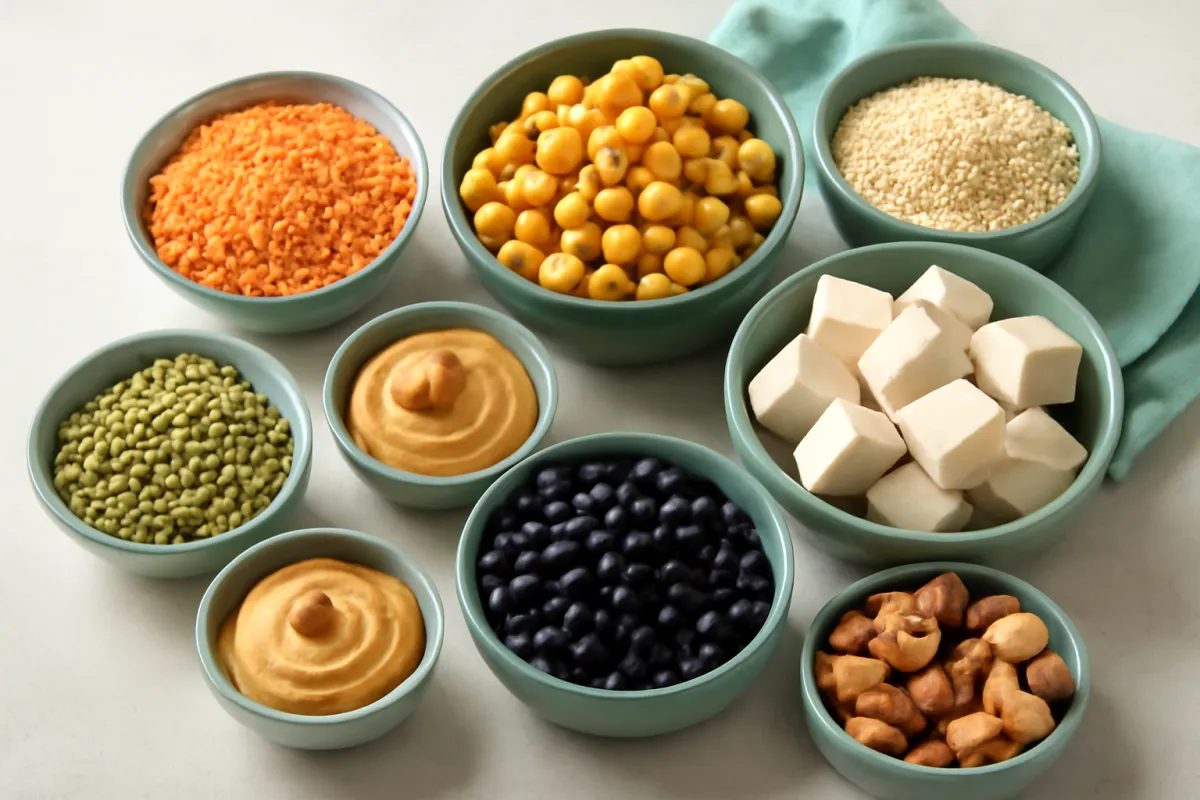
This section exists because the negative case is the practical one, and it is rarely stated plainly. Beans, lentils, chickpeas, tofu made without fortification, whole grains, bread, pasta, rice, nuts, seeds, nut butters, vegetables, leafy greens, fruit, herbs and cooking oils do not carry vitamin B12 in any amount worth counting. Not a little. Not enough to add up across a week.
That is not a knock on any of those foods, several of which lead their own reference lists. A bowl of lentils is an excellent source of fiber, folate and non-heme iron, as our foods high in iron list describes, and it is a non-source of B12 at the same time. Both statements are true and neither cancels the other.
The distinction matters most for people who have recently changed how they eat. A shift toward plant-based meals improves several columns of the nutrient table at once, and the improvement is real, which makes it easy to assume the whole table moved. B12 is the column that does not move, and because of the liver store described earlier, nothing signals the change for a long time. Our note on getting protein without meat covers the protein side of the same transition, where the substitutions do carry over.
An Illustrative Plant-Based Day, by Source
Here is one illustrative day showing where the B12 comes from for someone eating fully plant-based. It is an example of a pattern rather than a meal plan, a recommendation, or a claim about any health outcome, and the actual amounts depend entirely on the products chosen.
Where a plant-based day's B12 comes from
Illustrative shares of one example day. Every segment is a fortified product, which is the entire point of the chart.
Segments sum to 100 percent of one illustrative day. Shares are chosen to show the pattern, not measured from any product, and the real figures come from each package's own panel. Remove the fortified items and the day contains essentially none.
The chart makes a point no food list can make as quickly. For a plant-based eater, the entire supply comes from fortification, so the day has a single point of failure. Change brand, run out, travel somewhere the same products are not fortified, or simply stop eating cereal for a month, and the whole column goes to zero without anything else about the diet changing.
That fragility is why reference bodies treat B12 as the one nutrient plant-based eaters are routinely advised to plan for deliberately, and why the question of supplementation is a common one to raise with a clinician or registered dietitian. This evidence review does not recommend any supplement, product or amount. It describes why the conversation exists. Sketch your own week in the companion below and the share coming from fortification will be one of the outputs.
Reading a Label for Vitamin B12
On the United States Nutrition Facts panel, vitamin B12 is a voluntary declaration rather than a mandatory one, which is the first thing to understand. Its absence from a package therefore says nothing about whether the food contains any, and its presence usually means the manufacturer had a reason to declare it, most often because the product is fortified.
Where it does appear, it is stated in micrograms with a percentage of a Daily Value. The Daily Value used for labeling is commonly cited at 2.4 micrograms for adults and children of four and older, which happens to line up with the adult reference intake, so a percentage on a fortified package reads more intuitively for this nutrient than it does for most. A product declaring 100 percent is declaring roughly one adult reference intake. Labeling rules are set by the Food and Drug Administration and can be revised, so confirm the current requirement with the agency rather than with any article.
Supplement Facts panels use the same units and often show percentages in the hundreds or thousands, and the earlier section on saturation is the reason those figures do not describe what enters the body. A large percentage is a statement about what is in the tablet. Nothing more.

The Chemical Forms on a Label
B12 appears on labels under several names, and the differences are real without being as dramatic as marketing suggests. All of them are cobalamin with a different small group attached to the cobalt atom at the center of the molecule.
Cyanocobalamin is the form most often used in fortification and in supplements. It is stable, well characterized and inexpensive to produce, and the body converts it into the forms it actually uses. Methylcobalamin and adenosylcobalamin are those working forms, the ones the two human enzyme reactions employ directly, and both are sold as supplements on the strength of that. Hydroxocobalamin is a further form more commonly encountered in clinical injection products.
The honest position on which form is better is that the published picture does not support a confident general ranking, and that claims about superiority are marketed considerably more firmly than the evidence carries them. Stability, conversion, retention and cost all differ somewhat between forms, and which of those matters depends on a person’s situation rather than on a general rule. For anyone weighing a specific product for a specific reason, that comparison belongs with a pharmacist or doctor who can see the whole picture, including any medication list.
Cooking, Storage and What Survives
B12 is more robust in the kitchen than several other water-soluble vitamins, and it is nothing like as fragile as vitamin C, covered separately in our vitamin C review. Ordinary cooking does not eliminate it, and normal storage of a fortified product on a shelf does not either.
There are two modest loss mechanisms worth knowing. Prolonged high heat causes some degradation, so a long, hard cook loses more than a short one. And because the vitamin is water soluble, some of it leaches into cooking liquid, which means boiling reduces what remains in the food while a soup or stew keeps everything on the plate. Neither effect is large enough to change which foods are worth eating.
The more relevant kitchen point concerns fortified products specifically. Fortification amounts are added at manufacture and reflect the product as sold, so heavy processing at home, long simmering of a fortified sauce, or heating a fortified beverage repeatedly is a mild loss rather than a serious one. No cooking method turns a non-source into a source, which remains the operative rule.
Who Is Commonly Monitored for Low B12
Clinical references consistently name several groups, and the reasons map directly onto the four absorption stages described earlier. Older adults appear because the stomach lining and acid production commonly change with age, which affects the release of food-bound B12. People who eat fully plant-based, or close to it, without reliable fortified sources appear because the supply itself is absent rather than poorly absorbed.
People who have had stomach surgery, including weight loss procedures, or surgery involving the far end of the small intestine appear because the machinery has been altered directly. Conditions affecting the stomach lining or the terminal small intestine appear for the same reason, and an autoimmune condition in which intrinsic factor is lost is a recognized cause with its own management. People taking certain long-term medications appear for the reasons described earlier. Infants of mothers with low B12 are also commonly discussed, which is one reason intake in pregnancy and breastfeeding is a clinical topic rather than a dietary one.
Reading a list like that and matching yourself to it is not how anyone should determine their status. This evidence review contains no symptom checklist by deliberate choice, because self-matching against general symptoms produces wrong conclusions in both directions and because some of what B12 status affects is not something a person can assess from the inside. If a category above describes you, that is a reason to raise the subject at an appointment.

Testing Belongs With a Clinician
B12 status is measured rather than sensed, and the measuring is more complicated than a single number. A serum B12 test is the usual starting point and the most widely available, and it has known limitations, including that a result can sit in an unremarkable range while the picture at the tissue level is different.
For that reason clinicians sometimes look at additional markers that reflect whether the two B12-dependent reactions are running properly, since a substance that accumulates when a reaction stalls is a more functional signal than the level of the vitamin in blood. Which tests are appropriate, when, and what a given result means in combination with everything else, is precisely the kind of judgment that requires training and access to a full history.
Two practical notes follow without any of this constituting advice. Taking B12 in supplement form before testing can affect what a test shows, which is a reason to discuss timing with whoever ordered it rather than to make a decision independently. And a result interpreted by a search engine is not interpreted. This evidence review can describe why the tests exist. It cannot tell any reader what their own numbers mean, and neither can any article.
Vitamin B12 and Folate: Why They Are Discussed Together
These two vitamins share a reaction, which is why they are almost always discussed as a pair in clinical references. The conversion of homocysteine to methionine requires both, and folate cannot complete its part of that cycle without B12 present to accept a handover. When B12 is missing, folate effectively becomes stuck in a form the cell cannot recycle.
The consequence is that a shortage of either one can produce a similar picture in the bone marrow, since both interruptions stall the same DNA synthesis step in rapidly dividing cells. That overlap is the reason a clinician investigating one will typically consider the other, and it is the reason the two are measured together.
There is a further point that matters at the level of public health policy and belongs to clinicians rather than to readers. Because the marrow effects overlap, a generous folate intake can leave that particular sign looking better while the separate, non-overlapping consequences of low B12 continue. This is not something anyone should attempt to reason about for themselves, and it is not a reason to change a folate intake, avoid a fortified food, or stop any supplement. It is stated here only to explain why the two vitamins appear in the same sentence so often.
Common Mistakes When Thinking About B12
The first mistake is treating B12 like every other nutrient, as a matter of eating more of foods that have some. For most of the nutrient table that works. For this one it fails, because the relevant foods either carry the vitamin or carry none, and portion size does not bridge the difference.
The second is assuming a food is fortified because a similar product is. Fortification is voluntary and brand-specific, and the only reliable check is the panel. The third is reading a very large percentage on a supplement panel as a description of what is absorbed, when the saturable route means the two are not proportional. The fourth is trusting a B12 figure on an algae or seaweed product, where the analogue problem makes the number a poor guide to what the body can use.
The fifth is the opposite failure: over-tracking. B12 does not benefit from a spreadsheet. The whole intake question resolves into whether reliable sources appear in the week and whether anything about your situation affects absorption, and both of those are answered in a sentence rather than a log. Our daily nutrient intake reference makes the same argument across the wider table.
A Short Approach to the Shopping List
For anyone eating animal foods, the shopping list barely needs a B12 section. Fish, meat, dairy and eggs appearing across the week in ordinary quantities cover the sourcing question, which is why our balanced meal method does not treat the vitamin as a separate errand. The open question in that case is absorption, and absorption is a clinical topic rather than a grocery one.
For anyone eating fully plant-based or close to it, the list has exactly one job, and it is a reading job rather than a buying one. Check the panel on the plant beverage, on the breakfast cereal, on the nutritional yeast and on any meat alternative already in the basket, and find out which of them are fortified. That single pass tells you whether the week has a supply at all, and it costs nothing.
The second habit worth having is stability. Because the supply comes from specific products rather than from a food category, changing brands can change the answer without any visible signal. Building the check into the routine our grocery list method describes is more useful than any list of foods, since the list of foods is short and the list of brands is the part that moves.
When to Ask a Clinician
There are five situations where a general nutrition article stops being the right source, and naming them plainly is more useful than implying them. The first is any diet with no animal foods and no reliable fortified products, where the supply question is genuine and supplementation is a common topic for a clinician or registered dietitian.
The second is any history of stomach or intestinal surgery, or any condition affecting the stomach lining or the far end of the small intestine, because the absorption machinery described above has been altered directly. The third is long-term use of acid-reducing medicines or of certain other long-term prescriptions, where the person holding the full medication list is the right one to ask.
The fourth is pregnancy, breastfeeding, infancy and childhood, where reference figures differ and the margin for guessing is narrower. The fifth is any concern about deficiency, any interest in testing, and any question about a result, all of which are clinical matters by definition. Anyone in those situations should treat this evidence review as background for a conversation rather than as a substitute for one, and the companion below as a sketching tool rather than an assessment.
The Bottom Line
How much vitamin B12 per day is answered by a small number and then complicated by everything around it. The commonly cited adult reference intake is roughly 2.4 micrograms a day, with slightly higher figures commonly cited for pregnancy and breastfeeding and lower ones through childhood, published by national health authorities, reviewed periodically, and worth confirming for your own age and situation rather than taken from any article. No upper intake level has been established, which is a statement about observed risk rather than a suggestion that more is better.
The part that actually decides the outcome is source and absorption. B12 is made by bacteria, so it reaches food through animals or through fortification, and unfortified plant foods contain none at any portion size. Absorption depends on stomach acid releasing the vitamin from food protein and on intrinsic factor carrying it to a receptor at the far end of the small intestine, which is why absorption is commonly described as less reliable with age, after certain surgeries, and in the presence of certain long-term medications. That route saturates, so a large amount is not absorbed in proportion to its size.
What follows from all of that is short. If you eat animal foods regularly, sourcing is handled and absorption is the question worth raising at an appointment. If you do not, read the panels on the fortified products in your basket and treat the supply as something to plan rather than to assume. And for anything involving deficiency, testing, a result, a medication or a supplement, the answer comes from a clinician who can see your full history, not from this page.
This evidence review is published for general education and reproduces commonly cited population reference intakes for vitamin B12 alongside a plain-language description of how the vitamin is absorbed. It is not medical, dietary or nutritional advice, it does not diagnose, treat or manage any condition, and reading it creates no clinician-patient relationship. No microgram figure is given for any individual food or product above, deliberately, because content varies with species, cut, brand, country and fortification decision, and because the panel on a package is the only source that describes that package. No absorption percentage is quoted for any amount or form, because published estimates vary with the quantity, the person and the measurement method. The relative ranking chart is an ordinal reading aid rather than a measurement, and the illustrative day is a pattern rather than a meal plan. No symptom description appears here, because vitamin B12 status is established by laboratory testing interpreted by a clinician rather than by self assessment, and nothing above should be used to rule a concern in or out. Nothing here is a recommendation to take, avoid, start, stop, time or change any supplement or any medication, including acid-reducing medicines and long-term prescriptions that are commonly discussed in this context. Anyone eating fully plant-based, anyone with a history of stomach or intestinal surgery or a condition affecting absorption, anyone who is pregnant, breastfeeding, or asking on behalf of an infant or child, and anyone considering testing or supplementation, should take the question to a doctor, pharmacist or registered dietitian who knows the full history.
Frequently asked questions
How much vitamin B12 per day do adults need?
The Recommended Dietary Allowance published by the Food and Nutrition Board of the National Academies is commonly cited at roughly 2.4 micrograms a day for adults, with slightly higher figures commonly cited for pregnancy and breastfeeding and lower ones through childhood. That is a very small quantity by the standards of a nutrient table, which is part of why the amount is rarely the interesting part of the question. Reference intakes are population values published by national health authorities, are reviewed periodically, and do get revised, so the figure for your own age and situation should be confirmed against the publishing body rather than taken from any article. This evidence review reproduces commonly cited figures for reasoning, not as a personal target.
Can you get vitamin B12 from plant foods?
Not from unfortified ones in any dependable way. Vitamin B12 is made by bacteria and archaea rather than by plants or animals, and plants have no route to accumulate it, which is why beans, grains, nuts, seeds, vegetables and fruit are not treated as sources in any reference list. People eating fully plant-based therefore rely on fortified products, where the vitamin has been added during manufacture, or on supplementation discussed with a clinician. This is the one nutrient where the question is not how much a food contains but whether the food contains any at all, and the answer for unfortified plant foods is the same regardless of portion size.
Why does vitamin B12 absorption depend on the stomach?
Because two separate stomach jobs sit on the path. Stomach acid and digestive enzymes first release the vitamin from the food protein it arrives bound to, and cells in the stomach lining also secrete a carrier called intrinsic factor that the vitamin must pair with before a receptor at the far end of the small intestine will take it up. Anything that reduces stomach acid, damages the stomach lining, or removes part of the stomach can interrupt one or both steps, which is why absorption is commonly described as declining with age and after certain surgeries. Whether that applies to any individual is a clinical question answered by a doctor with access to testing and a full history, not by reading.
Is a large oral dose of vitamin B12 absorbed in proportion to its size?
No, and this is one of the more useful things to understand about the vitamin. The intrinsic factor route is a receptor system with a limited capacity, so it takes up only a small quantity at any one time and doubling the amount presented to it does not double what gets through. A separate route exists in which a small proportion crosses the intestinal wall by simple diffusion without any carrier, and that route is why very large amounts are sometimes discussed in clinical settings, but it is inefficient by nature. This evidence review does not quote an absorption percentage for any dose or product, because published estimates vary with the amount, the person and the method used to measure them.
What is the difference between cyanocobalamin and methylcobalamin on a label?
They are different chemical forms of the same vitamin, distinguished by the small group attached to the cobalt atom at the center of the molecule. Cyanocobalamin is the form most commonly used in fortification and in supplements because it is stable and inexpensive to produce, while methylcobalamin and adenosylcobalamin are forms the body uses directly in its own reactions, and hydroxocobalamin is a form more often seen in clinical injection products. The body interconverts forms as part of normal metabolism. Claims that one form is decisively superior for general use are marketed more confidently than the published picture supports, so a comparison of forms for a specific situation is a conversation for a pharmacist or doctor rather than a purchase decision made from a shelf.
Is there an upper limit for vitamin B12?
No Tolerable Upper Intake Level has been established for vitamin B12 by the Food and Nutrition Board, on the reasoning that the vitamin has a low potential for harm from food and supplements in healthy people, partly because absorption itself is limited and surplus is excreted. The absence of a ceiling is a statement about observed risk rather than an endorsement of large amounts, and it does not mean more is better or that any amount is appropriate for any person. High supplemental intakes can also affect the interpretation of laboratory results, which matters if testing is part of the picture. Any decision about taking vitamin B12 in supplement form, in any amount, belongs with a clinician who knows your medications and history.
Who is commonly monitored for low vitamin B12?
Clinical references usually name older adults, people who eat fully plant-based or close to it without reliable fortified sources, people who have had stomach or intestinal surgery, people with conditions affecting the stomach lining or the far end of the small intestine, and people taking certain long-term medications. The reasons are mechanical rather than mysterious, since each one interrupts a specific step in the release, carrying or uptake of the vitamin. Belonging to one of those groups is a reason to raise the subject at an appointment, not a finding about your own status. This evidence review contains no symptom list, because matching yourself against general symptoms is a reliable route to a wrong conclusion and because status is established by testing rather than by reading.
Does spirulina or seaweed count as a vitamin B12 source?
They are generally not treated as dependable sources, and the reason is specific rather than dismissive. Some algae and seaweed products contain compounds that are structurally similar to vitamin B12 but are not usable by human metabolism, described in the literature as analogues or as pseudovitamin B12. Those compounds can register on some laboratory assays and on some product labels while contributing nothing the body can use, which makes the label figure misleading rather than merely small. Reference lists therefore direct people who need a non-animal source toward products fortified with a known form of the vitamin, and toward a clinician for anything beyond that.

Hamza Hai is the editor of NourishMark. She holds an MBA and reviews the site's articles against our editorial standards, checking that every figure is labelled for what it is, that nothing is presented as verified fact without a source the reader can check, and that the writing stays useful to a non-specialist.