What's in this review
- How Much Iron per Day? The Direct Answer
- Iron Reference Intakes by Age, Sex and Life Stage
- Why the Adult Figure Splits by Sex
- Why the Figure for Women Falls Again After Menopause
- Pregnancy Carries the Largest Figure on the Table
- Infants, Children and Teenagers
- RDA, AI and UL: Three Numbers, Three Questions
- The 45 mg Upper Limit Is a Boundary, Not a Target
- The Body Has No Ordinary Route for Shedding Iron
- Heme and Non-Heme Iron: The Split Behind Everything Else
- Why No Absorption Percentage Appears on This Page
- What Helps Non-Heme Iron Along
- What Gets in the Way
- Coffee, Tea and the Question of Timing
- Calcium and Iron at the Same Meal
- Food Sources of Iron: A Reference Table
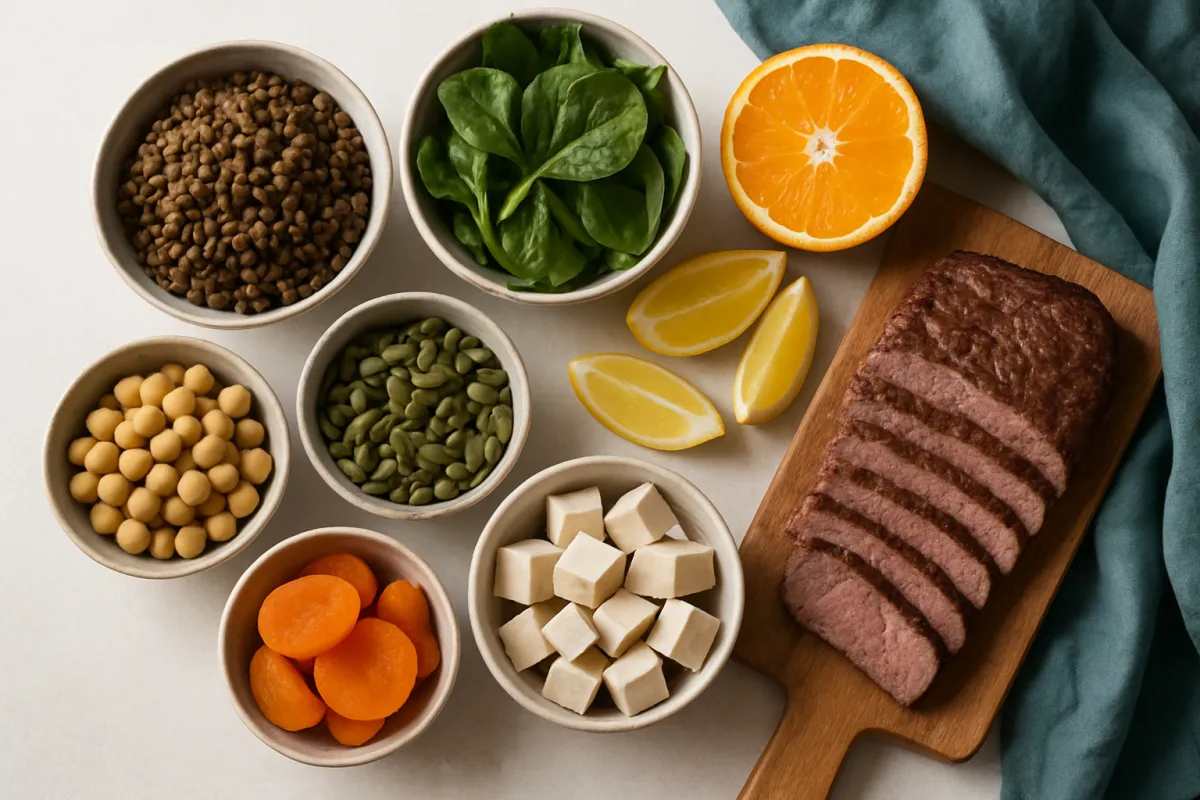
- Which Foods Carry the Most Iron per Serving
- Beans, Lentils and Tofu: The Plant-Forward Middle
- Fortification and Enrichment
- Meat, Fish and Shellfish
- Cooking in Cast Iron
- Why Plant-Forward Eaters Are Given a Higher Figure
- An Illustrative Day That Reaches 18 mg
- Reading the Iron Line on a Nutrition Facts Panel
- Supplements Are a Clinical Decision, Not a Shopping One
- Iron-Containing Products and the Hazard to Small Children
- Who Is Commonly Monitored, and Why There Is No Symptom List Here
- Common Mistakes When Counting Iron
- A Short Iron-Forward Shopping List
- When to Ask a Clinician
- The Bottom Line
Iron is the nutrient where the daily figure depends more on who is asking than for almost anything else on the reference table. A woman of 30 and a man of 30 are given numbers that differ by more than a factor of two. The same woman at 55 is given the man’s number. Pregnancy carries the largest figure of all. None of that is arbitrary, and the explanation says something useful about how the body handles a mineral it cannot easily get rid of.
This evidence review works through the commonly cited reference figures and why they split by age and sex, what heme and non-heme iron are and why the difference matters at every meal, which meal components help uptake and which get in the way, where iron sits in ordinary food, and why the supplement question belongs with a clinician rather than a shopping list. The wider table of reference figures sits in our daily nutrient intake reference, the food list is expanded in foods high in iron, and you can sketch a rough day in the companion below. Everything here is general education describing approximate figures, not medical or dietary advice.
Key takeaways
- Adult reference intakes are commonly cited near 8 mg a day for men, near 18 mg for women aged roughly 19 to 50, near 8 mg again for women from about 51, and near 27 mg in pregnancy. Confirm your own row with the publishing health authority.
- The split is menstrual blood loss. Iron leaves the body with blood and with shed cells rather than through a regulated excretion route, so what is lost has to be replaced from food.
- Heme iron occurs only in meat, poultry, fish and shellfish and is generally described as absorbed more readily. Non-heme iron, which is everything else, is highly variable and is pushed up or down by the rest of the meal.
- Vitamin C at the same meal is the most consistently described enhancer. Tea and coffee tannins, phytates in whole plant foods and a large calcium load at the same sitting are the commonly described brakes.
- The commonly cited 45 mg ceiling counts food, fortification and supplements together. Because surplus iron has no easy exit, supplementation is a decision for a clinician who has seen bloodwork, and iron-containing products are a real poisoning hazard for small children.
How Much Iron per Day? The Direct Answer
For healthy adults, the commonly cited daily figures are roughly 8 milligrams for men aged 19 and older, roughly 18 milligrams for women aged 19 to 50, and roughly 8 milligrams for women from about age 51. Pregnancy is commonly cited near 27 milligrams, which is the largest figure anywhere on the iron table. These are Recommended Dietary Allowances published by the Food and Nutrition Board of the National Academies as part of the Dietary Reference Intakes.
Two cautions belong with that answer before anything is built on it. First, reference intakes are published by national health authorities, are reviewed periodically, and do get revised, so the current figure for your specific age, sex and life stage should be confirmed against the publishing body rather than against any article. Second, an RDA is a population reference designed to cover the requirement of nearly all healthy people in a group. It is not a personal quota, and a day that lands under it is not a diagnosis of anything.
The rest of this evidence review is largely about why those figures differ so sharply, and about the second half of the iron question, which is that the amount on the plate and the amount that gets in are not the same number. Set your own reference figure in the companion below and the arithmetic in each section runs against it.
Iron Reference Intakes by Age, Sex and Life Stage
The published reference table runs from infancy through later adulthood, and it is worth reading in full because iron is the nutrient whose figures move around the most. The values below are the commonly cited figures in milligrams per day. The infant figure for the first six months is an Adequate Intake rather than an RDA, a distinction covered further down.
| Group | Iron, mg per day |
|---|---|
| Infants 0 to 6 months | 0.27 (AI) |
| Infants 7 to 12 months | 11 |
| Children 1 to 3 years | 7 |
| Children 4 to 8 years | 10 |
| Children 9 to 13 years | 8 |
| Boys 14 to 18 years | 11 |
| Girls 14 to 18 years | 15 |
| Men 19 to 50 years | 8 |
| Women 19 to 50 years | 18 |
| Men 51 years and older | 8 |
| Women 51 years and older | 8 |
| Pregnancy | 27 |
| Breastfeeding, 14 to 18 | 10 |
| Breastfeeding, 19 to 50 | 9 |
Several features stand out immediately. The figure for a one year old is close to the figure for an adult man. The figure jumps for girls at 14 and not for boys. It more than doubles again in pregnancy and then falls below the non-pregnant figure while breastfeeding. And it drops back at around 51 for women only. Every one of those is explained by blood, growth or both. Treat this table as a reproduction of commonly cited figures and confirm your own row against the current official publication.
Why the Adult Figure Splits by Sex
The commonly cited gap between 8 milligrams for men and 18 for women in the reproductive years is the widest sex difference on the entire reference table, and the reason is mechanical. Menstrual blood loss is iron loss. Most of the iron in the body is held in hemoglobin inside red blood cells, so blood leaving the body takes iron with it, and what leaves has to be replaced from food.
The size of that loss varies enormously between individuals, which is a genuine limitation of any single population figure. A reference intake is set to cover the requirement of nearly all healthy people in a group, so the 18 milligram figure is deliberately generous relative to the average rather than pitched at it. Someone with light periods is covered comfortably by less, and someone with heavy ones may not be covered by the figure at all, which is a clinical matter rather than a dietary one.
That variation is exactly why the figure is a reference and not an instruction. It describes what a population needs on average with a margin, not what any reader in front of it needs.
Why the Figure for Women Falls Again After Menopause
The commonly cited drop from 18 milligrams back to 8 at around age 51 looks abrupt, and it is the tidiest illustration of what these tables actually encode. Nothing changes at a birthday. What the age band is standing in for is the end of menstrual losses, after which the requirement for replacement falls to the same baseline that applies to men.
The practical consequence is worth stating plainly, because it runs opposite to the usual expectation that older adults need more of everything. For iron, the requirement drops by more than half, and the assumption that a supplement suitable at 35 remains suitable at 60 is one of the more common ways people end up taking more iron than their situation calls for. Since surplus iron has no ordinary exit route, that is not a harmless error.
None of that is a direction to start or stop anything. It is a reason that iron is one of the nutrients where a reference figure genuinely goes stale for an individual over time, and where a periodic conversation with a clinician is more useful than a fixed habit.
Pregnancy Carries the Largest Figure on the Table
The commonly cited pregnancy figure of roughly 27 milligrams a day is the highest on the iron table by a wide margin, and there are three separate demands behind it. Maternal blood volume expands substantially during pregnancy, and the extra red blood cells needed to fill it are built from iron. The developing baby accumulates its own iron stores. And the placenta has requirements of its own.
Set against that, menstrual losses stop, which offsets part of the demand but nowhere near all of it. The net effect is a requirement large enough that it is one of the very few situations where routine supplementation is commonly discussed in clinical practice rather than treated as an individual decision. That discussion belongs entirely with the clinician providing antenatal care, and this page offers no view on it.
The breastfeeding figures are the surprise for many readers, sitting at roughly 9 to 10 milligrams and therefore below the non-pregnant adult female figure. The reason is again menstrual, since periods commonly remain absent for a period after birth. Our note on high fiber foods during pregnancy covers a related question from the same life stage, and every part of it defers to antenatal care in the same way.
Infants, Children and Teenagers
The infant rows are the strangest looking on the table, and both are explained by stores rather than by intake. The commonly cited figure for the first six months is around 0.27 milligrams, which is an Adequate Intake anchored on the intake of a healthy breastfed baby, and it is small because a baby is generally born with iron stores laid down before birth. The figure then jumps to roughly 11 milligrams in the second half of the first year, when those stores are running down and growth is rapid.
Childhood figures settle to roughly 7 milligrams at ages one to three, roughly 10 at four to eight, and roughly 8 at nine to thirteen. The dip at nine to thirteen relative to four to eight looks odd and reflects how the reference bands were derived rather than a fall in need.
At fourteen the paths separate. Boys are commonly cited near 11 milligrams, reflecting the growth spurt and the expansion of blood volume and muscle mass that comes with it. Girls are commonly cited near 15, which combines growth with the onset of menstrual losses. Infant and child feeding is a paediatric matter, and any question about a specific baby or child belongs with a paediatric clinician rather than a reference page.
RDA, AI and UL: Three Numbers, Three Questions
Three abbreviations carry most of the meaning in any reference intake table, and they answer three different questions. A Recommended Dietary Allowance is an intake estimated to meet the requirement of nearly all healthy people in a group. It is derived from evidence about a measurable requirement, and iron has one for everyone past the first six months of life.
An Adequate Intake is the fallback used where the evidence is not strong enough to set an RDA. It is typically anchored on the intake observed in apparently healthy populations, which for infants under six months means the intake of a healthy breastfed baby. That single row is the only place an Adequate Intake appears on the iron table.
A Tolerable Upper Intake Level is a ceiling rather than a target, describing the highest routine intake likely to pose no risk of adverse effects in almost everyone. Readers misread it constantly, because a number in a nutrition table looks like something to aim at. For iron the ceiling deserves close attention, because unlike the magnesium ceiling covered in our magnesium review, this one counts everything.
The 45 mg Upper Limit Is a Boundary, Not a Target
The Tolerable Upper Intake Level for iron is commonly cited at roughly 45 milligrams a day for adults and teenagers from about age 14, and roughly 40 milligrams a day for younger children. The important structural point is that this ceiling counts every source together, meaning iron from food, iron added to fortified products, and iron from supplements.
That is the ordinary arrangement for upper limits and the opposite of the magnesium case, where the ceiling excludes food entirely. It is worth naming the contrast because readers who have absorbed the magnesium rule sometimes carry it across, and here it does not apply. A day of food plus a fortified cereal plus a supplement is all counted in the same total.
The effect the ceiling is set against is gastrointestinal, since larger amounts of iron reaching the gut are commonly associated with nausea, constipation and stomach upset. That is the near term boundary. The longer term concern with sustained excess is a different matter and more serious. One further caveat matters: the upper limit does not apply to people taking iron under medical supervision for a diagnosed reason, which is a reminder that the whole territory past ordinary food is clinical.
The Body Has No Ordinary Route for Shedding Iron
This is the single fact that explains why iron is treated more carefully than most minerals, and it is worth stating without softening. There is no regulated excretion pathway for iron comparable to the way the kidney sheds surplus magnesium, potassium or sodium in urine. Once iron is absorbed, the body largely keeps it.
What leaves does so passively. Iron departs with cells that are shed from the lining of the gut and from skin, in small amounts, and with any blood that leaves the body. That is essentially the whole list. Because the outflow is fixed and modest, the only place the body can meaningfully control its iron balance is at the point of entry.
So regulation happens at absorption. The intestine adjusts how much iron it lets through according to the body’s stores, taking up more when stores are low and less when they are replete, under hormonal control. That system is elegant and it is not unlimited, which is why a sustained high intake from supplements is a genuinely different proposition from a high intake from food, and why nobody should be topping up on the assumption that the surplus simply washes out. It does not.
Heme and Non-Heme Iron: The Split Behind Everything Else
Dietary iron arrives in two chemically different forms, and almost every practical question about iron traces back to the difference. Heme iron is iron held inside the heme ring, the same structure that carries oxygen in hemoglobin and myoglobin. It occurs only in the tissues of animals, meaning meat, poultry, fish and shellfish, and it makes up a share of the iron in those foods rather than all of it.
Non-heme iron is everything else. All the iron in plants is non-heme. So is the iron in eggs and dairy, the iron added to fortified cereals and enriched flour, the iron in supplements, and the remaining fraction of the iron in meat that is not bound in heme.
The two are taken up by different routes in the intestine, and the consequence is what matters. Heme iron is generally described as absorbed more efficiently and as relatively insensitive to what else is on the plate. Non-heme iron is described as far more variable, with uptake pushed up or down by other components of the same meal and by the body’s own stores. That is why a page about iron has to talk about meals rather than just about foods.
Why No Absorption Percentage Appears on This Page
It would be easy to give the two familiar percentages here, and this evidence review is not going to, for a reason worth explaining rather than hiding. Published estimates of how much of the iron in a meal is absorbed vary widely between studies, populations, meal compositions and methods, and they vary further with the iron status of the person eating.
That last point is the awkward one for any fixed figure. Absorption of non-heme iron rises when body stores are low and falls when they are replete, which means the percentage is not a property of the food at all. It is a property of the meal and the eater together. A number that changes with the diner cannot honestly be printed next to a food.
What can be said is directional and still useful. Heme iron is absorbed more readily than non-heme iron. Non-heme uptake is the part that responds to enhancers and inhibitors. And the ratio between them is large enough that two meals containing identical milligram totals can deliver quite different amounts. Anyone who needs a real figure for a real person needs bloodwork and a clinician, not a percentage from an article.
What Helps Non-Heme Iron Along
Two enhancers appear consistently in nutrition references, and both are ordinary food rather than anything exotic. The first is vitamin C. Ascorbic acid keeps iron in a more soluble state in the gut and forms a complex with it that resists the binding agents that would otherwise tie it up. The effect is described as substantial and as dependent on the two arriving together, which means at the same meal rather than at some point in the same day.
The second is usually called the meat factor. Meat, poultry and fish appear to improve absorption of the non-heme iron eaten alongside them, beyond the heme iron they contribute themselves. The mechanism is not fully settled, which is a reason to state the effect and not a size for it.
The practical translation is the least demanding advice in nutrition. Squeeze lemon over lentils. Put tomatoes in the bean stew. Have a citrus fruit, some peppers, some broccoli or some strawberries at the meal where the plant iron is. Our vitamin C review covers those foods in their own right, and our balanced meal method is the plate level version of the same move.
What Gets in the Way
The inhibitors are equally ordinary, and the honest framing is that none of them is a reason to avoid a healthy food. Phytates, found in whole grains, legumes, nuts and seeds, bind minerals in the gut and reduce the share absorbed. That is a genuine effect, and it sits inside foods that are among the better plant sources of iron in the first place, so the net contribution stays positive. Soaking, sprouting, fermenting and long cooking all reduce phytate content to varying degrees.
Polyphenols and tannins in tea, coffee, cocoa, red wine and some herbal infusions are the second group, and their effect on non-heme iron is described as strong when the drink accompanies the meal. Certain plant proteins, notably some soy protein preparations, are also described as inhibitory, though soy foods still carry useful iron.
The pattern behind the list is that the inhibitors act on non-heme iron specifically, and that they act within a meal rather than across a day. That is what makes timing the lever rather than exclusion, which is the subject of the next two sections.
Coffee, Tea and the Question of Timing
Tea is the clearest case in the whole inhibitor category, and it is a case where a small habit change does the work. The tannins in tea bind non-heme iron in the gut, and the effect described in nutrition references is for tea taken with the meal. Coffee behaves similarly through its own polyphenols, and cocoa and red wine belong in the same family.
The commonly described handling is separation rather than avoidance: keep the tea or coffee away from the iron-carrying meal rather than out of the day. How much separation is enough is exactly the kind of question where a specific number would be invented rather than reported, so this evidence review does not give one, and a clinician or dietitian advising someone with a real reason to care will give a specific answer.
There is a group for whom this matters more than for anyone else, which is people whose iron comes almost entirely from plants and who also drink tea with meals as a matter of routine. For someone eating meat at most meals, the same habit is far less consequential. That difference is itself a reminder that meal patterns, not individual foods, are the unit of analysis for iron.
Calcium and Iron at the Same Meal
Calcium is the odd one out among the inhibitors, because it is described as reducing the absorption of both non-heme and heme iron, where everything else in the list affects only the non-heme fraction. That makes it the one inhibitor that a steak dinner does not shrug off.
The effect is generally described as acute, meaning it applies to the meal in which the calcium is present rather than to the day as a whole, and the longer term significance for people eating a varied diet is treated as modest. That is a genuinely mixed picture rather than a settled one, and this evidence review reports it that way rather than resolving it.
What follows practically is mild. Very large calcium loads and iron-carrying meals do not need to coincide, and where both matter to someone, spacing is the usual suggestion. Nothing about that is a reason to eat less calcium, which has its own reference figure and its own importance, covered in our foods high in calcium list. Two nutrients competing at one meal is a scheduling question, not a ranking of which one wins.
Food Sources of Iron: A Reference Table
The figures below are commonly cited, approximate values for ordinary servings. They shift with variety, growing conditions, cut, brand, fortification and preparation, so read them as reference approximations rather than as measurements of anything on your own counter. The panel on your own package is always the more reliable figure.
| Food | Serving | Iron, roughly |
|---|---|---|
| Fortified breakfast cereal | 1 serving | varies from near zero to a full Daily Value; read the panel |
| White beans, canned | 1 cup | ~8 mg |
| Oysters, cooked | 3 oz | ~8 mg |
| Lentils, cooked | 1 cup | ~7 mg |
| Spinach, cooked | 1 cup | ~6 mg |
| Tofu, firm | 1/2 cup | ~3 mg |
| Lentils, cooked | 1/2 cup | ~3 mg |
| Spinach, cooked | 1/2 cup | ~3 mg |
| Pumpkin seeds, roasted | 1 oz | ~2.5 mg |
| Sardines, canned with bones | 3 oz | ~2.4 mg |
| Chickpeas, cooked | 1/2 cup | ~2.4 mg |
| Dark chocolate, 45 to 69 percent | 1 oz | ~2.3 mg |
| Kidney beans, canned | 1/2 cup | ~2 mg |
| Beef, braised | 3 oz | ~2 mg |
| Potato, baked with skin | 1 medium | ~1.9 mg |
| White beans, canned | 1/2 cup | ~4 mg |
| Cashews | 1 oz | ~2 mg |
| Tomatoes, canned, stewed | 1/2 cup | ~1.7 mg |
| Dried apricots | 1/4 cup | ~1 mg |
| Chicken breast, roasted | 3 oz | ~1 mg |
| Tuna, canned in water | 3 oz | ~1 mg |
| Egg, large | 1 | ~0.9 mg |
| Whole wheat bread | 1 slice | ~1 mg |
| Enriched white bread | 1 slice | ~1 mg |
| Raisins | 1/4 cup | ~0.8 mg |
| Broccoli, cooked | 1/2 cup | ~0.5 mg |
| Milk | 1 cup | ~0 mg |
Three things are worth noticing before any single row. Plant foods dominate the top of the list by milligram, which surprises people who associate iron with red meat. Milk is effectively absent, which is why it appears in discussions of iron in infants and toddlers. And the fortified cereal row has no number at all, because the amount added is a manufacturer’s decision rather than a property of the grain.
Which Foods Carry the Most Iron per Serving
Iron per common serving
Milligrams per typical portion, against adult reference intakes commonly cited near 8 to 18 mg a day. Fortified cereals are left out because the amount added varies by brand. Illustrative approximations.
Bars scale to canned white beans and cooked oysters at 100 percent. Commonly cited approximations that vary with variety, cut, brand and preparation, and not personal targets. Bar length is milligrams on the plate, not milligrams absorbed.
The chart carries a warning inside it that a milligram table cannot. Bar length is what is on the plate, and the two categories at the top of that plate behave differently once eaten. The beans, lentils and spinach are non-heme, so their real contribution swings with what else is at the meal. The oysters, sardines and beef carry a heme fraction that is comparatively steady.
That is why the plant entries are not simply better despite having longer bars. They are larger figures with more variance attached, and the variance is the part a reader can actually influence by putting a lemon wedge or a tomato on the same plate.
Beans, Lentils and Tofu: The Plant-Forward Middle
Legumes carry the load in most plant-forward diets, and the figures are genuinely competitive. A cup of cooked lentils is commonly cited near 7 milligrams and a cup of canned white beans near 8, with the corresponding half cups near 3 and 4. A half cup of chickpeas lands near 2.4 and canned kidney beans near 2. Firm tofu is commonly cited near 3 milligrams a half cup.
Two things make this category efficient beyond the milligram figure. They are cheap and shelf stable, so they survive the gap between intention and a real Tuesday. And they pay into several columns at once, carrying fiber, plant protein, magnesium and potassium in the same serving, which is why they sit near the top of our high-fiber foods list and appear in our protein without meat note as well.
The caveat is the phytate one from earlier, and it does not change the recommendation to eat them. These foods carry both the iron and the binding agent, and the net still favours eating them. Soaking dried beans, using canned ones that have already been cooked, and putting an acidic vitamin C component in the same dish are the ordinary handling, and the last of those is a flavour improvement anyway.
Fortification and Enrichment
Fortified and enriched products are the largest single source of iron in many national diets, and they are also the least predictable line on any table. Enrichment is the practice of adding back certain nutrients that refining removed, and in many countries refined wheat flour is enriched with iron along with several B vitamins. Fortification is the broader practice of adding a nutrient that was never there in quantity, which is what happens to most breakfast cereals.
The consequence for anyone counting is that the iron in a bowl of cereal is a manufacturer’s decision. Two boxes side by side on the same shelf can differ by an order of magnitude, with one declaring a small fraction of a Daily Value and another declaring the whole of it in a single serving. Neither number can be inferred from the grain.
That makes the Nutrition Facts panel the only source for this category, and it makes fortified products the reason many people meet the figure without ever thinking about iron. It also makes them a real consideration in the upper limit arithmetic, since a heavily fortified cereal plus a supplement can add up faster than either alone suggests. Fortification rules are set by national regulators and are revised over time, so the panel on the package is the current fact rather than anything stated here.
Meat, Fish and Shellfish
Animal foods contribute less by milligram than most people expect and more by absorbed iron than the table suggests, which is the whole reason the heme distinction exists. Three ounces of braised beef is commonly cited near 2 milligrams, roasted chicken breast and canned tuna near 1, and a three ounce tin of sardines near 2.4. Cooked oysters are the outlier at roughly 8 milligrams, well clear of anything else in the category.
Red meat carries more iron than poultry, and darker poultry meat carries more than breast, for the same underlying reason in both cases. Myoglobin is the oxygen storing protein in muscle, it contains heme, and the muscles that work hardest carry the most of it. Colour is therefore a rough proxy for iron within any animal, which is a rare case where an intuition about food happens to be correct.
Organ meats sit far above everything else in this category and are the traditional answer to the question, though they come with their own considerations, including a very high vitamin A content in liver that carries its own cautions in pregnancy. That is a clinical matter and it is one of several reasons this evidence review is not putting a serving suggestion next to it.
Cooking in Cast Iron
Cooking in cast iron transfers some iron from the pan into the food, and this is one of the few pieces of nutrition folklore that turns out to be broadly true rather than broadly wrong. The transfer is described as larger with acidic foods, longer cooking times, more stirring, and newer or less seasoned pans.
The honest limit on that observation is that the amount is unpredictable. It depends on the pan, its age, its seasoning, the dish and the cooking time, and no reliable per meal figure can be attached to it. A tomato sauce simmered for an hour in a bare cast iron pan is doing something measurable, and a steak seared for four minutes in a well seasoned one is doing very little.
So it belongs in the same category as hard drinking water: an input that genuinely exists, varies too much to plan around, and is invisible in any food tracking application. Nobody should buy cookware for its nutrition, and nobody counting milligrams should assume the pan contributed nothing either. It is a reason that real world intakes are slightly less knowable than a table implies.
Why Plant-Forward Eaters Are Given a Higher Figure
Reference intake publications commonly note that people eating no meat, poultry or fish may need a higher intake than the standard figure, with an adjustment often cited at roughly 1.8 times the published value. The reason follows directly from everything above. The published figures assume a mixed diet containing some heme iron, and a diet without any is composed entirely of the more variable non-heme form.
Applied to the commonly cited adult figures, that adjustment moves 8 milligrams to roughly 14 and 18 milligrams to roughly 32, which are large numbers to reach from food. This is one of the clearer cases where a reference adjustment is a signal to pay attention rather than a target to hit exactly, and where the enhancers matter more than the raw milligram count.
The practical response is not to eat more of everything. It is to put the enhancers where they help: vitamin C at the meals carrying the plant iron, tea and coffee moved away from those meals, legumes and tofu appearing regularly rather than occasionally, and soaking or fermenting where the cooking method allows. Anyone eating this way and wondering about their status should raise it at an appointment, since the question is answered by a blood test rather than by arithmetic.
An Illustrative Day That Reaches 18 mg
Here is one illustrative day assembled from the reference table above, built against the commonly cited 18 milligram figure for women aged 19 to 50 because it is the most demanding of the non-pregnant adult figures. It is an example of the arithmetic and not a meal plan, a recommendation, or a claim about any health outcome.
| Meal | Foods | Iron |
|---|---|---|
| Breakfast | Fortified cereal whose panel declares ~4 mg, 1 slice whole wheat toast (~1 mg) | ~5 mg |
| Lunch | 1/2 cup cooked lentils (~3), 1/2 cup cooked spinach (~3), an orange alongside | ~6 mg |
| Snack | 1 medium baked potato with skin (~2 mg) | ~2 mg |
| Dinner | 3 oz braised beef (~2), 1/2 cup chickpeas (~2), tomatoes and broccoli (~1) | ~5 mg |
| Total | ~18 mg |
Two details in that day are worth more than the total. The breakfast line depends entirely on a panel, since a different box could put that same line anywhere between 1 and 18 milligrams. And the orange at lunch does not appear in the milligram column at all, yet it is arguably the most useful item in the meal, because it sits with the two non-heme sources that respond to it.
The dinner line is the mixed one, with a heme contribution from the beef, a non-heme contribution from the chickpeas, and tomatoes supplying acid and vitamin C to the same plate. Build your own version in the companion below and the same arithmetic runs against whichever reference figure applies to you.
Where an illustrative 18 mg day comes from
Shares of the worked day above, by meal, against the commonly cited 18 mg figure for women aged 19 to 50. Reference approximations, not a meal plan.
Segments sum to 100 percent of the illustrative 18 mg day. Milligrams on the plate rather than milligrams absorbed, and approximations rather than a personal target.
The distribution says something the table does not. No single meal carries the day, and the largest line is a plant one built from two cheap ingredients. Take the fortified cereal out and replace it with an unfortified one and the day falls by roughly a fifth without anything else changing, which is the fortification point in miniature.
Reading the Iron Line on a Nutrition Facts Panel
Iron is a mandatory declaration on the United States Nutrition Facts panel, which puts it in a different position from magnesium, where declaration is voluntary. So the line is there to be read on packaged foods rather than sometimes present and sometimes absent.
The percentage shown is calculated against a Daily Value commonly cited at 18 milligrams for adults. That figure matches the commonly cited reference intake for women aged 19 to 50 and sits well above the figure for men and for women past about 51, so a panel percentage reads about right for one group and low for the other two. A food showing 10 percent is supplying roughly 1.8 milligrams whoever is reading it.
The general advice holds here as with every mineral: read the milligram figure and treat the percentage as a rough screen, because milligrams are absolute and addable while percentages depend on a denominator you did not choose. Our nutrition label walkthrough covers the panel as a whole. Labeling rules are set by the FDA and can be revised, so check the agency’s current guidance rather than any article for what must be declared and against what Daily Value.
Supplements Are a Clinical Decision, Not a Shopping One
This evidence review does not recommend any supplement, does not suggest an amount, and will not tell any reader whether they need one. For iron that is not a formality. It is the correct answer, and there are three reasons worth naming.
The first is that surplus iron has no easy exit. A mineral the body cannot readily shed is one where sustained excess accumulates rather than washing through, and where the margin for casual self-medication is genuinely narrower than for most nutrients. The second is that low iron has many possible causes, some of them trivial and some of them serious, and treating the number without investigating the cause can mask something that needed finding. The third is that iron interacts with several medications in both directions, which is a pharmacist’s territory.
There is also a practical labeling point that applies whenever a clinician has recommended something. Iron in a supplement is always bound to a partner compound, and the compound weighs more than the elemental iron inside it, so the figure on the Supplement Facts panel is the one that describes what is being taken. That is a reading skill rather than a recommendation, and the choice of product, amount and duration belongs entirely with the prescriber.
Iron-Containing Products and the Hazard to Small Children
This section exists because iron is different from the other nutrients on this site in one specific and serious way. Accidental ingestion of iron-containing products by young children is treated as a significant poisoning hazard, and supplement labeling in the United States has long been required to carry a warning to that effect, alongside packaging requirements intended to make accidental access harder.
The reasons are the ones already established. A substance with no ordinary route out of the body, tablets that can be mistaken for sweets by a small child, and an amount scaled for an adult reaching someone very much smaller. That combination is why the warning exists and why it is worded as strongly as it is.
The handling is not complicated. Iron-containing products, including multivitamins that contain iron, belong stored out of reach and out of sight rather than on a kitchen counter or in a handbag. Any suspected ingestion by a child is an immediate call to poison control or emergency services rather than a wait and see. Labeling and packaging requirements are set by regulators and are revised over time, so the warning printed on your own bottle is the authoritative one rather than any description of it here.

Who Is Commonly Monitored, and Why There Is No Symptom List Here
Clinical references consistently name a handful of groups where iron is watched more closely, and the reasons are mechanical. People with heavy menstrual bleeding appear first, since the loss is the requirement. Pregnancy appears for the reasons covered earlier. Infants and young children appear because growth is rapid and stores run down. Frequent blood donors appear for the obvious arithmetic reason. And people with gastrointestinal conditions that impair absorption or cause slow bleeding appear because both ends of the balance are affected.
Reading that list and matching yourself to it is not how anyone should reach a conclusion. Membership of a category is a reason to raise a question at an appointment, not a finding about yourself.
This evidence review deliberately includes no symptom checklist, and the omission is on purpose rather than an oversight. The symptoms associated with low iron are also associated with a long list of other things, including several that matter more, and self-matching against a general list is a reliable route to a wrong conclusion in both directions. It can produce unnecessary worry, and it can produce false reassurance while something else goes uninvestigated. A blood test read by a clinician who knows the rest of the picture is what answers the question.
Common Mistakes When Counting Iron
The first mistake is treating milligrams on the plate as milligrams absorbed. Two meals with the same total can deliver quite different amounts depending on the heme fraction, the enhancers and the inhibitors present, and the eater’s own stores. The table is a starting point, not a measurement.
The second is assuming red meat is the only real source. By milligram, beans, lentils and cooked greens sit above most cuts of meat, and the difference lies in the form rather than the amount. The third is the reverse error, which is treating plant sources as fully interchangeable with animal ones without adjusting the meal around them.
The fourth is inferring the iron in a fortified product from the grain rather than the panel, when the added amount is a manufacturer’s choice that varies enormously. The fifth is carrying an old reference figure forward, which matters most for women past about 51, where the commonly cited figure drops by more than half.
The sixth is the opposite of all of them, which is over-tracking. Iron does not need a spreadsheet. Our daily nutrient intake reference makes the same case across the whole table.
A Short Iron-Forward Shopping List
A compact list beats a comprehensive one, and for iron it is short and cheap. For the top of the range, canned white beans, dried or canned lentils, chickpeas, firm tofu, and frozen or fresh spinach. Those five cover more ground per pound spent than anything else in the shop, and four of them keep indefinitely.
For the enhancers, which matter as much as the sources, citrus fruit, canned tomatoes, peppers, broccoli or strawberries depending on the season. The point of that column is that it goes into the same meal as the column above it rather than being eaten separately, which is the whole reason it is on the list at all.
For the middle and the incidentals, pumpkin seeds, cashews, canned sardines, potatoes to bake with the skin on, dried apricots, and darker chocolate in the 45 to 69 percent range. If meat or fish is part of the pattern, it does two jobs at once by supplying heme iron and improving the uptake of the non-heme iron beside it.
That basket overlaps almost completely with a fiber-forward and magnesium-forward one, so it can be run alongside our grocery list method without a second trip.
When to Ask a Clinician
There are five situations where a general nutrition article stops being the right source, and naming them explicitly is more useful than leaving them implied. The first is any thought of taking an iron supplement, for the reasons set out above, because the decision rests on bloodwork rather than on intake arithmetic.
The second is pregnancy, where the figure is the largest on the table and where antenatal care already covers this ground. The third is any question about an infant, toddler or child, which is paediatric territory and where the overdose hazard makes casual handling of iron products particularly unwise.
The fourth is heavy menstrual bleeding, any gastrointestinal condition, any history of intestinal surgery, or regular blood donation, all of which change the balance between what goes in and what leaves. The fifth is a family history of an iron overload condition such as hemochromatosis, where the usual advice about increasing intake is inverted and where general nutrition writing, including this page, does not apply at all. Our vitamin B12 review and our vitamin D review make the same handover on different nutrients where testing is central.
The Bottom Line
How much iron per day depends more on who is asking than almost anything else on the reference table. The commonly cited adult figures are roughly 8 milligrams for men, roughly 18 for women aged about 19 to 50, roughly 8 again for women from about 51, and roughly 27 in pregnancy. Blood loss is the reason for the split, and those figures are published by national health authorities, reviewed periodically, and worth confirming for your own age, sex and life stage rather than taken from any article.
The food answer is that plants lead by milligram and animal foods lead by form. Canned white beans and cooked oysters both land near 8 milligrams a serving, cooked lentils near 7 a cup and cooked spinach near 6, against roughly 2 for a three ounce portion of braised beef. What closes the gap between those two columns is the meal rather than the food: vitamin C alongside the plant sources, tea and coffee moved away from them, and fortified products read from the panel rather than guessed.
The cautions override the arithmetic here more than anywhere else on this site. Iron has no ordinary exit route, the commonly cited 45 milligram ceiling counts food and supplements together, iron-containing products are a genuine poisoning hazard for small children and belong locked away, and no page can tell anyone whether they are low. If a supplement is in question, the next step is bloodwork and an appointment rather than a purchase, and the companion below is a sketching tool rather than an answer.
This evidence review is published for general education and reproduces commonly cited, approximate reference intakes and food composition figures for iron. It is not medical, dietary or nutritional advice, it does not diagnose, treat or manage any condition including iron deficiency or anaemia, and reading it creates no clinician-patient relationship. Population reference intakes and upper intake levels are published by national health authorities, are reviewed and revised over time, and differ between countries, so the current figure for your own age, sex and life stage should be confirmed against the publishing authority rather than taken from this page. Every milligram value above is a rounded reference approximation rather than a measurement of any particular bean, cut, tin or box, and content varies with variety, brand, cut, fortification, cookware and preparation, which is why the panel on your own package is the figure that applies to you. No absorption percentage is quoted here for any food or meal because published estimates vary too widely with the meal and with the eater’s own stores to state as fact. Nothing above recommends taking an iron supplement, suggests an amount or duration for one, or identifies who should take one, because iron status is established by blood tests interpreted by a clinician with your full history and because surplus iron is not readily excreted. No symptom list appears above, deliberately, since self-matching against general symptoms misleads in both directions. Iron-containing products are a recognised poisoning hazard for young children and should be stored out of reach and out of sight, with any suspected ingestion treated as an emergency. Anyone who is pregnant or breastfeeding, asking on behalf of an infant or child, experiencing heavy menstrual bleeding, living with a gastrointestinal condition, donating blood regularly, taking regular medication, or aware of a family history of an iron overload condition such as hemochromatosis should take any question about iron intake, testing or supplementation to a doctor, pharmacist or registered dietitian who knows the full history.
Frequently asked questions
How much iron per day do adults need?
The Recommended Dietary Allowances published by the Food and Nutrition Board of the National Academies are commonly cited at roughly 8 milligrams a day for men aged 19 and older, roughly 18 milligrams a day for women aged 19 to 50, and roughly 8 milligrams again for women from about age 51. Pregnancy carries the largest commonly cited figure on the table at roughly 27 milligrams. These are population reference values that describe a group rather than a prescription for any individual, they are reviewed and revised over time, and they differ between countries. Confirm the current figure for your own age, sex and life stage against the publishing health authority rather than treating any article, this one included, as the live source.
Why is the iron figure for women more than twice the figure for men?
Menstrual blood loss is the reason, and it is the largest single driver of the split. Iron leaves the body mainly with cells and with blood rather than through any regulated excretion route, so a monthly loss of blood is also a monthly loss of iron that has to be replaced from food. That is why the raised figure applies to the reproductive years and why the commonly cited value falls back to the same figure as men from around age 51, when the loss stops. The reference tables draw that boundary at an age band because reference intakes are written for populations, not because anything changes on a birthday.
What is the difference between heme and non-heme iron?
Heme iron is iron bound inside the heme ring found in hemoglobin and myoglobin, so it occurs only in meat, poultry, fish and shellfish, and it makes up part rather than all of the iron in those foods. Non-heme iron is everything else, meaning all the iron in plants, eggs, dairy and fortified products, plus the remainder of the iron in animal foods. The distinction matters because the two are taken up by different routes. Heme iron is generally described as absorbed more readily and as relatively insensitive to what else is on the plate, while non-heme uptake is highly variable and is pushed up or down by other components of the same meal.
Does vitamin C really improve iron absorption?
Ascorbic acid is the most consistently described enhancer of non-heme iron uptake in nutrition references, and the mechanism is chemical rather than vague. It keeps iron in a more soluble form in the gut and forms a complex with it that resists the binding agents that would otherwise lock it up. The practical version is that a vitamin C food eaten at the same meal as a plant iron source, rather than hours later, is the arrangement usually described. No percentage appears here because published estimates of the size of the effect vary widely with the meal, the dose and the person, and a single confident number would misrepresent that range.
What is the upper limit for iron?
The Tolerable Upper Intake Level commonly cited for iron is roughly 45 milligrams a day for adults and teenagers from about age 14, and roughly 40 milligrams a day for children below that. Unlike the magnesium ceiling, this one counts every source together, meaning food, fortified products and supplements. It is set against gastrointestinal effects rather than against a distant risk, and it is a boundary rather than a goal. It also does not apply to people taking iron under medical supervision for a diagnosed reason, which is one more illustration that anything past ordinary food belongs with a clinician who can see bloodwork.
Which foods carry the most iron?
By ordinary serving, canned white beans and cooked oysters are both commonly cited near 8 milligrams, cooked lentils near 7 milligrams a cup, and cooked spinach near 6 milligrams a cup. Firm tofu lands near 3 milligrams a half cup, and an ounce of pumpkin seeds, a three ounce tin of sardines, a half cup of chickpeas and an ounce of darker chocolate all sit near 2 to 3 milligrams. Fortified breakfast cereals are the wild card, because the amount added is a manufacturer's choice and ranges from almost nothing to a full labeling Daily Value in one bowl. Every figure here is a rounded reference approximation, and the panel on your own package is the only one that describes what you bought.
Should I take an iron supplement?
This evidence review does not recommend any supplement and cannot tell anyone whether they need one. Iron is one of the clearest cases where that restraint is the correct answer rather than a hedge, because the body has no ordinary route for shedding a surplus, because too much iron is genuinely harmful, and because the conditions that cause low iron range from trivial to serious and are distinguished by investigation rather than by guessing. Iron status is established by blood tests interpreted alongside a full history. Anyone wondering about a supplement should take the question to a doctor or pharmacist who can order and read those tests rather than starting one on the strength of an article or a symptom list.
Why do iron supplements carry a warning about children?
Because accidental overdose of iron-containing products is treated as a serious poisoning hazard for young children, and supplement labeling in the United States has long been required to carry a warning to that effect along with child-resistant packaging requirements. The reason is the combination of a substance with no easy exit route from the body, tablets that can look like sweets, and a dose scaled for an adult reaching a small child. Labeling and packaging rules are set by the FDA and can be revised, so the warning printed on your own bottle is the current one rather than anything quoted here. The practical handling is that iron-containing products belong stored out of reach and out of sight, and any suspected ingestion is an immediate call to poison control or emergency services.

Hamza Hai is the editor of NourishMark. She holds an MBA and reviews the site's articles against our editorial standards, checking that every figure is labelled for what it is, that nothing is presented as verified fact without a source the reader can check, and that the writing stays useful to a non-specialist.