
What's in this review
- What a high protein diet for muscle gain means
- Why protein specifically matters for building muscle
- Muscle gain requires more than protein
- How much protein to aim for
- Protein, carbohydrate, and fat at a few calorie levels
- Ranking common protein sources by protein per serving
- A sample day, worked out
- Protein timing and meal frequency
- Post-exercise nutrition considerations
- High protein breakfasts for muscle gain
- High protein lunches and dinners for a surplus
- Snacks and between-meal options
- Vegetarian and vegan muscle-building options
- Whole food versus protein powder for bulking
- Progressive resistance training: the other half of the equation
- Common mistakes on a high protein muscle-building diet
- Lean bulk versus a less controlled surplus
- Do you need BCAAs or other supplements beyond protein
- Tracking progress on a muscle-gain diet
- How long it takes to see results
- Who should be cautious with a high protein muscle-gain diet
- Sleep, hydration, and other commonly discussed adjuncts
- Grocery list basics for a muscle-gain kitchen
- Building your own muscle-gain day
- A quick checklist for getting started
- The bottom line
Short answer: A high protein diet supports muscle gain by supplying the raw material for muscle protein synthesis, but it works alongside a calorie surplus or at least maintenance calories and resistance training, not in place of either. A commonly cited illustrative range is about 1.6 to 2.2 grams of protein per kilogram of body weight, spread across three to five meals rather than concentrated in one, from foods like chicken, eggs, dairy, fish, and legumes.
Search “high protein diet for muscle gain” and most results hand over a number, a food list, and a shake recommendation, without explaining why the number is what it is or what happens if the rest of the picture is missing. Protein is necessary for building muscle, but it is not sufficient on its own, and a lot of frustration in this space comes from people raising protein intake substantially while calories, training, or sleep quietly stay unchanged and wondering why the scale and the mirror are not moving.
This evidence review works through the mechanism behind protein and muscle gain, a reasonable daily target, how that target interacts with calories and training, and a worked sample day. For the training side of the equation, this review touches on resistance exercise but does not replace a training program; for the protein target itself in more general terms, see our protein needs review, and for meal-by-meal distribution, our protein per meal review. Build your own day in the companion below.
Key takeaways
- Protein supplies the material for muscle protein synthesis, but a calorie surplus or maintenance calories and resistance training are what actually create the stimulus and the energy budget to build new tissue.
- A commonly cited illustrative range for muscle gain is about 1.6 to 2.2 grams of protein per kilogram of body weight, with limited evidence that intake meaningfully above that adds further benefit.
- Spreading protein across three to five meals, roughly 25 to 40 grams each, is a commonly cited pattern linked to the idea of a leucine threshold per meal.
- Complete, protein-dense foods, including animal sources and soy, are generally favored, though a well-planned plant-based diet can meet the same target with more attention to variety.
- These figures are illustrative references for reasoning about a diet, not a personal prescription; anyone with kidney disease or another condition should confirm a target with a doctor or registered dietitian.
What a high protein diet for muscle gain means
A high protein diet for muscle gain is an eating pattern that raises protein intake above general population reference levels specifically to support building new muscle tissue, generally alongside a calorie intake at or above maintenance and a structured resistance training program. It differs from a high protein weight loss diet mainly in the calorie context: weight loss pairs higher protein with a deficit, while muscle gain pairs it with a surplus or, in some recomposition cases, maintenance calories.
The protein share of total calories in a muscle gain context is often similar to or somewhat lower than a weight loss version, commonly landing near 20 to 30 percent, because total calories are higher to begin with, which means the same gram target represents a smaller percentage. The emphasis is still on protein quality and distribution across meals, alongside carbohydrate, which plays a larger supporting role here than in a weight loss diet by fueling training and replenishing muscle glycogen.
Why protein specifically matters for building muscle
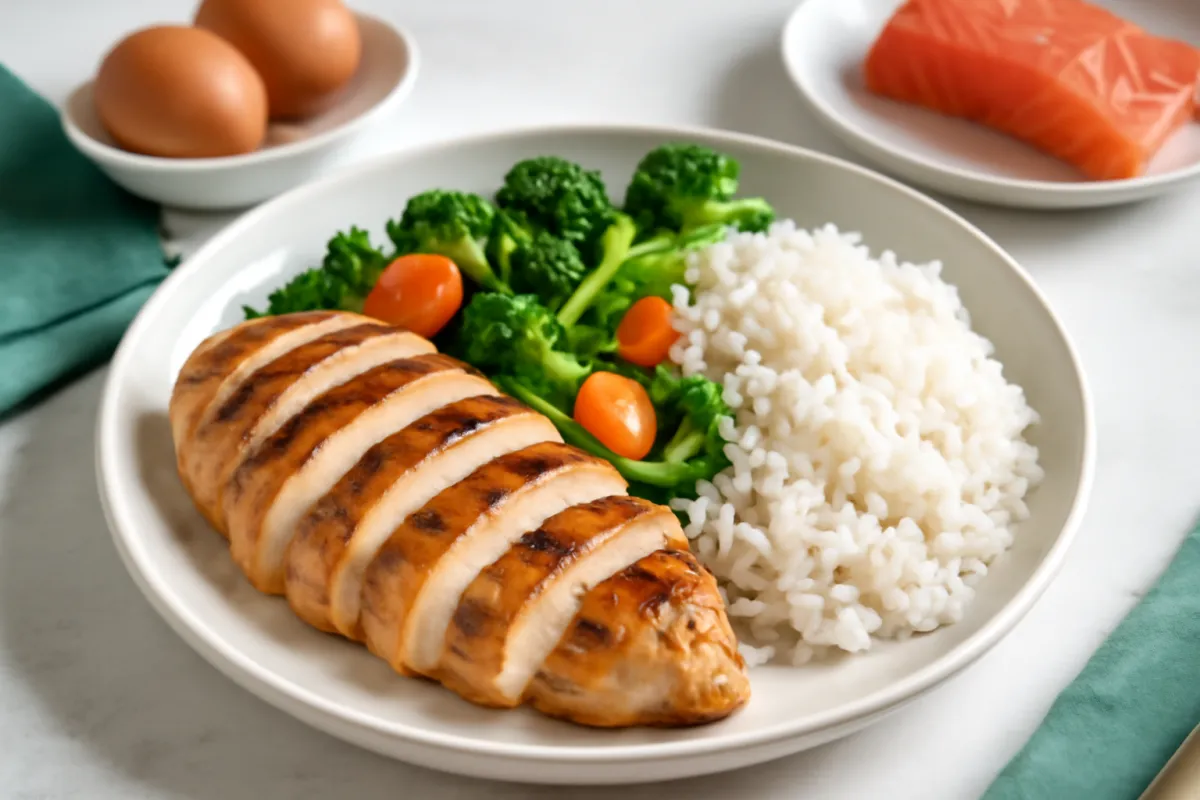
Muscle tissue is built and broken down continuously, a process called muscle protein turnover, and net muscle growth happens when the rate of building, muscle protein synthesis, exceeds the rate of breakdown over time. Resistance training raises muscle protein synthesis for a period after a workout, and dietary protein, specifically its essential amino acids, supplies the material that synthesis actually uses. Without enough protein, training still raises synthesis somewhat, but there is less raw material to build with, and without training, higher protein intake alone does not meaningfully increase muscle mass in most people.
One amino acid, leucine, gets particular attention in this research because it appears to act as a trigger for muscle protein synthesis at the cellular level, not just a building block. This is the basis for the leucine threshold idea discussed later in this review: each meal is commonly described as needing a certain leucine-rich protein amount to maximally trigger synthesis, which is part of why spreading protein across the day, rather than loading it into one meal, is a commonly suggested pattern for this specific goal.
Muscle gain requires more than protein
It is worth stating plainly, because it is the most common gap in muscle-building diets: protein cannot substitute for a calorie surplus, and it cannot substitute for progressive resistance training. Building new tissue requires energy, and most commonly cited research finds meaningful average muscle gain is more reliable at maintenance calories or above than in a sustained deficit, with some exceptions for less trained individuals discussed in the FAQ above. Training provides the stimulus that tells the body which tissue to prioritize; without it, extra calories and extra protein are more likely to be stored as fat than built into muscle.
This review focuses on the nutrition side because that is its scope, but any high protein diet for muscle gain that is not paired with a structured, progressive resistance training program, and generally adequate sleep, is missing at least half of what actually drives the outcome. None of the numbers below will produce muscle gain by themselves.
How much protein to aim for
A commonly cited illustrative range for building muscle runs from about 1.6 to 2.2 grams of protein per kilogram of body weight, higher than both the general population reference intake and, generally, the lower end of a weight-loss-focused range, though the two overlap. Multiple reviews of controlled trials in resistance-trained individuals have generally found that intakes above roughly 2.2 grams per kilogram do not add further measurable muscle gain for most people, suggesting a practical ceiling rather than an open-ended “more is better” relationship.
Where someone lands within that range depends on factors this general review cannot assess individually, including training experience, current muscle mass, and total calorie intake; our protein needs review covers these variables in more depth. This is an illustrative range for reasoning about a diet, not a personal prescription, and anyone with kidney disease, liver disease, or another relevant condition should set a specific target with a doctor or registered dietitian.
Protein, carbohydrate, and fat at a few calorie levels
Here is how an illustrative muscle-gain macro split, aiming for roughly 25 percent of calories from protein with a larger carbohydrate share to support training, might translate into grams at three calorie levels used during a gaining phase. These are worked examples to show the arithmetic, not recommended calorie levels for any individual.
| Daily calories | Protein (~25%) | Carbohydrate (~45%) | Fat (~30%) |
|---|---|---|---|
| 2,400 kcal | ~150 g | ~270 g | ~80 g |
| 2,800 kcal | ~175 g | ~315 g | ~93 g |
| 3,200 kcal | ~200 g | ~360 g | ~107 g |
Carbohydrate takes a noticeably larger share here than in the weight-loss-focused version of this table, reflecting its role fueling training sessions and replenishing muscle glycogen between them, which matters more when training volume is a central part of the goal. Set your own calorie level and see the grams in the companion below.
Ranking common protein sources by protein per serving
For muscle gain, protein per serving, rather than protein per calorie, is usually the more useful lens, since the calorie cost of a food is less of a concern in a calorie-surplus context than it is during weight loss.
Illustrative protein grams per common serving
Grams of protein in a typical serving of each food. Commonly cited, illustrative reference figures.
Bars scale to a 150 gram chicken breast at 100 percent. Larger portions are common in a muscle-gain context; these figures scale up or down with the actual portion eaten.
The chart also illustrates why hitting a higher daily target in a muscle-gain context is generally more straightforward than during weight loss: larger, calorie-inclusive portions are welcome here, which naturally pushes protein totals up alongside the extra calories the goal already calls for.
A sample day, worked out
Here is one illustrative way a day might distribute protein across meals at a roughly 2,800 calorie target, aiming for about 175 grams of protein total across five eating occasions.
An illustrative day's protein, by meal
Approximate grams summing to about 175 g at an illustrative 2,800 calorie target.
Segments show each meal's share of an illustrative 175-gram day. Swap in fish, tofu, or beans and the shape holds; figures are approximate references, not a prescribed menu.
The even spread across five occasions, rather than two very large meals, reflects the leucine threshold idea discussed next: each occasion here clears a commonly cited 25 to 40 gram range, giving the body several distinct opportunities across the day to maximally trigger muscle protein synthesis. Set your own meals and target in the companion below.
Protein timing and meal frequency
The leucine threshold concept holds that each meal needs roughly 0.3 to 0.4 grams of protein per kilogram of body weight, or a commonly cited flat reference of about 25 to 40 grams for most adults, to maximally stimulate muscle protein synthesis at that sitting; protein beyond that amount in a single meal still gets used by the body but does not add a proportional further synthesis boost at that specific meal. This is the reasoning behind spreading intake across three to five meals rather than concentrating the day’s total into one or two very large servings.
It is worth being precise about what this does and does not mean. It is not evidence that a single large meal is wasted or that missing this pattern occasionally undoes progress; total daily protein intake is generally considered the dominant factor, with meal distribution as a secondary, second-order consideration. For someone who genuinely prefers two or three larger meals a day, hitting the same daily total is very likely to still support muscle gain reasonably well; the even-spread pattern is a commonly suggested optimization, not a strict requirement.
Post-exercise nutrition considerations
A protein-containing meal or shake after resistance training is commonly discussed as a practical opportunity, both because muscle protein synthesis is elevated for a period following a workout and because appetite is sometimes more manageable through a shake than a full meal immediately afterward. The idea of a narrow, all-or-nothing “anabolic window” of a specific number of minutes has been substantially walked back in more recent reviews of this research; the broader window across the surrounding hours appears more forgiving than earlier popular accounts suggested.
The practical takeaway is to eat a reasonable protein-containing meal or snack within a few hours of training, rather than treating a specific short window as make-or-break, and to make sure the day’s total protein target is met regardless of exact timing. Anyone training fasted or training later before a planned meal is very unlikely to lose meaningful progress purely from timing, provided the daily total is still reached.
High protein breakfasts for muscle gain
Breakfast in a muscle-gain context has more room than a weight-loss-focused breakfast, since calorie density is not a concern in the same way. Whole eggs, not just whites, are a natural fit here, along with Greek yogurt, milk or a fortified plant milk, oats, and a source of fruit for additional carbohydrate to fuel the day’s training.
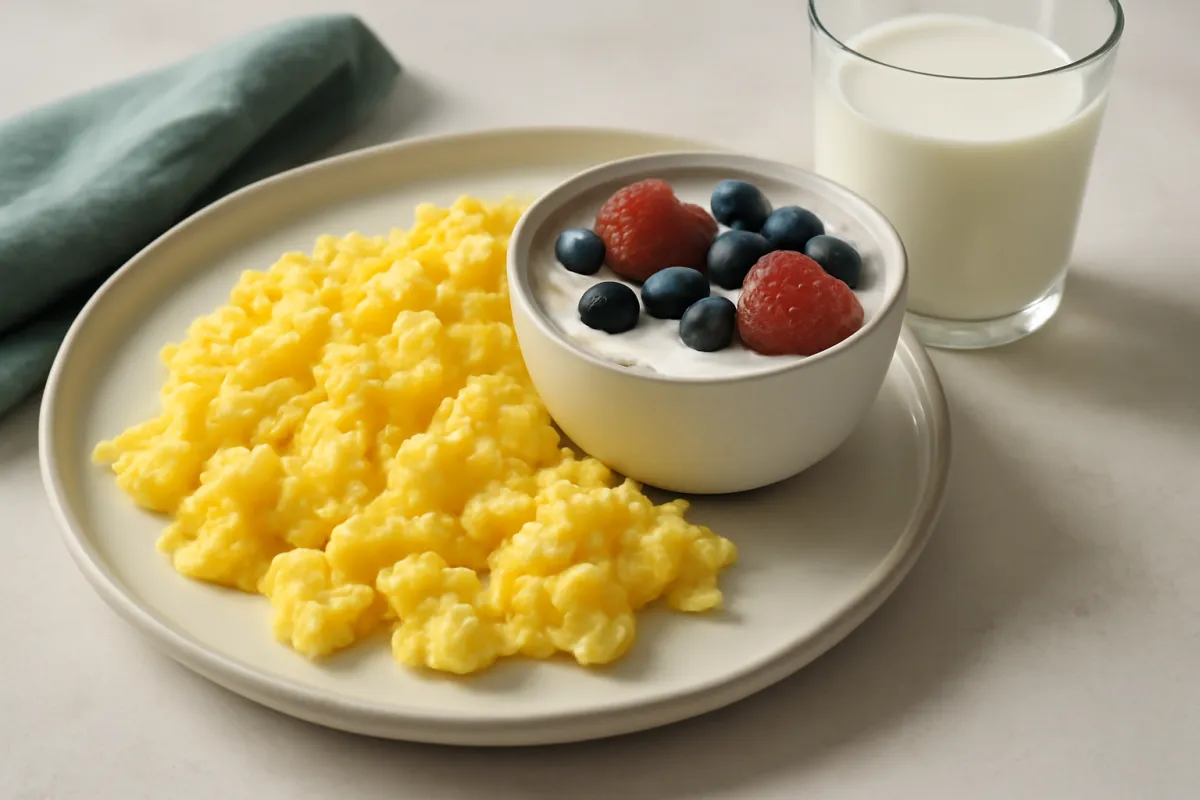
A protein shake blended with oats, milk, and fruit is a common way to add both calories and protein quickly for anyone whose morning appetite runs lower than their calorie target requires, particularly on days with early training sessions.
High protein lunches and dinners for a surplus
For the larger meals of the day, the same plate template used for weight loss still applies, a protein source, vegetables, and a carbohydrate, but portions generally run larger across the board to support the calorie surplus. Lean beef, chicken thighs as well as breast, salmon, and larger portions of legumes all fit well here, alongside a more generous serving of rice, potatoes, or pasta than a weight-loss-focused plate would carry.
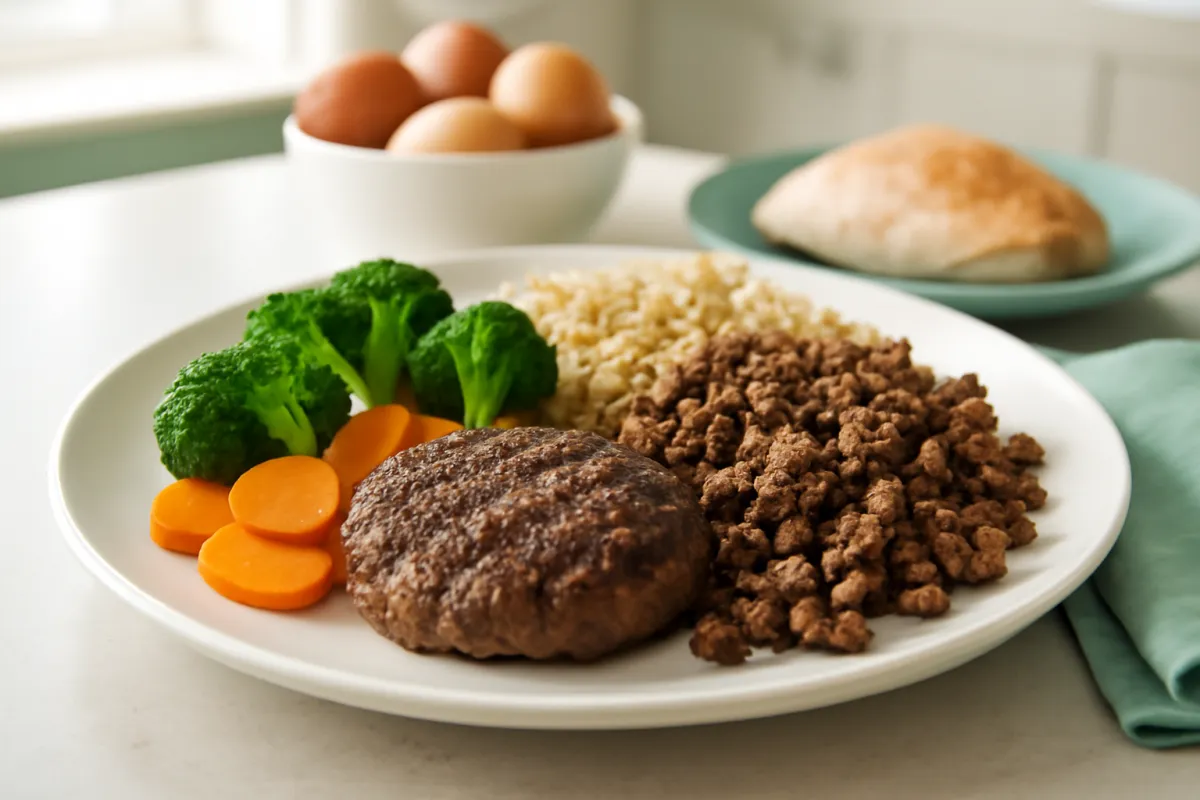
Our step-by-step balanced meal guide covers plate-building for any goal, and the proportions can simply be scaled up in a muscle-gain context by increasing the carbohydrate and protein portions together.
Snacks and between-meal options
Snacks in a muscle-gain diet double as a way to add calories and protein between larger meals rather than purely a hunger management tool. Trail mix, nut butter on toast or fruit, a protein shake, cottage cheese, a bagel with eggs, and full-fat Greek yogurt all fit well here. Our high protein snacks review lists more than 40 options by protein count, and in a muscle-gain context the calorie-denser options on that list, rather than the leanest ones, are generally more useful. Keeping a couple of these on hand at a desk, in a bag, or in the car closes the gap on days when a full meal is not practical between training and other commitments.
Vegetarian and vegan muscle-building options
A plant-based approach can support muscle gain, though it typically requires more deliberate planning around both total protein and leucine content, since most individual plant proteins are lower in leucine than animal sources or soy. Soy foods, tofu, tempeh, and edamame, are commonly highlighted specifically for this reason, alongside seitan, which is unusually protein-dense for a plant food. Combining a variety of legumes, whole grains, nuts, and soy across the day, rather than relying on any single source, is the practical way to approach both total protein and amino acid completeness on a plant-based muscle-gain diet.
Our step-by-step guide to getting protein without meat turns this into a full meal-by-meal approach. Anyone building a serious plant-based muscle-gain plan is well served by working with a registered dietitian familiar with sports nutrition, since the calorie and protein targets in this goal are higher than a general plant-based eating pattern typically assumes.
Whole food versus protein powder for bulking
Protein powder is arguably more useful in a muscle-gain context than in a weight-loss one, simply because the calorie surplus needed for muscle gain is often easier to reach with a calorie-and-protein-dense shake than by eating additional whole food volume, particularly for people who struggle to eat enough. A shake blended with milk, oats, and nut butter can add several hundred calories and 30 or more grams of protein in a format that is faster to consume than an equivalent plate of food.
That said, whole foods still form the foundation for most people following this kind of diet, bringing a wider range of nutrients, and for anyone who does not struggle to eat enough, whole food alone covers the target comfortably, as the sample day above shows. This review takes no position on which is “better”; it depends on individual appetite, schedule, and preference.
Progressive resistance training: the other half of the equation
Nutrition supplies the material; resistance training supplies the stimulus that determines where that material gets used. A structured program that progressively increases the demand placed on muscles over time, through added weight, additional repetitions, or additional volume, is the training-side requirement that pairs with the nutrition described in this review. Training frequency, exercise selection, and program design are outside the scope of a nutrition-focused review, but it is worth stating clearly that no amount of protein or calorie surplus reliably builds muscle without this half of the equation in place.
Consistency over months, rather than any single standout session, is what the commonly cited research associates with steady muscle gain, which mirrors the same long-horizon framing this review applies to diet. A program that provides enough total training volume and gradually adds difficulty over time tends to outperform one that repeats the same weights and repetitions indefinitely, and a qualified coach or trainer can help design that progression for someone new to structured resistance training.
Common mistakes on a high protein muscle-building diet
A handful of patterns undercut this approach more often than any single food choice does.
- Raising protein without raising total calories. Muscle gain generally requires a calorie surplus or maintenance calories; protein alone in a deficit is unlikely to build meaningful new tissue for most trained individuals.
- Skipping or under-programming resistance training. Diet supplies material; training supplies the stimulus that decides what the material is used for.
- Chasing protein far beyond the illustrative ceiling. Intakes well above roughly 2.2 grams per kilogram have not reliably been shown to add further muscle gain and simply displace other calories.
- Concentrating protein into one large meal. Spreading it across three to five meals is a commonly suggested pattern tied to the leucine threshold idea.
- Underestimating total calorie needs. Many people trying to gain muscle underestimate how many calories a genuine surplus requires and end up closer to maintenance than intended.
Lean bulk versus a less controlled surplus
A “lean bulk” describes a relatively modest calorie surplus, aimed at minimizing the fat gained alongside the muscle, compared with a larger, less controlled surplus sometimes called a “dirty bulk,” which tends to add fat faster without necessarily accelerating muscle gain much beyond a certain point. The commonly cited evidence generally favors a smaller, more controlled surplus for most people, since larger surpluses have not reliably been shown to build muscle meaningfully faster while they do reliably add more fat.
There is no single agreed figure for what a lean bulk surplus should be; illustrative ranges commonly discussed run modestly above maintenance calories, individualized to training experience and goals, which is again a conversation worth having with a registered dietitian or qualified coach rather than settling on a fixed universal number here. Some people alternate deliberate gaining phases with shorter maintenance or slight-deficit phases across a year, which can help manage the fat gained alongside muscle without requiring a single continuous surplus for months on end.
Do you need BCAAs or other supplements beyond protein
Branched-chain amino acid supplements, BCAAs, were popular on the premise that isolating a few specific amino acids would boost muscle protein synthesis beyond what complete protein foods already provide. The commonly cited more recent evidence generally does not support an added benefit from BCAAs on top of an adequate total protein intake from complete protein sources, since those foods already supply the same amino acids, including leucine, in the context of the full amino acid profile the body uses. For someone already meeting their daily protein target from food or a complete protein shake, BCAAs are not typically described as adding further muscle-building benefit.
This does not describe every supplement in the same way; creatine, discussed earlier, has a substantially different and more supportive evidence base specifically for strength and lean mass outcomes. The general pattern across this category is that meeting the fundamentals, protein target, calorie surplus, and training program, produces most of the outcome, and supplements beyond a small, well-supported list are more often a marginal addition than a meaningful lever, which is worth knowing before spending on a long list of products marketed around this goal.
Tracking progress on a muscle-gain diet
The scale alone is a poor signal for muscle gain specifically, because it cannot distinguish new muscle from added fat or water weight, and a muscle-gain diet is, by design, adding some weight overall. More informative signals include strength progress on key lifts over weeks and months, how clothes fit around the shoulders, arms, and chest specifically, and periodic body composition estimates, from a tape measure, skinfold calipers, or a scan, tracked as a trend rather than any single reading.
A commonly cited pattern for a controlled gain is roughly a small, steady weekly increase in body weight over a period of months, adjusted based on whether strength and measurements are moving in the intended direction; large rapid weight gain generally signals a surplus that is bigger than necessary for the muscle-gain goal specifically. Keeping a simple log of both the scale trend and the key lifts side by side, reviewed every few weeks rather than daily, tends to give a clearer picture than either signal read alone.
How long it takes to see results
Muscle gain is a slow process compared with the water-weight and glycogen-related shifts that can make early progress feel faster than it actually is. Commonly cited illustrative figures for a well-executed muscle-gain approach, adequate protein, a modest calorie surplus, and consistent progressive training, describe a small amount of new lean tissue per month for most natural, already-somewhat-trained individuals, with beginners sometimes seeing a faster initial pace, often called “newbie gains,” that slows as training experience increases. These are general patterns rather than a personal timeline, and genetics, age, sex, training history, and consistency all move the actual number meaningfully.
Because the pace is slow, short-term feedback, a single week’s scale reading or a single workout, is a poor way to judge whether the approach is working. Reassessing over a period of six to twelve weeks, using the strength and measurement signals described earlier rather than the scale alone, gives a more honest read on whether the current calorie level, protein target, and training program are producing the intended result, with room to adjust any of the three if progress has stalled.
Who should be cautious with a high protein muscle-gain diet
This approach is not appropriate for everyone without professional guidance. People with chronic kidney disease or reduced kidney function are commonly advised to limit protein rather than raise it. Adolescents have different, generally lower, reference protein needs and growing bodies that a general adult-focused review cannot responsibly set targets for; a pediatrician or registered dietitian should be involved for anyone under 18 pursuing a structured muscle-gain diet. Anyone with a history of disordered eating should approach a calorie surplus and structured eating plan with particular care and professional support, since diet structure of any kind can interact with that history in ways a general article cannot anticipate.
Sleep, hydration, and other commonly discussed adjuncts
Diet and training get most of the attention in this topic, but sleep is commonly cited as a third pillar, since much of the hormonal environment associated with muscle repair and growth is linked with adequate sleep duration and quality. Consistently short sleep is associated in the commonly cited research with reduced training performance and less favorable body composition outcomes over time, even when diet and training are otherwise well managed, which makes it a relevant piece of this picture rather than a side note.
Hydration is a more modest factor but still worth naming: training performance and recovery are generally supported by adequate fluid intake, and our hydration guide covers a practical approach. Creatine monohydrate is the most extensively studied sports supplement in this area and is commonly associated in the research literature with modest additional strength and lean mass gains when paired with resistance training, though it is a supplement decision separate from the diet framework in this review, and anyone considering it, particularly alongside any medication or kidney condition, should discuss it with a doctor or registered dietitian first.
Grocery list basics for a muscle-gain kitchen
A muscle-gain grocery list overlaps heavily with a general high protein list but leans further into calorie-dense, protein-rich staples: whole eggs, chicken thighs as well as breast, ground beef or turkey, salmon or other fatty fish, whole milk or a fortified plant milk, full-fat Greek yogurt, oats, rice, potatoes, and a source of nuts or nut butter. Frozen vegetables and pre-cooked grains are practical time-savers for anyone eating larger volumes of food regularly, since a muscle-gain diet generally involves more total meal preparation than a smaller-portion weight-loss diet.
Buying proteins in bulk and batch-cooking a base of rice, chicken, and vegetables for the week is a common strategy for meeting a higher calorie and protein target without cooking from scratch at every meal, and our meal prep guide covers that process in more detail for any goal, including this one.
Building your own muscle-gain day
Bringing the pieces together: set a calorie target at or modestly above maintenance appropriate for your situation, aim for roughly 1.6 to 2.2 grams of protein per kilogram of body weight, spread across three to five meals of roughly 25 to 40 grams each, and pair the whole plan with a progressive resistance training program. None of the individual numbers here are a personal prescription; they are a worked framework you can adapt with real foods, real training, and, ideally, input from a registered dietitian or qualified coach for your specific situation.
Use the companion below to set your own weight and calorie level and see an illustrative gram target and how a day of meals compares to it. Revisit the plan every few weeks against the strength and measurement signals described above, and treat every number in this review as a starting point to adjust from rather than a fixed target to hit exactly, since the honest answer to most questions about an individual’s ideal calorie level or protein target is that it is found by tracking a real response over time, not by a formula alone.
A quick checklist for getting started
- Set calories at maintenance or a modest surplus, since building new muscle tissue generally requires the energy budget to support it.
- Aim for roughly 1.6 to 2.2 g of protein per kilogram of body weight as an illustrative starting range.
- Spread protein across three to five meals, roughly 25 to 40 g each, rather than concentrating it at one sitting.
- Pair the diet with progressive resistance training; nutrition alone does not build muscle without a training stimulus.
- Track strength and measurements, not only the scale, since weight alone cannot distinguish muscle from fat or water.
- Check in with a doctor or registered dietitian before adopting a higher protein target if you have kidney disease, are under 18, or have a history of disordered eating.
The bottom line
Muscle gain rewards patience more than any single tweak to the numbers above. A high protein diet supports muscle gain by supplying the material muscle protein synthesis uses, but it works only alongside a calorie surplus or maintenance calories and consistent, progressive resistance training, not in place of either. A commonly cited illustrative range is about 1.6 to 2.2 grams of protein per kilogram of body weight, spread across three to five meals of roughly 25 to 40 grams each, from foods like chicken, eggs, dairy, fish, and legumes. The deficit-side caution from weight loss becomes a calorie-surplus caution here: intake far beyond the illustrative protein ceiling, or a much larger surplus than intended, has not reliably been shown to add proportional benefit. Anyone with kidney disease, is under 18, or has a history of disordered eating should build a plan with a doctor or registered dietitian. Pair this review with our protein needs review and protein per meal review for the rest of the framework.
This evidence review is published for education about how protein intake is commonly discussed in relation to muscle gain, and it is not medical or dietary advice, and reading it creates no clinician-patient relationship or training program. Every gram figure, percentage, and calorie level above is an illustrative, commonly cited reference for reasoning about a diet, not a personal target or a guaranteed outcome, and individual needs vary with body size, training status, health status, and medications. This article does not diagnose any condition and does not replace a personalized nutrition or training plan. Anyone with kidney disease, liver disease, a history of disordered eating, or another medical condition, and anyone under 18, should set a protein and calorie target with a doctor or registered dietitian before changing their diet.
Frequently asked questions
How much protein do I need per day to build muscle?
A commonly cited illustrative range for building muscle runs roughly 1.6 to 2.2 grams of protein per kilogram of body weight, higher than the general population reference intake and somewhat higher than the range typically used for weight loss alone. Research in this area has generally found that intakes above roughly 2.2 grams per kilogram do not produce additional muscle gain in most people, so more is not automatically better past that point. Our companion protein needs review covers the full set of variables, including training status and age, and the companion below lets you enter your own weight to see where the range lands for you. This is an illustrative range, not a personal prescription.
Can I build muscle on a calorie deficit with enough protein?
Some muscle gain alongside fat loss, sometimes called body recomposition, is reported in certain groups, notably people new to resistance training, those returning after time off, and people carrying a higher body fat percentage, particularly when protein intake is high and training is consistent. For most trained, leaner individuals, meaningful muscle gain is more reliably associated with a calorie surplus or at least maintenance calories, because building new tissue is an energy-demanding process. Protein alone does not create the additional energy budget that new muscle requires; it can only work with whatever calorie balance is actually in place.
Is more protein always better for muscle gain?
No. The commonly cited evidence suggests a point of diminishing returns, generally described as somewhere around 1.6 to 2.2 grams per kilogram of body weight for most people actively resistance training, beyond which additional protein has not reliably been shown to add further muscle gain and simply displaces calories that could otherwise come from carbohydrate or fat. Extremely high protein intakes are not typically described as harmful for people with healthy kidneys, but they are also not typically described as more effective, so there is little reason to push far beyond the upper end of the illustrative range without a specific reason to do so.
What foods should I eat on a high protein muscle building diet?
The foods that work well for this goal are complete, protein-dense sources eaten in adequate portions across several meals: chicken, turkey, lean beef, fish, eggs, dairy such as Greek yogurt and cottage cheese, and, for plant-based eaters, soy foods, seitan, and a variety of legumes. Because muscle gain generally requires a calorie surplus or at least maintenance calories, foods that are calorie-dense as well as protein-dense, whole eggs, fattier cuts of meat, nuts, and dairy, fit more naturally into this goal than into a weight loss oriented high protein diet. Our protein food composition review lists common figures for these foods side by side.
Do I need a protein shake to build muscle?
No single supplement is required to build muscle, and whole foods can supply a high protein target for most people. A protein shake is a convenience, useful for hitting a higher total more easily, adding protein to a meal that otherwise runs short, or as a practical option immediately after training when appetite is sometimes lower than usual. Whichever way protein is delivered across the day, total daily intake and consistent resistance training appear to matter more than whether any single gram came from food or a shake, based on the commonly cited comparisons between the two.
How should protein be spread across the day for muscle gain?
A commonly cited pattern is to spread protein across three to five meals or snacks rather than concentrating it in one or two large servings, with roughly 0.3 to 0.4 grams per kilogram of body weight, or a commonly cited flat reference of about 25 to 40 grams, per eating occasion. This relates to a concept called the leucine threshold, the idea that each meal needs a certain amount of protein to maximally stimulate muscle protein synthesis, and that spreading intake evenly gives more opportunities across the day to clear that threshold than loading it all at one sitting.
Is a high protein diet safe for building muscle long term?
For people with healthy kidneys, the commonly cited evidence does not show that a higher protein intake within the illustrative 1.6 to 2.2 gram per kilogram range causes harm over the long term. People with chronic kidney disease, reduced kidney function, or certain other medical conditions are a different case, where limiting protein is sometimes part of medical management, and a higher intake could be inappropriate. Anyone with an existing kidney condition, liver condition, or a history of disordered eating should build a muscle gain plan with a doctor or registered dietitian rather than a general-audience target.
What is a good muscle gain diet on 2800 calories?
Using the illustrative 1.6 to 2.2 gram per kilogram range, someone weighing around 80 kilograms following an illustrative 2800 calorie plan might land near 130 to 175 grams of protein a day, commonly split across four or five meals of roughly 30 to 40 grams each, with the remaining calories split between carbohydrate, generally the larger share to fuel training, and fat. That is a worked example for illustration, not a personal number; the companion below lets you enter your own weight and calorie level to see where the figure falls for you, and a doctor or registered dietitian can confirm what is appropriate for your training and health situation.

Hamza Hai is the editor of NourishMark. She holds an MBA and reviews the site's articles against our editorial standards, checking that every figure is labelled for what it is, that nothing is presented as verified fact without a source the reader can check, and that the writing stays useful to a non-specialist.

Dr. Shayaan Khan is the medical reviewer for NourishMark. He holds an MBBS from MGM Medical College, Navi Mumbai, and is the author of published research including a narrative review of postpartum anxiety and depression in Mental Health Science. He has taught physiology at university level. He reviews the site's health content for medical accuracy: that physiology and mechanisms are described correctly, that no claim is stated more strongly than the evidence behind it, and that anything specific to an individual reader is sent to that reader's own clinician.
Not medical advice. Dr. Khan reviews NourishMark's health content for medical accuracy. He is not a registered dietitian, he does not hold a United States practising licence, and he is not your doctor. His review does not make anything here medical advice. Always talk to a qualified health professional about your own situation, and never delay or stop care because of something you read here.