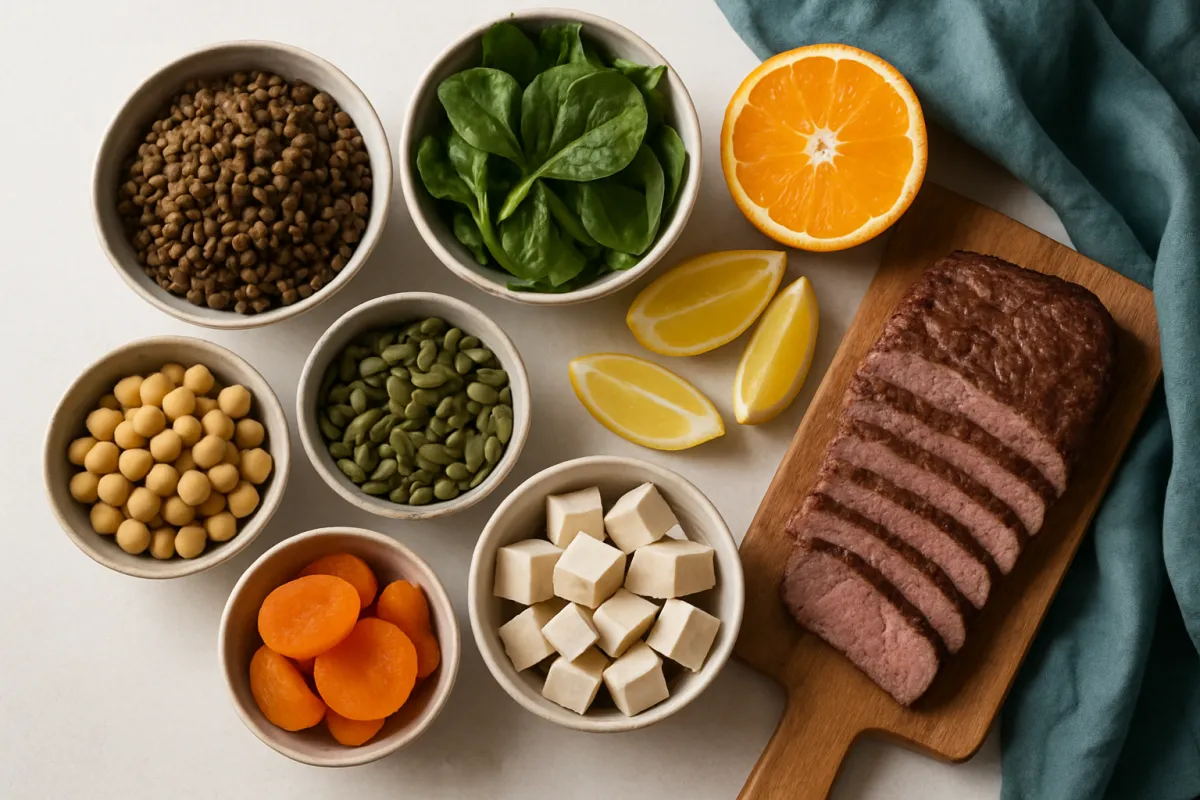
What's in this review
- Iron Deficiency Symptoms: The Direct Answer
- What Counts as Iron Deficiency
- Depleted Stores, Iron Deficiency, and Iron Deficiency Anemia: Three Stages
- The Symptoms Commonly Associated With Low Iron
- Fatigue and Low Energy
- Pale Skin, Lips, and Inner Eyelids
- Shortness of Breath and a Fast Heartbeat
- Cold Hands and Feet, Headache, and Dizziness
- Brittle Nails and Hair Changes
- Restless Legs and an Unusual Craving for Ice
- Why Symptoms Alone Cannot Diagnose Anything
- How the Commonly Reported Symptoms Compare
- Who Is at Higher Risk of Iron Deficiency
- Heavy Menstrual Bleeding: The Most Common Driver in Adults
- Pregnancy and the Largest Reference Figure on the Table
- Diets With Little or No Heme Iron
- Gastrointestinal Conditions and Blood Loss You Cannot See
- Infants, Toddlers, and Frequent Blood Donors
- An Illustrative Risk Picture, by Factor
- The Only Way to Know: A Blood Test
- Reading Ferritin, Hemoglobin, and Transferrin Saturation
- What Happens After a Low Result
- Why Iron Supplementation Is a Clinical Decision, Not a Shopping One
- A Note on Iron Products and Children
- Common Misunderstandings About Iron Deficiency Symptoms
- When to See a Doctor
- The Bottom Line
Short answer: Iron deficiency symptoms are commonly linked to fatigue, pale skin, and shortness of breath with ordinary activity, with cold hands and feet, headache, brittle nails, and an unusual craving for ice discussed further down the list. Every one of these except the ice craving is nonspecific, and iron deficiency often produces no noticeable symptoms at all in its earlier stage. The only way to actually know your status is a blood test, usually ferritin and hemoglobin, ordered and read by a clinician, not a symptom checklist.
Iron deficiency symptoms are among the most searched health questions there are, and the honest answer disappoints the search intent behind that phrase a little: there is no symptom, or combination of symptoms, that reliably tells anyone they are low on iron. Fatigue and pale skin are common experiences with dozens of ordinary explanations, and a ferritin result is one piece of a larger picture a clinician assembles alongside your history.
That is not a reason to skip the topic. It is a reason to cover it carefully. This evidence review works through what clinical references actually say is commonly associated with low iron, how strong each association is, who is more likely to run low in the first place, what a blood test measures, and what happens after a low result. Nothing here is a diagnosis, a symptom checklist to self-score, or a substitute for a doctor. For the companion question of how much iron a day is recommended and where it comes from, see our iron intake review; for the food list on its own, see foods high in iron. You can sketch your own risk picture in the companion below.
Key takeaways
- Fatigue, pale skin, and shortness of breath with ordinary activity are the iron deficiency symptoms most consistently named in clinical references, but all three are nonspecific and have many other common causes.
- An unusual craving for ice, called pagophagia, is a more distinctive sign specifically discussed in connection with iron deficiency, though it is far from universal.
- Iron deficiency frequently causes no noticeable symptoms at all, especially in its earlier stage, which is exactly why testing rather than symptom-watching is the route clinical references point to.
- Risk is not evenly distributed: heavy menstrual bleeding, pregnancy, diets with little heme iron, gastrointestinal conditions, infancy, and frequent blood donation all raise it, and several often overlap in one person.
- A blood test, usually ferritin and hemoglobin together, is the only way to know your own status, and because iron deficiency has causes ranging from trivial to serious, a result belongs with a clinician who can look for why, not only confirm that it is low.
Iron Deficiency Symptoms: The Direct Answer
Ask what iron deficiency symptoms look like and clinical references converge on a short core list: fatigue and low energy, pale skin, and shortness of breath or a pounding heartbeat with activity that would not normally cause it. Those three come up most consistently across patient-facing sources. Beyond that core, cold hands and feet, headache, dizziness, brittle nails, and hair changes are discussed, with restless legs and an unusual craving for ice named as rarer but more distinctive signs further down this page.
The word that matters more than any item on that list is nonspecific, for every symptom except the ice craving. Fatigue has an enormous number of ordinary causes, from poor sleep to stress to a demanding week. Pale skin and breathlessness are the same. None of these symptoms was discovered by isolating iron deficiency as their one cause; they are experiences that turn up in people with confirmed low iron more often than average, which is a different and weaker kind of evidence than a symptom that points at one cause alone.
The practical takeaway sits ahead of everything that follows: this page describes association, not diagnosis. If any of these symptoms concern you, particularly if they are new, persistent, or getting worse, the right next step is a conversation with a clinician, not a self-assessment against this list.
What Counts as Iron Deficiency
“Deficiency” here describes a measured shortfall in the body’s iron stores, not a feeling. The main marker reference sources point to is ferritin, a blood protein that stores iron and whose level in blood correlates with how much iron is in reserve. A ferritin result below a threshold associated with depleted stores is what clinicians generally mean by iron deficiency, though exact cutoffs vary somewhat by laboratory and by which guideline is being applied.
The important distinction up front is between deficiency and simply eating less iron than a reference intake describes on a given day. Our iron intake review covers the Recommended Dietary Allowances, commonly cited near 8 milligrams a day for men and 18 for women aged 19 to 50. Falling short of that figure occasionally is common and usually harmless, the same way eating slightly less protein than a target one day rarely matters on its own. Deficiency is a measured, sustained shortfall built up over weeks or months, reflecting intake, loss, and absorption together, and the two ideas are related but not the same thing.
This matters because the two get conflated constantly in casual conversation. A person can eat below the reference intake most days and still carry adequate stores, particularly if losses are low. A person can eat at or above the reference intake and still test low, if losses are high or absorption is impaired for some other reason. The intake figure describes a target for the food side of the supply. The blood test describes the actual outcome, which is why it is the only measurement that answers the question this page is about.
Depleted Stores, Iron Deficiency, and Iron Deficiency Anemia: Three Stages
Reference sources generally describe a progression rather than a single on-off state. The first stage is depleted iron stores, where ferritin has fallen but hemoglobin, the oxygen-carrying protein in red blood cells, is still within its normal range. Many people at this stage report no symptoms at all.
The second stage, sometimes called iron deficiency without anemia, is where stores are low enough to start affecting red blood cell production even though hemoglobin has not yet fallen outside the reference range. Some people begin to notice fatigue or reduced exercise tolerance here, though many still do not.
The third stage is iron deficiency anemia, where the shortfall has gone on long enough, or has been severe enough, that hemoglobin itself drops below the reference range and the blood carries less oxygen than it should. This is the stage where the classic symptoms, fatigue, pale skin, and breathlessness, are most consistently reported, because the mechanism behind them, reduced oxygen delivery to tissue, is now directly in play. Not everyone with depleted stores progresses all the way to anemia, and the rate of progression depends on the balance between ongoing losses and ongoing intake.
The Symptoms Commonly Associated With Low Iron
With that staging in mind, here is what the literature actually associates with iron deficiency, organized from the most consistently reported findings to the rarer but more distinctive ones. Every item below carries the honest caveat that belongs with it, because the caveat is the useful part.
Fatigue and Low Energy
Fatigue is the symptom most frequently mentioned in patient-facing summaries of iron deficiency. The mechanism is relatively well understood: hemoglobin carries oxygen to tissue, and when iron-deficient red blood cells cannot be made in normal numbers or with normal hemoglobin content, tissue receives less oxygen, which the body commonly experiences as tiredness and reduced stamina. That gives fatigue here a somewhat firmer mechanistic footing than, say, the mood changes discussed on vitamin D pages.
That does not make the symptom diagnostic. Fatigue remains one of the least specific symptoms in medicine, with causes ranging from poor sleep and stress to thyroid conditions, depression, other nutrient shortfalls, and simply working too much. Our sleep guide and caffeine review both cover far more common contributors to daytime tiredness than iron status does for most people. A clinician working through fatigue will typically consider iron as one item on a longer list, not the first stop.

Pale Skin, Lips, and Inner Eyelids
Pale skin, and more specifically pallor noticed in the lips or the inner lower eyelid, is named consistently in reference sources as a sign associated with anemia generally, iron deficiency anemia included. The mechanism is the reduced hemoglobin itself, which gives blood its red color, so less of it shows through skin and mucous membranes.
This sign is harder for a person to judge in themselves than it sounds, since normal skin tone varies enormously and a change is often noticed by someone else before the person experiencing it. It is also nonspecific, since pallor can come from other causes of anemia, from cold, from certain medications, and simply from normal variation in complexion. A clinician comparing current appearance with a photograph or a prior exam is in a far better position to judge a genuine change than a reader comparing themselves against a description in an article.
Shortness of Breath and a Fast Heartbeat
Breathlessness with activity that would not normally cause it, and an awareness of a faster or harder heartbeat, are both named consistently once anemia is present, again tracing back to reduced oxygen-carrying capacity. The body compensates for less oxygen per unit of blood partly by moving blood faster, which is what a faster heart rate accomplishes, and partly by breathing harder to bring in more oxygen per breath.
Like fatigue, this has a comparatively clear mechanism behind it, and like fatigue, it is shared with a long list of other conditions, including ordinary deconditioning, other causes of anemia, and real cardiac or respiratory conditions that deserve their own investigation rather than an assumption about iron. New or worsening breathlessness, especially if sudden or severe, is always worth raising promptly with a clinician regardless of any theory about the cause.
Cold Hands and Feet, Headache, and Dizziness
Cold hands and feet are discussed in reference sources as a further consequence of reduced oxygen delivery to the body’s extremities, sitting in the same mechanistic family as fatigue and breathlessness. Headache and lightheadedness or dizziness are discussed too, again plausibly connected to reduced oxygen reaching the brain, though the research base behind headache specifically is thinner and more mixed than for the core symptoms above.
All three are common in the general population for reasons that have nothing to do with iron. Cold intolerance has its own long list of causes, including thyroid conditions and simple circulation differences between people. Headache is one of the most common human complaints and is overwhelmingly more likely to reflect something other than iron status. None of these three, alone, is a reason to suspect iron deficiency specifically.
Brittle Nails and Hair Changes
Brittle, thin, or spoon-shaped nails, a pattern sometimes called koilonychia in clinical terminology, are discussed in reference sources as a sign that can accompany more significant or longer-standing iron deficiency, though it is described as a less common finding than fatigue or pallor. Hair thinning or increased shedding is mentioned too, on a thinner evidence base, in the same family as the weaker vitamin D associations covered in our vitamin D deficiency symptoms review.
Both have far more common everyday explanations. Brittle nails are frequently a matter of moisture, repeated hand washing, nail products, or simple genetics. Hair shedding has its own large list of causes, including thyroid conditions, recent illness, stress, and normal seasonal shedding patterns. Treating either as an iron symptom on its own, without other findings, is not something clinical references support strongly.
Restless Legs and an Unusual Craving for Ice
Two further signs sit at the more distinctive end of this list. An uncomfortable urge to move the legs, particularly at rest or at night, consistent with restless legs syndrome, is discussed in clinical literature as associated with low iron in some people, and iron status is one of the things a clinician may investigate when restless legs symptoms are reported, though restless legs syndrome has other causes and contributors too.
The second, and the single most specific sign on this page, is an unusual craving for ice, sometimes called pagophagia, a particular form of a broader pattern called pica, meaning a craving to eat substances with little or no nutritional value. Clinical references describe this craving as specifically associated with iron deficiency more than most other symptoms on this list, and as something that can resolve once iron status is corrected. It is still far from universal: most people with confirmed iron deficiency never report it, and craving ice is not, by itself, a diagnosis. Anyone with a persistent, unusual craving for ice or other non-food substances should mention it at an appointment rather than treat it as a curiosity.
Why Symptoms Alone Cannot Diagnose Anything
Here is the pattern worth carrying away from the list above: every symptom commonly associated with iron deficiency, except the ice craving, is also a common symptom of something else, and most people experiencing any one of them do not have an iron problem. Fatigue is overwhelmingly more likely to reflect sleep, stress, or a dozen other ordinary causes than an iron level. Pallor and cold hands have their own common explanations. Headache is one of the most common complaints there is.
There is a second, equally important point clinical references make: iron deficiency, especially at the depleted-stores stage, is frequently silent. Many people with low ferritin report no symptoms at all, which means the absence of symptoms says nothing reassuring either. A symptom checklist runs in both directions and is unreliable in both. That combination, nonspecific when present, often absent when it matters, is precisely why testing rather than symptom-matching is what reference sources recommend for anyone who genuinely wants to know their status.
How the Commonly Reported Symptoms Compare
How consistently each symptom is linked to low iron
An ordinal reading of how often each item is named in clinical references and how well-established the mechanism behind it is. Not a probability, and not a score for any individual.
Bar length reflects how consistently patient-facing clinical references name each item and how well-established the underlying mechanism is, scaled to fatigue at 90. The short bar for the ice craving reflects rarity, not weak specificity; it is read as the more distinctive sign where it does occur. A reading aid built by this evidence review, not a published score or a diagnostic tool.
Reading the chart correctly matters more than reading it at all. A long bar means a symptom is named more often and rests on a clearer mechanism, not that it is more likely to happen to you, not that having it means you are deficient, and not that a short bar means an association is fake. The ice craving sits at the bottom for frequency while being, when it does occur, among the more specific items on the whole list, which is a distinction the bar length alone cannot carry.
Who Is at Higher Risk of Iron Deficiency
Because symptoms are unreliable, the more useful practical question is who is more likely to run low in the first place. Reference sources name a consistent set of groups, and the mechanisms behind each are straightforward once the three broad causes, not enough coming in, too much going out, and poor absorption, are understood.
The groups named most consistently are people with heavy or prolonged menstrual bleeding, people who are pregnant, people eating little or no meat, poultry or fish without particular attention to iron-rich plant foods and enhancers, people with a gastrointestinal condition or a history of gastrointestinal surgery, infants and toddlers, and people who donate blood regularly. Several of these commonly stack in one person. The companion below lets you tally how many of these ordinary factors apply to your own situation, purely as a sketch rather than a risk score.
Heavy Menstrual Bleeding: The Most Common Driver in Adults
Menstrual blood loss is the single largest driver of the sex gap in iron reference intakes, as our iron intake review covers in more depth, with the commonly cited adult figure more than doubling from roughly 8 milligrams a day for men to roughly 18 for women aged 19 to 50. Heavier or more prolonged periods than typical increase that loss further, and reference sources name heavy menstrual bleeding as the most commonly cited cause of iron deficiency in adult women specifically.
This is a mechanism rather than a verdict on anyone’s body. What matters practically is that heavy or prolonged periods are themselves a reason to talk to a clinician, both because the bleeding pattern itself may be worth evaluating and because the resulting iron loss may need addressing. Treating heavy bleeding as normal because it has always been that way is a common and understandable pattern, and it is one worth revisiting at an appointment rather than assuming nothing can be done.
Pregnancy and the Largest Reference Figure on the Table
The commonly cited pregnancy reference figure of roughly 27 milligrams a day is the highest on the iron table by a wide margin, driven by expanding maternal blood volume, the growing baby’s own iron accumulation, and the placenta’s requirements, as our iron intake review explains. That large requirement is exactly why iron deficiency and iron deficiency anemia are both discussed specifically in the context of pregnancy, and why routine iron-related testing is commonly part of antenatal care in many places.
Anything specific to a pregnancy, including whether supplementation is appropriate and at what level, belongs entirely with the clinician providing antenatal care rather than with a general nutrition article. This evidence review offers no view on that decision beyond naming the mechanism behind the elevated figure.
Diets With Little or No Heme Iron
Heme iron, found only in meat, poultry, fish and shellfish, is generally described as absorbed more readily than the non-heme iron found in plants, eggs, dairy and fortified foods, as our iron intake review explains. Reference sources commonly cite an adjustment of roughly 1.8 times the standard figure for people eating no meat, poultry or fish at all, reflecting that a fully plant-based diet relies entirely on the more variable non-heme form.
This is not a reason to avoid a plant-forward diet, which carries its own well-documented benefits. It is a reason to pay more deliberate attention to iron-rich plant foods and to the enhancers that help non-heme iron along, chiefly vitamin C eaten at the same meal. Our protein without meat note covers plant protein sources that frequently overlap with iron-rich plant foods, including legumes and tofu.
Gastrointestinal Conditions and Blood Loss You Cannot See
Gastrointestinal causes of iron deficiency split into two mechanisms that are worth telling apart. The first is reduced absorption, where a condition affecting the lining of the stomach or small intestine, or surgery that bypasses part of the digestive tract, reduces how much iron the gut takes up regardless of how much is eaten. The second is slow, often invisible blood loss from somewhere in the digestive tract, which can come from a wide range of causes, some of them minor and some of them requiring prompt attention.
This is exactly why clinicians generally investigate the cause of iron deficiency in people who are not pregnant and do not have an obvious explanation such as heavy periods, rather than simply recommending more iron and moving on. Iron deficiency found without an obvious reason is a signal to look for one, not a condition to self-treat with a supplement bought off a shelf. This evidence review does not list specific gastrointestinal diagnoses here deliberately, since that determination belongs entirely with a clinician working through the individual picture.
Infants, Toddlers, and Frequent Blood Donors
Infants and toddlers are named as a higher-risk group because of rapid growth combined with a diet that, depending on feeding choices, can supply relatively little iron, which is one reason iron-fortified infant cereal and attention to iron-containing foods are commonly discussed in pediatric guidance during the second half of the first year and into toddlerhood. Any question about a specific infant or toddler belongs with a pediatric clinician rather than a general reference page.
Frequent blood donors are named for a more straightforward reason: each donation removes a measurable amount of iron along with the blood, and donating repeatedly without adequate time or intake to rebuild stores can deplete them over time. Blood donation organizations generally screen hemoglobin before each donation partly for this reason, and anyone donating regularly who notices new fatigue or other symptoms has a reasonable, specific thing to mention at their next screening or to a clinician.

An Illustrative Risk Picture, by Factor
The chart below is an illustrative example of how several ordinary risk factors can stack in one plausible person, built to show the pattern rather than to describe any real individual or to assign a score.
An illustrative stack of overlapping risk factors
One illustrative example person with several common risk factors present at once. Not a scoring system and not a real case.
Segments sum to 100 percent of one illustrative example and are not weighted probabilities, a scoring formula, or a statement about how these factors actually combine in any real person. Real risk depends on far more than can be captured in a single chart.
The point of the chart is that risk factors compound rather than existing in isolation. A person with two or three of these present at once is a more reasonable candidate for a conversation about testing than a person with one or none, though the chart is illustrative rather than a calculator of anyone’s actual risk. Run your own combination through the companion below to see how many of these ordinary factors describe your situation; it tallies factors rather than estimating a blood result, and the number it returns is a conversation starter, not a result.
The Only Way to Know: A Blood Test
Every section above points toward the same conclusion. The only way to actually find out whether you have iron deficiency is a blood test, ordered by a clinician. The core panel generally includes a complete blood count, which reports hemoglobin among other things, and a ferritin test, which reflects stored iron. Depending on the picture, a clinician may also order transferrin saturation or other iron studies to build a fuller view.
No symptom checklist, home test marketed without clinical oversight, or online calculator, including the companion tool on this page, substitutes for this. The companion below is built to sketch a rough risk picture from ordinary lifestyle and health factors, not to estimate a blood result or offer anything resembling a diagnosis.
Reading Ferritin, Hemoglobin, and Transferrin Saturation
Ferritin is generally the most sensitive early marker, since it reflects stores and tends to fall before hemoglobin does. One complication reference sources flag is that ferritin can rise temporarily with inflammation or infection for reasons unrelated to iron status, which is one reason a clinician reading the result considers the fuller clinical picture rather than the ferritin number in isolation.
Hemoglobin reflects the later, anemia stage of the progression described earlier on this page, and a normal hemoglobin does not rule out depleted stores, which is exactly why ferritin and hemoglobin are generally read together rather than either alone. Transferrin saturation, when ordered, adds a further piece describing how much of the body’s iron-transport protein is actually carrying iron. Reference ranges for all three vary somewhat by laboratory and by the population being compared against, which is one more reason a result belongs with a clinician who can weigh it against your specific history rather than against a number quoted in an article.
What Happens After a Low Result
If a test does come back showing iron deficiency, what follows is a clinical decision rather than a fixed protocol this evidence review can describe in advance. Reference sources generally describe a two-part process: addressing the cause, which may mean managing heavy bleeding, treating a gastrointestinal condition, or adjusting diet, and addressing the shortfall itself, which may mean dietary changes, a supplement, or in some circumstances another route entirely, with the specifics depending on how low the result is and why.
Because iron has no easy exit from the body once absorbed, as our iron intake review explains, dosing and duration for correction are set by the clinician based on the result and the cause, and are not something to self-direct from a product label or a general article. This evidence review does not recommend a dose, product, or duration for correction, because that decision depends on a specific result and history that only a clinician has.
Why Iron Supplementation Is a Clinical Decision, Not a Shopping One
This evidence review does not recommend any supplement, does not suggest an amount, and will not tell any reader whether they need one. For iron that is not a formality. The first reason is that surplus iron has no easy exit, so a mineral the body cannot readily shed is one where sustained excess accumulates rather than washing through. The second is that low iron has many possible causes, some of them trivial and some of them serious, and treating the number without investigating the cause can mask something that needed finding. The third is that iron interacts with several medications in both directions, which is a pharmacist’s territory.
Starting a supplement because of a suspected symptom rather than a confirmed result and an understood cause is one of the more common ways people end up taking iron they do not need, or missing the actual explanation for how they feel. The right order of operations is testing first, cause second, and a supplement, if indicated, third, all set by a clinician.

A Note on Iron Products and Children
This evidence review’s iron intake review covers this in full, and it is worth repeating briefly here: accidental ingestion of iron-containing products by young children is treated as a significant poisoning hazard, because iron has no easy exit from a small body and because tablets can be mistaken for sweets. Any iron supplement in a household with children, including a multivitamin containing iron, belongs stored out of reach and out of sight, and any suspected ingestion by a child is an immediate call to poison control or emergency services rather than a wait and see.
Common Misunderstandings About Iron Deficiency Symptoms
The first mistake is symptom-matching: reading a list like the one on this page and concluding a diagnosis from how many items sound familiar. Every symptom here except the ice craving is common in the general population for reasons that have nothing to do with iron, and matching several of them proves nothing on its own.
The second is assuming no symptoms means no deficiency. Reference sources are explicit that depleted stores are frequently silent, particularly before anemia develops, which means feeling fine is not evidence of adequate iron either. The third is treating fatigue as automatically an iron problem ahead of more common and sometimes more serious explanations, when a clinician working through persistent fatigue will typically consider iron as one item on a longer list rather than the first stop.
The fourth is starting an iron supplement in response to a suspected symptom rather than a confirmed result, which risks the accumulation issue covered above, since iron taken daily above what the body uses builds up rather than washing out. The fifth is assuming iron deficiency found without an obvious cause needs no further investigation, when reference sources generally treat that situation as a reason to look for why, not a reason to simply supplement and move on. A sixth, subtler mistake is reaching for an iron explanation because it is easy to search and easy to buy a supplement for, ahead of more likely or more urgent explanations for the same fatigue or breathlessness.
When to See a Doctor
Raise iron with a clinician if you have persistent, unexplained fatigue, pale skin noticed by yourself or someone else, or breathlessness with activity that has not resolved with obvious explanations like poor sleep ruled out; if you have heavy or prolonged menstrual bleeding; if you fall into one or more of the higher-risk groups described above, a diet with little or no meat, poultry or fish, a gastrointestinal condition, pregnancy, or regular blood donation; if you notice an unusual craving for ice or other non-food substances; or if you simply want to know your status and would like to discuss whether testing makes sense for you specifically.
None of those situations requires a confident self-diagnosis first. Describing what you are experiencing and letting a clinician decide what, if anything, to test for is the entire point of the appointment, and it is a far more reliable process than matching symptoms against any article, including this one.
The Bottom Line
Iron deficiency symptoms, where they exist at all, most consistently mean fatigue, pale skin, and shortness of breath with ordinary activity, with cold hands and feet, headache, and brittle nails discussed on thinner evidence, and restless legs and an unusual craving for ice named as rarer but more distinctive signs. Every one of these except the ice craving is nonspecific, shared by many far more common conditions, and iron deficiency frequently causes no symptoms whatsoever at its earlier, depleted-stores stage.
Risk is genuinely uneven, concentrated in people with heavy menstrual bleeding, pregnancy, diets with little heme iron, gastrointestinal conditions, infancy, and regular blood donation, and it compounds when several of these overlap in one person. None of that adds up to a self-diagnosis. The only way to actually know your iron status is a blood test, usually ferritin and hemoglobin together, and because iron deficiency has causes ranging from trivial to serious, reading that result and finding the cause is a job for a clinician, not a symptom list or a calculator. If anything here sounds like your situation, the productive next step is an appointment, not another search, and never a supplement bought on the strength of this page.
This evidence review is published for general education about iron deficiency and the symptoms and risk factors commonly discussed alongside it, reproducing commonly cited associations and reference intakes. It is not medical advice, does not diagnose or rule out any condition including iron deficiency or anemia, and reading it creates no clinician-patient relationship. Every symptom described here except an unusual craving for ice is nonspecific and has other, often more common, explanations, and even that craving is not universal and is not a diagnosis on its own. Iron deficiency is frequently present without any noticeable symptoms, particularly before anemia develops, so the absence of symptoms is not reassurance either. The relative-consistency chart and the illustrative risk-factor chart are reading aids built by this evidence review, not published scores, diagnostic tools, or statements about any individual. Nothing here recommends any dose, product, test, or course of action for any person. Iron-containing products are a recognized poisoning hazard for young children and should be stored out of reach and out of sight, with any suspected ingestion treated as an emergency. Anyone experiencing persistent symptoms, anyone in a higher-risk group, anyone pregnant, breastfeeding, or asking on behalf of an infant or child, and anyone wanting to know their own status should raise the question with a doctor, pharmacist, or registered dietitian who knows their full history.
Frequently asked questions
What are the most commonly reported iron deficiency symptoms?
Clinical references most often name fatigue, pale skin, and shortness of breath with ordinary activity as the symptoms most consistently associated with low iron, with cold hands and feet, headache, brittle nails, and an unusual craving for ice discussed further down the list. Every one of these is nonspecific except the ice craving, which is comparatively specific but also comparatively rare. None of these symptoms, alone or together, confirms iron deficiency. The only way to know is a blood test, typically including ferritin and hemoglobin, ordered and interpreted by a clinician who knows your history.
Can you have iron deficiency with no symptoms at all?
Yes, and clinical references describe this as common rather than unusual, particularly in the earlier stage where the body's iron stores are low but hemoglobin has not yet fallen. A person can carry several risk factors and feel entirely well, and symptoms, when they appear, generally reflect a shortfall that has been building for a while rather than an early warning system. That is one more reason testing rather than symptom-watching is what reference sources recommend for anyone who wants to know their status.
What is the difference between iron deficiency and iron deficiency anemia?
Iron deficiency describes low iron stores in the body, measured mainly by a blood marker called ferritin. Iron deficiency anemia is a later and more severe stage, where the shortfall has gone on long enough that the body cannot make enough normal red blood cells, and hemoglobin itself falls below the reference range. Reference sources generally describe a progression from depleted stores, to iron deficiency without anemia, to iron deficiency anemia, though not everyone with low stores goes on to develop anemia. The distinction matters because symptoms generally become more noticeable at the anemia stage, and because the two are read from different numbers on the same blood panel.
What commonly causes iron deficiency in adults?
Reference sources generally group the causes into three categories: not enough iron coming in, measured against what the body needs; too much iron leaving the body, mainly through blood loss; and reduced absorption, where iron is eaten but not taken up well in the gut. Heavy menstrual bleeding is the most commonly cited driver in adult women. Gastrointestinal blood loss, which can come from a range of causes some of them serious, is a reason clinicians investigate the cause of iron deficiency in other groups rather than simply recommending more iron. This evidence review describes the categories rather than diagnosing any individual case, which is a job for a clinician working through the specific picture.
Who is most at risk of iron deficiency?
Reference sources most consistently name people with heavy or prolonged menstrual bleeding, people who are pregnant, people eating little or no meat, poultry or fish without attention to iron-rich plant foods and enhancers, people with a gastrointestinal condition or a history of gastrointestinal surgery, infants and toddlers, and people who donate blood regularly. Several of these can overlap in one person, which raises the overall picture further. Belonging to one or more of these groups is a reason to ask a clinician whether testing makes sense, not a basis for self-diagnosis or self-supplementation.
Can iron deficiency cause unusual cravings like eating ice?
An unusual craving for ice, sometimes called pagophagia, is specifically discussed in clinical references as associated with iron deficiency, and it is treated as a more distinctive sign than fatigue or pale skin, both of which have many other common causes. It is still not universal, meaning plenty of people with confirmed iron deficiency never experience it, and craving ice on its own, without other findings, is not a diagnosis. Anyone noticing a persistent, unusual craving for ice or other non-food substances should mention it to a clinician rather than treat it as a curiosity.
How is iron deficiency diagnosed and treated?
Diagnosis generally starts with a complete blood count and a ferritin test, sometimes alongside other iron studies such as transferrin saturation, interpreted by a clinician alongside your history and any symptoms. Because iron deficiency has causes ranging from trivial to serious, a clinician will often also ask why it is happening, not only confirm that it is. Treatment, when indicated, is generally a dose and duration set by that clinician, sometimes dietary changes, sometimes a supplement, with the specifics depending on how low the result is and what is causing it. This evidence review does not recommend any dose, product or duration, because that decision depends on a result and a history neither of which it has.
Should I take an iron supplement if I think I might be low?
This evidence review does not recommend any supplement and cannot tell anyone whether they need one. Iron is one of the clearest cases where that restraint is the right answer rather than a hedge, because the body has no ordinary route for shedding a surplus, because too much iron is genuinely harmful, and because the underlying cause of low iron needs investigating rather than assuming. Iron status is established by blood tests interpreted alongside a full history. Anyone wondering about a supplement should take the question to a doctor or pharmacist who can order and read those tests rather than starting one on the strength of an article or a symptom list.

Hamza Hai is the editor of NourishMark. She holds an MBA and reviews the site's articles against our editorial standards, checking that every figure is labelled for what it is, that nothing is presented as verified fact without a source the reader can check, and that the writing stays useful to a non-specialist.

Dr. Shayaan Khan is the medical reviewer for NourishMark. He holds an MBBS from MGM Medical College, Navi Mumbai, and is the author of published research including a narrative review of postpartum anxiety and depression in Mental Health Science. He has taught physiology at university level. He reviews the site's health content for medical accuracy: that physiology and mechanisms are described correctly, that no claim is stated more strongly than the evidence behind it, and that anything specific to an individual reader is sent to that reader's own clinician.
Not medical advice. Dr. Khan reviews NourishMark's health content for medical accuracy. He is not a registered dietitian, he does not hold a United States practising licence, and he is not your doctor. His review does not make anything here medical advice. Always talk to a qualified health professional about your own situation, and never delay or stop care because of something you read here.