What's in this review
- How Much Calcium per Day? The Direct Answer
- Calcium Reference Intakes by Age, Sex and Life Stage
- Why the Figure Rises for Women at 51
- Why the Figure for Men Waits Until 71
- Teenagers Carry the Highest Figure on the Table
- RDA, AI and UL for Calcium
- The Calcium Upper Limit, and Why Supplements Are the Usual Route to It
- Vitamin D: The Nutrient That Decides How Much Calcium Actually Gets Used
- Calcium-Rich Foods: A Reference Table
- Charting Calcium Sources Side by Side
- Why Spinach Does Not Belong on a Calcium Shopping List
- Building a Plant-Forward Calcium Day
- Reading the Fortification Label on Plant Milks and Juice
- Exercise and the Rest of the Bone Health Picture
- Calcium and Kidney Stones: What the Caution Actually Says
- Calcium From Supplements: Citrate Versus Carbonate
- Why Spreading Calcium Across the Day Matters
- Lactose Intolerance and Finding Calcium Elsewhere
- Calcium and Certain Medications
- Common Mistakes When Counting Calcium
- A Short Calcium-Forward Shopping List
- When to Ask a Clinician
- The Bottom Line
Short answer: Adult reference intakes for calcium are commonly cited near 1,000 milligrams a day for most adults aged 19 to 50 and for men aged 51 to 70, rising to about 1,200 milligrams for women from 51 and for all adults from 71. Teenagers are cited higher still at roughly 1,300 milligrams while bone mass is being built. A commonly cited upper limit of 2,000 to 2,500 milligrams counts food and supplements together. Confirm your own row with the publishing authority; supplementation belongs with a clinician.
Calcium is the mineral most people assume they understand because it was explained in school alongside a glass of milk and a cartoon skeleton, yet the actual reference figure most adults need per day is rarely stated plainly, and it changes more than once across a lifetime in ways that surprise people who assume one number applies from 20 to 80. The figure also depends on a second nutrient working quietly in the background, since calcium eaten is not the same as calcium absorbed, and the milligram printed on a food label is only the starting point of the real answer.
This evidence review works through the commonly cited reference figures for calcium by age, sex and life stage, why the figure rises at different points for men and women, the role vitamin D plays in absorption, the tolerable upper limit and why it exists, and where calcium actually comes from beyond the obvious glass of milk. The food list is expanded in our foods high in calcium review, the deficiency picture is covered in our calcium deficiency symptoms review, and the wider reference table sits in our daily nutrient intake reference. Sketch your own day in the companion below. Everything here is general education describing commonly cited figures, not medical or dietary advice.
Key takeaways
- Adult reference intakes are commonly cited near 1,000 mg a day for most adults 19 to 50 and for men 51 to 70, rising to about 1,200 mg for women from 51 and for everyone from 71.
- Teenagers 9 to 18 are cited at roughly 1,300 mg, one of the higher figures on the table, because this is when peak bone mass is actively built.
- Vitamin D is required for the intestine to absorb calcium efficiently, so meeting the calcium figure on paper does not guarantee the calcium eaten is actually taken up.
- The commonly cited upper limit is roughly 2,500 mg for adults under 51 and 2,000 mg from 51 on, counting food and supplements together; food alone rarely approaches it.
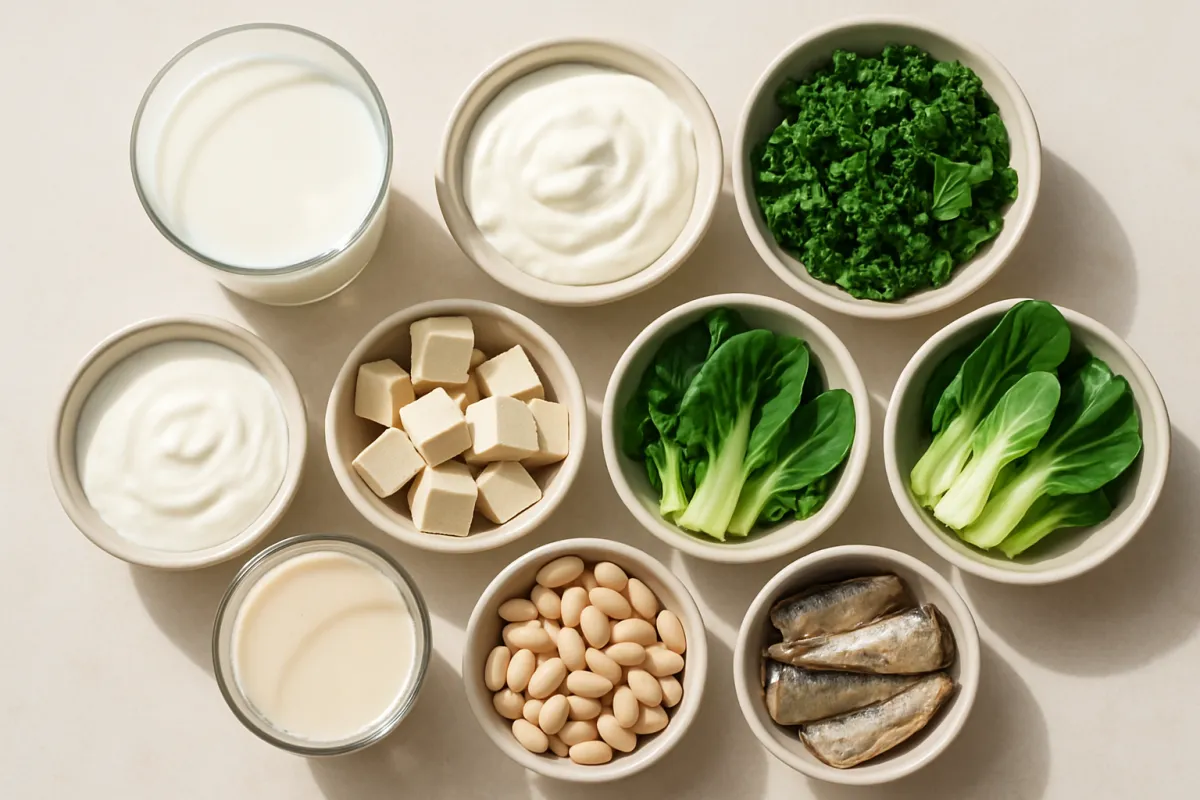
- Dairy, fortified plant milks, calcium-set tofu, canned fish with soft bones, and low-oxalate greens like kale and bok choy are the reliable sources; spinach's calcium is largely blocked by its own oxalate content.
How Much Calcium per Day? The Direct Answer
For healthy adults, the commonly cited reference figure is roughly 1,000 milligrams a day for most adults aged 19 to 50 and for men aged 51 to 70, rising to about 1,200 milligrams for women from age 51 and for all adults from age 71. These are Recommended Dietary Allowances set by the Food and Nutrition Board of the National Academies as part of the Dietary Reference Intakes, the same reference system behind the iron, vitamin D and other intake figures on this site.
The rest of this evidence review works through the mechanics behind that headline figure in more detail. As with every reference figure here, two cautions matter before anything is built on it. First, these values are reviewed periodically and can be revised, so your specific age, sex and life stage figure is worth confirming against the publishing body directly. Second, a Recommended Dietary Allowance is set to cover nearly all healthy people in a group, which makes it a population reference rather than a personal quota that any individual day must hit exactly.
Calcium Reference Intakes by Age, Sex and Life Stage
The published table runs from infancy through later adulthood, and the figures below are the commonly cited values in milligrams per day. The two infant rows are Adequate Intakes rather than RDAs, a distinction explained further down this page.
| Group | Calcium, mg per day |
|---|---|
| Infants 0 to 6 months | 200 (AI) |
| Infants 7 to 12 months | 260 (AI) |
| Children 1 to 3 years | 700 |
| Children 4 to 8 years | 1,000 |
| Children 9 to 13 years | 1,300 |
| Teens 14 to 18 years | 1,300 |
| Men 19 to 50 years | 1,000 |
| Women 19 to 50 years | 1,000 |
| Men 51 to 70 years | 1,000 |
| Women 51 to 70 years | 1,200 |
| Adults 71 and older | 1,200 |
| Pregnancy, 14 to 18 | 1,300 |
| Pregnancy, 19 to 50 | 1,000 |
The table’s most notable feature is the asymmetry in the middle rows. Women cross into the higher figure at 51 while men stay at the lower figure until 71, a twenty-year gap that is easy to miss if you only remember “calcium goes up after 50.” The teenage figure, 1,300 milligrams, actually exceeds the adult figure, which surprises people used to assuming adult needs are always the larger ones.
Why the Figure Rises for Women at 51
The commonly cited jump to 1,200 milligrams for women at age 51 is tied to the hormonal changes around menopause rather than to the number 51 itself. Estrogen plays a protective role in maintaining bone density, and the decline in estrogen around menopause is associated with an accelerated phase of bone loss in many women, which is the mechanism reference publications cite for raising the calcium figure at this life stage.
The age band is, as with every reference table on this site, a population marker rather than a precise biological switch. Menopause timing varies between individuals, and the raised figure is set to cover the group rather than to track any one person’s actual hormonal transition. That variation is a reason the broader topic of bone health after menopause is worth a direct conversation with a clinician rather than relying solely on an age cutoff from a nutrition table.
Why the Figure for Men Waits Until 71
Men are cited at the lower 1,000 milligram figure through age 70 and only move to 1,200 milligrams at 71, a full two decades after the comparable shift for women. Reference sources generally describe this gap as reflecting a more gradual, later-onset pattern of bone density decline in men compared with the more clearly demarcated acceleration many women experience around menopause.
That does not mean bone health is irrelevant to men before 71. It means the reference intake specifically, which is calibrated to a measurable average requirement, is judged not to need the same early increase. Men with other risk factors for bone density loss, including certain medications, low body weight, or a family history of osteoporosis, are a separate clinical conversation that a reference table alone cannot resolve.

Teenagers Carry the Highest Figure on the Table
The commonly cited 1,300 milligram figure for ages 9 to 18 is higher than every adult figure except the raised figure for adults past 70, and the reason is that roughly 90 percent of peak adult bone mass is generally described as being built by the end of adolescence. This is the window reference sources treat as the most consequential for lifetime bone health, more so than any single adult age band.
The practical implication is that a calcium shortfall during adolescence is treated differently from a shortfall later in life, since the opportunity to build bone mass during this specific window does not fully repeat afterward. Parents or caregivers with questions about a specific child’s or teenager’s calcium intake, especially one avoiding dairy or following a restricted diet, are better served by a pediatrician or pediatric dietitian than by extrapolating an adult-focused figure downward.
RDA, AI and UL for Calcium
The same three categories that structure every reference intake table on this site apply to calcium. A Recommended Dietary Allowance, which covers nearly every age and sex group on the calcium table, is an intake estimated to meet the requirement of almost all healthy people in that group, derived from evidence about a measurable requirement.
An Adequate Intake is used where the evidence is not strong enough for a full RDA, which on the calcium table applies only to the two infant rows, anchored on the calcium intake of healthy breastfed infants. A Tolerable Upper Intake Level is a ceiling describing the highest routine intake likely to pose no risk in almost everyone, not a target, and calcium’s ceiling is covered in detail next.
The Calcium Upper Limit, and Why Supplements Are the Usual Route to It
The Tolerable Upper Intake Level for calcium is commonly cited at roughly 2,500 milligrams a day for adults aged 19 to 50 and roughly 2,000 milligrams a day for adults over 50, counting every source, food and supplements, together. The age pattern mirrors the lowered risk tolerance reference bodies apply as sustained high intakes are associated with concerns discussed in the literature, including a commonly noted association with kidney stones at habitually high supplemental intakes.
The practical point is that reaching this ceiling from ordinary food is unusual, since even a calcium-forward day built from dairy, fortified products and greens generally lands well under 2,000 milligrams. The more common route to the upper limit is a calcium supplement added on top of an already calcium-adequate diet, which is one reason this evidence review does not recommend a supplement dose for any individual and defers that decision to a doctor or pharmacist who can weigh total intake, bone health status and other medications together.
Vitamin D: The Nutrient That Decides How Much Calcium Actually Gets Used
Calcium’s reference figure describes what goes in, not what gets absorbed, and vitamin D is the single factor most consistently described as governing that gap. Vitamin D is required for the small intestine to absorb calcium efficiently, meaning a diet that technically reaches the calcium reference figure can still under-deliver if vitamin D status is low, which is why the two nutrients are discussed together constantly in bone health literature rather than as separate, unrelated topics.
This evidence review does not state a single absorption percentage, because published estimates vary with vitamin D status, age, the form of calcium eaten and other dietary factors, and a single confident number would misrepresent that range. The practical takeaway is structural rather than numerical: a calcium-adequate diet paired with inadequate vitamin D is a genuinely different nutritional picture from a calcium-adequate diet paired with adequate vitamin D, even though both would look identical on a calcium-only tracker. Our vitamin D intake review covers the companion reference figures.

Calcium-Rich Foods: A Reference Table
The figures below are commonly cited, approximate values for ordinary servings. They shift with brand, fortification level and preparation, so the panel on your own product is the more reliable figure for anything you actually bought.
| Food | Typical serving | Calcium, roughly |
|---|---|---|
| Plain low-fat yogurt | 1 cup | ~450 mg |
| Fortified orange juice | 1 cup | ~350 mg |
| Part-skim mozzarella | 1.5 oz | ~330 mg |
| Canned sardines, with bones | 3 oz | ~325 mg |
| Milk | 1 cup | ~300 mg |
| Fortified plant milk | 1 cup | ~300 mg |
| Cheddar cheese | 1.5 oz | ~300 mg |
| Cooked collard greens | 1 cup | ~270 mg |
| Calcium-set tofu | 1/2 cup | ~250 mg |
| Cooked kale | 1 cup | ~180 mg |
| Cooked bok choy | 1 cup | ~160 mg |
| White beans, canned | 1 cup | ~160 mg |
| Almonds | 1 oz | ~75 mg |
| Cooked broccoli | 1 cup | ~60 mg |
| Orange | 1 medium | ~50 mg |
Dairy and fortified products dominate the top of the chart, as expected, but the middle of the table shows a genuinely workable plant-forward path once low-oxalate greens and calcium-set tofu are included. The bottom entries are not meaningful calcium sources on their own, and are listed mainly to show how far they sit from the foods that actually matter for this nutrient.
Charting Calcium Sources Side by Side
Calcium per common serving
Milligrams per typical portion, against adult reference intakes commonly cited near 1,000 to 1,200 mg a day. Illustrative approximations that vary by brand and preparation.
Bars scale to plain yogurt at 100 percent. Commonly cited approximations that vary with brand, fortification and preparation, and not personal targets.
Yogurt leading the chart surprises people who default to milk as the calcium reference food, and the gap between the two is a reminder that the specific dairy product, not just the category, changes the number meaningfully.
Why Spinach Does Not Belong on a Calcium Shopping List
Spinach’s calcium figure, commonly cited near 245 milligrams a cooked cup, looks competitive with collard greens and kale on paper, which is exactly why it appears on so many generic calcium lists. The complication is oxalate, a naturally occurring compound spinach carries in unusually high amounts, and oxalate binds calcium into a form the digestive tract largely cannot absorb.
The result is a food whose printed calcium figure substantially overstates what the body actually gets from it. Low-oxalate greens, kale, bok choy, collards and turnip greens among them, are generally described in nutrition references as contributing calcium the body can genuinely use, which is why this evidence review and its companion food list treat them differently from spinach despite superficially similar numbers on a label.
Building a Plant-Forward Calcium Day
Here is one illustrative day assembled from the reference table, built against the commonly cited 1,000 milligram figure for an adult aged 19 to 50, and containing no dairy at all. It is an example of the arithmetic, not a meal plan or a recommendation.
| Meal | Foods | Calcium |
|---|---|---|
| Breakfast | 1 cup fortified plant milk (~300 mg), fortified cereal | ~300 mg |
| Lunch | 1/2 cup calcium-set tofu (~250 mg), stir-fried bok choy (~160 mg) | ~410 mg |
| Snack | 1 cup fortified orange juice | ~350 mg |
| Dinner | Cooked kale side (~180 mg), white beans (~160 mg, partial serving ~80 mg) | ~260 mg |
| Total | ~1,320 mg |
This illustrative plant-forward day clears the 1,000 milligram adult figure comfortably, largely on the strength of fortified products carrying a third of the total between them. That pattern is worth noticing on its own: fortification, not any single whole food, is doing much of the structural work in a dairy-free calcium day.
Where an illustrative 1,320 mg plant-forward day comes from
Shares of the worked day above, by meal, against the commonly cited 1,000 mg figure for an adult aged 19 to 50. Reference approximations, not a meal plan.
Segments sum to 100 percent of the illustrative day. Milligrams on the plate rather than milligrams absorbed, and approximations rather than a personal target.
Reading the Fortification Label on Plant Milks and Juice
Fortified plant milks and fortified orange juice are typically formulated to land near dairy milk’s calcium content, commonly around 300 milligrams a cup, and the added calcium is generally described as being absorbed reasonably well when the product is consumed as intended. Two practical caveats matter more than that headline figure.
First, added calcium in a liquid settles to the bottom of the container over time rather than staying suspended, so an unshaken carton can deliver meaningfully less calcium in an early pour and more in a later one. Shaking thoroughly before every pour is the entire fix. Second, unfortified versions of the same plant milk carry very little calcium at all, and some product lines, particularly organic ones, are more often sold unfortified, so the label has to be read on the specific carton rather than assumed from the product category.

Exercise and the Rest of the Bone Health Picture
Calcium and vitamin D are necessary inputs for bone health, not the whole story, and this evidence review would be incomplete without saying so plainly. Weight-bearing physical activity, the kind that puts mechanical stress through bone, such as walking, stair climbing or resistance training, is generally described in reference sources as a meaningful independent contributor to bone density, separate from diet entirely.
That means a nutritionally perfect calcium and vitamin D intake paired with a fully sedentary lifestyle is not the same picture as the same intake paired with regular weight-bearing activity, even though a food tracker would show identical numbers for both. This page focuses on the nutrient side of that equation because it is a nutrition evidence review, not because diet is the only lever, and anyone building a bone health plan is better served considering activity, smoking status, alcohol intake and family history alongside calcium and vitamin D rather than treating diet as sufficient on its own.
Calcium and Kidney Stones: What the Caution Actually Says
Calcium carries an association with kidney stones that is frequently misunderstood in a specific way worth correcting. The concern reference sources discuss is generally about high-dose calcium supplements, not calcium from food, and some research on dietary calcium specifically suggests it may be associated with a lower stone risk rather than a higher one, through its effect on oxalate absorption in the gut.
This is not a blanket statement that supplements cause stones in everyone, and it is not advice for anyone with an actual history of kidney stones, which is a situation requiring individualized guidance from a doctor who knows the specific stone type and other risk factors involved. It is a reason that the calcium-from-food-versus-calcium-from-supplement distinction, already important for the upper limit discussed earlier, matters again here.
Calcium From Supplements: Citrate Versus Carbonate
For anyone whose clinician has recommended a calcium supplement, the two common forms behave differently enough to be worth understanding rather than treating as interchangeable. Calcium carbonate is generally described as needing stomach acid for absorption and is therefore commonly recommended to be taken with food, while calcium citrate is generally described as absorbed reasonably well with or without food, which is sometimes the preferred form for older adults whose stomach acid production has declined, the same mechanism discussed on this site’s vitamin B12 pages.
This evidence review does not recommend either form, a brand, or a dose for any individual, since that decision depends on why a supplement was recommended in the first place, what else the person takes, and their digestive history. The distinction is offered here only because people frequently assume all calcium supplements work the same way, and the timing-with-food difference between the two common forms is a reasonable thing to ask a pharmacist about if a supplement is already in the picture.
Why Spreading Calcium Across the Day Matters
The body’s ability to absorb calcium from a single dose is generally described as declining once that dose gets large, meaning 500 milligrams taken at once is commonly discussed as being absorbed proportionally better than 1,000 milligrams taken at once. This is one reason reference sources generally suggest spreading calcium-rich foods or a supplement across two or more servings in a day rather than loading the entire reference figure into one sitting.
The practical consequence for the worked day above is structural rather than incidental: a plant-forward day that spreads calcium across breakfast, lunch, a snack and dinner is not just convenient for variety, it is plausibly working with the body’s absorption pattern rather than against it. This evidence review does not attach a specific percentage to the drop-off, since published figures vary with the form of calcium, what else is eaten at the same time, and the person, but the general direction, smaller doses spread out, is consistently described.
Lactose Intolerance and Finding Calcium Elsewhere
Lactose intolerance is one of the more common reasons people actively search for non-dairy calcium sources rather than arriving at the topic out of general curiosity, and it deserves a direct note. Many people with lactose intolerance can still tolerate aged hard cheeses and yogurt reasonably well, since both carry less lactose than fluid milk due to fermentation and processing, which means a blanket avoidance of all dairy is not always necessary.
For anyone avoiding dairy entirely, by choice or by necessity, the fortified plant milk, calcium-set tofu, canned fish with bones and low-oxalate greens covered earlier in this evidence review form a genuinely workable alternative path to the reference figure, not a consolation list. Anyone with digestive symptoms attributed to dairy who has not had the cause confirmed is better served raising it with a doctor than assuming lactose intolerance by default, since other conditions can produce a similar pattern of symptoms.
Calcium and Certain Medications
Calcium is commonly discussed in pharmacy references as capable of interfering with the absorption of several medication classes when taken too close together, including some antibiotics and thyroid hormone replacement, by binding to the medication in the gut in a way that reduces how much of the drug is actually absorbed. This is a timing interaction rather than a reason to avoid calcium altogether for someone on an affected medication.
The usual handling described in reference sources is separating the calcium-containing food, supplement or antacid from the medication dose by a period a pharmacist specifies for that particular drug, since the needed gap varies by medication. Anyone taking a long-term prescription medication who also eats calcium-rich foods regularly or takes a calcium supplement should confirm the right spacing with the prescribing clinician or a pharmacist rather than guess from a general article, since this evidence review does not name specific drugs or gaps for exactly that reason.
Common Mistakes When Counting Calcium
The first mistake is assuming spinach counts the way its printed figure suggests, when its own oxalate content blocks most of that calcium from being absorbed. The second is assuming an unfortified plant milk delivers the same calcium as dairy milk, when most unfortified versions carry very little.
The third mistake is applying the same reference figure across all of adulthood, missing the asymmetric jump that happens for women at 51 and for men only at 71. The fourth is tracking calcium in isolation from vitamin D, when the two nutrients jointly determine how much of the calcium eaten is actually put to use. The fifth is assuming more calcium from a supplement is automatically safer than more from food, when supplements are the more common route to the upper limit specifically because food alone rarely approaches it. The sixth is loading an entire day’s reference figure into one large supplement dose rather than spreading it out, when absorption efficiency is generally described as declining as a single dose gets larger.
A Short Calcium-Forward Shopping List
A compact list works better than an exhaustive one. For the dairy aisle, plain yogurt and milk remain the most calcium-dense ordinary purchases by serving. For a dairy-free version of the same list, fortified plant milk, fortified orange juice, and calcium-set tofu, checking the label for “calcium sulfate” in the ingredients since not all tofu is set that way.
For the produce and canned goods aisle, kale, bok choy, collard greens, canned sardines with their soft bones, and white beans round out a workable list, all of which keep reasonably well. That basket pairs naturally with the vitamin D conversation above, since a calcium-forward shopping list without attention to vitamin D status tells only half the story this page has tried to make clear.
When to Ask a Clinician
Several situations call for individualized guidance rather than the general figures on this page. Anyone considering a calcium supplement, for the reasons set out above regarding the upper limit and the kidney stone discussion, should raise the question with a doctor or pharmacist rather than choosing a dose independently. Anyone with an existing bone health diagnosis, a family history of osteoporosis, or a history of kidney stones is in a genuinely different situation than the general population this page describes.
Pregnant or breastfeeding readers, and anyone asking on behalf of a child or teenager with a restricted or dairy-free diet, should also take specific questions to the clinician managing that care rather than extrapolating from the adult-focused tables here. Our vitamin D intake review and our magnesium review cover two other nutrients commonly discussed alongside bone health on this site.
The Bottom Line
How much calcium per day an adult needs depends on age and sex more than most people expect, and it is one of the few nutrients on this site whose reference figure genuinely changes more than once across an ordinary adult lifetime rather than holding steady from 19 to 70. The commonly cited figures are roughly 1,000 milligrams for most adults aged 19 to 50 and for men aged 51 to 70, rising to about 1,200 milligrams for women from 51 and for everyone from 71, with teenagers cited highest of all at roughly 1,300 milligrams during the years peak bone mass is built.
Vitamin D decides how much of that calcium actually gets absorbed, which is why the two nutrients are discussed together rather than in isolation. The commonly cited upper limit of 2,000 to 2,500 milligrams counts food and supplements together, and food alone rarely approaches it, which is why supplementation specifically is the decision that belongs with a clinician. Sketch your own day in the companion below, and remember that spinach’s calcium looks better on paper than it performs in the body.
This evidence review is published for general education and reproduces commonly cited, approximate reference intakes and food composition figures for calcium. It is not medical, dietary or nutritional advice, does not diagnose, treat or manage any condition including osteoporosis or calcium deficiency, and reading it creates no clinician-patient relationship. Population reference intakes and upper intake levels are published by national health authorities, are reviewed and revised over time, and differ between countries, so the current figure for your own age, sex and life stage should be confirmed against the publishing authority rather than taken from this page. Every milligram value above is a rounded reference approximation rather than a measurement of any particular product, and content varies with brand, fortification and preparation, which is why the panel on your own package is the figure that applies to you. No absorption percentage is quoted here for calcium and vitamin D together because published estimates vary too widely with status, age and diet to state as fact. Nothing above recommends a calcium supplement, suggests a dose, or addresses any individual’s bone density, kidney stone history or other medical condition, all of which require evaluation by a doctor with your full history. Anyone pregnant or breastfeeding, asking on behalf of a child or teenager, managing a bone health diagnosis, or with a personal or family history of kidney stones should take questions about calcium intake or supplementation to a doctor, pharmacist or registered dietitian who knows that history.
Frequently asked questions
How much calcium per day do adults need?
The Dietary Reference Intakes published by the National Academies are commonly cited at roughly 1,000 milligrams a day for most adults aged 19 to 50 and for men aged 51 to 70, rising to about 1,200 milligrams for women from age 51 and for all adults from age 71. These are population reference values rather than a personal prescription, and they are reviewed and revised over time, so confirm the current figure for your own age, sex and life stage against the publishing health authority rather than any article.
Why does the calcium figure rise for women at 51 but for men only at 71?
The age at which the figure rises is commonly tied to bone loss patterns rather than to a fixed birthday rule. Bone density loss accelerates for many women around the time of menopause, commonly placed near age 51 in reference publications, while men are generally described as experiencing a more gradual decline that reference tables place later, around age 71. Both figures are population averages set to cover most healthy people in each group, not a measurement of any individual's bone density.
What is the tolerable upper intake level for calcium?
The Tolerable Upper Intake Level for calcium is commonly cited at roughly 2,500 milligrams a day for adults aged 19 to 50 and roughly 2,000 milligrams a day for adults over 50, counting food and supplements together. It is set against the risk of adverse effects from habitually high intake, including a commonly discussed concern around kidney stones and other issues at sustained high supplemental intakes, and it is a ceiling rather than a target. Reaching it from food alone is unusual; reaching or exceeding it generally involves a supplement.
Does vitamin D affect how much calcium you absorb?
Yes, and the relationship is commonly described as central to calcium nutrition. Vitamin D is required for the intestine to absorb calcium efficiently, so a diet that technically meets the calcium reference figure can still under-deliver if vitamin D status is low, and the reverse is also discussed, where adequate vitamin D supports more complete use of the calcium eaten. This evidence review does not state a single absorption percentage because published estimates vary with vitamin D status, age, and other factors. See our vitamin D intake review for the companion figure.
Can you get enough calcium without dairy?
Yes, though it takes more deliberate assembly than drinking a glass of milk. Fortified plant milks and fortified orange juice are commonly cited near 300 milligrams a cup, calcium-set tofu near 250 milligrams a half cup, canned fish eaten with their soft bones near 300 to 325 milligrams per serving, and low-oxalate greens such as kale and bok choy in the 150 to 270 milligram range per cooked cup. An illustrative day built from a mix of these sources can reach the adult reference figure without any dairy, though fortified products vary by brand and the label is the figure that applies to a specific product.
Is spinach a good source of calcium?
Spinach carries a large printed calcium figure, commonly cited near 245 milligrams a cooked cup, but it is also unusually high in oxalate, a compound that binds calcium into a form the body largely cannot absorb. Most nutrition references describe spinach's calcium as poorly available for this reason, while lower-oxalate greens such as kale, bok choy, collards and turnip greens are generally described as contributing calcium the body can actually use. Spinach remains valuable for other nutrients; it is simply not a reliable calcium source despite the number on the label.
How much calcium is too much from supplements?
This evidence review does not recommend a supplement dose for any individual. What reference sources generally note is that supplemental calcium, taken in large single doses or combined with a calcium-rich diet, is the more likely route to exceeding the commonly cited upper limit of roughly 2,000 to 2,500 milligrams a day, since food alone rarely approaches that ceiling. Whether a supplement is appropriate, and at what dose, depends on diet, bone health status and other medications, and belongs with a doctor or pharmacist rather than a general guideline.
Do children and teenagers need more calcium than adults?
Yes, teenagers carry one of the higher figures on the entire calcium reference table, commonly cited at roughly 1,300 milligrams a day for ages 9 to 18, above even the adult figure, because this is the period when peak bone mass is actively being built. A shortfall during these years is discussed in reference sources as a missed opportunity rather than something made up easily later, which is why adolescent calcium intake is specifically highlighted in pediatric nutrition guidance distinct from the adult picture this page otherwise focuses on.

Hamza Hai is the editor of NourishMark. She holds an MBA and reviews the site's articles against our editorial standards, checking that every figure is labelled for what it is, that nothing is presented as verified fact without a source the reader can check, and that the writing stays useful to a non-specialist.

Dr. Shayaan Khan is the medical reviewer for NourishMark. He holds an MBBS from MGM Medical College, Navi Mumbai, and is the author of published research including a narrative review of postpartum anxiety and depression in Mental Health Science. He has taught physiology at university level. He reviews the site's health content for medical accuracy: that physiology and mechanisms are described correctly, that no claim is stated more strongly than the evidence behind it, and that anything specific to an individual reader is sent to that reader's own clinician.
Not medical advice. Dr. Khan reviews NourishMark's health content for medical accuracy. He is not a registered dietitian, he does not hold a United States practising licence, and he is not your doctor. His review does not make anything here medical advice. Always talk to a qualified health professional about your own situation, and never delay or stop care because of something you read here.