
What's in this review
- What “best time to fast” actually asks
- The short answer: total calories matter more than clock placement
- Early time-restricted eating versus late time-restricted eating
- What research on eating-window timing actually shows
- Circadian rhythm and metabolism, honestly described
- Why mornings get more attention in fasting research
- Does fasting overnight count differently than fasting during the day
- Morning eating window: what it looks like
- Evening eating window: what it looks like
- Sleep quality and a late eating window
- Exercise timing and your eating window
- Work schedules and shift work: a timing problem research has not solved
- A worked example: placing your own window
- Your day, by the numbers
- Comparing window placements at a glance
- Blood sugar and meal timing
- Meal frequency inside your window
- Weekends, travel, and keeping a window consistent
- What you can drink before your window opens
- Common reasons people assume mornings are “better”
- Appetite and hunger across different window placements
- What the evidence does not show
- Who should pay closer attention to timing specifically
- Hydration and energy across a delayed morning
- Realistic expectations over several weeks
- Talking to your doctor about timing your eating window
- Common mistakes when choosing a fasting time
- The bottom line
Short answer: the time of day you fast matters less for weight loss than how many total calories you eat across the day and the week, and that holds regardless of whether your eating window sits in the morning or the evening. A small body of research on early time-restricted eating, placing the eating window earlier in the day, has found modestly better results on some metabolic markers compared with the same window shifted later, but the differences are generally small and the evidence base is still limited. Where your window actually sits is more a question of what fits your schedule, your sleep, and your appetite than a guaranteed metabolic advantage, and anyone managing a medical condition should bring meal timing specifically to a doctor rather than deciding from general research alone.
A common assumption in fasting conversation is that there is a single best clock time to start and stop eating, some window that unlocks a metabolic advantage a differently placed window does not. The honest answer is more modest than that framing suggests. Research on eating-window timing exists and is genuinely interesting, but it describes small, directional differences on specific markers, not a dramatic weight-loss advantage tied to a particular hour.
This evidence review covers what research on eating-window timing actually shows, the difference between early and late time-restricted eating, how sleep and exercise interact with where your window sits, a worked example of placing your own window, and who has a genuine, specific reason to think carefully about timing. Nothing below is a recommendation to fast or a claim that any clock time guarantees a result, and any decision to change your eating pattern belongs with a doctor or registered dietitian who knows your health history. You can work through your own window placement in the companion below.
Key takeaways
- Total calories eaten across the day and the week is the factor most consistently linked to weight change, regardless of which hours the eating window occupies.
- Early time-restricted eating, placing the window earlier in the day, has shown modestly better results on some metabolic markers in a handful of small studies, not a large or guaranteed weight-loss advantage.
- Fasting overnight and fasting while awake are mechanistically the same thing, a stretch without food, but they feel very different because one passes during sleep.
- A late eating window is not established as universally harmful to sleep, though a heavy meal close to bedtime is a reasonable, individual reason to shift earlier if you notice discomfort.
- Anyone managing diabetes, taking medication timed around meals, or working night or rotating shifts has a specific, individual reason to discuss meal timing with a doctor.
What “best time to fast” actually asks
“Best time to fast” usually means one of two different questions, and it is worth separating them before looking at the evidence. The first is about window length: how many hours should the fasting portion of the day run, a question our intermittent fasting review and our 18-hour fasting review cover in depth. The second, the one this review focuses on, is about placement: given a fasting window of a certain length, does it matter whether it sits mostly in the morning, mostly in the evening, or somewhere in between.
These are genuinely different questions with genuinely different evidence behind them. Window length research is relatively extensive. Window placement research is smaller and newer, which is exactly why the honest answer below is more hedged than a confident headline promising a single best clock time.
The short answer: total calories matter more than clock placement
Before getting into the more nuanced placement research, the larger, better established point deserves to be stated plainly: the single factor most consistently linked to weight change across decades of research is total calorie intake relative to what the body uses, the mechanism our calorie deficit review covers in full. Shifting an eating window earlier or later in the day does not change this arithmetic on its own. Someone who eats the identical total food in an identical eating window length will not reliably lose more or less weight just because the window starts at 7 a.m. instead of 11 a.m., absent some other change in behavior that the timing shift happens to produce.
Where timing can matter is indirectly: a particular window placement might make it easier or harder for a specific person to eat less, sleep better, or stay consistent, and those secondary effects are where most of the real, individual benefit of choosing one window over another tends to live.
Early time-restricted eating versus late time-restricted eating
Researchers studying eating-window placement generally compare early time-restricted eating, often abbreviated eTRE, against a later window covering the same number of hours. A typical early window might run roughly 7 a.m. to 3 p.m. or 8 a.m. to 4 p.m., while a typical later window of the same length might run closer to noon to 8 p.m. or 1 p.m. to 9 p.m. Both are the same length; only the placement differs.
A handful of smaller studies comparing these two placements have found modestly better results for the earlier window on markers including blood sugar control, blood pressure, and some measures of appetite regulation. The differences found have generally been modest, the studies have mostly involved smaller groups over shorter periods, and the research has not been replicated at the scale needed to call early time-restricted eating a clearly established, major lever for most people. It is a real, active research area worth watching, not a settled recommendation.
What research on eating-window timing actually shows
Stepping back from the early-versus-late comparison specifically, the broader body of research on meal timing and weight is honestly mixed and still developing. Some studies find small metabolic advantages tied to earlier eating. Others find no meaningful difference in weight outcomes between differently placed windows of the same length when total calories are matched. What is consistently true across this research is that total intake remains the dominant factor, with timing contributing a smaller, secondary effect that varies between studies and between people.
This is worth stating honestly rather than rounding up to a stronger claim, because a lot of online fasting content treats a few promising small studies as though they settle the question. They do not. Treat any specific claim about a precise best starting hour as illustrative of an interesting research direction, not as a measured fact that applies identically to you.
Circadian rhythm and metabolism, honestly described
The circadian rhythm is the body’s roughly 24-hour internal clock, which influences far more than sleep, including hormone release, body temperature, and how the body processes nutrients at different times of day. This is real, well established biology, and it is the mechanism most often cited to explain why an earlier eating window might align better with the body’s natural rhythm for some metabolic processes than a later one.
The honest caveat is the gap between this general biological principle and a specific, individual weight-loss prediction. Circadian biology explains why timing research exists and why it is a reasonable hypothesis worth studying; it does not, on its own, prove that shifting your personal eating window earlier will produce a noticeably different result for you specifically. The mechanism is real; the size of its practical effect for any one person is the part that is still being worked out.
Why mornings get more attention in fasting research
Part of why early time-restricted eating draws more research attention than late time-restricted eating traces back to circadian biology: insulin sensitivity, the body’s responsiveness to the hormone that manages blood sugar after eating, tends to be somewhat better earlier in the day than later in the evening for many people, based on research measuring this directly. This is one of the more concrete, measurable differences behind the research interest in earlier eating windows.
It is worth being precise about what this does and does not mean. A modestly better insulin response earlier in the day is a real, measurable finding. It is not the same as proof that an earlier eating window produces meaningfully more weight loss, since weight change depends on total intake across the full day and week, not solely on how a single meal’s insulin response looks in isolation.
Does fasting overnight count differently than fasting during the day
Mechanistically, no: a fasting window is the same stretch without food whether it happens during sleep or during waking hours. Practically, the experience is very different. Hours spent asleep pass without conscious hunger, effort, or decision-making, while waking fasted hours require actively not eating through ordinary daily activity, which most people find considerably harder.
This is the real, practical reason window placement matters for most people, more than any metabolic difference: a window placed so that more of the fasting portion overlaps with sleep is often easier to live with than an identical-length window where more of the fasting hours fall during waking time. Our stages of fasting by hour review covers what happens physiologically across a fasting window in more depth, independent of placement.
Morning eating window: what it looks like
A morning-leaning eating window typically means the first meal arrives not long after waking, for example within an hour or two, with the window closing in the mid to late afternoon and the fasting portion of the day spanning evening, overnight, and the early morning hours before waking. This arrangement puts most of the waking fasted time in the evening, after the day’s main activities and obligations are often finished.
Some people find this arrangement easier because mornings feel energized without needing food first, and evenings pass without the temptation of a late dinner or evening snacking that often derails a calorie target. Others find skipping breakfast or an early lunch genuinely difficult, particularly if hunger or low energy interferes with morning focus or exercise.
Evening eating window: what it looks like
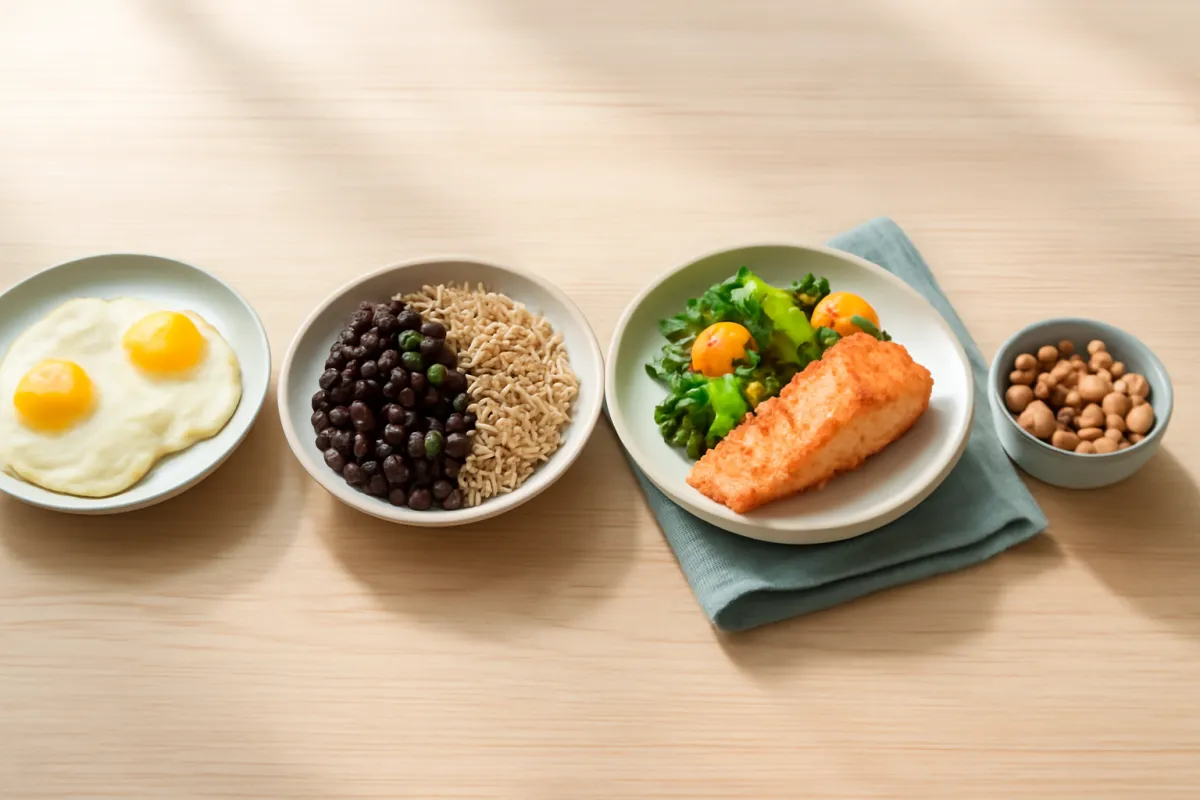
A later-leaning eating window typically pushes the first meal into midday or early afternoon, with the window extending into the evening, often covering a standard dinner time, and the fasting portion of the day spanning late night through late morning. This is the more commonly chosen arrangement in practice, largely because it fits more easily around typical work schedules and social meals, particularly dinner with family or friends.
The waking fasted time in this arrangement sits mostly in the morning, before the window opens, which some people manage comfortably with black coffee or tea and others find genuinely harder, particularly if morning hunger is strong or if skipping breakfast affects focus or mood.
Sleep quality and a late eating window
A large or heavy meal eaten close to bedtime is commonly reported to make falling asleep harder for some people and can contribute to reflux or discomfort lying down soon after eating. This is a reasonable, individual pattern worth noticing in yourself, and finishing eating a couple of hours before bed is a commonly cited, sensible convention for anyone who experiences it.
Current research has not established that a later eating window universally damages sleep quality for everyone, and plenty of people sleep well with dinner close to bedtime. Our sleep needs review covers broader sleep guidance independent of eating window placement; if a late window is genuinely disrupting sleep for you specifically, shifting it earlier or lightening the last meal is a reasonable first step before assuming the whole schedule needs an overhaul.
Exercise timing and your eating window
Where your eating window sits interacts directly with when you can realistically train. An early window generally means training either fasted, before the window opens, or very soon after it opens, while a later window generally allows training on a full stomach earlier in the day or fasted later in the afternoon before the window opens. Neither arrangement is universally better for performance; tolerance for fasted training varies considerably between individuals and between types of activity.

Anyone training seriously, particularly for strength or endurance goals, should treat the interaction between exercise timing and eating-window placement as worth planning deliberately rather than an afterthought, and should raise specific performance concerns with a coach, doctor, or registered dietitian familiar with their training load.
Work schedules and shift work: a timing problem research has not solved
Most eating-window timing research assumes a fairly standard daytime schedule, waking in the morning and sleeping at night. This assumption does not hold for shift workers, particularly those on night shifts or rotating schedules, whose circadian rhythm and practical eating opportunities do not line up with the “morning” and “evening” framing most research and most popular fasting advice uses.
There is no well established, specific best eating-window placement for shift workers in current research, and the general early-versus-late findings described above should not be assumed to transfer directly to a schedule where “morning” for the body is not morning on the clock. Anyone working night or rotating shifts who wants to adjust meal timing should raise their specific schedule with a doctor or registered dietitian rather than applying standard daytime timing advice to a very different situation.
A worked example: placing your own window
A concrete example makes the arithmetic easier to picture. Imagine a hypothetical reader who wakes at 7 a.m. and goes to bed around 11 p.m., 16 hours later. If they choose an 8-hour eating window starting 1 hour after waking, at 8 a.m., their window closes at 4 p.m., leaving the fasting portion to run from 4 p.m. to 8 a.m. the next day, 16 hours total. Roughly 8 of those 16 fasting hours overlap with sleep, leaving about 8 waking fasted hours, mostly in the evening.
Compare that with the same person choosing the same 8-hour window but starting 5 hours after waking, at noon, closing at 8 p.m. The fasting portion then runs from 8 p.m. to noon the next day, still 16 hours total, but now only about 8 hours overlap with sleep in a similar way, with the remaining waking fasted hours falling mostly in the morning instead of the evening. The total fasting length is identical in both cases; only which part of the day feels fasted while awake has changed. The companion below lets you rework this arithmetic with your own wake time, bedtime, and window choice.

Your day, by the numbers
Putting the worked example above into a single picture shows how the same fasting-window length can split very differently between sleeping hours and waking hours depending on where it sits.
A 16-hour fasting window split between sleep and waking hours, two placements compared
Illustrative split for the 7 a.m. wake, 11 p.m. bedtime example above, comparing an 8 a.m. to 4 p.m. window against a noon to 8 p.m. window. Illustrative arithmetic, not a personal forecast.
50 plus 50 sums to the full 16-hour fasting window in this example. Shifting the window earlier or later changes which part of the day the waking fasted hours fall in, not the total length. Use the companion below for your own numbers.
Comparing window placements at a glance
Lining up a few common window placements side by side shows how differently the same window length can land across a day, depending on when it starts.
Illustrative waking fasted hours for a few common 8-hour window placements
Hours of the fasting window spent awake rather than asleep, for a 7 a.m. wake and 11 p.m. bedtime, scaled against the longest bar shown. Illustrative scheduling arithmetic only.
A later window generally leaves fewer waking fasted hours before it opens, since more of the morning fast overlaps with sleep instead. This describes scheduling arithmetic, not an effectiveness ranking.
Blood sugar and meal timing
Blood sugar responses to the same meal can differ somewhat depending on the time of day it is eaten, with research generally finding a somewhat smaller blood sugar rise after an identical meal eaten earlier in the day compared with the same meal eaten late in the evening for many people. This is part of the biological basis for interest in early time-restricted eating specifically.
As with the broader timing research, this is a real, measurable finding that should not be stretched into a precise individual promise. Anyone managing diabetes, prediabetes, or another condition affecting blood sugar should discuss meal timing specifically with a doctor, since the clinical picture involves medication timing and individual monitoring that a general review cannot account for.
Meal frequency inside your window
A separate question from window placement is how many meals to fit inside whichever window you choose. Some people do best with two larger meals inside an 8-hour window, others prefer three smaller ones, and research comparing meal frequency at matched total calories has generally found similar outcomes between the two approaches. This is a personal fit question, similar to window placement itself, rather than one with a clearly superior answer research has settled.
Where this intersects with timing is practical: a window placed earlier in the day, closing by mid-afternoon, leaves less room to fit in three full meals comfortably than a later window that extends into the evening. Anyone building meals around a shorter or earlier window may find two larger meals with a snack easier to plan around than three separate full meals, particularly while still reaching an adequate daily protein target, which our protein needs review covers in more depth.
Weekends, travel, and keeping a window consistent
A fixed eating-window placement is easiest to maintain on a predictable weekday schedule and hardest to maintain around weekends, travel, time-zone changes, and social meals that do not line up with a chosen window. Shifting a window by an hour or two on an occasional day is unlikely to undo a pattern that is otherwise consistent across most of the week, and treating every deviation as a failure tends to make a schedule harder to sustain rather than easier.
A more durable approach for most people is picking a window placement that is close to compatible with a normal social and work life most of the time, rather than the theoretically most optimal placement that requires constant exceptions. Consistency across most days generally matters more for any outcome tied to total weekly calorie intake than strict adherence to an exact clock time on every single day.
What you can drink before your window opens
Plain water is standard during the fasting portion of any window placement and is generally encouraged, since dehydration is a common contributor to the headache and fatigue some people notice before their window opens, particularly with a later-starting window. Black coffee and plain tea, without milk, cream, or sweetener, are widely treated as compatible with a fast because they carry negligible calories, though caffeine on an empty stomach affects people differently depending on individual sensitivity.
Anything with meaningful calories, including milk, cream, sweeteners, or a splash of juice, technically ends a fast in the strict sense researchers use, regardless of what time of day it happens. Anyone managing a medical condition should confirm which drinks are appropriate with their doctor.
Common reasons people assume mornings are “better”
A few ideas circulate online to explain why an earlier eating window is sometimes framed as superior, and it is worth separating the ones with some research behind them from the ones that are closer to folk wisdom. The insulin sensitivity and blood sugar findings described above have genuine, if modest, research support. Claims that an earlier window dramatically boosts metabolism, or that eating the identical food after a certain evening hour causes it to be “stored as fat” differently, are considerably more precise and more dramatic than the actual evidence supports, and should be read as oversimplified rather than established fact.
Appetite and hunger across different window placements
Hunger does not distribute evenly across a fasting window, and where the window sits changes when hunger is most likely to show up. A later-starting window tends to concentrate hunger in the morning, before eating begins, while an earlier-starting window tends to concentrate it in the evening, after the window has closed. Neither pattern is inherently easier; which one feels more manageable is highly individual and often depends on which part of the day already carries more stress, social eating opportunities, or boredom that tends to prompt eating outside of genuine hunger.
Some smaller studies have looked at appetite-related hormones across different eating-window placements and found modest differences in reported hunger and fullness between early and late windows, generally favoring the earlier placement by a small margin. As with the other markers discussed in this review, these are real, measurable findings from limited research, not a guarantee that an earlier window will feel less hungry for any specific individual. Paying attention to your own hunger pattern across a trial period of a couple of weeks is more informative for your own decision than a study result describing an average across a different group of people.
What the evidence does not show
It is worth stating plainly what current research has not established about eating-window timing. Research has not shown that a specific clock hour produces a dramatically different weight outcome when total calories are matched between an early and a late window of the same length. It has not established that a later eating window is inherently unhealthy or that it reliably causes weight gain on its own, independent of total intake. It has not shown that shift workers or anyone with an unusual schedule should follow standard daytime timing advice. Refusing to claim any of these things is the responsible position given the current, limited state of the research, not a gap in this review.
Who should pay closer attention to timing specifically
For most people without a specific medical reason, total calorie intake and whether a schedule can actually be sustained consistently matter more than exactly where the eating window sits. A handful of groups do have a genuine, individual reason to think more carefully about timing: anyone managing diabetes or blood sugar concerns, anyone on medication timed around meals, anyone who notices a clear personal pattern between a late eating window and poor sleep or digestive discomfort, and anyone working night or rotating shifts, where standard morning-and-evening timing advice does not straightforwardly apply.
A practical way to weigh timing against the bigger levers
- Total calories across the day and week is the larger, better established factor; window placement is a smaller, more individual one layered on top of it.
- An eating window you can sustain consistently will generally outperform a theoretically earlier or later window you cannot keep up.
- Noticing your own patterns, around sleep, hunger, and energy, is more useful for choosing a placement than chasing a specific hour cited online.
Hydration and energy across a delayed morning
Delaying the first meal of the day, as a later-starting window requires, raises the importance of staying hydrated through the morning, since dehydration is a common and easily overlooked contributor to the headache, low energy, or difficulty concentrating some people notice before their window opens. Our hydration guide covers daily fluid guidance independent of any fasting schedule.
Plain water and, for most people, black coffee or plain tea cover this adequately through a delayed morning. Anyone who trains in the morning on a later-starting window, or who has a medical reason to monitor fluid or electrolyte intake closely, should raise the specifics with a doctor rather than guessing.
Realistic expectations over several weeks
Several weeks into any eating-window schedule, regardless of placement, the honest expectation is the same mechanism covered in our calorie deficit review: whatever change shows up traces back to the total calorie gap the schedule actually produced, sustained consistently, not to a special effect unlocked by starting the window at a particular hour. Two people with identically placed windows can see different results because one of them is eating fewer total calories inside it and the other is not, independent of the clock.
A reasonable, hedged way to frame a typical pace: general public health guidance commonly cites roughly 1 to 2 pounds a week as a sustainable weight-loss target for anyone running a consistent calorie deficit, not a figure specific to any particular window placement, which is useful context rather than a promise tied to morning or evening eating.
Talking to your doctor about timing your eating window
Bring specifics to the conversation rather than a general question. Useful details include your current wake and sleep times, your work schedule, including any shift work, any medications taken on a fixed timing, and any history of blood sugar issues, reflux, or sleep problems. A doctor who knows this history can weigh a concrete window placement against it in a way a general review like this one cannot. You can also use our BMI and daily calorie tool to estimate your own baseline calorie needs before that conversation, and revisit the same BMI and daily calorie tool if your schedule or goals change.
Common mistakes when choosing a fasting time
A handful of avoidable errors account for much of the frustration people report when picking an eating-window placement.
- Chasing a specific “optimal” hour instead of a sustainable schedule. A window you can keep up consistently will generally outperform a theoretically ideal one you abandon within a month.
- Ignoring your own sleep and digestion patterns. A late window that genuinely disrupts your sleep is a personal, practical reason to shift earlier, independent of any general research finding.
- Assuming shift-work timing should mirror standard daytime advice. Most research assumes a daytime schedule and does not transfer directly to night or rotating shifts.
- Treating a modest research finding as a dramatic promise. Early time-restricted eating studies show small, directional differences, not a guaranteed transformation.
- Training hard deep into a long fasted stretch without adjusting. Performance and recovery concerns are worth raising with a coach or doctor rather than guessing.
- Changing window placement and total calories at the same time. This makes it hard to tell which change actually produced any result you notice.
- Starting without medical input when a specific exclusion applies. Anyone managing diabetes or another condition affecting blood sugar should involve a doctor before adjusting meal timing.
The bottom line
The time of day you fast matters less for weight loss than how many total calories you eat across the day and the week, and that holds whether your eating window sits mostly in the morning or mostly in the evening. A small, developing body of research on early time-restricted eating has found modestly better results on some metabolic markers for earlier windows, but the differences are small, the studies are limited, and nothing here establishes a dramatic advantage tied to a specific clock hour. Fasting overnight and fasting while awake are the same mechanism, a stretch without food, experienced very differently because one happens during sleep. For most people, the practical question is which placement fits a real schedule, sleep pattern, and appetite well enough to sustain consistently, not which hour research has studied most. For specific groups, including anyone managing diabetes, anyone on medication timed around meals, and anyone working night or rotating shifts, meal timing is worth raising directly with a doctor rather than deciding from general research alone. Our 18-hour fasting review and our 24-hour fasting review cover window length in more depth, and the companion below turns your own wake time, bedtime, and window choice into illustrative hours.
NourishMark publishes this article as general education about eating-window timing and the research behind it, and it is neither medical nor dietetic advice for any individual, nor a recommendation that any reader adopt a particular fasting schedule or window placement. It does not diagnose, treat, or claim to prevent any condition, and no figure above is a promised weight-loss outcome or timeline. Adjusting when you eat is unsafe without medical guidance for some people, including anyone on insulin or a sulfonylurea medication, anyone pregnant or breastfeeding, anyone under 18, and anyone with a current or past eating disorder. Please bring any decision about meal timing to a doctor or registered dietitian, particularly if you manage diabetes, work night or rotating shifts, or have a history of sleep or digestive problems.
Frequently asked questions
Does the time of day you fast matter for weight loss?
Total calories eaten across the day and the week is the factor research has most consistently linked to weight change, and that holds true regardless of which hours the eating window sits in. Some smaller studies on early time-restricted eating, where the eating window is shifted earlier in the day, have found modestly better results on some metabolic markers compared with the same window shifted later, but the differences are generally small and the research is not extensive enough to call timing a major lever on its own. Where you place your window is more a question of what you can sustain consistently than a guaranteed metabolic advantage.
Is it better to fast in the morning or at night?
Neither direction is clearly better in a way that applies to everyone, though the framing is slightly misleading, because fasting overnight is unavoidable for almost everyone since sleep itself is a fast. The real question is whether your eating window sits earlier in the day, roughly morning through mid-afternoon, or later, roughly midday through evening. Some evidence modestly favors an earlier window for metabolic markers, but the differences found are small, the studies are limited, and an eating window you cannot sustain because it conflicts with your schedule or social life will generally underperform a less theoretically ideal one you can actually keep.
What is early time-restricted eating?
Early time-restricted eating, often abbreviated eTRE in research, describes an eating window placed in the earlier part of the day, commonly something like 7 a.m. to 3 p.m. or 8 a.m. to 4 p.m., with the fasting portion falling in the evening and overnight. It is contrasted in research with a mid-day or later window, such as noon to 8 p.m., which covers the same number of eating hours but shifted toward the evening. Some smaller studies have found modest advantages for early windows on markers like blood sugar and blood pressure, though the research base is still limited and has not been replicated at a large scale.
Does eating earlier in the day help with insulin sensitivity?
Some research has found that insulin sensitivity, the body's responsiveness to the hormone that manages blood sugar, tends to be somewhat better earlier in the day than later in the evening for many people, which is one reason early time-restricted eating has drawn research interest. A handful of small studies comparing early and late eating windows have found modestly better blood sugar and blood pressure markers with the earlier window. This is a genuinely interesting, developing area of research rather than a settled, individually guaranteed effect, and anyone managing diabetes or blood sugar concerns should discuss meal timing specifically with a doctor.
Is a late eating window bad for sleep?
Eating a large or heavy meal very close to bedtime is commonly reported to make falling asleep harder and can contribute to reflux or discomfort lying down, which is a reasonable, individual reason to finish eating a couple of hours before bed if that is something you notice in yourself. Current research has not established that a later eating window inherently damages sleep quality for everyone, and some people sleep perfectly well with dinner close to bedtime. If a late window is genuinely disrupting your sleep, shifting it earlier, or simply making the last meal lighter, is worth trying before assuming your whole schedule needs to change.
Does fasting overnight count the same as fasting during the day?
Mechanistically, the body does not distinguish between hours spent fasting while asleep and hours spent fasting while awake; a fasting window is the same stretch of not eating regardless of what you were doing during it. Practically, the two feel very different, because the hours spent asleep pass without any conscious hunger, while waking fasted hours require actively not eating through normal daily activity. This is why two people with the identical total fasting-window length can have very different experiences depending on how much of that window overlaps with sleep, which depends on where the window sits, not just how long it is.
What time should I stop eating before bed?
There is no single, universally correct number of hours between your last meal and bedtime established by strong research, and the commonly cited suggestion of finishing eating two to three hours before bed is a reasonable, individual convention rather than a medical rule. What matters more consistently is whether a late meal is large or heavy enough to cause discomfort, reflux, or disrupted sleep for you specifically. Someone who sleeps fine with dinner an hour before bed has no particular reason to change that, while someone who notices discomfort or poor sleep after late meals has a clear, personal reason to shift earlier.
Who should pay closer attention to meal timing specifically?
Anyone managing diabetes or blood sugar concerns, anyone on medication timed around meals, anyone who works night shifts or rotating shifts, and anyone who notices a clear personal pattern between a late eating window and poor sleep or digestive discomfort has a specific, individual reason to think carefully about when their eating window sits, beyond the general population. For most people without one of these specific reasons, consistency and total calorie intake remain the larger levers, and timing is a secondary, individual adjustment rather than a required change. Anyone with a medical condition should raise meal timing specifically with a doctor rather than deciding alone.

Hamza Hai is the editor of NourishMark. She holds an MBA and reviews the site's articles against our editorial standards, checking that every figure is labelled for what it is, that nothing is presented as verified fact without a source the reader can check, and that the writing stays useful to a non-specialist.

Dr. Shayaan Khan is the medical reviewer for NourishMark. He holds an MBBS from MGM Medical College, Navi Mumbai, and is the author of published research including a narrative review of postpartum anxiety and depression in Mental Health Science. He has taught physiology at university level. He reviews the site's health content for medical accuracy: that physiology and mechanisms are described correctly, that no claim is stated more strongly than the evidence behind it, and that anything specific to an individual reader is sent to that reader's own clinician.
Not medical advice. Dr. Khan reviews NourishMark's health content for medical accuracy. He is not a registered dietitian, he does not hold a United States practising licence, and he is not your doctor. His review does not make anything here medical advice. Always talk to a qualified health professional about your own situation, and never delay or stop care because of something you read here.